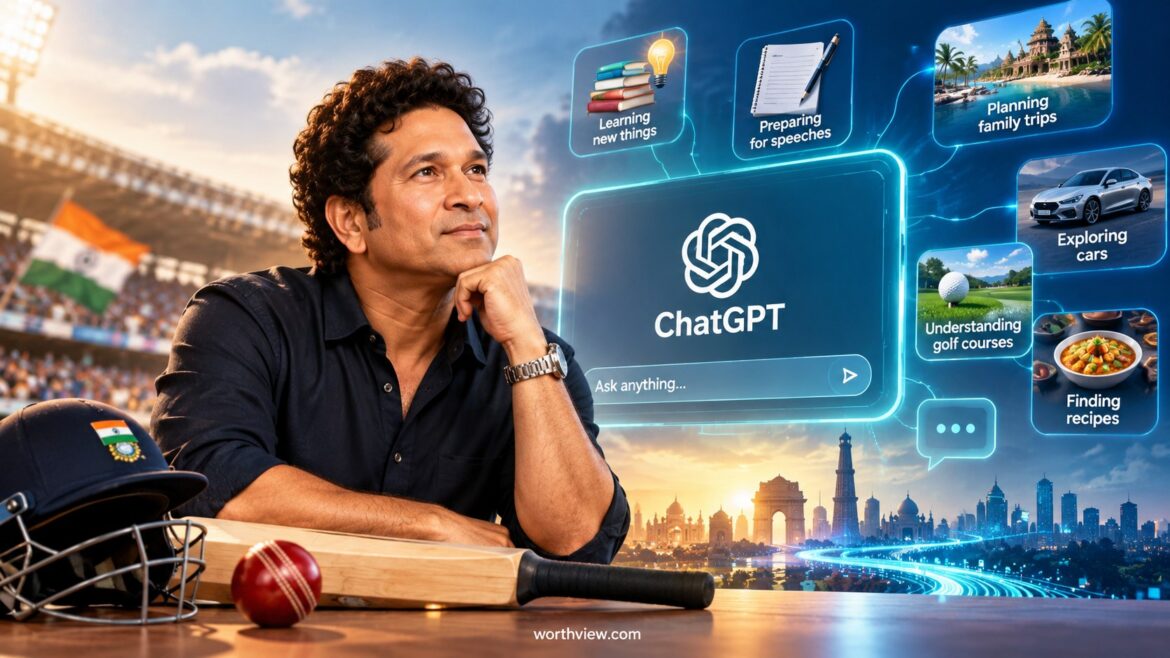
OpenAI has found a rather unusual opening partner for its next phase of growth in India: Sachin Tendulkar.
The company has entered into a multi-year partnership with the cricket legend to demonstrate how ChatGPT can be used in everyday personal and professional life. The collaboration will include content, campaigns and experiences built around Tendulkar’s own use of ChatGPT.
At first glance, it looks like another celebrity-and-technology partnership.
But there is a bigger strategy underneath it.
OpenAI isn’t simply putting a famous face behind ChatGPT. It is trying to make AI feel less like a technology product and more like something ordinary Indians can use to learn, explore ideas and get things done.
Sachin Tendulkar’s new AI innings
Tendulkar announced the partnership on September 28, 2026, saying he was excited about exploring what else he could do with ChatGPT and sharing those experiences with others.
View this post on Instagram
His relationship with ChatGPT, according to the campaign material, began with curiosity.
Tendulkar has said that his daughter Sara introduced him to ChatGPT while they were planning a family holiday. He has since used it for a range of practical activities, from exploring his interests to preparing for speeches and finding cooking inspiration.
That detail is important.
OpenAI isn’t presenting AI through a programmer writing code or an enterprise executive discussing productivity.
It is showing a world-famous cricketer asking questions.
And that makes the technology considerably easier to relate to.
The campaign starts with 10 questions
The first campaign video takes a deliberately simple approach.
Tendulkar challenges ChatGPT to identify who he is using only 10 questions.
The premise is playful, but the message is straightforward: you don’t need to understand artificial intelligence before you start using it.
You can simply begin with a question.
Additional content is expected to feature Tendulkar exploring other uses of ChatGPT, including collaborations with entrepreneur and creator Varun Mayya.
This is a very different way of introducing AI to the public.
Instead of explaining models, tokens, prompts or neural networks, the campaign starts with something everyone understands:
Ask a question.
Why Sachin makes strategic sense for OpenAI
Sachin Tendulkar occupies a rare position in Indian popular culture.
His career spans generations. People who watched him play in the 1990s can now introduce his legacy to their children, while younger audiences continue to encounter him through cricket, social media and popular culture.
OpenAI’s India leadership has explicitly pointed to this cross-generational connection.
Prabhjeet Singh, Managing Director of OpenAI India, said Tendulkar’s own experience with ChatGPT could help people see a starting point for themselves, whether they want to pursue an interest, develop an idea or try something new.
That tells us something about the objective.
The partnership isn’t only about reaching existing AI users.
It is about lowering the psychological barrier for people who haven’t yet figured out what AI can do for them.
India’s AI opportunity is already enormous
The timing is significant.
OpenAI said in February 2026 that India had more than 100 million weekly ChatGPT users, spanning students, teachers, developers and entrepreneurs. Its broader “OpenAI for India” initiative is focused on infrastructure, enterprise adoption, education and workforce skills.
OpenAI has also been studying how people are actually using ChatGPT.
Its August 2026 global usage research found that ChatGPT is increasingly moving from simply answering questions toward helping people complete tasks and create things. The company also reported that usage among people aged 35 and above had increased across more than 90% of countries in its dataset.
That makes the Tendulkar campaign particularly interesting.
The next challenge for AI companies isn’t necessarily convincing people that AI exists.
It is showing them what they can actually do with it.
From “What is AI?” to “What can AI do for me?”
This may be the most important shift represented by the partnership.
For years, much of the public conversation around generative AI revolved around questions such as:
- What is ChatGPT?
- How does generative AI work?
- Will AI replace jobs?
- Which AI model is better?
The Tendulkar campaign takes a different route.
It effectively asks:
What are you curious about?
That is a much easier entry point.
Someone interested in travel can use ChatGPT to plan a trip.
Someone preparing a presentation can use it to develop ideas.
Someone learning about cars can ask questions and explore possibilities.
Someone interested in cooking can look for recipes or inspiration.
And someone simply curious about a subject can keep asking follow-up questions.
The technology becomes secondary.
The person’s curiosity becomes the starting point.
Sachin is not being positioned as an AI expert
There is another subtle advantage to this approach.
Tendulkar doesn’t need to be presented as an artificial intelligence expert.
In fact, the campaign works better if he isn’t.
He represents the ordinary user who is discovering new possibilities with the technology.
That creates a different narrative:
You don’t have to be an AI expert to start using AI.
This is potentially more powerful for mass adoption than another demonstration aimed exclusively at developers and technology professionals.
OpenAI’s India strategy goes beyond celebrity marketing
The Tendulkar partnership should also be viewed alongside OpenAI’s broader India expansion.
In February, OpenAI announced its “OpenAI for India” initiative, including partnerships around AI infrastructure, enterprise adoption, education and workforce upskilling. The company also announced plans to expand its presence in India with offices in Mumbai and Bengaluru.
So the Sachin partnership represents one part of a much larger effort.
There is an infrastructure layer.
There is an enterprise layer.
There is an education and skills layer.
And now there is a mass-market consumer layer.
Tendulkar fits into that final piece particularly well.
Why this matters beyond Sachin and ChatGPT
The interesting story here isn’t really about a cricketer promoting an AI chatbot.
It is about how AI companies may increasingly communicate with mainstream audiences.
The first generation of AI marketing often focused on capability:
Look what the model can do.
The next generation is likely to focus more heavily on context:
Look what someone like you can do with it.
That is a significant difference.
Technology adoption doesn’t happen simply because a technology becomes more powerful. People also need to understand where it fits into their lives.
Sachin Tendulkar gives OpenAI a familiar human context for that conversation.
The bigger AI lesson
There is an interesting parallel between Tendulkar’s cricket career and the way people are learning to use AI.
You don’t become good at something by understanding every technical detail before you begin.
You start.
You experiment.
You learn from the result.
Then you try something more difficult.
OpenAI appears to be applying a similar philosophy to AI adoption: start with a question, experiment with the answer, and gradually discover what the technology can do.
Whether the partnership significantly changes ChatGPT adoption in India will take time to assess.
But its message is already clear.
OpenAI isn’t just trying to make AI more powerful. It is trying to make AI feel more approachable.
And in India, it has chosen one of the country’s most recognisable personalities to help deliver that message.
Sachin Tendulkar’s next innings, it seems, isn’t going to be played on a cricket pitch.
It will be played in the increasingly crowded world of artificial intelligence.
Enjoy Worthview?
Add Worthview as a Preferred Source on Google to see more of our stories in Search.

Worthview Editorial Team is the shared byline for content created collaboratively by Worthview’s editors and contributors. Since 2008, we’ve published thousands of articles across technology, AI, finance, health, home, travel, and lifestyle. Our editorial process emphasizes original research, reputable sources, regular content updates, and clear attribution. Articles covering higher-trust topics, including health and finance, may also undergo review by qualified subject-matter experts.