Every video model announcement arrives with a list of figures, and almost none of them tell a reader what the thing can actually be used for.
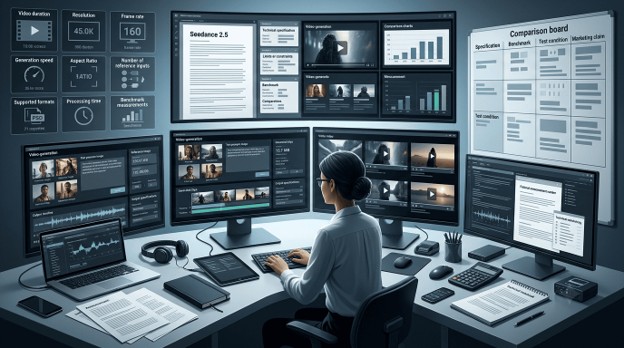
Seconds of output. Resolution. Frames per second. Number of reference inputs. Languages supported. Whether audio is generated natively. Each is quoted as though its meaning is obvious, and each means something quite different depending on what somebody is trying to produce.
Reading these announcements well is a skill, and it is worth having, because the gap between two models with similar headline numbers can be enormous in practice while the gap between two very different-looking specification sheets can be nothing at all.
Seedance 2.5, with practical production workflows through Higgsfield, ByteDance’s current video model, is a useful worked example because its specification sheet contains most of the figures that appear in this category, and because what each one enables is reasonably easy to demonstrate.
Why are video model announcements hard to read?
Because the figures describe capability rather than usability, and those are different things.
A specification tells you what the model can produce under ideal conditions. A demonstration reel shows selected output from an unknown number of attempts. Neither tells you what happens when somebody types an ordinary request on a Tuesday.
The numbers also interact. Peak resolution at the shortest duration is a different claim from the same resolution at maximum length, and announcements rarely separate the two.
And the important properties frequently have no number at all. Whether a subject stays consistent across a generation, whether motion looks physically plausible, whether text in a scene survives, and whether the same request produces similar output twice are all central to using a model and none appears on a specification sheet.
So the useful approach, whether the announcement covers Seedance 2.5 or anything else, is to work out which figures map to something you would actually do, and to treat the rest as context.
Which figure matters most in practice?
Duration, by a considerable distance, and for reasons that are not obvious.
Length determines what can be made at all. A model producing a few seconds makes clips that must be assembled into anything longer. A model producing thirty seconds in one pass makes a complete short piece.
That is a categorical difference rather than a quantitative one. Assembling short clips means matching lighting, subject appearance and motion across joins, which is where most of the visible failure in generated video occurs. A single continuous pass removes the joins entirely.
Resolution matters less than people assume because most generated video is watched on a phone, and the difference between adequate and excellent resolution is far less visible than a subject whose face changes between cuts.
Frame rate matters for specific content and not much otherwise. Anything with fast motion benefits, and a static scene does not.
So when comparing two models, the duration figure tells you what category of thing each can make, and everything else tells you how good it will look.
What makes duration the difficult problem?
Consistency degradation, which is the central technical challenge in this category.
A model generating video has to keep track of what it established earlier. A person’s face, the colour of a wall, where the light is coming from, what is on the table. The longer the sequence, the more there is to hold and the more opportunity for drift.
Early models drifted quickly, which is why clips were short. A subject would subtly change appearance across a few seconds, and stretching that to thirty would produce something visibly unstable.
Extending duration therefore requires architectural work rather than simply running the generation longer, and it is the reason duration figures have climbed slowly while resolution climbed fast.
Which is why the Seedance 2.5 thirty second single pass is a meaningful claim. It indicates the consistency problem has been addressed to a degree that shorter-output models had not reached.
And it explains why stitching is not equivalent. Four clips of a few seconds each, joined, is not the same artifact as one continuous pass, even where the total runtime matches.
Why does native audio change the workflow?
Because sound produced in the same pass as the picture is synchronised by construction rather than by editing.
Audio added afterwards has to be matched. Timing, mouth movement where anybody is speaking, ambience corresponding to the setting. Each of those is an editing task, and each is where a piece starts to feel assembled.
Seedance 2.5 removes that step. The ambience belongs to the scene because it was produced with the scene, and speech aligns with mouth movement because both came from the same generation.
The multilingual dimension follows from this. A model generating speech natively across several languages produces each version as a variant of the same piece rather than as a separate production with dubbing over it, which is a substantial difference for anybody producing for more than one market.
It also changes who can produce. A workflow requiring separate audio, sync and mix steps needs somebody who can do those things. One producing finished clips does not.
Seedance 2.5 generates audio alongside the picture, which is among the more consequential entries on its specification sheet and among the least discussed in coverage.
What do reference inputs actually do?
Anchor the output to something specific, which is the difference between a generic result and a usable one.
A text description produces a plausible instance of what was described. A reference image gives Seedance 2.5 something to stay consistent with.
That matters for almost every real use. A business wanting its actual product, a location that exists, a colour that matches a brand, or a style continued from previous material all need the output tied to something rather than invented freshly.
The count matters less than the capability. Whether a model accepts a handful or fifty references is less important than whether it uses them meaningfully, though a higher ceiling helps when a piece needs to be consistent with a substantial body of existing material.
Seedance 2.5 accepts up to fifty reference inputs, which is generous, and the practical value shows up in continuity across a series rather than in any single generation.
The thing to watch in any announcement is whether references are described as inputs or as style guidance, since those behave very differently.
How does multi-shot generation differ from stitching?
By keeping everything consistent across the cut, which is the whole difficulty.
A multi-shot Seedance 2.5 generation produces several camera positions within one pass. A wide, a closer view, a different angle, all produced together and therefore sharing lighting, subject appearance and setting by construction.
Stitching produces those separately and joins them, which means every element that should match has to be made to match.
The visible difference is exactly where audiences notice generated video. A face that shifts between shots, a wall that changes colour, light that comes from a different direction. Those are the failures that make something look produced by a machine, and they are joins rather than generation errors.
Seedance 2.5 handles multi-shot sequences inside a single generation, which is what allows a thirty second piece to contain a small narrative rather than a single continuous camera position.
For anybody reading announcements, this is worth distinguishing from a model that can produce multiple clips quickly, which is a different claim entirely.
Which claims deserve less weight than they get?
Three, and recognising them saves a good deal of disappointment.
Peak resolution figures, quoted without stating the duration and settings they apply to. The number is usually achievable and rarely at maximum length.
Demonstration reels. Every model looks extraordinary in its own showcase, because the showcase is selected from a large number of attempts by people who know the model intimately. The honest question is what the median attempt looks like, and no announcement answers it.
And benchmark placements, which measure aggregate preference across a broad range of prompts. A model winning on average may be worse than a rival at the specific thing you need, and better than it at things you will never ask for.
What deserves more weight is anything describing consistency, duration in a single pass, and how a model such as Seedance 2.5 behaves with references, because those describe what happens when somebody uses it rather than what it can do at its best.
Where does Seedance 2.5 sit on each of these?
Stronger on the properties that affect use than on headline figures, which is the more useful profile.
Thirty seconds in a single continuous pass, which puts it in the category of models that make complete short pieces rather than components.
Multi-shot sequences within that pass, so a piece can contain a beginning, a middle and an end rather than one camera position held for half a minute.
Native audio generation across more than ten languages, with speech aligned to mouth movement, which removes the separate audio stage.
Up to fifty reference inputs, which supports continuity across a body of work rather than a single output.
And region level editing, meaning one element can change between versions while the rest stays as approved. That is a production feature rather than a generation one, and it matters considerably for anybody producing variants of an approved piece.
None of that makes it the right model for every job, and other models lead on photorealism, on stylised output and on instruction following. The specification tells you which category of work a model suits, which is the question worth asking.
What does a workspace add on top of a model?
More than announcements suggest, because a model is a component rather than a product.
Higgsfield operates as an AI creative suite, carrying Seedance 2.5 alongside other models with a production environment around them, and the difference shows up on the second piece rather than the first.
Saved settings are the main one. Seedance 2.5 output varies between runs, so when a generation is worth keeping, what produced it is the valuable artifact. Reproducing it from memory does not work.
Higgsfield keeping references with a project is what makes continuity across a series realistic, since resupplying the same material each session is the friction that stops people using references at all.
Higgsfield keeping attempts side by side matters because generating three and choosing is normal practice, and comparing them requires them visible together.
Several models in one place allows the same request to run through two and be compared directly, which settles the which-is-better question for your own material faster than any comparison article.
And Higgsfield format variants from one approved generation, since a finished piece is rarely needed in only one shape.
How would a reader test any of this?
On a real task, in about half an hour, which is more informative than any specification sheet.
Pick something you would actually make. A short explanation, an establishing sequence, a product piece.
Run the identical request through Seedance 2.5 and one alternative without rewording between them, since changing the phrasing compares your prompting rather than the models.
Generate three attempts from each in Higgsfield, because a single output is a sample rather than a result.
Then judge the specific property that matters for your work. Whether the subject stayed consistent, whether the audio landed, whether the reference was respected, whether the motion looked plausible.
And repeat with a second task, because a model winning on one job frequently loses on another, and knowing where the boundary sits is more valuable than knowing which won overall.
Conclusion
A video model specification sheet describes what something can do under ideal conditions, and the figures that predict whether it will suit a particular job are not the ones that lead the announcement.
Duration in a single pass tells you what category of thing can be made. Native audio tells you whether a separate production stage disappears. Reference handling tells you whether output can be tied to something real. Those three answer more than resolution and benchmark placement combined.
Seedance 2.5 is strong on each, and Higgsfield sitting around it is what turns a model into something producing consistent work rather than impressive individual clips.
Run your own request through it and something else, three times each, and the specification sheet becomes considerably easier to read.
Enjoy Worthview?
Add Worthview as a Preferred Source on Google to see more of our stories in Search.

Sethuram Kishore is the founder and editor of Worthview, an online publication established in 2008. With over 18 years of experience in SEO, digital marketing, and online publishing, he writes about AI, technology, business, and digital trends. He is also the founder of MoneyHulk, a personal finance and business publication.