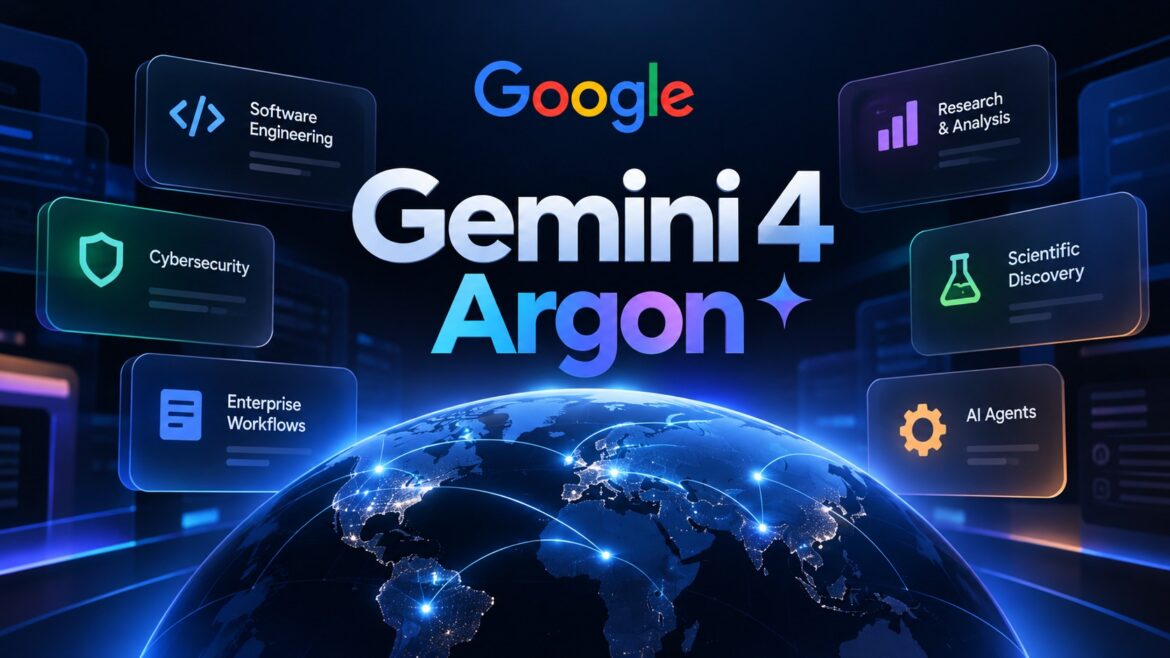
Google has made Gemini 4 Argon globally available to developers and enterprises, opening access to its latest AI model through Google AI Studio and the Gemini platform on Google Cloud.
Announced on October 13, 2026, the global rollout moves Argon beyond its initial restricted release for trusted cybersecurity defenders. Developers can now explore its capabilities through the API, while eligible Google AI subscribers can access it through supported consumer products.
Designed for complex, multi-step workflows, Argon targets applications ranging from software engineering and cybersecurity to enterprise automation and scientific research.
In this article, we’ll cover what’s new, how to access Gemini 4 Argon, its pricing, and practical ways developers and businesses can use it.
What’s New With the Gemini 4 Argon Launch?
The biggest change is broader access to Argon’s agentic capabilities. Developers and enterprises can use the model through Google’s developer and cloud platforms rather than waiting for a general release.
Key highlights include:
- Global API access: Available through Google AI Studio and the Gemini platform on Google Cloud.
- Developer-focused workflows: Designed for complex coding, research, and multi-step automation tasks.
- Expanded consumer access: Eligible Google AI Pro and Ultra subscribers can access Argon through supported Google products.
- Introductory API pricing: Google has announced discounted initial rates, making it easier for developers to experiment with the model.
If you’re unfamiliar with the model’s capabilities, read our complete guide to Gemini 4 Argon and its agentic workflows.
Gemini 4 Argon Pricing
Google has introduced discounted API pricing for developers who want to experiment with Gemini 4 Argon. The cost depends on the number of input and output tokens processed by the model.
Input tokens
Per 1 million tokens
Input tokens – $2
Output tokens – $10
Introductory rates valid through November 30, 2026. Standard pricing begins December 1.
After the introductory period, input pricing increases to $4 per million tokens, while output pricing rises to $20 per million tokens. Cached input tokens receive a 95% discount, bringing the introductory cached-input rate to $0.10 per million tokens.
Developers should note that Gemini 4 Argon API access is not available on the free tier or through a Google AI Pro subscription alone. API usage is billed separately, while consumer access through the Gemini app follows its own subscription eligibility rules.
Real-World Use Cases of Gemini 4 Argon
Gemini 4 Argon is designed for more than generating text or answering questions. Its focus on complex, multi-step tasks makes it relevant to several practical applications.
1. Software Engineering and Code Refactoring
Developers can use Argon to analyze large codebases, identify bugs, refactor legacy code, and assist with testing. Google has highlighted its use in complex Chromium code-refactoring work, demonstrating how AI agents can contribute to large engineering projects.
2. AI Coding Agents and Automated Testing
Argon can serve as the reasoning engine behind coding agents that plan changes, execute development tools, inspect test results, and iterate on solutions. This could help development teams automate repetitive engineering tasks while keeping human reviewers involved in critical changes.
3. Cybersecurity and Vulnerability Remediation
Security teams can use AI agents to investigate software vulnerabilities, validate findings, and develop potential fixes. Because these capabilities can also create security risks, testing should take place in authorized environments with appropriate safeguards.
4. Enterprise Research and Document Analysis
Businesses can explore Argon for analyzing large collections of documents, comparing financial reports, supporting legal research, and preparing summaries from multiple information sources. Outputs still require professional verification, especially in regulated or high-stakes work.
5. Scientific Research and Data Analysis
Researchers can use capable AI models to assist with literature reviews, write analysis scripts, explore datasets, and investigate scientific problems. Argon’s potential value lies in helping coordinate several steps of a research workflow rather than handling each question separately.
The key takeaway: These applications depend not only on the model but also on the tools, data access, permissions, and verification systems surrounding it. Argon can power an agentic workflow, but reliable execution still requires good system design.
How to Access Gemini 4 Argon
Developers can try Gemini 4 Argon through Google AI Studio or integrate it into applications using the Gemini API.
Option 1: Try Argon in Google AI Studio
- Open Google AI Studio.
- Sign in with your Google account.
- Open the model selector and look for Gemini 4 Argon, if enabled for your account.
- Enter a prompt and experiment with the model’s capabilities.
API access may require billing to be enabled, and availability can depend on your account and region.
Option 2: Integrate Argon Using the Gemini API
Developers can use the Gemini API to incorporate Argon into applications, coding agents, and automated workflows.
- Open Google AI Studio and create an API key.
- Set up the official Google Gen AI SDK.
- Use the model ID
gemini-4-argonin your API request. - Configure billing and test the integration with a small workload before scaling up.
For enterprise deployments, developers can also explore the Gemini platform on Google Cloud.
Important: Check Google’s current API documentation for model availability, supported features, token limits, and billing requirements before deploying Argon in production.
What Businesses Should Know Before Using Gemini 4 Argon
Gemini 4 Argon offers opportunities to automate complex workflows, but businesses should evaluate more than the model’s capabilities before adopting it.
- Identify suitable workflows: Start with repetitive, multi-step tasks such as code reviews, document analysis, research, and internal reporting.
- Monitor costs: Long-running agents can consume substantial input and output tokens. Set budgets, usage limits, and monitoring before scaling.
- Protect sensitive data: Review data-handling policies, access permissions, and security requirements before connecting Argon to internal systems.
- Keep humans involved: Require human approval for consequential actions, particularly changes to production systems, financial decisions, and security remediation.
- Measure results: Evaluate accuracy, completion rates, execution time, and cost against your existing workflow.
Argon’s availability does not mean every task should be fully automated. For many businesses, the best starting point is a supervised AI agent that handles routine work while employees review its decisions and results.
The goal should be measurable improvements in productivity and reliability, not simply adopting a newer AI model.
Frequently Asked Questions
1. Is Gemini 4 Argon available globally?
Yes. Google announced global availability for developers and enterprises on October 13, 2026, through Google AI Studio and the Gemini platform on Google Cloud. Consumer access depends on subscription eligibility and supported products.
2. How much does Gemini 4 Argon cost?
Introductory API pricing is $2 per million input tokens and $10 per million output tokens through November 30, 2026. From December 1, standard rates are $4 and $20 per million tokens, respectively.
3. Can I use Gemini 4 Argon for free?
The API requires paid usage rather than free-tier access. Consumer access through the Gemini app follows separate subscription requirements. Check Google’s current documentation for eligibility.
4. What can Gemini 4 Argon be used for?
Potential applications include software engineering, code refactoring, cybersecurity, enterprise research, document analysis, and scientific workflows.
5. What is Gemini 4 Argon’s token limit?
The API supports a combined input-and-output context limit of approximately 1 million tokens. Outputs of up to 1 million tokens are supported through long decoding; the default synchronous output limit is lower.
6. Is Gemini 4 Argon suitable for building AI agents?
Yes. Its focus on complex, multi-step tasks makes it relevant to agentic applications. However, reliable agents also need appropriate tools, permissions, memory, error handling, and verification.
Conclusion
Gemini 4 Argon’s global availability gives developers and businesses a new opportunity to experiment with AI systems designed for complex, multi-step work. From software engineering and cybersecurity to enterprise research, its potential extends beyond traditional chatbot interactions.
However, successful implementation depends on choosing the right workflows, controlling costs, protecting sensitive data, and verifying results.
For developers, the practical next step is to test Argon through Google AI Studio or the Gemini API and evaluate its performance against real tasks before deploying it at scale.
As AI continues moving from answering questions to completing workflows, models like Gemini 4 Argon could play an important role in the evolution of agentic applications.
Enjoy Worthview?
Add Worthview as a Preferred Source on Google to see more of our stories in Search.

Worthview Editorial Team is the shared byline for content created collaboratively by Worthview’s editors and contributors. Since 2008, we’ve published thousands of articles across technology, AI, finance, health, home, travel, and lifestyle. Our editorial process emphasizes original research, reputable sources, regular content updates, and clear attribution. Articles covering higher-trust topics, including health and finance, may also undergo review by qualified subject-matter experts.





One thought on “Google Gemini 4 Argon Is Now Available Globally: Pricing, Access and Real-World Use Cases”