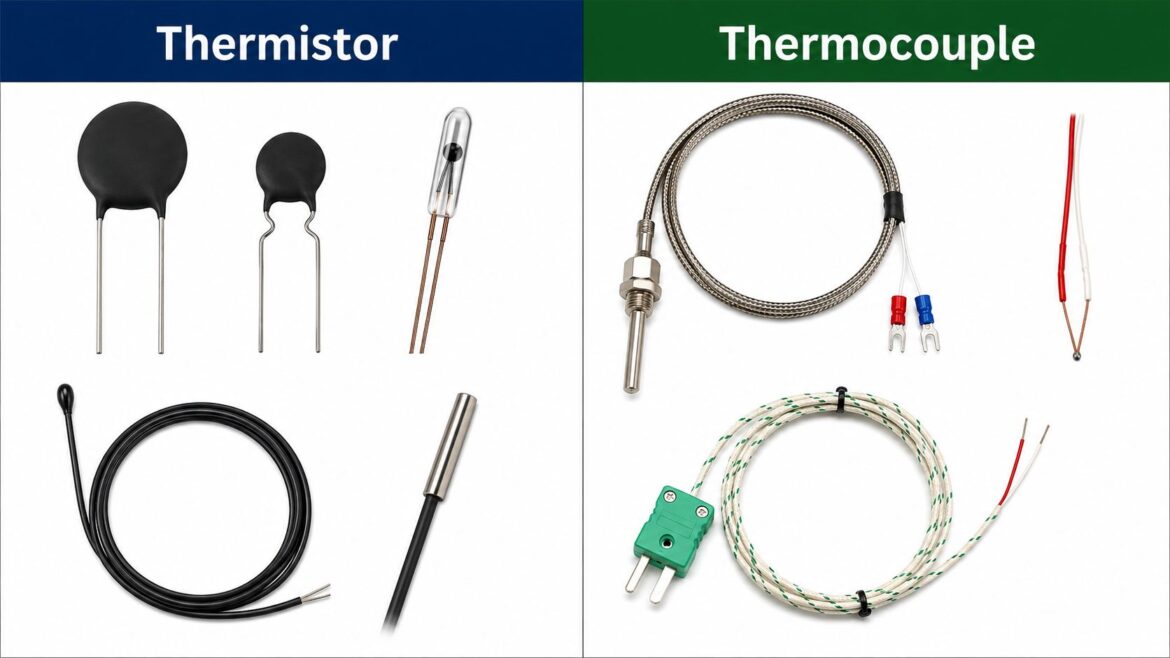
The thermistor and the thermocouple are two important devices that are used for temperature measuring and control. These two are effective for temperature changes and monitoring for different values. with differentiating, and their features make them prominent differences. In this post we will cover a comparison of thermistors and thermocouples, along with information on their characteristics, advantages, and ideal applications. Let’s get started with Thermistor vs. Thermocouple.
Introduction
The main component of different industries, like manufacturing electronics to food processing, is temperature calculation. Thermocouples and thermistors are two main devices used for temperature calculations. Both come with the same features but operate according to different features and methods.
Understanding Thermistors
What is a thermistor?
A thermistor is a type of temperature sensor that shows response according to temperature variations with changes in resistance with some features of material. These materials, made with alloys of metals or ceramic semiconductors provide certain changes for resistance in temperature.
How Do Thermistors Work?
Thermistors work as temperature sensors. We can determine the ambient temperature by observing changes in resistance. The thermostat comes with two categories for working.
The first one is a negative temperature coefficient thermistor, where resistance reduces with temperature. NTC thermistors’ sensitive nature for temperature varies due to negative correlation, like for low temperatures.
The second is a positive temperature coefficient thermistor that works opposite of NTC. Since temperature increases, resistance also increases. Due to self-resetting features, PTC thermistors are part of circuits where protection is needed, also if not sensitive to offering correct temperature calculations.
Types of Thermistors
NTC thermistors have different resistance values that provide accurate fitting for certain temperature values. This flexibility makes them best for compensation features and sensing.
PTC thermistors come with a fixed trip point when connected to a face threshold; resistance increases, and they are best for protection circuits where constant features are needed.
For quality purposes, glass-encapsulated thermistors charge larger to the epoxy-coated version but come with good working in rough conditions. Moisture corrosion, wear, and glass types have good handling.
Surface mount thermistors come with different features, made of automated assembly lines, having a compact design and standard packaging that move easily in board design.
Thin film thermistor has a speedy process. that is used for medical sensor wearables and other locations where high-speed response is needed. Each type comes with certain features, so using the best for required operations, thermal factors, and electrical and mechanical features
NTC does not have overcurrent protection, since when heated, resistance losses cause high current flow. PTC is not the best for certain temperature values.
Their resistance graph is steep and does not have a high prediction, so it is better for performing switching compared to fine-tuned sensing.
glass encapsulated glow in corrosive applications. Their sealed design removes moisture and offers good working. surface mount and thin film types used for advanced electronics that are compatible with miniaturization and work fast for temperature variations.
Understanding Thermocouple
What is a Thermocouple?
A thermocouple is also a temperature sensor that functions with different working principle. that uses the Seebeck effect process, where temperature differences between junctions and other reference points result in voltage generation with different metals’ intersection
How Do Thermocouples Work?
main use of thermocouples for temperature detection and conversion of heat to current. temperature differential occurring between reference junction that make constant temperature and hot junction with two metals connect find voltage generated.
temperature at hot junction is defined with voltage calculations and get the reference temperature is considered
Types of Thermocouples
Type K, Type J, and Type T thermocouples are main types. each is best for certain projects since they have certain features like different temperature values and sensitivity values.
Thermocouple Features
The main features of thermocouples are
- It is made of iron, copper, or some chromium, nickel, iridium, or tungsten alloys. Some come with mineral design and definition according to bending and calibration.
- It is used for temperature sensing, conductivity, and control systems.
- It has a high-speed reaction of about 0.1 to 10 seconds.
- They have temperature tolerance in the range of -50 to +500.
- Their non-linear graph made sense of temperature changing based on junction voltage.
Thermistors Features
main Features of thermistor are
- It is used in industries compared to home-based temperature control calculations.
- Thermistors made with different materials like cobalt, manganese, nickel, and semiconductor materials are also covered with Teflon, epoxies, or glass.
- It offers high-speed reaction time, just seconds for some categories. Its working range is 0.2 to 10 s in different models.
- Its graphical results are linear. and the temperature tolerance value is -200 to +1200 o
- Their temperature detection according to resistance comes with certain features.
Thermistor vs Thermocouple
| Feature | Thermistor | Thermocouple |
| Definition | A temperature-sensitive resistor has a resistance that changes with temperature. | A temperature sensor made from two different metals that produces a voltage when heated. |
| Working Principle | Measures temperature through resistance variation. | Measures temperature through the Seebeck effect (voltage generation). |
| Temperature Range | -50°C to 150°C (some types up to 300°C) | -200°C to 2300°C (depending on type) |
| Accuracy | High (±0.1°C to ±1°C) | Moderate (±1°C to ±5°C) |
| Response Time | Fast | Very Fast |
| Sensitivity | Very high | Lower than thermistors |
| Output Signal | Resistance change | Millivolt voltage |
| Linearity | Non-linear | linear over wide ranges |
| Power Requirement | Requires excitation current | Self-powered |
| Durability | Less rugged | Highly rugged |
| Environmental Resistance | Sensitive to harsh conditions | Excellent for harsh environments |
| Cost | Low to moderate | Low to moderate |
| Long-Term Stability | Good | Excellent |
| Installation Complexity | Simple | Requires cold-junction compensation |
| Best Applications | Medical devices, HVAC systems, consumer electronics, battery packs | Industrial furnaces, engines, exhaust systems, power plants |
| Measurement Range | Narrow | Very wide |
| Noise Immunity | short distances | long-distance measurements |
| Calibration Requirements | require calibration for precision applications | Standardized calibration tables available |
| Common Types | NTC, PTC | Type K, J, T, E, N, R, S, B |
Conclusion
Thermistors and thermocouples come with temperature-measuring features best for different applications. For accurate working, thermistors have high accuracy, high-speed response, and low-cost features. Thermocouples are a robust design and support high-temperature conditions. certain demand of projects define their working
Frequently Asked Questions
Can thermocouples be used in medical equipment?
Thermocouples can be used for medical devices such as infusion pumps and temperature monitoring purposes.
Are thermistors suitable for measuring extremely high temperatures?
Thermistor not reffered to use for these conditions where high temperatures exist.
Do thermocouples require regular calibration?
Compared to thermistors, thermocouples are self-calibrating and need less regular calibration.
Which is more cost-effective for industrial processes: thermistors or thermocouples?
Since they are low-cost, thermometers are low-cost options for industrial procedures.
Can I replace a thermocouple with a thermistor without any adjustments?
For different sensitivity features’ accuracy, a replacement one with other required variations is needed.
Can thermocouples be used in medical equipment?
Thermocouples can be used for medical devices such as infusion pumps and temperature monitoring purposes.
Are thermistors suitable for measuring extremely high temperatures?
Thermistor not referred to use for these conditions where high temperatures exist.
Do thermocouples require regular calibration?
Compared to thermistors, thermocouples are self-calibrating and need less regular calibration.
Which is more cost-effective for industrial processes: thermistors or thermocouples?
Since they are low-cost, thermometers are low-cost options for industrial procedures.
Can I replace a thermocouple with a thermistor without any adjustments?
For different sensitivity features’ accuracy, a replacement one with other required variations is needed.
Enjoy Worthview?
Add Worthview as a Preferred Source on Google to see more of our stories in Search.

Worthview Editorial Team is the shared byline for content created collaboratively by Worthview’s editors and contributors. Since 2008, we’ve published thousands of articles across technology, AI, finance, health, home, travel, and lifestyle. Our editorial process emphasizes original research, reputable sources, regular content updates, and clear attribution. Articles covering higher-trust topics, including health and finance, may also undergo review by qualified subject-matter experts.