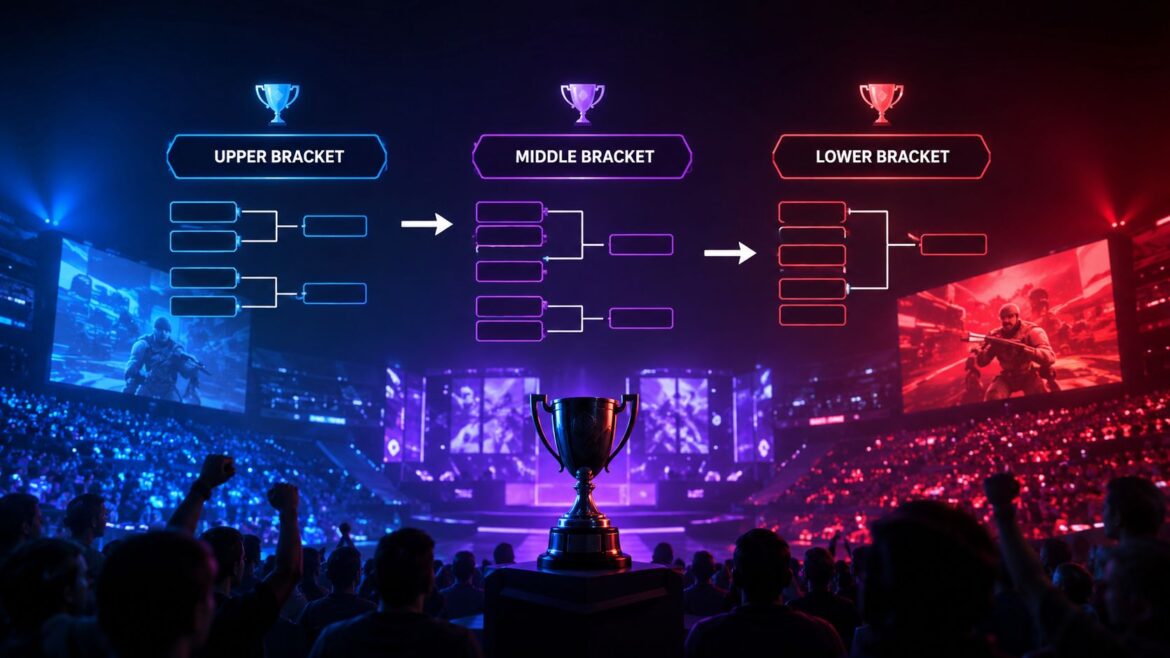
Esports organizers continue to search for formats that reduce the impact of an isolated poor result while preserving tension until the final days of competition. Triple elimination has emerged as one possible solution, allowing a participant to remain in contention until losing three series. The system introduces an additional bracket, creates more potential comeback routes and changes the significance of every defeat. A setback no longer means an immediate exit, but each subsequent match becomes more demanding as the remaining margin for error gradually disappears.
Key Takeaways
- Triple elimination allows teams to lose up to three matches before elimination.
- Teams move through Upper, Middle, and Lower Brackets.
- The format rewards consistency while reducing the impact of one poor performance.
- Organizers benefit from a more competitive qualification process but face higher scheduling complexity.
- Triple elimination is best suited for major esports tournaments with enough time and resources.
Why Organizers Introduced a Third Chance
Single and double elimination have remained the dominant tournament formats for many years. Under the first system, one unsuccessful series immediately ends a team’s run, meaning that the outcome can be shaped by a poor start, an unfavourable matchup or a single closely contested map. Double elimination provides a second opportunity through the lower bracket, but organizers may still prefer a longer competitive sample when international qualification is at stake. A third life gives every participant more time to settle into the event while making consistency across several series increasingly important.
A notable example was the regional Kickoff stage of the 2026 VALORANT Champions Tour, where 12 teams in each International League competed under a triple-elimination system. After losing their first series, participants moved from the Upper Bracket to the Middle Bracket. A second defeat sent them into the Lower Bracket, and only a third loss ended their run. Interest in this structure was supported by broadcasts, statistical services and platforms such as pin up bet, where matches and betting lines are discussed. For viewers, the format created more reasons to follow the event because a team could remain in contention for international qualification after two difficult series.
Triple Elimination vs Single and Double Elimination
Before exploring how the system works, it’s helpful to compare it with the two tournament formats most esports fans are already familiar with.
| Feature | Single Elimination | Double Elimination | Triple Elimination |
|---|---|---|---|
| Elimination After | 1 loss | 2 losses | 3 losses |
| Brackets | One | Upper & Lower | Upper, Middle & Lower |
| Match Opportunities | Lowest | Moderate | Highest |
| Chance to Recover | None | One second chance | Two recovery opportunities |
| Tournament Duration | Short | Medium | Long |
| Best For | Small events | Most esports tournaments | Major qualifiers and long-format competitions |
How Three Brackets Change a Team’s Tournament Path
The main difference is not simply the addition of another match. Each section of the structure represents a different competitive position. The Upper Bracket contains teams that have not yet lost, the Middle Bracket gives participants with one defeat another route forward, and the Lower Bracket becomes the final opportunity for those that have already lost twice. At VCT 2026 Kickoff events, the winners of the Upper, Middle and Lower Finals all qualified for Masters Santiago, creating three separate qualification matches instead of one conventional grand final.
What Happens After Each Defeat
Triple elimination turns a tournament into a sequence of stages with progressively smaller margins for error. A team’s position changes according to a clear structure:
- the first defeat moves the participant into the Middle Bracket;
- the second defeat sends the team into the Lower Bracket;
- the third loss ends the team’s tournament run;
- winning one of the three bracket finals secures qualification;
- remaining in the Upper Bracket provides the shortest route.
This structure preserves the value of winning because an undefeated team plays fewer series, receives more preparation time and can secure the strongest competitive position without navigating the additional elimination rounds.
The format also creates more opportunities for coaching adjustments. After an initial defeat, a team can reconsider its map selection, modify the starting lineup or prepare a different plan for opponents with similar tendencies. Double elimination allows only one recovery route, whereas a third bracket provides additional time to correct recurring errors. At the same time, more official matches become available for analysis. Teams can study player preferences, identify tactical patterns and prepare more precise map bans, making adaptation throughout the event increasingly important.
Why the New Format Makes Scheduling More Complicated
An additional bracket substantially increases the workload for organizers. A 12-team competition requires more match windows, servers, officials and broadcast hours than a comparable event based on two defeats. The schedule must account for long series, technical pauses and delays caused by overtime maps. A third opportunity cannot simply be inserted into the existing calendar because teams progressing through the Middle and Lower Brackets may need to compete more frequently. With limited recovery time, players can have only a short period to analyse the next opponent, eat, rest and prepare for another series.
Presenting the competition clearly to viewers also becomes more difficult. In a double-elimination bracket, it is usually easy to identify the undefeated teams and those facing immediate elimination. Three parallel routes require clear graphics, regular explanations and an accessible schedule. Organizers must show not only the next opponent but also each team’s number of defeats, possible qualification route and the importance of every final. Without this context, viewers may mistake a decisive qualifying series for an ordinary bracket match or fail to understand why the losing side still has another opportunity.
What Advantages Consistent Teams Receive
Triple elimination reduces the likelihood that a strong participant will leave after only two unsuccessful series. Across a larger competitive sample, teams capable of changing tactics, maintaining concentration and defeating opponents with different styles are more likely to advance. However, the additional life does not make early defeats harmless. A team that remains in the Upper Bracket plays fewer matches and gains more time to study its next opponent. A Lower Bracket participant must follow a longer route, reveal more prepared strategies and withstand a heavier workload, so early victories retain genuine value.
The added opportunity also has disadvantages. More series increase production costs and make it harder to maintain equal audience interest in every matchup. Repeated meetings between the same opponents can reduce the sense of novelty, particularly when an event lasts several weeks. The format is also poorly suited to short tournaments with limited venue availability. If an organizer has only three or four days, accommodating a third bracket may require simultaneous broadcasts or an excessively dense schedule that quickly exhausts players, production crews and viewers.
Triple Elimination Will Not Suit Every Competition
The format can produce a broader assessment of competitive strength because it reduces the influence of one poor series and evaluates teams across a longer run of matches. It is particularly useful when several participants must qualify from the same regional event and each qualification place needs a separate decisive series. At the same time, triple elimination requires additional time, clear visual presentation and carefully planned recovery periods. It is unlikely to replace conventional brackets entirely, but it may remain valuable during the opening stages of major leagues. Its long-term success will depend on whether organizers can turn the extra opportunities into a developing tournament narrative rather than simply adding more matches to the calendar.
Frequently Asked Questions
What is a triple elimination tournament?
A triple elimination tournament allows competitors to lose up to three matches before they are eliminated. Teams progress through Upper, Middle, and Lower Brackets until a third loss ends their tournament.
How is triple elimination different from double elimination?
Double elimination removes a team after two losses, while triple elimination provides an additional opportunity by introducing a third bracket. This reduces the impact of one or two poor performances and rewards long-term consistency.
Which esports use triple elimination?
Triple elimination is less common than double elimination but has been used in events such as the 2026 VALORANT Champions Tour (VCT) Kickoff regional tournaments.
Enjoy Worthview?
Add Worthview as a Preferred Source on Google to see more of our stories in Search.

Worthview Editorial Team is the shared byline for content created collaboratively by Worthview’s editors and contributors. Since 2008, we’ve published thousands of articles across technology, AI, finance, health, home, travel, and lifestyle. Our editorial process emphasizes original research, reputable sources, regular content updates, and clear attribution. Articles covering higher-trust topics, including health and finance, may also undergo review by qualified subject-matter experts.