For the past few years, the AI industry has followed a familiar pattern.
A company releases a new model. It scores higher on benchmarks, generates better text, writes cleaner code, and everyone races to compare it with the previous version.
OpenAI’s GPT series has followed this formula for years. GPT-3 was more capable than GPT-2. GPT-4 dramatically expanded reasoning abilities. GPT-5.5 refined coding, conversations, and AI agents.
At first glance, GPT-5.6 appears to be the next step in that same journey.
But if you look beyond the performance improvements, something much bigger is happening.
GPT-5.6 isn’t just a better AI model—it represents a major shift in how OpenAI plans to build, price, and deliver AI in the future.
Instead of asking, “How can we make one model smarter?” OpenAI is asking a different question:
“How can we give every user the right model for the right job?”
That subtle change could reshape the entire AI industry.
The Old AI Strategy: One Flagship for Everyone
Until recently, most AI companies competed by building a single flagship model.
The assumption was simple: create the smartest model possible, then let everyone—from students to Fortune 500 companies—use the same technology.
While this worked well during the early years of generative AI, it introduced a significant challenge.
Not every task requires frontier-level intelligence.
Imagine hiring a world-renowned surgeon to treat a common cold. The surgeon is undoubtedly capable, but it’s an expensive and unnecessary use of expertise.
The same principle applies to AI.
If a customer wants to summarize meeting notes, rewrite emails, or translate documents, using the most computationally intensive model may not be the most efficient solution.
As AI adoption grew, the mismatch between capability and cost became increasingly apparent.
GPT-5.6 Sol, Terra, and Luna: A Different Philosophy
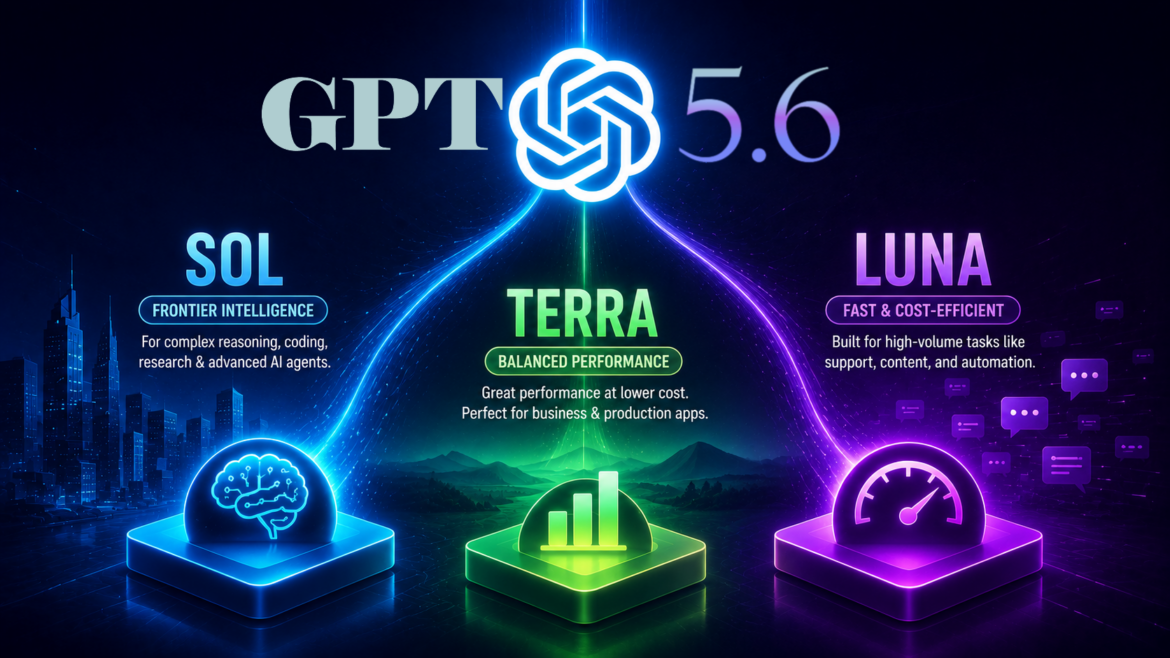
Rather than releasing one universal model, OpenAI introduced a family of models:
- Sol for frontier reasoning, software engineering, scientific research, cybersecurity, and advanced AI agents.
- Terra for businesses seeking strong performance with improved cost efficiency.
- Luna for fast, affordable, high-volume tasks such as customer support, document processing, and content generation.
This isn’t merely a naming exercise.
It’s a business strategy.
Instead of forcing every customer onto the same expensive model, OpenAI is matching computing power to actual customer needs.
The result is greater flexibility for developers and organizations while potentially lowering operating costs for applications that don’t require maximum intelligence.
Intelligence Is No Longer the Only Product
During the first wave of AI, companies competed almost entirely on intelligence.
Today, buyers ask very different questions:
- How much does each AI request cost?
- Can it scale to millions of users?
- Will response times remain fast?
- Can different teams use different models?
- Does the most advanced model actually provide enough additional value?
These are business questions, not research questions.
GPT-5.6 reflects this evolution.
The conversation has shifted from “Which model is smartest?” to “Which model delivers the best value for this specific task?”
That marks a significant change in how AI products are positioned.
AI Is Following the Same Path as Cloud Computing
If this strategy feels familiar, it’s because we’ve seen it before.
Cloud providers don’t offer a single server configuration.
Instead, they provide hundreds of options optimized for different workloads:
- General-purpose computing
- Memory-intensive applications
- GPU workloads
- Storage-optimized systems
- High-performance computing
Businesses choose the resources they actually need.
OpenAI appears to be applying a similar philosophy to AI.
Rather than treating intelligence as a one-size-fits-all product, GPT-5.6 allows customers to select the right balance of capability, speed, and cost.
This makes AI feel less like a single product and more like an infrastructure platform.
Cost May Become the Biggest Competitive Advantage
For years, benchmark scores dominated AI discussions.
However, enterprise customers often care more about economics than leaderboard rankings.
If two models deliver similar real-world results, but one costs significantly less to operate, the lower-cost option becomes highly attractive.
This is where Terra could play a crucial role.
OpenAI has positioned Terra as offering performance comparable to GPT-5.5 while reducing costs substantially for many production workloads.
For businesses processing millions of requests each month, even modest savings can translate into substantial reductions in operating expenses.
The future of AI competition may therefore revolve as much around efficiency as raw capability.
Why This Matters for Developers
Developers have long faced a difficult compromise.
Using the most capable model improves output quality but increases operating costs.
Choosing a cheaper model reduces expenses but may require sacrificing performance.
GPT-5.6 introduces greater flexibility.
For example:
- A customer support chatbot could use Luna.
- Internal document analysis might run on Terra.
- Complex coding or research assistants could rely on Sol.
Rather than paying premium prices for every interaction, organizations can allocate resources intelligently.
This approach resembles how businesses already manage cloud infrastructure, databases, and networking services.
The Enterprise AI Market Is Entering a New Phase
The first phase of AI focused on proving what was possible.
The second phase is about making AI economically sustainable.
Large organizations don’t simply ask whether AI works.
They ask:
- Can it reduce costs?
- Can it improve employee productivity?
- Can it integrate with existing software?
- Can it scale globally?
- Can we predict monthly operating expenses?
GPT-5.6 appears designed with these questions in mind.
Instead of selling intelligence alone, OpenAI is selling flexibility.
What This Means for Everyday Users
If you’re an individual ChatGPT user, you may not immediately notice the strategic implications.
You’ll likely experience:
- Better coding assistance
- More reliable long-running conversations
- Improved reasoning
- Faster responses for certain tasks
Behind the scenes, however, OpenAI may automatically route different requests to different models based on the complexity of the task.
In other words, users may no longer think about which model they’re using—they’ll simply receive an experience optimized for speed, quality, and cost.
A Glimpse Into the Future of AI
GPT-5.6 may also signal where the industry is heading.
Instead of annual releases centered on one flagship model, we may see AI ecosystems composed of specialized models working together.
Future AI platforms could include:
- Reasoning specialists
- Coding specialists
- Creative writing specialists
- Research specialists
- Customer support specialists
Rather than replacing one another, these models may collaborate behind the scenes to complete increasingly sophisticated workflows.
This vision aligns closely with the broader shift toward AI agents capable of planning, using tools, and executing multi-step tasks.
My Perspective
In my view, GPT-5.6 will be remembered less for its benchmark improvements and more for the strategic direction it represents.
The introduction of Sol, Terra, and Luna suggests that OpenAI recognizes a simple reality:
Different users have different needs.
A startup founder, a software engineer, a content creator, and a global enterprise shouldn’t all be paying for—or waiting on—the exact same AI model.
By treating AI like cloud infrastructure rather than a single premium product, OpenAI is acknowledging that scalability, affordability, and specialization are becoming just as important as intelligence.
If this approach proves successful, it’s likely that other AI companies will follow a similar path.
Final Thoughts
GPT-5.6 is undoubtedly more capable than its predecessor, but focusing solely on new features misses the bigger story.
The real innovation isn’t just better reasoning or stronger coding.
It’s a fundamental change in how AI is packaged, priced, and delivered.
OpenAI is moving away from the idea of one flagship model serving everyone and toward a portfolio of specialized models designed for different workloads and budgets.
That shift could influence how developers build applications, how enterprises adopt AI, and how the next generation of AI products is designed.
In the coming years, we may look back at GPT-5.6 not simply as another model release, but as the moment AI evolved from a single product into a complete computing platform.
Enjoy Worthview?
Add Worthview as a Preferred Source on Google to see more of our stories in Search.

Sethuram Kishore is the founder and editor of Worthview, an online publication established in 2008. With over 18 years of experience in SEO, digital marketing, and online publishing, he writes about AI, technology, business, and digital trends. He is also the founder of MoneyHulk, a personal finance and business publication.