The AI race isn’t slowing down, and OpenAI is once again pushing the boundaries with the introduction of the GPT-5.6 family of models. If you’ve been using ChatGPT or building AI-powered applications, you’ve probably wondered whether GPT-5.6 is a revolutionary leap or simply another incremental update.
The short answer is: it’s a bit of both.
GPT-5.5 already set a high standard. It became a reliable assistant for writing, programming, research, brainstorming, and even running AI agents capable of completing multi-step tasks. For many users, it felt like the first AI model that could genuinely act as a collaborative partner instead of just answering questions.
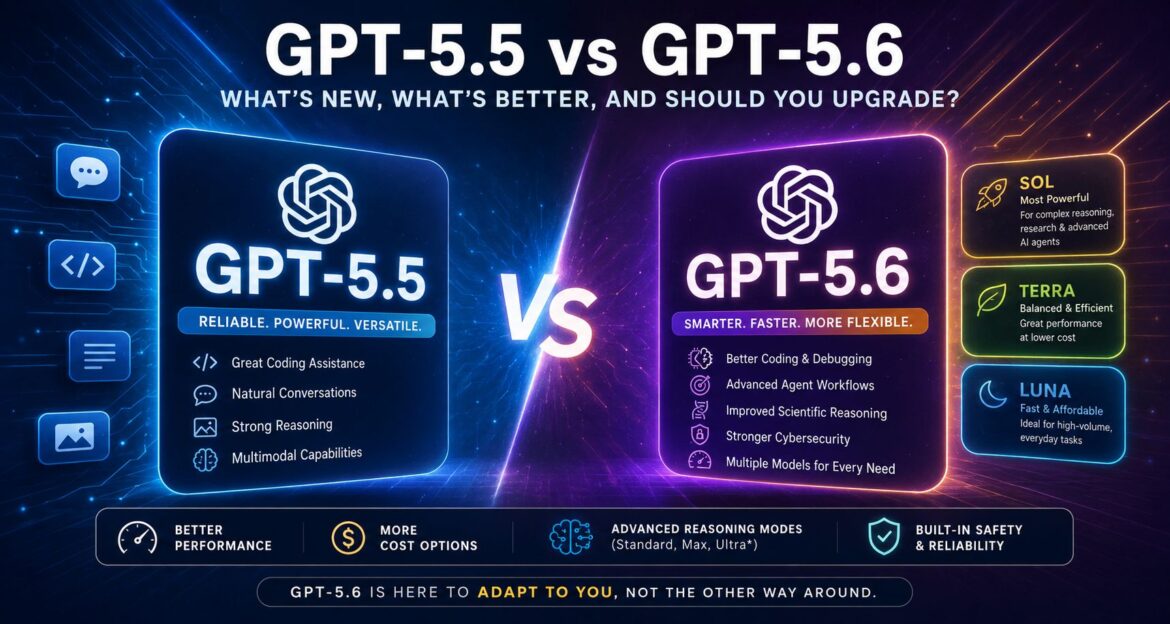
GPT-5.6 builds on that foundation, but OpenAI has taken a different approach this time. Instead of releasing one model for everyone, it has introduced an entire family of models—Sol, Terra, and Luna—each designed with a different balance of intelligence, speed, and cost.
That shift tells us something important: AI is no longer just about making a model smarter. It’s also about making it practical for different kinds of users, from individual creators to large enterprises running millions of AI requests every day.
In this guide, we’ll look beyond the marketing headlines and explore what has actually changed between GPT-5.5 and GPT-5.6, where the improvements matter, and whether upgrading makes sense for your workflow.
GPT-5.5 at a Glance
Released in April 2026, GPT-5.5 significantly improved:
- Natural conversations
- Coding assistance
- Image understanding
- Long-context reasoning
- AI agent workflows
When GPT-5.5 arrived, it wasn’t simply faster than its predecessors—it was noticeably more dependable.
Earlier AI models sometimes produced convincing but incorrect answers, forgot important details in long conversations, or struggled to follow complicated instructions. GPT-5.5 significantly reduced many of those frustrations. It became better at maintaining context, following multi-step prompts, and generating responses that felt more coherent and thoughtful.
For software developers, GPT-5.5 could explain unfamiliar code, debug issues, generate complete functions, and even assist with architecture discussions. Writers appreciated its ability to adapt tone and structure, while marketers found it useful for creating high-quality content that required less editing.
Perhaps its biggest strength was versatility. Whether you were drafting emails, analyzing documents, learning a new programming language, or experimenting with AI agents, GPT-5.5 proved capable across a remarkably broad range of tasks.
Because of this, many people considered GPT-5.5 the first model that could realistically replace several specialized AI tools with a single assistant.
What is GPT-5.6?
Unlike previous releases, GPT-5.6 isn’t a single model.
OpenAI introduced an entire family:
- GPT-5.6 Sol – Flagship model for advanced reasoning and complex agentic tasks.
- GPT-5.6 Terra – Balanced model offering GPT-5.5-level performance at roughly half the cost.
- GPT-5.6 Luna – Fastest and most affordable model for high-volume workloads.
This allows developers to choose the right balance of intelligence, speed, and cost. This is one of the biggest philosophical shifts in the GPT series.
Imagine buying a vehicle. Not everyone needs a high-performance sports car. Some people want a comfortable family SUV, while others simply need an economical city car. GPT-5.6 follows a similar idea: instead of expecting one model to fit every use case, OpenAI now offers different models optimized for different needs.
For businesses, this could significantly reduce costs without sacrificing quality where maximum intelligence isn’t necessary.
GPT-5.5 vs GPT-5.6 Comparison
| Feature | GPT-5.5 | GPT-5.6 |
|---|---|---|
| Release | April 2026 | June 2026 (limited preview) |
| Model lineup | Single flagship model | Sol, Terra & Luna |
| Coding | Excellent | Better planning and debugging |
| AI Agents | Strong | Better long-running autonomous workflows |
| Biology | Good | Improved scientific and genomics performance |
| Cybersecurity | Strong | Significant improvements with stronger safeguards |
| Cost Options | One pricing tier | Three pricing tiers |
| Reasoning Modes | Standard | Standard + Max + Ultra (Sol only) |
| Availability | Public | Limited preview |

GPT-5.5 excelled at answering individual questions. GPT-5.6 is designed to stay effective over much longer and more complex tasks. Whether it’s planning a software project, coordinating multiple tools, or assisting with research that spans dozens of steps, the newer model aims to maintain consistency and context more effectively.
In other words, GPT-5.6 isn’t just trying to be smarter—it is trying to be a better long-term collaborator.
Biggest Improvements in GPT-5.6
1. Three Models Instead of One
Perhaps the biggest change is flexibility.
Instead of forcing every workload onto one expensive model, OpenAI now offers three options:
Sol
Designed for:
- Research
- Software engineering
- Multi-step reasoning
- Long-running AI agents
- Cybersecurity
Terra
Perfect for:
- Chatbots
- Business automation
- Document analysis
- Enterprise applications
OpenAI says Terra delivers performance comparable to GPT-5.5 while costing around 50% less.
Luna
Ideal for:
- Customer support
- Summarization
- Translation
- High-volume content generation
- Large-scale automation
2. Better Agentic AI
GPT-5.5 already handled multi-step tasks well.
GPT-5.6 improves this by staying focused across much longer workflows.
OpenAI specifically highlights improvements for:
- Planning
- Tool usage
- Iteration
- Autonomous coding
- Command-line workflows
3. New Reasoning Modes
GPT-5.6 Sol introduces two new compute modes.
Max Reasoning
The model spends more compute on difficult problems before responding.
Best for:
- Mathematics
- Research
- Architecture design
- Complex debugging
Ultra Mode
Ultra goes a step further by orchestrating multiple sub-agents to solve especially challenging tasks in parallel, making it well suited for large engineering and research workflows.
4. Better Coding
Developers should notice improvements in:
- Large codebases
- Refactoring
- Tool calling
- Debugging
- Multi-file editing
- Long engineering sessions
GPT-5.6 Sol also sets a new state of the art on OpenAI’s Terminal-Bench 2.1 benchmark for command-line coding workflows.
5. Improved Scientific Reasoning
OpenAI specifically mentions improvements in:
- Biology
- Genomics
- Research workflows
The model achieves stronger results while using fewer output tokens than GPT-5.5 in OpenAI’s published evaluations.
6. Stronger Cybersecurity
GPT-5.6 isn’t just more capable.
It also includes OpenAI’s most robust safeguard stack to date.
The company invested heavily in:
- Automated red teaming
- Misuse prevention
- Cyber safety testing
- Stronger protections for high-risk requests
The goal is to improve defensive cybersecurity capabilities while making the model more resilient against misuse.
Pricing Comparison
The GPT-5.6 family introduces more pricing flexibility.
| Model | Relative Cost |
|---|---|
| GPT-5.5 | Standard |
| GPT-5.6 Sol | Similar to GPT-5.5 |
| GPT-5.6 Terra | About 50% cheaper |
| GPT-5.6 Luna | Lowest-cost option |
This makes GPT-5.6 more attractive for businesses running AI at scale.
Should You Upgrade?
Stay with GPT-5.5 if:
- Your workflows already perform well.
- You primarily use AI for writing, coding, or everyday productivity.
- You don’t need advanced agent capabilities.
Upgrade to GPT-5.6 when available if you:
- Build AI agents.
- Run complex coding workflows.
- Need better long-term planning.
- Want lower API costs (Terra or Luna).
- Need stronger scientific or cybersecurity capabilities.
Final Thoughts
GPT-5.5 was already an outstanding general-purpose AI model, but GPT-5.6 shifts OpenAI’s strategy from offering one flagship model to providing a family of models tailored to different workloads.
Rather than simply making the flagship smarter, OpenAI now gives developers and businesses choices: Sol for frontier reasoning, Terra for cost-efficient production use, and Luna for fast, high-volume tasks. Combined with new reasoning modes, stronger agent performance, and enhanced safety, GPT-5.6 represents one of the most significant architectural changes in the GPT series to date.
If GPT-5.5 was about making AI more capable, GPT-5.6 is about making advanced AI more practical, scalable, and adaptable across a wider range of real-world applications.
Enjoy Worthview?
Add Worthview as a Preferred Source on Google to see more of our stories in Search.

Sethuram Kishore is the founder and editor of Worthview, an online publication established in 2008. With over 18 years of experience in SEO, digital marketing, and online publishing, he writes about AI, technology, business, and digital trends. He is also the founder of MoneyHulk, a personal finance and business publication.






One thought on “GPT-5.5 vs GPT-5.6: What’s New, Key Differences, and Should You Upgrade?”
Comments are closed.