
Buying a business in the UK does not automatically give a foreign buyer a visa, residence permit or right to work in the country. It can, however, support a wider relocation strategy by giving the buyer access to an operating company, customers, employees and trading history. The immigration route must be assessed separately and approved on its own requirements.
Key Takeaways
- Foreign nationals can legally buy and own a UK business, but ownership alone does not provide a visa, residence rights, or permission to work in the UK.
- Business acquisition and immigration planning should be treated as two separate processes, with each meeting its own legal and commercial requirements.
- An established business can provide immediate operational advantages such as existing customers, employees, supplier relationships, and trading history, but future performance must be evaluated independently of the current owner.
- Buying a business solely because it appears to offer a visa pathway is a high-risk strategy. Visa eligibility depends on meeting the specific requirements of the relevant UK immigration route.
- The true cost of acquiring a UK business often exceeds the asking price once working capital, management replacement, legal fees, immigration expenses, and relocation costs are included.
- Comprehensive due diligence should assess financial performance, customer concentration, employee obligations, contracts, liabilities, property, and immigration implications before completing the purchase.
- The strongest relocation strategy combines a commercially viable business with a valid immigration route, sufficient financial reserves, and realistic expectations about post-acquisition management.
What You Will Learn From This Article
- Whether a foreigner can legally buy a UK business
- Why ownership does not automatically create immigration rights
- Which UK visa routes may be relevant to business owners
- What advantages an existing company can offer after relocation
- Which financial and operational risks buyers should investigate
- How to combine business acquisition and immigration planning safely
A Foreigner Can Own a UK Business Without Living in the UK
A non-UK resident can generally own shares in a British company and may also serve as a director. UK government guidance states that company directors do not have to live in the country, although the company must maintain an appropriate registered office address in the relevant UK jurisdiction. A limited company may also have a single shareholder who owns all its shares.
This means a foreign buyer may acquire a British company without first becoming a UK resident. Ownership and immigration permission are separate legal questions, however. A person may own the company from overseas while lacking permission to move to the UK and work inside it.
That distinction causes many misunderstandings. Marketing materials sometimes suggest that purchasing a company creates a direct path to residence, but the UK does not currently offer a general “buy a business and receive a visa” programme. The former Tier 1 Entrepreneur route is closed to new applicants, as is the Start-up visa.
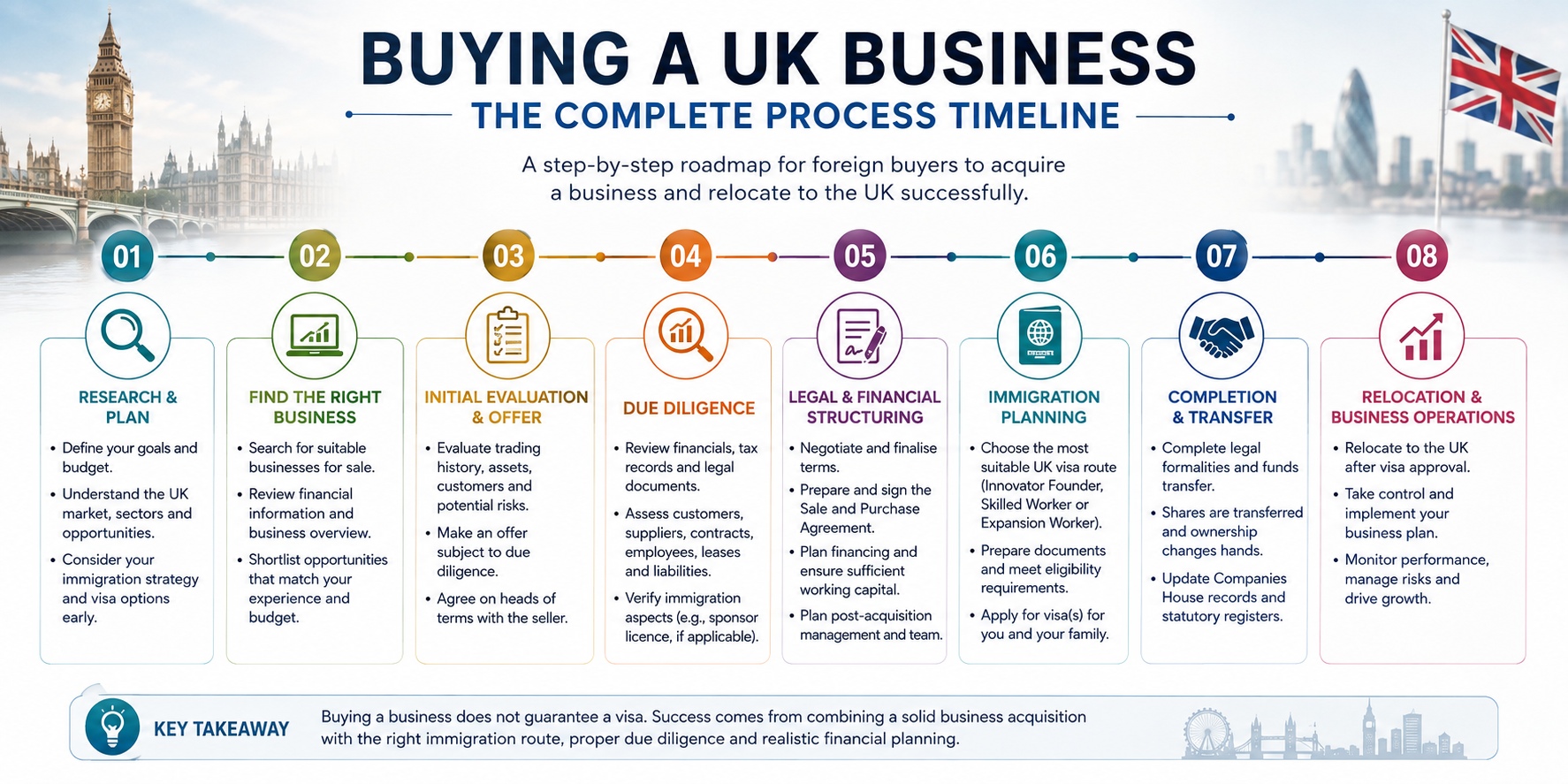
A buyer therefore needs two parallel plans. The acquisition plan explains what business will be purchased, how it will be financed and whether it is commercially sound. The immigration plan explains under which route the buyer and any family members may enter, live and work in the UK.
Both plans must work independently. A profitable company cannot repair an unsuitable visa application, while a valid visa does not make an overpriced or poorly managed business worth buying.
Buying an Existing Business Can Make Entering the UK Market Easier
The main advantage of buying an existing business is speed. Instead of spending months building every part of the operation from zero, the buyer may acquire an established legal entity, customer relationships, trained employees, supplier accounts, operating systems and a history of revenue.
A functioning company can also provide real data. Rather than relying only on a business plan, the buyer can examine previous accounts, tax filings, payroll, bank transactions, customer contracts and monthly sales. This does not remove uncertainty, but it provides more evidence than a new venture with no trading record.
The existing team may be especially valuable to someone relocating from abroad. Employees often understand local customer expectations, industry practices and day-to-day operational problems that are difficult to learn from overseas. They may also hold licences, technical knowledge or customer relationships that would take years to rebuild.
A buyer can review current businesses for sale in the UK to compare sectors, locations and asking prices before deciding what type of company fits their capital and experience. This initial comparison is useful for understanding what different budgets may buy in London, Manchester, Birmingham, Scotland, Wales and other UK markets.
The advantage is not simply that the business already exists. The real value is that it may continue producing income while the new owner learns the market. That only works when the company is genuinely transferable and does not depend entirely on the seller.
Buying an Existing Business Can Make Entering the UK Market Easier
Buying an established company can reduce some of the uncertainty that comes with entering a new market. Instead of building everything from zero, the buyer may acquire a business that already has customers, employees, supplier relationships, operating processes and a track record of revenue.
For someone relocating from abroad, this can be especially valuable. A functioning team may already understand local customer expectations, industry standards and the practical issues that are difficult to learn before moving. Existing contracts, trading history and financial records also give the buyer real information to assess, rather than relying only on forecasts in a business plan.
The strongest advantage is speed. A new company may need months or years to build trust, recruit staff and generate stable sales, while an established business can provide an operating base from the first day after completion. This does not mean the income is guaranteed, but it gives the buyer something concrete to evaluate and improve.
Before choosing a sector or location, buyers can visit the UK site of Yescapo to compare businesses by industry, region and asking price. Reviewing current listings can help clarify what different budgets may realistically buy and whether the market offers owner-operated businesses, managed companies or opportunities that require additional investment.
The main risk is assuming that the business will continue performing exactly as it did under the seller. A company may look stable because the owner personally manages major customers, solves staffing problems and controls daily operations. If those responsibilities need to be replaced after the sale, the buyer may face additional management costs and lower practical earnings.
For that reason, the real benefit of buying an existing business is not simply that it already generates revenue. It is that the buyer can examine how the company actually works, identify what depends on the seller and decide whether the operation can continue after the ownership change.
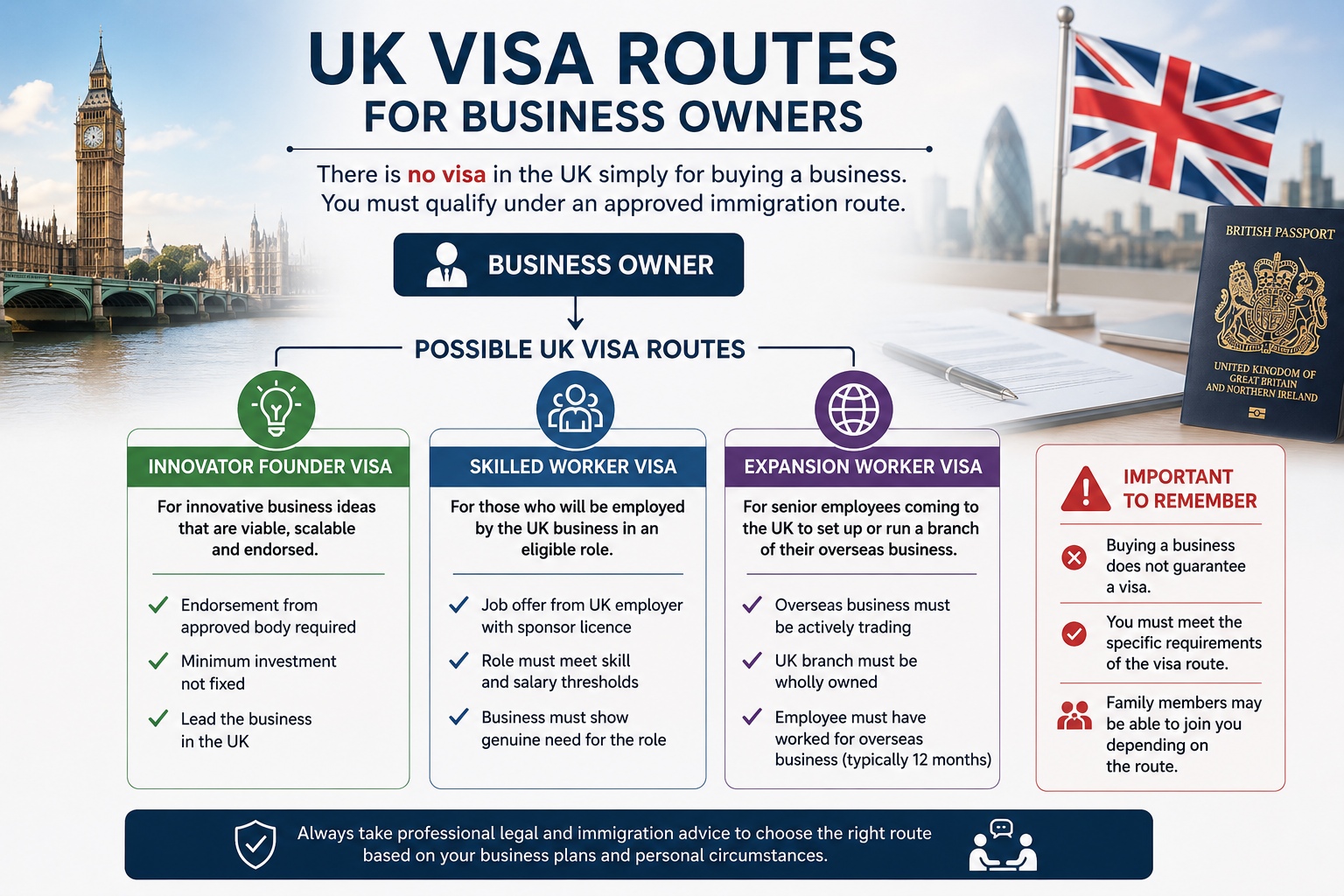
Innovator Founder Is Not a General Visa for Buying an Ordinary Company
The Innovator Founder visa is designed for people establishing and developing an endorsed business idea. The applicant needs endorsement from an authorised body and must satisfy requirements connected with the business proposal and active involvement in its development.
The route allows a successful applicant to stay for three years, and settlement may be possible after three years if the relevant conditions are met. Applicants must also maintain contact with their endorsing body and demonstrate progress.
Purchasing an ordinary existing café, cleaning company or retail shop does not automatically meet these requirements. An acquisition could potentially form part of a wider endorsed business strategy, but simply taking over an existing company should not be presented as a guaranteed Innovator Founder solution.
The practical question is whether the proposed business activity satisfies the immigration route, not whether the buyer has paid for a company.
Skilled Worker Sponsorship Requires a Real Job and a Compliant Sponsor
Some advisers use the term “self-sponsorship” to describe a structure in which a foreign entrepreneur owns or controls a UK company and the company sponsors them for a Skilled Worker visa. There is no official visa category called the UK self-sponsorship visa.
A UK company seeking to sponsor a Skilled Worker must hold the appropriate sponsor licence. The position must also be genuine. Home Office guidance allows an application to be refused where the job does not exist, is a sham or has been created mainly so the applicant can obtain immigration permission.
Buying a company that already holds a sponsor licence does not mean the buyer can use the licence without further action. Changes in ownership and corporate structure may trigger reporting duties and, depending on the transaction, a new sponsor licence application. Sponsor guidance includes specific takeover scenarios and refers to a 20-working-day reporting or application period in relevant cases.
Before relying on this structure, the buyer needs to verify the company’s sponsor status, compliance history, organisational structure and ability to support a genuine qualifying role. The acquisition agreement should also deal with what happens if the expected sponsorship arrangement is delayed or rejected.
UK Expansion Worker Usually Applies to Expanding an Overseas Company
The UK Expansion Worker route is designed for an overseas company opening a British branch or subsidiary before it has started trading in the UK. The applicant must already work for the overseas business as a senior manager or specialist employee.
It is generally not the natural route for someone simply purchasing an existing British company that is already trading. Government immigration rules specifically state that the route can only be used where the business has not yet begun trading in the UK, and it is not a route to settlement.
A buyer who already owns a substantial overseas company may need to compare expansion, acquisition and sponsorship structures before deciding which approach is commercially and legally appropriate.
The Business Must Work Without the Seller
The most important acquisition question is not whether the company is profitable under the current owner. It is whether the same level of profit can survive after that owner leaves.
In smaller businesses, the seller may manage sales, employee problems, supplier negotiations, quotations and major customer relationships. These duties are often hidden inside a single figure described as owner earnings or adjusted profit.
The advertised profit may be accurate for a hands-on owner who works 50 or 60 hours per week. It may be misleading for a foreign buyer who expects to hire a manager, travel regularly or spend the first year dealing with immigration and relocation.
A buyer should calculate the cost of replacing every function performed by the seller. This may mean adding a general manager, salesperson, bookkeeper or technical supervisor to the post-acquisition budget.
Customer relationships require similar attention. A contract may belong legally to the company, but the client may remain because of a personal relationship with the seller. The buyer should identify the largest customers, measure their share of revenue and determine whether written contracts, renewal terms and change-of-control provisions exist.
If one customer produces 35% of annual sales and leaves after the acquisition, the company may lose most of its profit while still carrying the same rent, salaries and loan payments.
Also read, What Entrepreneurs Should Know About UK Immigration Requirements
A £450,000 Business May Require Far More Than £450,000
Consider a hypothetical service company offered for £450,000. It reports annual revenue of £950,000 and adjusted owner earnings of £200,000. The company employs six people and serves several recurring commercial customers.
The opportunity initially appears attractive. The buyer assumes that the company will provide immediate income and support their relocation after the transaction.
Further investigation shows that the seller personally generates most quotations, manages the two largest accounts and resolves staffing problems. Hiring an operations manager and an experienced salesperson could cost approximately £90,000 per year.
The buyer also identifies £30,000 of equipment that may need replacement, £50,000 of working capital for wages and supplier payments, and around £25,000 for accounting, legal, immigration and transaction expenses. A contingency reserve of £35,000 is kept for delayed customer payments and unexpected staff changes.
The total cash requirement may therefore reach approximately £590,000, even before considering the buyer’s personal relocation costs. Once replacement management is included, the sustainable annual benefit may fall from the advertised £200,000 to closer to £110,000 before financing and tax.
This is an illustrative scenario rather than a documented transaction, but it reflects a common acquisition problem. The business may still be worth buying, although the asking price, financing structure or seller transition period would need to change.
Due Diligence Must Cover More Than the Company Accounts
Financial statements are only one part of a UK business acquisition. A foreign buyer should investigate the commercial, legal, operational and immigration consequences together rather than completing them in separate stages.
The main review should include the following areas:
- Financial performance: Compare monthly revenue, gross profit, payroll and operating profit over at least two or three years. Reconcile the figures with tax records and bank transactions where possible.
- Owner involvement: Record what the seller does each week, how many hours it takes and what salary would be required to replace those duties.
- Customers and contracts: Identify the largest customers, renewal dates, termination rights and any clauses triggered by a change of ownership.
- Employees: Review contracts, salaries, holiday liabilities, pension obligations, key-person dependency and whether the proposed transaction may affect employee rights.
- Property and leases: Check the remaining lease term, rent reviews, assignment conditions, landlord consent and repair obligations.
- Assets and equipment: Confirm ownership, finance agreements, maintenance history and expected replacement costs.
- Tax and liabilities: Investigate outstanding tax, loans, litigation, supplier disputes, guarantees and commitments that may remain with the company after completion.
- Immigration and sponsorship: Confirm that the planned visa route is legally available and does not depend on assumptions about a sponsor licence, job role or company structure that cannot be satisfied.
The exact process differs between a share purchase and an asset purchase. In a share purchase, the buyer acquires the company itself, including its history and many of its liabilities. In an asset purchase, the buyer selects particular assets and operations, although contracts, employees, licences and leases may still require careful transfer arrangements.
The transaction structure should be chosen with UK legal, tax and immigration advisers who understand both the acquisition and the buyer’s relocation plan.
Relocation Costs Should Be Kept Outside the Acquisition Budget
Foreign buyers often calculate the company price but underestimate the personal cost of moving. Immigration applications, professional advice, temporary housing, deposits, schools, insurance and several months of living expenses may all be required before the buyer receives stable income from the business.
These funds should not be mixed with operating working capital. Money reserved for payroll, rent and suppliers should remain available to the company, while personal relocation costs should be funded separately.
The first months after completion may be weaker than the seller’s historical results. Employees may leave, customers may delay decisions and the new owner may need time to understand the business. Even a healthy acquisition can experience a temporary decline during the transition.
A sensible buyer therefore avoids using every available pound for the purchase price. The safest deal is often a smaller company that leaves enough cash for management, working capital and personal relocation.
When Buying a UK Business Can Support a Successful Move
An existing company can be a strong foundation for relocation when the buyer has relevant experience, enough capital and a valid immigration route that matches the proposed role.
The strongest opportunities usually have financial records that can be verified, a management team that will remain, diversified customers and documented processes. They also give the buyer enough time to learn the market rather than forcing them to replace the seller immediately.
The strategy becomes much riskier when the buyer chooses the company mainly because they believe it will “provide a visa.” This can lead to overpaying for a weak business, accepting an unsuitable ownership structure or relying on a sponsorship plan that does not meet Home Office requirements.
FAQ
Does buying a business give you a UK visa?
No. Purchasing shares or assets in a UK business does not automatically provide immigration permission. The buyer must qualify separately under an appropriate visa route.
Can a foreigner buy a business in the UK?
A foreign person can generally own shares in a UK company and may serve as a director without living in the country. They still need the correct permission if they intend to relocate and work in the business from the UK.
Can a UK company sponsor its foreign owner?
Potentially, but ownership alone is not enough. The company needs an appropriate sponsor licence, the job must be genuine and all Skilled Worker requirements must be met. The arrangement should be reviewed by a regulated immigration professional before the acquisition.
Can I buy a business under the Innovator Founder visa?
Buying an existing company does not automatically satisfy the Innovator Founder requirements. The endorsed business proposal and the applicant’s role must meet the rules of the route, so an ordinary acquisition should not be assumed to qualify.
How much money do I need to buy a UK business?
The required capital is usually higher than the asking price. Buyers may also need funds for professional fees, working capital, equipment, deposits, replacement management and personal relocation expenses.
Enjoy Worthview?
Add Worthview as a Preferred Source on Google to see more of our stories in Search.

Sethuram Kishore is the founder and editor of Worthview, an online publication established in 2008. With over 18 years of experience in SEO, digital marketing, and online publishing, he writes about AI, technology, business, and digital trends. He is also the founder of MoneyHulk, a personal finance and business publication.