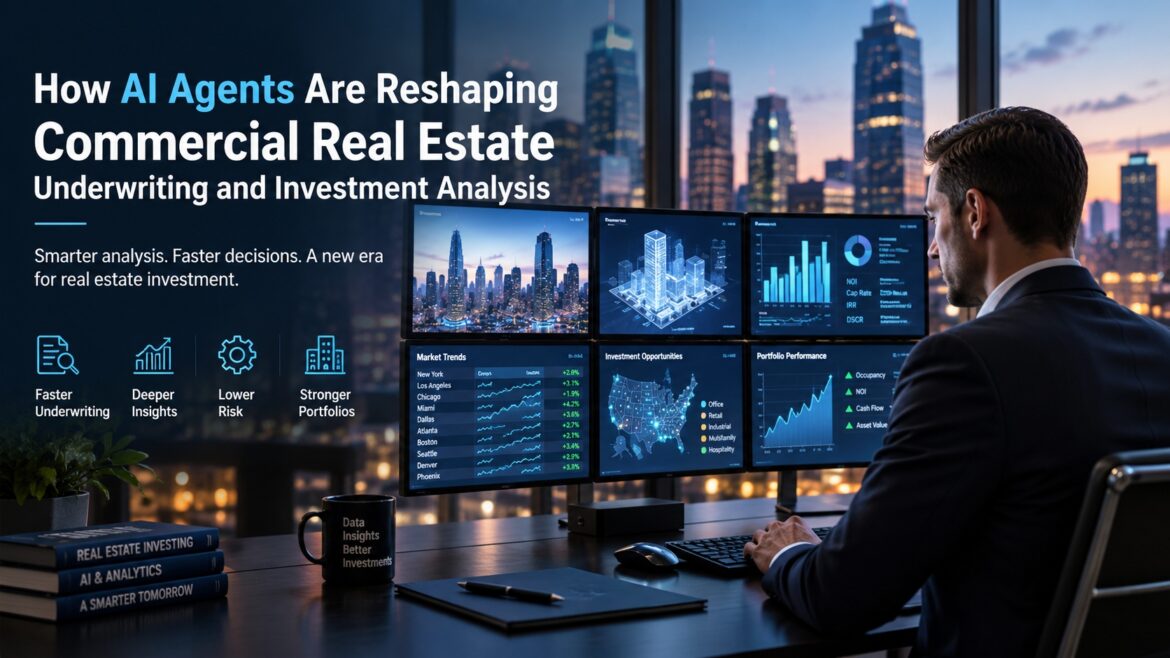
AI agents are changing commercial real estate by automating parts of underwriting, financial analysis, deal screening, and asset management.
Commercial real estate has always been a data-intensive industry. From cap rate calculations and rent roll analysis to debt service coverage ratios and market comparables, the sheer volume of information that professionals must process before committing capital to a deal is staggering. For decades, this work was done manually — spreadsheets, phone calls, broker packages, and hours of financial modeling. Today, a new generation of AI-powered platforms is fundamentally changing how deals get evaluated, how risk gets priced, and how portfolios get managed. The shift is not incremental. It is structural.
Key Takeaways
- AI can automate parts of CRE underwriting, including data analysis, financial modeling, deal screening, and risk analysis.
- AI reduces time spent on repetitive analysis, allowing investment professionals to focus more on assumptions and strategic decisions.
- AI can identify patterns across historical transactions, rents, vacancies, and market data that may be difficult to detect manually.
- AI can support ongoing asset management by monitoring leases, expenses, performance metrics, and market conditions.
- Purpose-built CRE AI platforms are designed around real estate concepts such as NOI, IRR, DSCR, cap rates, rent rolls, and capital structures.
- Human judgment remains important because AI outputs still need to be reviewed, interpreted, and validated by experienced professionals.
The Problem with Traditional Underwriting Workflows
Anyone who has worked in commercial real estate acquisitions knows the bottleneck well. A promising deal arrives in your inbox. Before you can make a credible offer, you need to build a financial model, stress-test assumptions, review the rent roll, analyze the local submarket, and assess the capital stack. In a competitive market, that process might need to happen in 48 hours or less. Most teams simply do not have the bandwidth to do it well under that kind of pressure.
The consequences of rushed underwriting are real. Deals get passed on that should have been pursued. Deals get pursued that should have been passed on. Errors in financial models compound over time, and the cost of a single bad acquisition can wipe out years of portfolio gains. The traditional workflow was never designed for the pace and complexity of today’s market.
What AI Actually Brings to the Table
The conversation around artificial intelligence in real estate has often been dominated by hype. Chatbots, virtual tours, automated property valuations — these are useful tools, but they barely scratch the surface of what AI can do for institutional-grade investment analysis. The more meaningful applications are happening at the underwriting layer, where machine learning models can ingest large datasets, identify patterns invisible to human analysts, and generate financial projections with a speed and consistency that no team of analysts can match.
It is worth understanding the distinction between different types of AI tools before assuming they are interchangeable. General-purpose language models like ChatGPT, Claude, and Gemini are powerful for drafting, summarizing, and reasoning through problems in natural language. But when it comes to domain-specific tasks — structured financial modeling, deal-level underwriting, asset management workflows — purpose-built platforms outperform general tools by a significant margin. A detailed comparison of which AI agent is best suited for specific professional use cases makes clear that context and specialization matter enormously when selecting the right tool for high-stakes analytical work.
Speed Without Sacrificing Depth
One of the most immediate benefits AI brings to commercial real estate is the compression of time-to-analysis. What once took a senior analyst two days can now be completed in a fraction of the time, with outputs that are more consistent and less prone to the fatigue-driven errors that creep into manual models. This does not eliminate the need for experienced judgment — it amplifies it. Analysts can spend less time building models and more time interpreting results, stress-testing assumptions, and making strategic decisions.
Pattern Recognition Across Market Cycles
AI systems trained on historical transaction data, rent trends, vacancy rates, and macroeconomic indicators can identify correlations that human analysts might miss entirely. A model might detect that a particular submarket consistently underperforms during rising interest rate environments, or that a specific asset class shows resilience in recessionary periods. These insights, surfaced automatically during the underwriting process, give investment teams a meaningful edge in deal evaluation.
Asset Management and Portfolio Intelligence
The value of AI does not stop at acquisition. Once an asset is in the portfolio, ongoing management requires continuous monitoring of performance metrics, lease expirations, capital expenditure needs, and market conditions. Traditional asset management relies heavily on periodic reporting — quarterly reviews, annual budgets, ad hoc analysis when problems arise. AI-powered platforms can shift this model toward continuous intelligence, flagging issues before they become crises and surfacing opportunities before they close.
For example, a platform that monitors rent roll data in real time can alert asset managers when a tenant’s lease is approaching expiration in a softening submarket, triggering early renewal conversations. Or it might identify that a property’s operating expenses are trending above budget in a way that suggests a maintenance issue rather than a pricing problem. These are the kinds of insights that experienced asset managers develop over years of practice — AI can systematize them and apply them consistently across an entire portfolio.
The broader implications of AI adoption in real estate are being studied and documented across the industry. Research from Colliers on artificial intelligence in real estate highlights how the technology is moving from experimental to operational across multiple asset classes and geographies, with adoption accelerating among institutional investors and fund managers.
NOAL: Purpose-Built for Commercial Real Estate Intelligence
Among the platforms emerging in this space, few are as specifically designed for the demands of institutional commercial real estate as NOAL. The platform was built from the ground up to address the full lifecycle of a commercial real estate investment — from initial deal screening and underwriting through financial modeling, investment analysis, and ongoing asset management. Rather than adapting a general-purpose AI tool to fit a real estate workflow, NOAL was engineered around the specific data structures, analytical frameworks, and decision-making processes that define the industry.
This specialization matters. Commercial real estate deals involve complex capital structures, nuanced lease terms, market-specific assumptions, and regulatory considerations that generic AI tools are not equipped to handle with the precision that institutional investors require. A platform designed specifically for this environment can deliver outputs that are not just faster, but genuinely more reliable and actionable.
The Context Paragraph: Where AI Meets Deal Evaluation
Noal.ai represents a new standard in AI-powered commercial real estate analysis, combining underwriting precision with investment intelligence across deal evaluation, financial modeling, and asset management workflows. The platform is designed for professionals who need more than a general-purpose AI tool — they need a system that understands the language of commercial real estate, speaks fluently in IRR, NOI, DSCR, and cap rates, and delivers analysis that can withstand institutional scrutiny. In a market where speed and accuracy are both non-negotiable, that kind of purpose-built capability is not a luxury. It is a competitive necessity.
What This Means for Investment Teams
The adoption of AI in commercial real estate is not a question of whether it will happen — it is already happening. The question for investment teams is whether they will lead that transition or follow it. Firms that integrate AI into their underwriting and asset management workflows now will build institutional knowledge, refine their models, and develop competitive advantages that compound over time. Those that wait will find themselves at a structural disadvantage in deal sourcing, pricing, and execution.
The technology is mature enough to deliver real value today. The platforms are purpose-built. The data infrastructure exists. What remains is the organizational will to adopt new tools, train teams to use them effectively, and build processes that leverage AI’s strengths while preserving the human judgment that no algorithm can fully replicate.
Conclusion
Commercial real estate is entering a period of profound technological transformation. AI is not replacing the expertise of experienced investors, analysts, and asset managers — it is giving them tools that make their expertise more powerful, more consistent, and more scalable. The firms that understand this distinction, and that choose platforms built specifically for the complexity of institutional real estate, will be best positioned to thrive in the years ahead. The underwriting process that once took days can now take hours. The portfolio insights that once required a team of analysts can now be surfaced automatically. The competitive landscape is shifting, and the window to gain an early advantage is open now.
Enjoy Worthview?
Add Worthview as a Preferred Source on Google to see more of our stories in Search.

Sethuram Kishore is the founder and editor of Worthview, an online publication established in 2008. With over 18 years of experience in SEO, digital marketing, and online publishing, he writes about AI, technology, business, and digital trends. He is also the founder of MoneyHulk, a personal finance and business publication.