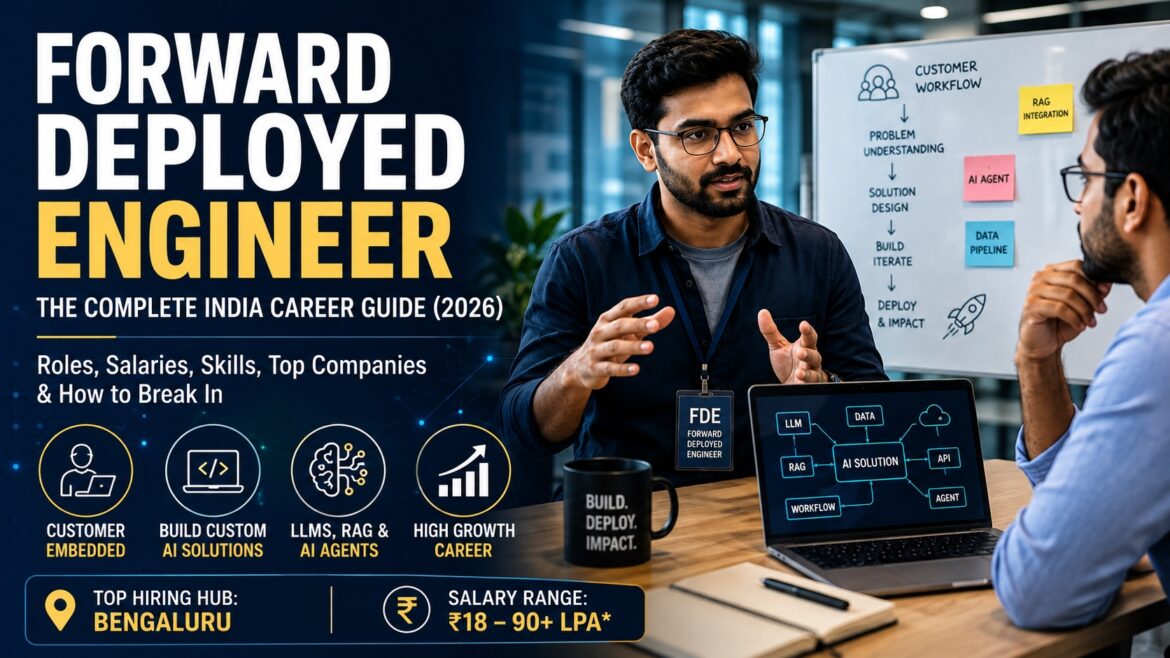
The Forward Deployed Engineer (FDE) role is becoming increasingly important in India’s AI and enterprise technology market. Unlike traditional software engineers who primarily build reusable product features, FDEs work directly with customers to turn real-world business problems into working software and AI solutions.
The role has gained significant attention as companies move beyond AI experiments and begin deploying LLMs, RAG systems, AI agents, and enterprise software into production. This has created demand for engineers who can combine strong software development skills with customer communication, problem-solving, and the ability to work effectively in ambiguous environments.
India is emerging as an important hiring market for Forward Deployed Engineers, with Bengaluru serving as the primary hub. Companies ranging from AI labs and cloud providers to consulting firms and global capability centers are building teams that require FDE-style engineering skills.
This guide explains what a Forward Deployed Engineer does, the skills required, FDE salaries in India in 2026, companies hiring for these roles, and how software engineers can transition into the career.
| A Forward Deployed Engineer (FDE) is a software engineer who works directly with customers to design, build, and deploy customized software or AI solutions for their specific business needs. FDEs often work with technologies such as LLMs, RAG, APIs, data pipelines, and AI agents, combining engineering expertise with customer-facing problem solving.
In India (2026), FDEs typically earn ₹18–28 LPA at 0–2 years of experience, ₹28–55 LPA at 3–6 years, and ₹55–90+ LPA in senior or global-remote roles. Anthropic, OpenAI, Google Cloud, Palantir, Databricks, and McKinsey QuantumBlack are among the active hirers, with Bengaluru as the primary hub. |
Key Takeaways
- Role: An FDE embeds with customers to ship custom AI/software integrations — part engineer, part consultant.
- Origin: Popularized by Palantir as “Forward Deployed Software Engineer,” now adopted across the AI industry.
- India salary: ₹18–28 LPA (0–2 yrs) · ₹28–55 LPA (3–6 yrs) · ₹55–90+ LPA (senior/global-remote).
- Scarcity: Only ~250–270 open roles in India at any time, despite a 729% YoY jump in listings.
- Entry path: Not a fresher-default role — the realistic lane is a 2–5 year product/backend engineer pivoting in.
- Top hirers: Anthropic, OpenAI’s deployment org, Google Cloud, Palantir, Databricks, McKinsey QuantumBlack, and GCCs, concentrated in Bengaluru.
What Is a Forward Deployed Engineer
A Forward Deployed Engineer sits between a company’s core product team and its customers. Instead of shipping one-size-fits-all software, an FDE works on-site or in close, ongoing collaboration with a specific client to understand their workflows and data, then builds a custom solution on top of the company’s core platform — often iterating in days or weeks rather than quarters.
The term originates with Palantir, whose entire go-to-market model is built around Forward Deployed Software Engineers (FDSEs) embedded inside government agencies, banks, and enterprises. As AI adoption has moved from pilots to production, the model has spread well beyond Palantir: Anthropic, OpenAI’s newly formed deployment organization, Google Cloud, Databricks, Salesforce, Snowflake, and McKinsey QuantumBlack all now run FDE-style teams.
The reason is structural. As one venture capital firm put it, enterprises buying AI are like a first-time smartphone user — they want to use the product, but someone still needs to set it up for them. The bottleneck in enterprise AI adoption has shifted from model capability to implementation, and FDEs are the engineers whose job is to close that gap.
Why Do Companies Need Forward Deployed Engineers?
Building an AI model or software platform is only one part of solving an enterprise problem. Companies also need to connect that technology to their existing systems, data, workflows, security requirements, and business processes.
This creates a gap between what a technology can demonstrate in a controlled environment and what it needs to do inside a real organization.
Forward Deployed Engineers help close that gap by working directly with customers, understanding their specific requirements, and turning those requirements into production-ready solutions.
What Does a Forward Deployed Engineer Do?
Typical FDE responsibilities include:
- Work directly with customers to understand their workflows, technical environment, data, and business requirements.
- Design and build customized solutions using software engineering and AI technologies.
- Develop LLM, RAG, and AI-agent integrations where they can solve specific business problems.
- Translate ambiguous requirements into working software by defining the problem, choosing an approach, and building a practical solution.
- Iterate quickly with customers, often moving from an initial idea to a working implementation within days or weeks.
- Communicate technical decisions and trade-offs to both technical and non-technical stakeholders.
- Share lessons from customer deployments with product and engineering teams so successful solutions can inform future products.
In simple terms, an FDE sits between engineering, product, and the customer. The role is not simply to write code; it is to understand a real-world problem, build the right technical solution, and make sure that solution works in the customer’s environment.
Forward Deployed Engineer vs. Traditional Software Engineer
A Forward Deployed Engineer and a traditional Software Development Engineer (SDE) share the same core software engineering foundation, but their day-to-day responsibilities are different.
An SDE typically focuses on building and improving a company’s reusable product, while an FDE focuses on adapting that technology to solve a specific customer’s problem.
| Dimension | Forward Deployed Engineer (FDE) | Traditional Software Engineer (SDE) |
|---|---|---|
| Primary focus | Build customized solutions for specific customers | Build reusable product features and systems |
| Customer interaction | Direct and frequent, often on-site | Usually indirect, through product or engineering teams |
| Requirements | Often ambiguous and customer-specific | Generally defined through product requirements |
| Development approach | Rapid build, test, deploy, and iterate cycles | Structured product development and engineering cycles |
| Iteration speed | Often days or weeks | Often weeks or months, depending on the product |
| Technical profile | Broad generalist skills plus strong communication | Often deeper specialization in a particular technical area |
| Business knowledge | High — must understand the customer’s workflow and objectives | Usually focused more heavily on the product and technical domain |
| Success measure | Whether the solution solves the customer’s real-world problem | Whether the product or feature works reliably at scale |
| Typical work environment | Close collaboration with customers and internal teams | Primarily collaboration with engineering, product, design, and other internal teams |
The broader pattern in the market isn’t “less engineering hiring” — it’s different engineering hiring. Routine, ticket-driven backend and L1 support work is contracting in the same market where FDE postings are multiplying.
FDE vs. SDE: Which Role Is Better?
Neither role is universally better. The right choice depends on how you prefer to work.
FDE may be a better fit if you:
- Enjoy solving different problems for different customers.
- Like combining coding with communication and problem-solving.
- Are comfortable with changing requirements and ambiguity.
- Want direct exposure to how businesses use technology.
- Prefer fast build-and-feedback cycles.
- Enjoy learning new industries, workflows, and technical environments.
Traditional SDE may be a better fit if you:
- Prefer building a single product or platform over a longer period.
- Want to develop deeper expertise in a specific technical area.
- Prefer predictable engineering processes and clearly defined requirements.
- Enjoy designing systems that need to serve a large and diverse user base.
- Prefer working primarily with engineering and product teams rather than customers.
Skills and Tech Stack Employers Ask For
A Forward Deployed Engineer needs more than strong coding ability. The role combines software engineering, AI implementation, customer communication, and business problem-solving.
Because FDEs work with different customers and technical environments, employers generally look for engineers who can learn quickly, work independently, and turn unclear requirements into practical solutions.
1. Strong Software Engineering Fundamentals
FDEs need to be able to build and ship production-quality software independently.
Common requirements include:
- Backend or full-stack development experience
- Strong programming fundamentals
- API development and integration
- Working with databases and data pipelines
- Debugging and troubleshooting
- Git and modern software development workflows
- Cloud and deployment fundamentals
The exact programming language varies by employer, but the important requirement is the ability to build, test, deploy, and maintain working software.
2. LLM and Generative AI Knowledge
As more FDE roles focus on AI deployment, candidates increasingly benefit from practical knowledge of:
- Large language models (LLMs)
- Prompt engineering
- Retrieval-Augmented Generation (RAG)
- AI agents and agentic workflows
- Model APIs and integrations
- Evaluation and testing of AI applications
- AI application deployment
Candidates do not necessarily need to train foundation models. For many FDE positions, the more valuable skill is knowing how to use existing AI models to solve a specific business problem.
3. Customer-Facing Communication
FDEs work directly with customers, which makes communication an important part of the job.
An FDE may need to:
- Understand a customer’s business problem.
- Explain technical concepts to non-technical stakeholders.
- Discuss technical trade-offs.
- Present prototypes and working solutions.
- Gather feedback and convert it into engineering requirements.
- Manage expectations around what can realistically be built.
A strong engineer who cannot communicate effectively with customers may struggle in an FDE role.
4. Problem-Solving and Comfort With Ambiguity
Customer problems are rarely presented as perfectly defined engineering tickets.
An FDE may start with a broad requirement such as:
“We want to use AI to make this workflow more efficient.”
The engineer then has to determine what the actual problem is, what data is available, what solution is technically feasible, and what should be built first.
This requires structured problem-solving, independent decision-making, and a high tolerance for ambiguity.
5. Fast Learning and Domain Adaptability
Every customer engagement can introduce a different industry, workflow, technology stack, or dataset.
FDEs therefore need to learn quickly and become productive in unfamiliar environments.
Useful abilities include:
- Understanding a new business process quickly
- Learning unfamiliar technologies
- Working with new datasets
- Asking the right questions
- Identifying the most important constraints
- Applying lessons from previous deployments to new problems
FDE Skill Set at a Glance
| Skill Area | What Employers Look For |
|---|---|
| Software engineering | Backend/full-stack development and production coding |
| AI/LLMs | LLMs, RAG, agents, model APIs and AI application development |
| Cloud & deployment | APIs, infrastructure and production deployment fundamentals |
| Problem-solving | Ability to turn ambiguous problems into practical solutions |
| Communication | Clear communication with technical and non-technical stakeholders |
| Customer management | Requirements gathering, feedback and expectation management |
| Adaptability | Ability to learn new industries, workflows and technologies quickly |
The Ideal FDE Profile
The strongest FDE candidates are usually T-shaped engineers: they have solid depth in software engineering while maintaining broad knowledge across AI, cloud technologies, business workflows, and customer delivery.
In practice, this means you do not need to know every AI framework or technology. You need to be capable of understanding a customer’s problem, choosing an appropriate technical approach, and shipping a working solution quickly.
- Strong backend or full-stack coding fundamentals — the ability to build and ship production code independently.
- Working knowledge of LLM, RAG, and AI agent frameworks and orchestration.
- Client-facing communication and stakeholder management — explaining technical trade-offs to non-technical teams.
- High tolerance for ambiguity, and the ability to scope a fuzzy business problem into a concrete build.
- Fast domain-learning ability, since each engagement may mean a new industry, workflow, or dataset.
Salary Expectations in India (2026)
Compensation bands vary by source and sample size, but a consistent picture emerges from India-specific job market data:
| Experience Band | Typical Range (Annual) | Employer Type |
| 0–2 years | ₹18–28 LPA | Startups, GCCs |
| 3–6 years | ₹28–55 LPA | Mid-size to large tech |
| Senior / global-remote India | ₹55–90+ LPA | Global AI labs, consultancies |
City-level data broadly supports these bands: Glassdoor’s Bengaluru sample (9 data points, as of July 2026) shows an average of roughly ₹17 LPA, with a typical range of ₹11–36 LPA and top earners reporting up to ₹46 LPA — a wide spread that reflects how much experience and employer type move the number. These are small, self-reported samples, so treat exact figures as directional rather than precise.
For comparison, these bands generally run ahead of standard SDE compensation at equivalent experience levels in India — a premium that reflects the role’s hybrid engineering-plus-client-delivery scope and its current scarcity.
Who’s Hiring in India
Active FDE hirers in the Indian market include Anthropic, OpenAI’s dedicated deployment organization, Google Cloud, Palantir, Databricks, and McKinsey QuantumBlack (which hires for a “Principal Forward Deployment Engineer” track). Global capability centers (GCCs) of multinational firms have also begun opening FDE-equivalent roles. Bengaluru remains the primary hiring hub, consistent with its position as India’s broader AI and enterprise-software center.
How to Break Into the Role
Despite the hiring buzz, FDE is not typically a fresher-friendly entry point. Most real job descriptions target engineers with 2–5 years of product or backend experience who can already ship independently and are pivoting toward more customer-facing, ambiguous work. Freshers are generally better served targeting adjacent roles — such as data engineering — and building toward an FDE-style position after a few years of hands-on delivery experience.
What tends to help a candidate stand out: demonstrated experience shipping something end-to-end for a real user or client (not just coursework or isolated side projects), any exposure to LLM/RAG/agent tooling, and evidence of comfort explaining technical decisions to non-engineers.
Is This a Bubble or a Structural Shift?
The honest answer is probably both, in different proportions. Some of the current hiring frenzy reflects the usual overcorrection that follows any hot new job title — postings proliferate faster than genuine open roles, and titles get relabeled opportunistically. But the underlying driver looks structural rather than cyclical: enterprises are not struggling to access AI models: they’re struggling to operationalize them inside messy, specific, real-world workflows. That gap — between what a model can do in a demo and what it can do inside a particular company’s systems — is not going away as models improve; if anything, more capable models raise the stakes of getting deployment right.
The more useful framing for engineers evaluating this path: the AI bottleneck has moved from the model to the meeting room. FDE is the job title for the person who has to operate in both.
Frequently Asked Questions
What does FDE mean in tech?
FDE stands for Forward Deployed Engineer — an engineer embedded with a customer to build and customize AI or software solutions for that customer’s specific environment.
What does a Forward Deployed Engineer do?
A Forward Deployed Engineer works with customers to understand their business problems and technical environment, then builds practical software or AI solutions around those requirements. The work can include LLM, RAG, AI-agent, API, data, and software integrations.
FDE vs. SDE — which is better?
Neither is objectively better; they suit different strengths. FDE roles pay a premium and offer broader, customer-facing exposure but demand strong communication skills and comfort with ambiguity. SDE roles offer deeper specialization and a more predictable, product-focused scope.
Is FDE a good career for freshers in India?
Generally not as a first job. Most Indian job descriptions expect 2–5 years of prior product or backend experience. Freshers are better positioned starting in an adjacent engineering role and pivoting toward FDE after building hands-on delivery experience.
How many FDE jobs are open in India right now?
Roughly 250 to 270 active openings nationally at any given time, according to TeamLease Digital data — a small pool relative to the surge in job postings and search interest.
Is FDE a senior role?
FDE is not inherently a seniority level. Companies can hire junior, mid-level, and senior FDEs. However, many current openings expect previous software engineering experience because FDEs are often required to work independently with customers and handle ambiguous technical problems.
Enjoy Worthview?
Add Worthview as a Preferred Source on Google to see more of our stories in Search.

Sethuram Kishore is the founder and editor of Worthview, an online publication established in 2008. With over 18 years of experience in SEO, digital marketing, and online publishing, he writes about AI, technology, business, and digital trends. He is also the founder of MoneyHulk, a personal finance and business publication.







One thought on “Forward Deployed Engineer: The Complete India Career Guide (2026)”
Comments are closed.