Google Pixel Tag is the company’s first dedicated Bluetooth item tracker, designed to help Android users find lost keys, wallets, luggage and other belongings. It costs $29 for one tag or $99 for a four-pack and will go on sale November 11, 2026.
The Pixel Tag uses Bluetooth, Ultra Wideband (UWB), and Google’s Find Hub network to locate misplaced items. It also includes Precision Finding, Left Behind alerts, a built-in speaker, a phone-finding button, a replaceable battery rated for up to one year, and an IP67 water- and dust-resistance rating.
Google announced the Pixel Tag at its Made by Google 2026 event on August 12 alongside the Pixel 11 series and Pixel Watch 5. The tracker is Google’s direct Android-focused alternative to products such as Apple’s AirTag and Samsung’s Galaxy SmartTag.
Key Takeaways
- Google Pixel Tag price: $29 for one tag or $99 for a four-pack.
- Release date: November 11, 2026.
- Tracking network: Google’s Find Hub network, which uses participating Android devices to help locate lost items.
- Precision Finding: UWB and Bluetooth Channel Sounding provide visual distance and directional guidance on compatible Android devices.
- Compatibility: Works with Android devices running Android 9 or later; compatible devices also require Bluetooth 6.0+ for the stated compatibility requirement.
- Battery: User-replaceable battery rated for up to one year under Google’s testing conditions.
- Durability: IP67 water- and dust-resistance rating.
- Extra features: Left Behind alerts, a built-in speaker, phone-finding button, and sharing with up to 10 people.
- Main competitor: Apple’s AirTag, although Pixel Tag is designed primarily for the Android ecosystem.
What Is Google Pixel Tag?
Google Pixel Tag is a small Bluetooth and Ultra Wideband (UWB) tracker designed to help Android users find lost or misplaced items. It can be attached to everyday belongings such as keys, wallets, bags and luggage, then located using Google’s Find Hub network.
When the Pixel Tag is nearby, users can use its built-in speaker to make it play a sound. On compatible Android devices, Precision Finding uses UWB and Bluetooth technology to provide distance and directional guidance to help locate the tag more precisely.
When an item is outside the phone’s direct Bluetooth range, the Pixel Tag can rely on Google’s crowdsourced Find Hub network. Nearby participating Android devices can help report the tag’s approximate location without requiring the owner to be physically near it.
The Pixel Tag also includes features such as Left Behind alerts, a physical button for finding a paired phone, a replaceable CR2032 battery, and an IP67 rating for dust and water resistance.
Unlike Apple’s AirTag, which is designed around Apple’s ecosystem, the Pixel Tag is built primarily for Android users and works with compatible devices running Android 9 or later.
Google Pixel Tag Price and Release Date
The Google Pixel Tag costs $29 for a single tracker or $99 for a four-pack. Google has confirmed that the Pixel Tag will go on sale on November 11, 2026, putting it on the market just ahead of the holiday shopping season.
At launch, the Pixel Tag will be available in a single Fog color. Google will also offer an optional keychain-loop accessory separately, allowing users to attach the tracker to keys, bags, luggage, or other everyday items.
Google Pixel Tag Price
- Single Pixel Tag: $29
- Four-pack: $99
- Launch color: Fog
- Release date: November 11, 2026
- Keychain accessory: Sold separately
The four-pack works out to $24.75 per tracker, making it $17 cheaper than buying four individual tags. This could make the multi-pack particularly appealing for users who want to track several items such as keys, wallets, backpacks, and luggage.
Google Pixel Tag Design
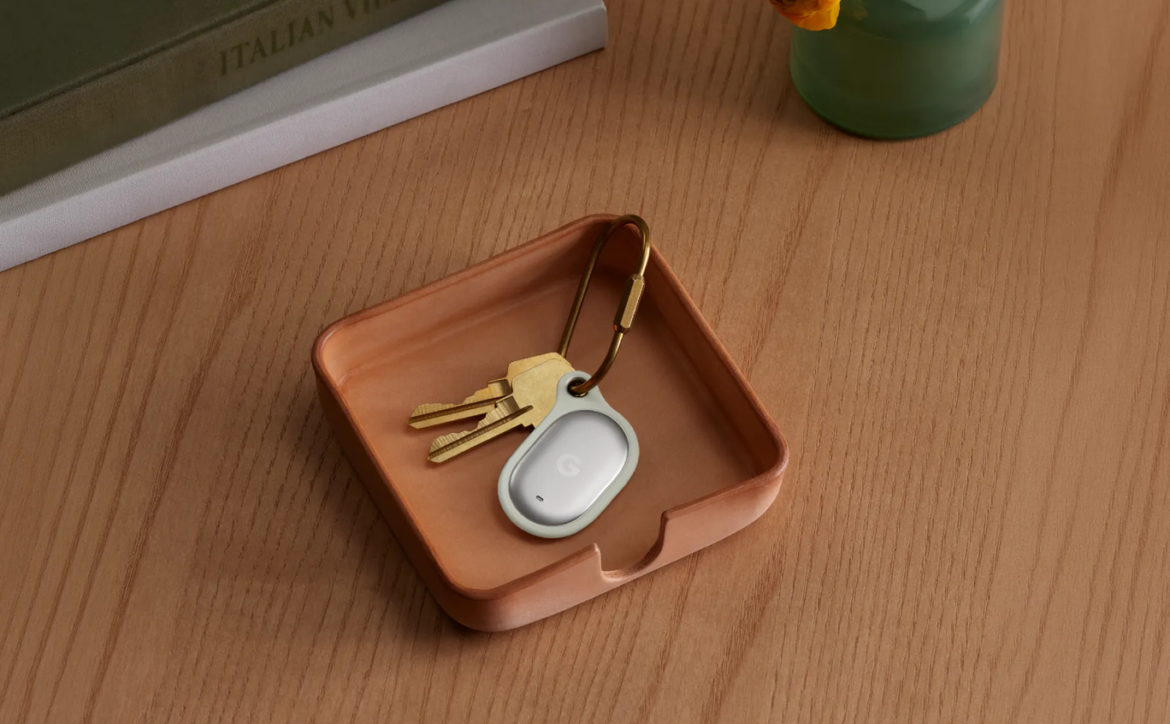
Unlike Apple’s circular AirTag and Samsung’s similarly rounded trackers, the Google Pixel Tag has a slim, pill-shaped design. The tracker measures 1.8 inches tall, 1.1 inches wide, and 5.4mm thick, with a weight of about 0.4 ounces.
The front features a metal panel with Google’s G logo, while the rear uses a plastic panel. A physical button on the device can be used to help locate a paired Android phone, adding a useful function beyond simply tracking belongings.
The elongated shape also makes the Pixel Tag noticeably different from the familiar circular AirTag design. Google says the device is designed to be used with everyday items such as keys, bags, wallets and luggage, with a separate keychain-loop accessory available for easier attachment.
The Pixel Tag will initially be available in Fog, with additional colors or accessories potentially expanding the options later.
Google Pixel Tag Features
The Google Pixel Tag combines Bluetooth, Ultra Wideband (UWB), Google’s Find Hub network, and several practical safety and convenience features to help users locate misplaced belongings. Its main features include:
UWB and Precision Finding
The Pixel Tag uses Ultra Wideband (UWB) and Bluetooth to provide more precise location guidance when searching for a nearby item. Google’s Precision Finding feature can show the direction and approximate distance to the tag on a compatible Android device, making it easier to locate items that are nearby but out of sight.
Find Hub Network
If the Pixel Tag is outside Bluetooth range, it can use Google’s Find Hub network to help determine its location. The network uses participating Android devices to detect nearby lost items and securely report their approximate location to the owner.
This gives Pixel Tag access to Google’s large Android ecosystem instead of requiring Google to build a separate tracking network.
Fast Pair Setup
Setting up the Pixel Tag is designed to be simple. Google Fast Pair can automatically recognize the tracker when it is brought near a compatible Android phone, allowing users to connect and configure it without going through a lengthy manual pairing process.
Left Behind Alerts
The Pixel Tag can send Left Behind alerts when users move away from a tagged item. This can help prevent situations where someone leaves a wallet, backpack, keys, or luggage behind.
Built-in Speaker
A built-in speaker allows users to make the Pixel Tag play a sound when searching for a nearby item. This is particularly useful when the tag is hidden under furniture, inside a bag, or somewhere else within hearing range.
Find Your Phone
The Pixel Tag also works in reverse. Its physical button can be pressed to ring a paired Android phone, helping users locate their phone when they know they have the tracker but cannot remember where they left their handset.
Replaceable Battery
The Pixel Tag uses a replaceable CR2032 coin-cell battery. Google rates the battery for up to one year under its testing conditions, after which users can replace the battery rather than replacing the entire tracker.
IP67 Water and Dust Resistance
The Pixel Tag has an IP67 rating, providing protection against dust and allowing the device to withstand immersion in up to 1 meter of fresh water for up to 30 minutes under laboratory conditions.
Share a Pixel Tag With Others
Google also allows a Pixel Tag to be shared with up to 10 people. This can be useful for families or shared belongings, such as household keys, luggage, or a commonly used vehicle.
Google Pixel Tag Compatibility
The Google Pixel Tag is designed for the Android ecosystem and does not require a Google Pixel phone. It works with compatible Android devices running Android 9 or later, giving it a much wider potential user base than a tracker restricted to a single phone brand.
Google says compatible devices also need Bluetooth 6.0 or later for Pixel Tag compatibility. Some advanced features, such as Precision Finding, require a device with the appropriate UWB hardware and software support.
This means the Pixel Tag can be used with compatible phones from different Android manufacturers, rather than being limited to Pixel smartphones.
Does Pixel Tag Work With iPhone?
No. The Pixel Tag is designed for Android devices and is not intended to work as a full-featured tracker with iPhones. Users looking for an item tracker for Apple’s ecosystem would generally use an AirTag or another tracker compatible with Apple’s Find My network.
For Android users, however, Pixel Tag’s integration with Google Find Hub gives it an ecosystem-level advantage: the tracker can benefit from the large number of participating Android devices that make up Google’s crowdsourced finding network.
Pixel Tag vs AirTag
The Google Pixel Tag and Apple AirTag are similar in their basic purpose: both are small item trackers designed to help users find misplaced belongings such as keys, wallets, bags and luggage. The biggest difference is the ecosystem each tracker belongs to.
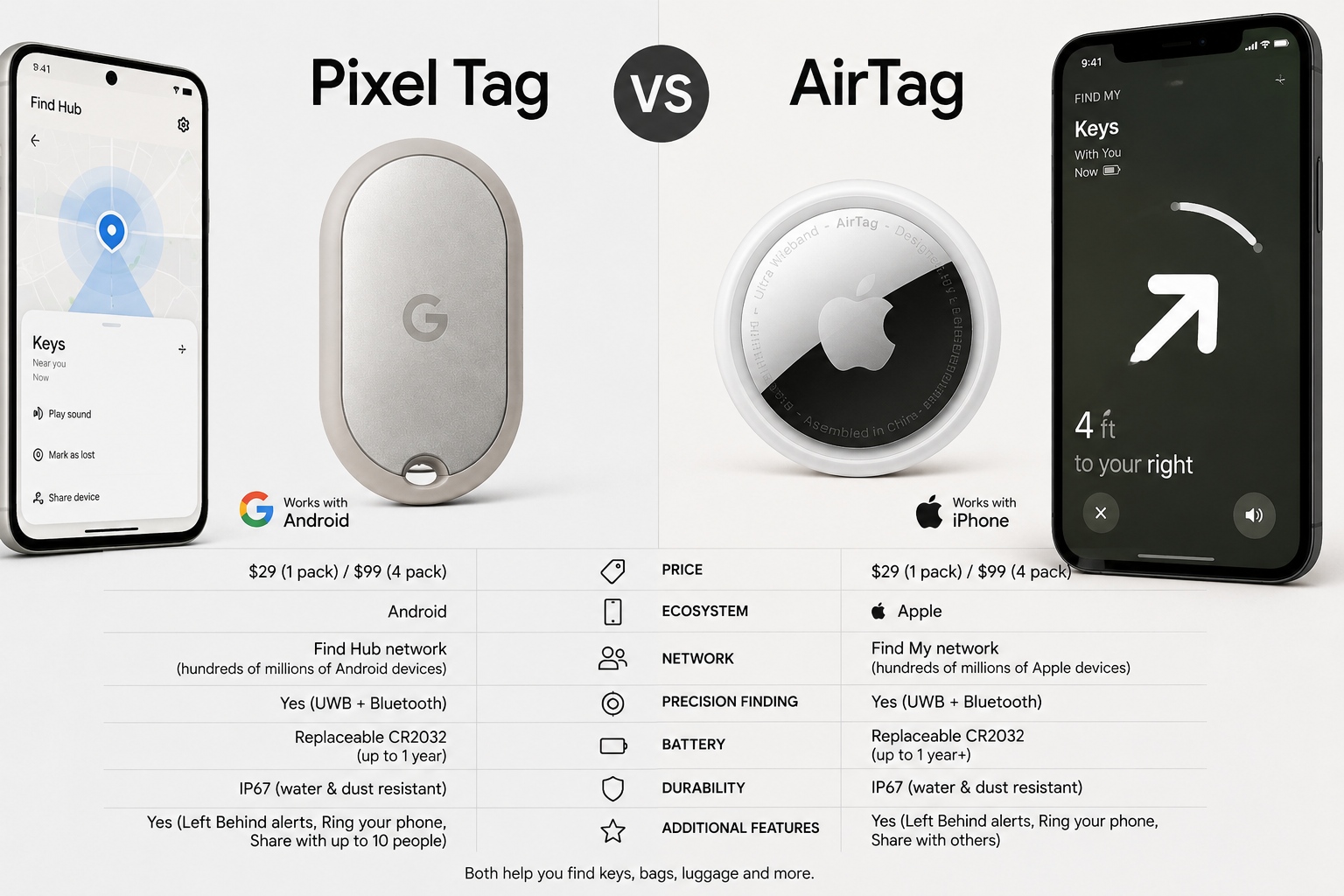
Pixel Tag is built around Android and Google’s Find Hub network, while AirTag is designed for Apple devices and the Find My network.
| Feature | Google Pixel Tag | Apple AirTag |
|---|---|---|
| Price | $29 | $29 |
| Multi-pack | $99 for 4 | $99 for 4 |
| Primary ecosystem | Android | Apple |
| Tracking network | Google Find Hub | Apple Find My |
| UWB | Yes | Yes |
| Precision finding | Yes, on compatible Android devices | Yes, on compatible iPhones |
| Battery | Replaceable CR2032 | Replaceable CR2032 |
| Battery life | Up to 1 year | More than 1 year |
| Water/dust resistance | IP67 | IP67 |
| Built-in speaker | Yes | Yes |
| Left-behind alerts | Yes | Yes |
| Phone finding | Yes | Yes, with compatible Apple devices |
Pixel Tag vs AirTag: Which One Is Better?
Pixel Tag is the more natural choice for Android users, while AirTag is better suited to people who use Apple’s ecosystem. Neither tracker is universally better because their biggest advantage comes from integration with their respective networks.
Pixel Tag’s key advantage is access to Google’s Find Hub network, which uses participating Android devices to help locate lost items. AirTag similarly benefits from Apple’s extensive Find My network.
The choice is therefore relatively straightforward: Android users should consider Pixel Tag, while iPhone users will generally get the best experience from AirTag.
For someone who uses both Android and Apple devices, ecosystem compatibility should be the first consideration rather than small differences in hardware specifications.
Frequently Asked Questions About Google Pixel Tag
What is Google Pixel Tag?
Google Pixel Tag is a Bluetooth and Ultra Wideband (UWB) item tracker designed to help Android users find misplaced belongings such as keys, wallets, bags and luggage. It works with Google’s Find Hub network to help locate items that are outside the owner’s phone’s direct range.
How much does Google Pixel Tag cost?
The Google Pixel Tag costs $29 for a single tracker or $99 for a four-pack. An optional keychain-loop accessory is sold separately.
When will Google Pixel Tag be released?
Google Pixel Tag will go on sale on November 11, 2026. Here is the store link.
Does Google Pixel Tag work with Android phones?
Yes. Pixel Tag works with compatible Android devices running Android 9 or later. Google also specifies Bluetooth 6.0 or later for compatible devices.
Does Google Pixel Tag work with iPhone?
No. Pixel Tag is designed for the Android ecosystem and uses Google’s Find Hub network. iPhone users looking for Apple’s equivalent item tracker can use an AirTag with the Find My network.
Does Pixel Tag require a Google Pixel phone?
No. You do not need a Google Pixel smartphone to use Pixel Tag. It is designed to work with compatible Android phones from different manufacturers.
Does Google Pixel Tag have UWB?
Yes. Pixel Tag supports Ultra Wideband (UWB) and Bluetooth technology. On compatible Android devices, these technologies enable Google’s Precision Finding feature, which can provide distance and directional guidance when searching for a nearby tag.
How long does the Pixel Tag battery last?
Google rates the replaceable CR2032 battery for up to one year under its testing conditions. Actual battery life can vary depending on usage and other factors.
Is Google Pixel Tag waterproof?
Pixel Tag has an IP67 rating for dust and water resistance. Under laboratory conditions, it can withstand immersion in up to 1 meter of fresh water for up to 30 minutes.
Can Pixel Tag find a lost phone?
Yes. Pixel Tag includes a physical button that can be used to ring a paired Android phone, allowing users to find their phone when it is misplaced nearby.
Can you share a Google Pixel Tag with other people?
Yes. Google allows a Pixel Tag to be shared with up to 10 people, which can be useful for families or shared belongings such as luggage, keys or household items.
Is Pixel Tag better than AirTag?
Neither tracker is universally better. Pixel Tag is designed for Android users and Google’s Find Hub network, while AirTag is designed for Apple’s ecosystem and Find My network. For most users, the better choice will be the tracker that matches the smartphone ecosystem they already use.
Enjoy Worthview?
Add Worthview as a Preferred Source on Google to see more of our stories in Search.

Sethuram Kishore is the founder and editor of Worthview, an online publication established in 2008. With over 18 years of experience in SEO, digital marketing, and online publishing, he writes about AI, technology, business, and digital trends. He is also the founder of MoneyHulk, a personal finance and business publication.