On September 1, Anthropic introduced Claude Fable 5.1 and Claude Mythos 5.1, calling them the most advanced models yet for coding and knowledge work. Most of the coverage that followed focused on what these models can now do — near-state-of-the-art coding benchmarks, a debugging story about a Wall Street firm’s years-old production bug, and lab-validated protein designs that outperformed a leading biotech competition. That’s the flashy part of the announcement, and it’s genuinely worth covering.
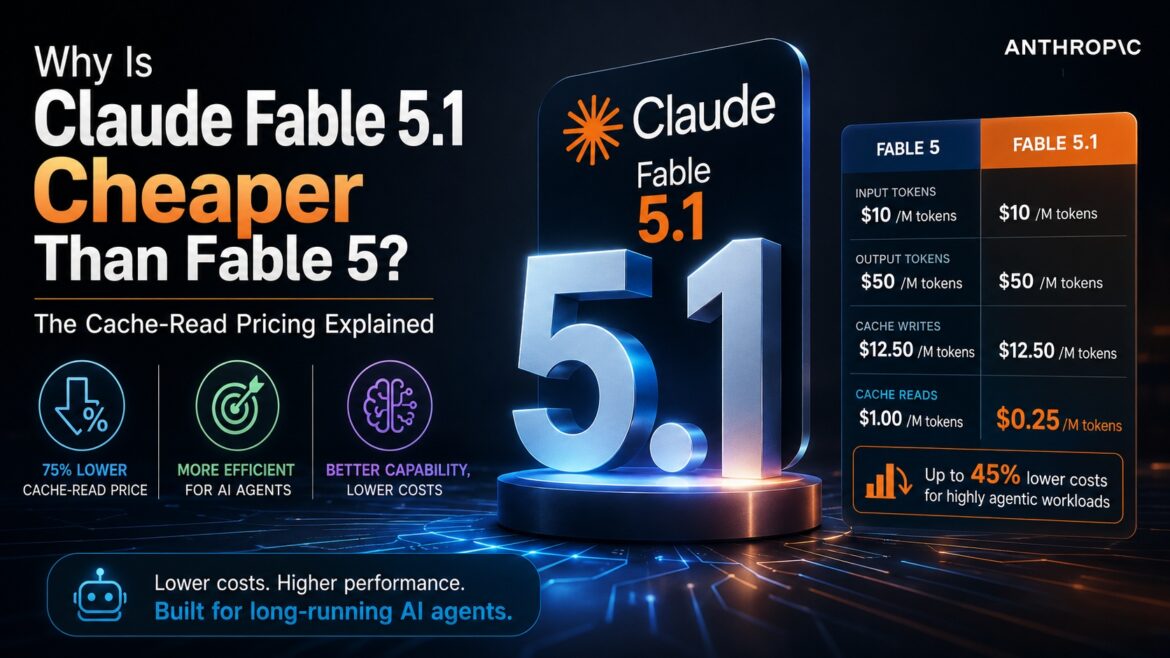
But buried a few paragraphs into Anthropic’s own release notes is a smaller line that tells a bigger story: Fable 5.1 will cost roughly 25% less than Fable 5 for typical workloads, driven by a cut to cache-read pricing — the cost of reusing context the model has already processed. Base token pricing hasn’t moved. This is a margin story, not a headline-grabbing one, and it deserves more attention than it’s getting.
So why did Anthropic target cache reads rather than simply lowering Fable 5.1’s headline price?
The answer is partly technical and partly strategic. The pricing structure appears designed to make long-running, context-heavy AI agents more economical while protecting the premium positioning of Anthropic’s most capable model.
That makes Fable 5.1’s pricing change more interesting than a simple discount. It offers a glimpse into where the economics of frontier AI may be heading: away from competing purely on the price of individual tokens and toward optimizing the cost of sustained AI work.
Key Takeaways
- Claude Fable 5.1 is not cheaper across every token category. Anthropic kept standard input pricing at $10 per million tokens and output pricing at $50 per million tokens.
- The major change is cache-read pricing. Fable 5.1 cache reads cost $0.25 per million tokens, 75% less than Fable 5.
- Anthropic estimates about 25% lower overall costs for typical workloads and savings of up to 45% for highly agentic, context-heavy workloads.
- The discount particularly benefits AI agents that repeatedly reuse large amounts of context during coding, research and other long-running tasks.
- The pricing change comes alongside a significant capability upgrade, with Fable 5.1 outperforming Fable 5 across several Anthropic-reported benchmarks.
- Competition matters. Anthropic launched Opus 5 in July at roughly half Fable 5’s price while positioning it as a more efficient model for everyday work.
- The bigger strategic question is whether Anthropic can make frontier-level, long-running AI agents economically viable without cutting headline input and output prices.
What Actually Changed in Claude Fable 5.1 Pricing?
The biggest pricing change in Claude Fable 5.1 is not a reduction in its standard input or output token rates. Anthropic kept those prices unchanged and instead cut the cost of cache reads.
| Pricing | Fable 5 | Fable 5.1 | Change |
|---|---|---|---|
| Input tokens | $10 / million | $10 / million | No change |
| Output tokens | $50 / million | $50 / million | No change |
| Cache writes | $12.50 / million | $12.50 / million | No change |
| Cache reads | $1 / million | $0.25 / million | 75% cheaper |
Prices shown are Anthropic API rates per million tokens.
Anthropic estimates that this change translates into roughly 25% lower total costs for typical workloads, with savings of up to 45% for highly agentic and complex coding workloads. The actual reduction depends on how much of a workload consists of cached context.
What are cache reads?
Cache reads occur when an application reuses information that the model has already processed instead of sending and processing the same context from scratch.
Consider an AI coding agent working on a large software project. During a long session, it may repeatedly need access to the same:
- codebase files
- project instructions
- documentation
- conversation history
- tool outputs
- configuration files
Rather than paying the full input-token price every time that information is reused, the application can use prompt caching. The cached context is then charged at the much lower cache-read rate.
That’s why the change matters disproportionately for long-running AI agents. A short prompt such as “Explain this function” may barely benefit. An autonomous coding agent that spends hours working through a large repository can repeatedly reuse thousands or millions of tokens of context.
In other words, Fable 5.1 isn’t simply a 25% cheaper model. It is a model whose pricing is substantially more favorable for workloads that repeatedly reuse context.
Why Anthropic targeted cache reads
Anthropic says the pricing change responds to customer feedback about price, alongside requests related to data retention and safeguards. The company does not explicitly say that improved margins or lower serving costs were the reason for the reduction.
However, the structure of the change is strategically interesting.
Instead of reducing the headline $10/$50 input-output rates, Anthropic targeted one of the costs that matters most to sophisticated users running agentic, context-heavy workloads. That makes Fable 5.1 more economical precisely where customers can generate very large token bills.
This is why the pricing change may be more significant than the headline “25% cheaper” figure suggests. The biggest beneficiaries aren’t necessarily casual users. They are developers and enterprises running AI systems that keep working, keep calling tools and keep reusing the same context over extended sessions.
Why the Opus 5 Competition Matters
Claude Fable 5.1’s pricing change also makes more sense in the context of Anthropic’s own model lineup.
Anthropic introduced Claude Opus 5 in July as a more efficient model designed for demanding everyday work. Its API pricing was substantially lower than Fable 5’s, while Anthropic positioned it as capable of handling many advanced coding and knowledge-work tasks.
That created an interesting pricing problem for Anthropic: if a less expensive model can handle a large share of the workloads that previously required the company’s flagship model, customers have a stronger reason to question the premium for Fable 5.
Fable 5.1 addresses that problem without simply cutting its headline price.
Instead, Anthropic made the model considerably cheaper for one of the workloads where its flagship capabilities are most valuable: long-running, context-heavy AI agents. The 75% reduction in cache-read pricing can make sustained coding and research workflows substantially more economical while preserving the $10-per-million input and $50-per-million output rates.
That distinction matters strategically.
Anthropic isn’t necessarily saying, “Fable 5.1 is now a cheaper model.” It is making a more targeted proposition:
Fable 5.1 can deliver frontier-level capability while becoming more economical when an application repeatedly reuses large amounts of context.
This is particularly relevant as AI development moves from simple chatbot interactions toward agents that can work for extended periods, call tools repeatedly and maintain large working contexts.
A price war—or a shift in AI economics?
It would be too strong to say Anthropic explicitly cut cache-read prices because of Opus 5. Anthropic says the pricing change responds to customer feedback on price, along with requests around data retention and safeguards.
But the timing is significant.
As frontier models become more capable and the differences between model tiers narrow for some workloads, cost per completed task becomes more important than the headline cost per token.
For an AI agent, the question isn’t simply:
“How much does one million input tokens cost?”
It is:
“How much does it cost to complete the entire job?”
Fable 5.1’s cache pricing is aimed directly at that second question.
Why the Pricing Change Matters for AI Agents
The significance of Claude Fable 5.1’s pricing change becomes clearer when you look at how modern AI agents actually use models.
A traditional chatbot may send a prompt, receive an answer and finish the interaction. An AI coding or research agent works differently. It can run through dozens or hundreds of steps, call external tools, inspect files, revise its work and repeatedly refer back to the same instructions and context.
That creates a different cost structure.
Fable 5.1 targets repeated-context workloads
When an agent repeatedly accesses the same context, prompt caching can prevent the application from paying the full input-token price for every request. Fable 5.1’s 75% cache-read price reduction therefore has a much larger impact on these workflows than it does on ordinary one-off prompts.
This could matter for applications such as:
- Autonomous coding agents
- Large codebase analysis
- Multi-step software debugging
- Long-running research agents
- Enterprise knowledge assistants
- Document-heavy workflows
- Agents that repeatedly call tools while maintaining a large context
Anthropic estimates savings of around 25% for typical workloads and up to 45% for highly agentic workloads. The actual savings will vary according to the proportion of cached versus new context in a particular application.
The important metric is cost per completed task
For developers building AI agents, token pricing alone doesn’t tell the whole story.
Suppose an agent needs several million tokens to complete a complicated coding task. If much of that context can be cached and reused, reducing the cache-read rate can lower the total cost of completing the task without reducing the model’s output quality or requiring developers to use a smaller model.
That shifts the economic calculation from:
“What does Fable 5.1 cost per million tokens?”
to:
“What does it cost Fable 5.1 to complete the entire job?”
That is an increasingly important distinction as AI systems move from answering individual questions toward performing multi-step work autonomously.
The capability gains still matter
The pricing change shouldn’t be viewed in isolation from Fable 5.1’s performance improvements.
Anthropic reports that Fable 5.1 improves on Fable 5 across several coding, computer-use and knowledge-work evaluations. The company describes the model as its most capable model yet for coding and agentic tasks.
That combination is what makes the pricing change strategically interesting: higher reported capability combined with lower effective costs for context-heavy workloads.
For developers and enterprises deciding whether to build an agent around a frontier model, the question is increasingly less about which model has the highest benchmark score and more about which model can complete real-world tasks at a sustainable cost.
The bottom line
Fable 5.1’s protein-binder results and coding benchmarks make for a better press release. But the pricing change is the part that tells you what Anthropic actually believes about its market position — under pressure from its own mid-tier model, and racing to make its most expensive product defensible again. Watch the pricing pages, not just the leaderboards.
Frequently Asked Questions About Claude Fable 5.1 Pricing
Is Claude Fable 5.1 cheaper than Fable 5?
Yes, but not across all token types. Anthropic kept standard input pricing at $10 per million tokens and output pricing at $50 per million tokens. The major reduction is in cache reads, which dropped from $1 to $0.25 per million tokens, a 75% reduction.
How much can Claude Fable 5.1 save?
Anthropic estimates that Fable 5.1 can reduce total costs by approximately 25% for typical workloads and by up to 45% for highly agentic and complex coding workloads. Actual savings depend on how heavily an application uses cached context.
What are cache reads in Claude Fable 5.1?
A cache read occurs when an application reuses context that has already been processed by the model. Instead of paying the full input-token rate again, the cached information is charged at a lower cache-read rate.
Who benefits most from Fable 5.1’s lower cache-read price?
The biggest beneficiaries are likely to be developers and enterprises running long-context and agentic workloads, including coding agents, large codebase analysis, multi-step research and applications that repeatedly reuse the same context.
Did Anthropic reduce Fable 5.1’s input and output token prices?
No. Anthropic kept the standard input price at $10 per million tokens and output price at $50 per million tokens. The significant pricing change is the 75% reduction in cache-read costs.
Is Claude Fable 5.1 better than Fable 5?
Anthropic reports improvements across several coding, computer-use and knowledge-work evaluations. Fable 5.1 is positioned as the company’s most capable model yet for coding and agentic tasks. Performance in a particular application can still vary depending on the workload.
Is Fable 5.1 worth using for AI coding agents?
For applications that repeatedly reuse large amounts of context, the lower cache-read price can make Fable 5.1 considerably more economical. Developers should compare the total cost of completing a task, rather than relying only on headline token prices.
Conclusion
Claude Fable 5.1’s pricing change is more nuanced than the phrase “25% cheaper” suggests.
Anthropic hasn’t cut the model’s headline input or output rates. Instead, it has made cache reads 75% cheaper, targeting one of the costs that becomes increasingly important when AI agents repeatedly work with large amounts of context.
That makes the change particularly relevant to coding agents, research systems and enterprise applications that perform multi-step work over long sessions. Anthropic estimates roughly 25% savings for typical workloads and up to 45% for highly agentic ones, although individual applications will see different results.
The competitive significance may be even more interesting. As frontier models become capable of completing increasingly complex tasks, the key question for developers is shifting from “Which model has the best benchmark score?” to “Which model can complete this job reliably at an economically sustainable cost?”
Fable 5.1 appears designed to compete on that second question.
The real story, then, isn’t simply that Anthropic made its flagship model cheaper. It’s that frontier AI pricing is increasingly being optimized around the economics of agents and completed tasks rather than individual prompts. For developers building the next generation of AI-powered software, that could prove more important than another benchmark record.
Enjoy Worthview?
Add Worthview as a Preferred Source on Google to see more of our stories in Search.

Sethuram Kishore is the founder and editor of Worthview, an online publication established in 2008. With over 18 years of experience in SEO, digital marketing, and online publishing, he writes about AI, technology, business, and digital trends. He is also the founder of MoneyHulk, a personal finance and business publication.







One thought on “Why Is Claude Fable 5.1 Cheaper Than Fable 5? The Cache-Read Pricing Explained”
Comments are closed.