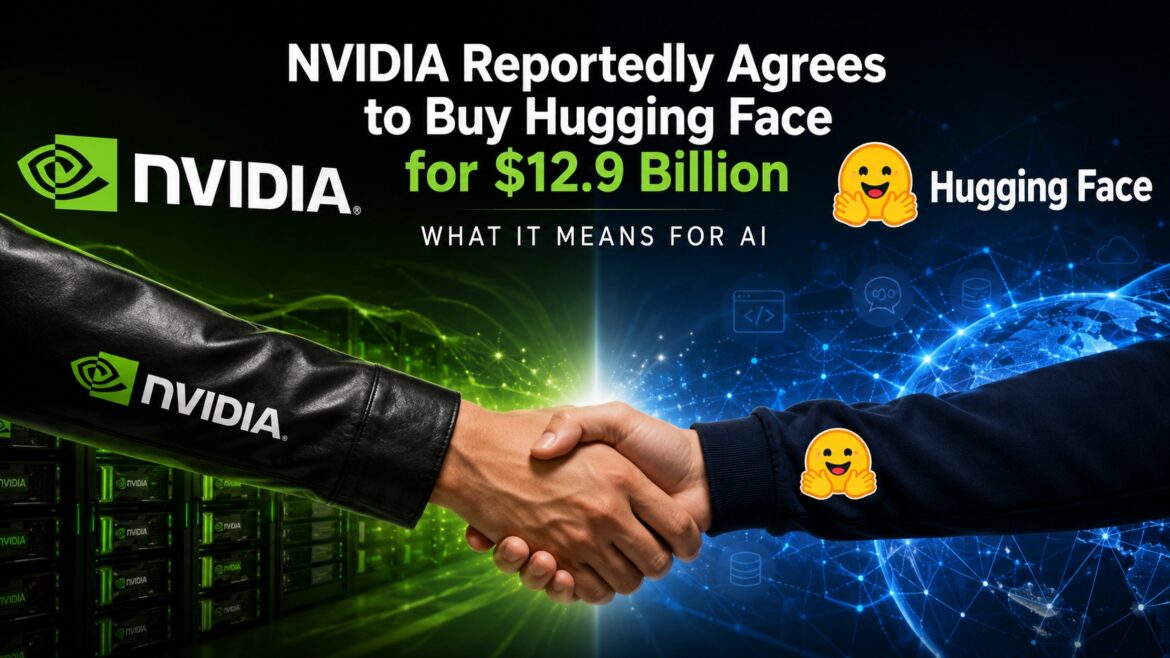
NVIDIA is reportedly set to acquire Hugging Face for $12.9 billion, in what could become one of the chipmaker’s biggest acquisitions and one of the most significant deals in the open-source AI ecosystem.
According to Reuters, citing The Information, NVIDIA has agreed to acquire Hugging Face, the platform widely used by AI developers to discover, share and build models and datasets. Hugging Face was valued at about $4.5 billion in 2023, making the reported deal price a dramatic increase in just a few years.
The deal would give NVIDIA something it cannot get from GPUs alone: a much deeper position in the software, models and developer ecosystem powering open-source artificial intelligence.
For Hugging Face, the reported acquisition would mark a major shift for a company that has positioned itself as an open platform serving developers and AI companies across the industry. It also raises an important question: can Hugging Face remain a neutral home for open-source AI if it becomes part of NVIDIA?
The answer could have implications far beyond the two companies. NVIDIA is already one of the most influential companies in AI infrastructure, while Hugging Face has become a key meeting point for the developers building the next generation of AI models.
If the deal goes through, NVIDIA would be moving further up the AI stack — from supplying the computing infrastructure to gaining greater influence over the models and developers using it.
What Happened: NVIDIA and Hugging Face Deal
NVIDIA has reportedly agreed to acquire Hugging Face for $12.9 billion, according to The Information, in a deal that would rank among NVIDIA’s largest acquisitions. Reuters reported the agreement while noting that the information originated from The Information’s reporting.
The reported price represents a significant jump from Hugging Face’s most recent major valuation. The company was valued at approximately $4.5 billion after a 2023 funding round, which was co-led by investors including NVIDIA. Hugging Face has since grown into a major platform for AI models, datasets and development tools, with annualized revenue reported at around $150 million.
The relationship between the two companies also predates the reported acquisition. NVIDIA has invested in Hugging Face and has worked with the company across its open-source AI ecosystem. Reuters reported that Hugging Face had also rejected a $500 million investment offer from NVIDIA in early 2025, underscoring how much the relationship has evolved.
If completed, the acquisition would represent a major expansion of NVIDIA’s role in AI. The company has historically dominated the computing infrastructure behind modern AI, while Hugging Face occupies a different part of the stack: the community and software layer where developers discover, share and build AI models.
That combination is what makes the reported deal particularly significant. NVIDIA would not simply be acquiring another AI company; it would be gaining a much stronger position in the open-source AI ecosystem and its developer community.
At the same time, the deal’s reported status should be treated carefully. While Reuters reports that NVIDIA has agreed to acquire Hugging Face, other reporting has described the transaction as being in talks. Until NVIDIA or Hugging Face formally confirms the transaction and its terms, the $12.9 billion figure and completion of the acquisition remain based on reported information.
What Is Hugging Face and Why Is It Important?
To understand why NVIDIA would reportedly spend $12.9 billion on Hugging Face, it helps to understand what the company has actually built.
Hugging Face is a collaborative platform for the AI and machine learning community, where developers and researchers can discover, share and build with models, datasets and AI applications. Its platform has become one of the central hubs for open-source and open-weight AI development.
The scale of that ecosystem is significant. Hugging Face says that by the end of 2025, its platform had reached 13 million users, more than 2 million public models and over 500,000 public datasets.
That makes Hugging Face much more than a repository for AI models. It has become infrastructure for the developers building with them.
Its Model Hub allows developers to find and download models for different tasks, while its datasets infrastructure provides the data needed to train and evaluate AI systems. Hugging Face also provides tools and libraries that help developers train, fine-tune and deploy models without having to build every component from scratch.
This ecosystem has helped make open AI development more accessible. Instead of every developer or company having to create an AI model entirely from the ground up, they can start with existing models, adapt them and contribute improvements back to the community.
That community effect is arguably Hugging Face’s most valuable asset.
The platform brings together developers, researchers, startups, enterprises and AI model creators in one ecosystem. As more people contribute models and datasets, the platform becomes more useful, which attracts more users and creates a powerful network effect.
For NVIDIA, that developer network could be particularly valuable.
NVIDIA already supplies much of the computing infrastructure used to train and run modern AI systems. Hugging Face sits closer to the developers and models actually being built on top of that infrastructure.
That creates a potentially powerful combination: NVIDIA provides the compute, while Hugging Face provides access to a huge community building the AI applications that consume it.
And that is where the reported acquisition starts to look less like a conventional startup purchase and more like a strategic move to expand NVIDIA’s influence across the AI stack.
Why NVIDIA Wants Hugging Face
The reported $12.9 billion price tag makes more sense when viewed as part of NVIDIA’s broader strategy. The company is no longer simply trying to sell the hardware used to train and run AI models. It is increasingly building a presence across the software and infrastructure layers surrounding those chips.
Hugging Face gives NVIDIA access to a particularly valuable part of that ecosystem: the developers and organizations actually building with AI models.
A large share of the models available through Hugging Face ultimately need computing infrastructure to run. Developers downloading open models still need GPUs or other accelerators to train, fine-tune and deploy them. Many of those workloads already run on NVIDIA hardware, while Hugging Face itself uses NVIDIA GPUs for some of its paid hosting services.
That creates a natural strategic connection.
From GPUs to the AI development stack
NVIDIA has spent years strengthening its software ecosystem around CUDA, libraries and developer tools. Acquiring Hugging Face could extend that reach further into the model-discovery and development workflow.
Instead of influencing AI development primarily through the hardware underneath it, NVIDIA would potentially have a direct relationship with one of the largest communities of people choosing, adapting and deploying AI models.
That could help NVIDIA understand where AI development is heading and make it easier to optimize its hardware and software around the models developers actually use.
The acquisition could also strengthen NVIDIA’s position in open-source and open-weight AI, an area that is becoming increasingly important as companies look for alternatives to relying entirely on proprietary models from providers such as OpenAI and Anthropic. Analysts have described Hugging Face as complementary to NVIDIA’s push around open models and its own AI software ecosystem.
Hugging Face also extends NVIDIA beyond chips
This is perhaps the most important part of the deal.
NVIDIA’s core business is selling accelerated computing infrastructure. But the AI industry is increasingly becoming a full-stack market involving chips, cloud infrastructure, software, models, agents and developer platforms.
Hugging Face operates much closer to the model and developer layers.
If the acquisition is completed, NVIDIA could therefore have influence at multiple stages:
Compute → Software → Models → Developers → Deployment
That would make Hugging Face strategically valuable even if the platform itself does not generate anything close to $12.9 billion in annual revenue.
The real asset may be the ecosystem and network effect surrounding the platform.
A hedge against a changing AI market
There is another reason the timing matters.
The biggest AI companies are increasingly trying to reduce their dependence on NVIDIA. Hyperscalers and AI companies are developing their own chips, while the industry continues to debate how much of future AI development will rely on proprietary models versus open models.
Owning a major open-model ecosystem could give NVIDIA another strategic foothold as that market evolves.
In other words, NVIDIA may be betting that the future of AI will not be determined by GPUs alone.
And if that is the strategy, Hugging Face is one of the few companies that gives NVIDIA immediate access to a massive developer ecosystem rather than requiring it to build one from scratch.
The bigger question, however, is whether putting an independent open-source platform under NVIDIA’s ownership could change the very ecosystem that made Hugging Face valuable in the first place. That is where the deal becomes much more complicated.
Key Takeaways
- NVIDIA has reportedly agreed to acquire Hugging Face for $12.9 billion, according to reports citing The Information.
- The reported deal would value Hugging Face at nearly three times its 2023 valuation of $4.5 billion.
- Hugging Face gives NVIDIA access to a massive open-source AI developer and model ecosystem, including millions of models and datasets.
- The acquisition could help NVIDIA expand beyond GPUs and strengthen its position across the AI compute, software, model and developer stack.
- The deal also raises questions about Hugging Face’s neutrality and how NVIDIA ownership could affect the broader open-source AI community.
- If completed, the acquisition would signal that control over AI developers and model ecosystems is becoming almost as strategically important as control over AI computing infrastructure.
Conclusion
NVIDIA’s reported $12.9 billion acquisition of Hugging Face is about more than adding another AI company to its portfolio. It represents a potential expansion of NVIDIA’s influence from the computing infrastructure behind AI to the developers, models and open-source ecosystem building AI itself.
For Hugging Face, NVIDIA’s resources could accelerate the platform’s growth and help it reach an even larger audience. But the acquisition could also test the platform’s commitment to remaining an open and neutral home for AI developers.
The biggest question is therefore not simply whether NVIDIA can justify spending $12.9 billion on Hugging Face. It is whether the deal can strengthen NVIDIA’s position in AI without weakening the openness that made Hugging Face so valuable in the first place.
If the acquisition is completed, it could become a defining moment in the evolution of the AI stack — and another sign that the battle for the future of AI is moving beyond chips and models toward control of the ecosystems connecting them.
Enjoy Worthview?
Add Worthview as a Preferred Source on Google to see more of our stories in Search.

Worthview Editorial Team is the shared byline for content created collaboratively by Worthview’s editors and contributors. Since 2008, we’ve published thousands of articles across technology, AI, finance, health, home, travel, and lifestyle. Our editorial process emphasizes original research, reputable sources, regular content updates, and clear attribution. Articles covering higher-trust topics, including health and finance, may also undergo review by qualified subject-matter experts.