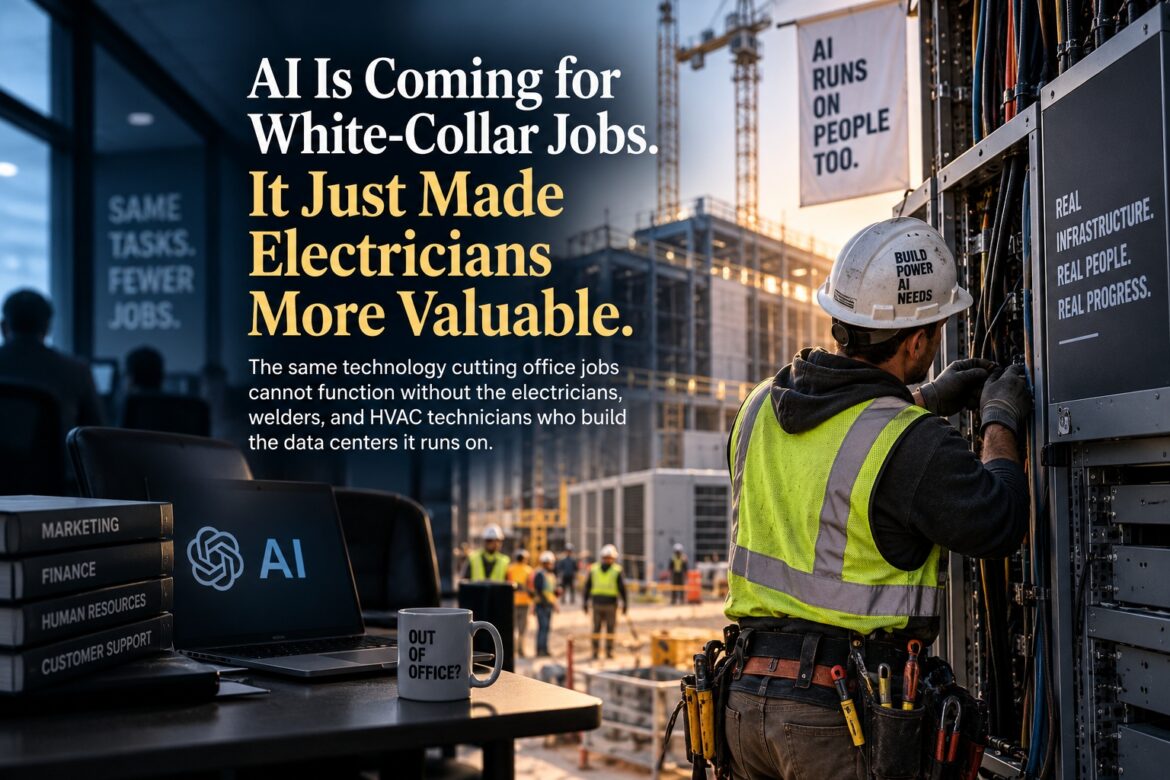
The AI boom that’s automating knowledge work is simultaneously creating a new demand for the people who build the physical infrastructure behind it.
Every AI model, chatbot and agent may exist as software, but none of them runs without warehouses full of servers, massive electrical systems and increasingly sophisticated cooling infrastructure. And those systems still need humans to build, wire, install and maintain them.
That is creating a surprising labor-market paradox: the same technology threatening some office jobs is making electricians, HVAC technicians, welders, plumbers and other skilled tradespeople increasingly valuable.
The question isn’t whether AI will create jobs. It’s whether we have enough people to build the physical world AI requires.
AI Doesn’t Live in the Cloud. It Lives in Buildings.
We call it “the cloud” because it sounds almost weightless.
AI is anything but.
The AI services we use every day ultimately depend on physical infrastructure: buildings packed with servers, massive electrical systems, cooling equipment, backup power and high-speed networking.
And that infrastructure is expanding at extraordinary speed.
U.S. data-center construction spending reached an annualized rate of more than $75 billion in July 2026, nearly 60% higher than a year earlier. The spending surge reflects the enormous physical buildout required to support AI and other growing digital workloads.
But building a data center isn’t like deploying another software service.
Someone has to pour the concrete.
Someone has to install the electrical systems.
Someone has to connect the power.
Someone has to build the cooling infrastructure.
Someone has to install miles of cable and piping.
And someone has to test and maintain all of it.
That means the AI economy has a workforce hiding underneath the technology headlines.
Electricians. HVAC technicians. Plumbers. Pipefitters. Welders. Construction workers. Power-line workers. Data-center technicians.
These aren’t peripheral jobs to the AI boom.
They are part of the infrastructure that makes the AI boom possible.
And the scale of that infrastructure is beginning to expose a problem Silicon Valley can’t solve simply by buying more chips:
There aren’t enough skilled workers to build everything fast enough.
That is where the AI industry’s labor problem begins.
The Jobs AI Can’t Automate – Yet
Every large language model, every AI chatbot, every “agentic” tool runs on a physical data center somewhere — a warehouse-sized building full of servers, cooling systems, and electrical infrastructure. Someone has to build that building. And unlike a copywriting job or a customer-support role, that work cannot be prompted away.
Electrical work is one of the biggest components of data-center construction.
Electrical work alone accounts for roughly 45–70% of total data center construction costs, according to the International Brotherhood of Electrical Workers (IBEW). A single hyperscale facility can be 40–50% larger than an average Walmart Supercenter and require hundreds or even thousands of workers during peak construction. That workforce includes electricians, HVAC technicians, plumbers, pipefitters, welders and other skilled tradespeople. That is the physical floor underneath the AI economy — and right now, it is short-staffed.
This is the physical floor underneath the AI economy. And increasingly, it’s where the labor shortage is showing up.
The Math Behind the Shortage
The numbers are stark. The U.S. currently employs around 818,700 electricians. The Bureau of Labor Statistics projects roughly 81,000 new openings a year through 2034 as demand grows and existing workers retire.
Layered on top of that baseline demand is AI-specific growth:
- More than 300,000 additional electricians are needed this decade just to meet AI-driven data center construction, per industry projections reported by Fortune.
- Roughly 200,000 more electricians are expected to retire over the same period — nearly 30% of union electricians are currently between 50 and 70 years old.
- McKinsey puts the AI-infrastructure-specific need even higher: 130,000 additional electricians, 240,000 construction laborers, and 150,000 supervisors by 2030.
- The Information Technology and Innovation Foundation estimated the data center construction shortage at roughly 439,000 workers as of late 2025, with over 400 data centers under active development.
- Some industry estimates put the broader construction shortfall as high as 499,000 workers, with 41% of the existing workforce expected to retire by 2031.
A 2026 Randstad analysis of 50 million job postings found electrician and construction-worker listings up 27% since 2022 — alongside a 107% jump in demand for robotics technicians and a 67% jump for HVAC engineers. The firm’s CEO summarized it simply: the constraint on AI growth isn’t chips or capital anymore, it’s the scarcity of people who can physically build the infrastructure.
What Electricians Are Actually Earning
The national median electrician salary is about $63,190 a year, according to the U.S. Bureau of Labor Statistics. But that national figure doesn’t tell the whole story when an electrician walks onto a major data-center construction project.
Data-center construction can offer substantially higher compensation, particularly for experienced electricians working on specialized electrical systems, commissioning and high-demand projects. Overtime, travel premiums and other incentives can push total compensation well into six figures.
The most-cited example comes from “Dirty Jobs” host Mike Rowe, who described meeting a group of electricians under 30 working a Texas data center, earning between $240,000 and $280,000 a year with as much overtime as they wanted — and no student debt. Some reports have pushed the ceiling even higher, citing figures above $300,000 for workers stacking heavy overtime on top of premium base pay.
That doesn’t mean $250,000 is the going rate for data-center electricians.
It means exceptional workers in an exceptionally tight labor market can command exceptional pay.
That’s an important distinction.
The national BLS median and the reported $240,000–$280,000 cases describe two very different ends of the labor market. Location, experience, specialization, union status, overtime and the intensity of a particular project can all dramatically affect what an electrician takes home.
And then there’s the number that made the original AI-electrician story go viral:
$500,000 a year.
There is no solid evidence that $500,000 is a typical—or even established—salary for data-center electricians. The figure appears to have grown out of increasingly sensational versions of genuine reports about unusually high compensation.
The underlying trend, however, is real.
AI isn’t turning every electrician into a half-million-dollar earner. It’s creating pockets of extraordinary demand for people with skills that take years to acquire.
And when billion-dollar data-center projects are competing for a limited pool of those workers, the bargaining power starts shifting toward the people who can actually build them.
Why Big Tech Is Worried
This shortage isn’t a side note for the companies building AI infrastructure — several have called it their single biggest constraint.
Microsoft president Brad Smith has publicly named the electrical labor shortage as the number one problem slowing the company’s U.S. data center expansion — ahead of chip supply and power availability. Microsoft has resorted to flying electricians in from more than 75 miles away, and in some cases relocating them temporarily, just to keep projects on schedule. Oracle reportedly pushed a data center completion timeline back a full year, citing labor shortages as a contributing factor.
Even Microsoft CEO Satya Nadella has pointed to a related but distinct bottleneck — power, not compute — as the industry’s biggest current constraint, underlining how the AI buildout keeps running into physical-world limits one after another: first chips, then power, now the people needed to wire it all together.
In response, tech companies are pouring money into training pipelines: Amazon has pledged $700 million to train and certify 15,000 workers; Microsoft is partnering with community colleges to certify roughly 8,500 technicians a year; Google has committed tens of millions across apprenticeship programs; BlackRock has earmarked $100 million to train plumbers, electricians, and HVAC technicians; and OpenAI has put $1.5 million into a pre-apprenticeship program spanning 34 states.
The Numbers at a Glance
| Metric | Figure | Source |
| New US electricians needed this decade | 300,000+ | Fortune / industry est. |
| Electricians expected to retire, same period | ~200,000 | Industry est. |
| Data center construction worker shortage | 439,000–499,000 | ITIF / iRecruit |
| National median electrician salary | $62,350/yr | U.S. BLS |
| Top data center electrician pay (with OT) | $240,000–$280,000/yr | Reported field cases |
| India data center engineering jobs by 2030 | ~1 lakh (100,000) | NLB Services |
| India data center investment commitments | $126 billion+ | Industry reporting |
The India Angle
India’s version of this story is arriving on a similar timeline, with a somewhat different shape.
India’s data center capacity is projected to grow from roughly 1.5 GW today to nearly 6.5 GW by 2030, with the market expected to exceed $22 billion and cumulative investment commitments already crossing $126 billion. A recent NLB Services report estimates the sector could create close to one lakh (100,000) engineering jobs by 2030.
But India’s talent gap looks less like the classic American “not enough electricians” story and more like a shortage of specialised technical roles: AI infrastructure operations engineers, liquid cooling engineers, energy optimisation specialists, critical facilities engineers, and power systems experts. With AI workloads expected to make up nearly 30% of India’s total data center capacity, that kind of infrastructure-literate engineering talent is becoming just as scarce as journeyman electricians are in the U.S.
Industry voices are already flagging the same warning American executives are making: without closer collaboration between educational institutions, industry, and policymakers, the skills gap could become the actual constraint on India’s data center ambitions — not capital, and not policy.
The Irony at the Center of the AI Boom
Put the two halves of this story side by side, and the irony writes itself. The same technology cutting analyst jobs, coding jobs, and customer-support jobs cannot exist without thousands of electricians, HVAC technicians, and commissioning specialists physically building and wiring the facilities that run it.
For a generation worried about AI replacing knowledge work, the more interesting story might be the one nobody’s watching closely enough: the jobs AI is quietly making more valuable, better paid, and — for now — impossible to automate.
Enjoy Worthview?
Add Worthview as a Preferred Source on Google to see more of our stories in Search.

Sethuram Kishore is the founder and editor of Worthview, an online publication established in 2008. With over 18 years of experience in SEO, digital marketing, and online publishing, he writes about AI, technology, business, and digital trends. He is also the founder of MoneyHulk, a personal finance and business publication.







One thought on “AI Is Coming for White-Collar Jobs. It Just Made Electricians More Valuable”
Comments are closed.