OpenAI has a new flagship AI model, and at first glance, GPT-6 Astra might look like another predictable step up from GPT-5.6. It has a larger list of capabilities, stronger reasoning, better coding performance and a much bigger emphasis on AI agents. But there is a more important question for anyone already using GPT-5.6: is GPT-6 actually better enough to justify switching?
The answer isn’t as simple as “GPT-6 is smarter.”
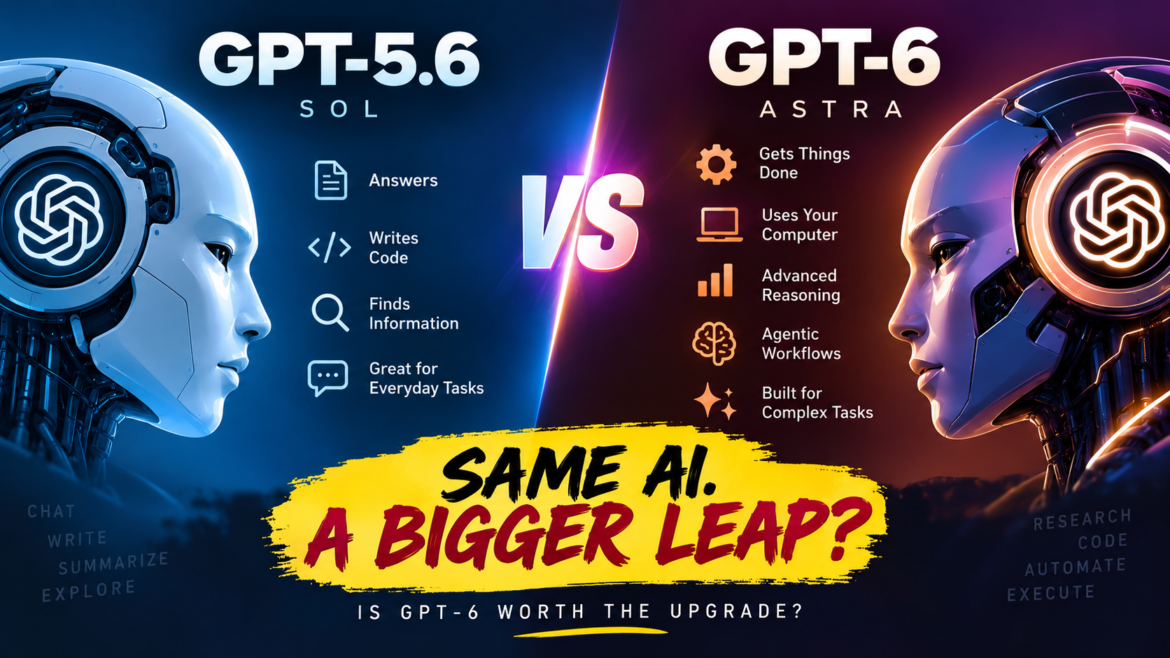
OpenAI is positioning GPT-6 Astra as a model built for complex, end-to-end work. It can reason through difficult problems, write and debug code, use computers, search the web, work with files and carry out multi-step tasks. In other words, the focus is shifting from an AI that primarily answers to one that can increasingly execute.
That makes the comparison with GPT-5.6 particularly interesting.
GPT-5.6 already offered a 1.05-million-token context window, computer use, web and file search, and strong reasoning capabilities. GPT-6 keeps the same context-window and maximum-output limits, while raising the API price from $4 to $10 per million input tokens and from $20 to $50 per million output tokens.
So this isn’t simply a story about bigger numbers.
The real question is whether GPT-6’s additional capability translates into less work for humans.
And early independent testing suggests the answer depends heavily on what you actually use AI for. GPT-6 Astra shows significant gains in coding-agent performance and can achieve similar intelligence with fewer tokens than GPT-5.6 Sol, but its higher price changes the economics of that improvement.
So, GPT-6 or GPT-5.6?
Let’s compare them where it actually matters: reasoning, coding, computer use, research, cost and real-world task completion—and find out who should upgrade and who probably doesn’t need to.
GPT-6 vs GPT-5.6: The Difference at a Glance
Before getting into benchmarks and real-world performance, it helps to understand what actually changed. GPT-5.6 Sol was already designed for demanding coding, knowledge-work, cybersecurity and science tasks, so GPT-6 Astra isn’t arriving to fix a weak predecessor. It’s trying to push an already capable model further into agentic, end-to-end work.
| Feature | GPT-5.6 Sol | GPT-6 Astra |
|---|---|---|
| Primary focus | Reasoning, coding & professional work | End-to-end agentic work |
| Context window | 1.05M tokens | 1.05M tokens |
| Computer use | Capable | Significantly stronger |
| Coding | Frontier-level | Stronger agentic coding |
| Research | Strong | More autonomous multi-step work |
| Cybersecurity | Advanced | Critical capability threshold |
| Maximum output | 128K tokens | 128K tokens |
| API input price | $5 / 1M tokens | $10 / 1M tokens |
| API output price | $30 / 1M tokens | $50 / 1M tokens |
The most revealing row is actually context window: it hasn’t increased. GPT-6 doesn’t need a larger memory window to differentiate itself. The emphasis is on using the available context and tools more effectively to complete complicated tasks.
The biggest change: GPT-6 is built to finish the job
Think of GPT-5.6 as an extremely capable expert you can collaborate with.
GPT-6 Astra is being positioned more like an agent you can delegate a project to.
For example, instead of asking an AI to:
“Write the code for this website.”
the workflow increasingly becomes:
“Build this website, test it, find what’s broken, fix it and deliver the finished version.”
That’s why computer use is such an important part of the GPT-6 story. Astra is designed to navigate browsers, spreadsheets, websites and desktop applications in ways that resemble how a person interacts with a computer.
And the early numbers are interesting. On OSWorld 2.0, Astra reportedly reaches 72.6%, compared with 65.7% for GPT-5.6 Sol, while also completing the benchmark tasks faster.
That difference matters because an AI that succeeds more often and requires less time to finish a task is much more useful than one that merely scores higher on a traditional knowledge test.
But there’s a catch: GPT-6 costs more.
And that’s where this comparison gets really interesting.
The next question isn’t simply “Is GPT-6 better?”
It’s:
“Is GPT-6 better enough to justify paying more for it?”
That takes us into the most important part of the comparison: reasoning performance.
Reasoning: Is GPT-6 Actually Smarter?
This is where the GPT-6 vs GPT-5.6 comparison gets interesting.
If you look only at the headline claims, GPT-6 Astra appears to be a major reasoning upgrade. OpenAI positions Astra as its most capable model for complex reasoning, research, coding and professional work. Its system card also shows Astra following complex instructions more reliably than GPT-5.6 Sol in controlled reasoning tests.
But there is an important catch: GPT-6 isn’t simply a universally smarter GPT-5.6.
Independent testing from Artificial Analysis paints a more nuanced picture. Its Intelligence Index put GPT-6 Astra at roughly the same overall level as GPT-5.6 Sol, suggesting that the biggest gains aren’t necessarily visible when all forms of intelligence are compressed into one score. Astra’s advantage becomes clearer when the task requires sustained reasoning, tool use and multiple steps rather than a single difficult question.
The real upgrade is reasoning efficiency
One of Astra’s more interesting improvements is how it uses its reasoning budget.
Artificial Analysis found that Astra used substantially fewer tokens than GPT-5.6 Sol in coding-agent evaluations while achieving a slightly higher score. In other words, Astra isn’t necessarily winning by simply “thinking more.” It can often get to the result with less intermediate work.
That matters because real-world AI costs aren’t determined only by whether the final answer is correct. How much computation, time and human supervision does it take to get there?
This is also where Astra’s improved performance on hallucination testing becomes important. At maximum reasoning effort, Artificial Analysis reported a major reduction in hallucination rate compared with GPT-5.6 Sol, while accuracy also improved. That suggests the upgrade isn’t merely about solving harder problems—it can also mean being more reliable when the model isn’t certain.
So, is GPT-6 smarter?
Yes—but “smarter” isn’t the best way to describe the upgrade.
GPT-5.6 Sol was already designed for difficult reasoning, coding, research and professional work. GPT-6 Astra pushes further toward long-horizon reasoning: breaking a complicated objective into steps, deciding what information or tools it needs, executing those steps and adapting when something goes wrong.
That distinction becomes much more important in the next sections.
For a simple question, summarization task or everyday piece of writing, GPT-5.6 may already be more than capable enough. But give both models a messy, multi-step assignment—research the problem, inspect files, use software, write code, test the result and produce a polished deliverable—and Astra’s additional reasoning and agentic capabilities become much more valuable.
The upgrade isn’t really about GPT-6 knowing more. It’s about GPT-6 being able to do more with what it knows.
And nowhere is that difference more obvious than coding.
Coding: From Writing Code to Building Things
GPT-5.6 Sol was already a serious coding model. It could understand large codebases, write features, debug errors and work through complicated software-engineering tasks. OpenAI specifically positioned GPT-5.6 for coding and longer-running professional workflows.
So what does GPT-6 Astra actually change?
The answer is agentic coding.
Instead of thinking of AI as a tool that writes a function after you describe what you want, Astra is designed to handle a much larger portion of the development loop: understand an existing codebase, plan an implementation, modify multiple files, run tests, inspect failures, make corrections and continue working toward the objective.
That distinction sounds subtle, but it can dramatically change how useful the model is.
GPT-5.6 writes code. GPT-6 can work on the project.
Independent testing backs up this direction. Artificial Analysis found GPT-6 Astra delivering a higher score than GPT-5.6 Sol in its coding-agent evaluation while using substantially fewer tokens. At maximum reasoning effort, Astra’s coding-agent performance was roughly two points higher while its token usage was around one-third of GPT-5.6 Sol’s in the tested Codex environment.
That efficiency matters because software development isn’t usually one prompt followed by one perfect answer.
A typical task looks more like this:
Understand → plan → code → test → fail → debug → retest → refine.
The better a model becomes at staying on that loop without constantly needing human intervention, the closer it gets to behaving like an AI software engineer rather than an AI autocomplete tool.
OpenAI’s launch material also highlights stronger codebase understanding and real-world coding workflows. Cognition, the company behind Devin, said Astra improved testing in its harness immediately, particularly in codebase understanding and the clarity of generated reports.
But there’s an important catch
This does not mean GPT-6 makes human developers obsolete.
Even a highly capable coding agent can make incorrect architectural decisions, misunderstand requirements or introduce subtle bugs. The more autonomy a model gets, the more important testing, code review and permissions become.
The bigger change is therefore not “AI replaces programmers.”
It’s:
A programmer can delegate a much larger chunk of the development process to AI.
And that is exactly why coding is one of the areas where GPT-6 can justify its higher cost for professional users.
For someone asking ChatGPT to write a 20-line Python script, GPT-5.6 may already be enough.
For a developer asking an AI to work through a large repository, implement a feature, run tests and iterate until the software actually works, GPT-6’s advantage becomes much easier to justify.
And coding isn’t even the biggest practical change.
The more interesting upgrade is what happens when GPT-6 can leave the chat window and actually use the computer.
Computer Use: The Biggest Practical Upgrade?
If coding is where GPT-6 Astra becomes more capable, computer use is where that capability becomes visible to ordinary users.
GPT-5.6 Sol already supported computer-use workflows. But Astra is designed around a broader idea: an AI that can operate across browsers, websites, spreadsheets and professional desktop software as part of a larger task. OpenAI describes it as being particularly strong at carrying out multistep workflows across code, browsers and professional applications.
That changes the question from:
“What should I click?”
to:
“Can you complete this task for me?”
From instructions to execution
Imagine asking an AI to research several products, compare their specifications, create a spreadsheet, calculate the differences and prepare a recommendation.
A traditional chatbot might give you the research and perhaps generate the spreadsheet.
A stronger computer-use agent can potentially perform the entire workflow—navigating websites, reading information, entering data, manipulating files and producing the final result.
That is the fundamental difference Astra is targeting.
Independent evaluations also suggest the improvement is measurable. In OSWorld 2.0, a benchmark designed to test real computer-use tasks, GPT-6 Astra reportedly reached a 72.6% success rate compared with 65.7% for GPT-5.6 Sol. Astra also completed the tested tasks considerably faster.
The numbers matter, but the bigger story is what they represent: the AI is increasingly being evaluated on whether it can accomplish an objective, rather than simply produce a good-looking answer.
Why this matters more than another benchmark score
For most people, the value of AI isn’t measured by how well it answers an obscure reasoning question.
It’s measured by whether it can save an hour of repetitive work.
Book the appointment.
Update the spreadsheet.
Research the options.
Move information between applications.
Prepare the report.
Build the presentation.
Check the result.
This is where GPT-6’s agentic design could have a much larger real-world impact than its raw intelligence score suggests.
Reuters reported that Astra can handle practical tasks ranging from tax preparation and legal-document formatting to game development and apartment hunting.
But autonomy comes with a price
There is an obvious trade-off.
The more control an AI has over your computer, accounts and files, the greater the consequences when it makes a mistake.
A chatbot giving you the wrong spreadsheet formula is annoying.
An agent making the wrong purchase, modifying the wrong file or taking an unintended action can be much more serious.
That is why OpenAI’s Astra rollout puts significant emphasis on safety, monitoring and controlled access. The company has also highlighted the additional safeguards developed alongside the model’s increased capabilities.
So, computer use may be GPT-6’s most important upgrade—but also the feature that requires the most trust.
And that leads to another major question: what happens when the AI isn’t just operating your computer, but is conducting an entire research project on your behalf?
That’s where GPT-6’s research and knowledge-work capabilities come into play.
Research & Knowledge Work: Can GPT-6 Actually Work Like an Analyst?
Research is another area where the GPT-5.6 vs GPT-6 difference can be easy to underestimate.
GPT-5.6 Sol was already built for knowledge work and research. GPT-6 Astra takes that foundation and pushes it toward longer, more autonomous workflows—where the model can gather information, reason over it, use tools, work with files and turn the findings into a finished deliverable. OpenAI describes Astra as being particularly strong at multistep workflows across browsing, software and professional work.
That distinction matters because serious research rarely consists of one question.
A real research assignment might look like this:
Find the relevant sources → compare conflicting information → extract the important data → analyze it → identify patterns → verify the findings → write the report.
The more of that chain an AI can handle without repeatedly waiting for instructions, the more useful it becomes as a research assistant.
GPT-6 is designed for the entire workflow
OpenAI says Astra achieves state-of-the-art results on several agent and computer-workflow evaluations, including Agents’ Last Exam, AutomationBench and ScreenSpot Pro. These evaluations are aimed at tasks that require an AI to operate through workflows rather than simply answer isolated questions.
This is an important distinction for professional users.
If you ask GPT-5.6 and GPT-6 the same factual question, the difference may be relatively small.
But give them a messy research assignment involving dozens of documents, websites, calculations and decisions, and the gap can become much more noticeable.
OpenAI is also emphasizing document creation as a core Astra capability. The model is intended not just to find information, but to turn complex research into usable outputs such as reports and other professional documents.
The million-token question
Interestingly, GPT-6 doesn’t increase the headline context window over GPT-5.6.
Both models support a 1.05-million-token context window and up to 128,000 output tokens.
So the upgrade isn’t about simply giving Astra a bigger memory.
It’s about what the model can do with that information.
A million-token context is useful only if the model can reliably identify what matters, connect information across documents, reason about it and take the appropriate next action.
That is why Astra’s agentic capabilities may matter more than another increase in context size.
Where GPT-5.6 still makes sense
This doesn’t make GPT-5.6 obsolete.
For straightforward research—summarizing an article, explaining a concept, comparing a few options or extracting information from a document—GPT-5.6 can already be more than capable.
The value of Astra becomes clearer when the assignment starts looking like analyst work rather than chatbot work.
Who Should Upgrade to GPT-6—and Who Shouldn’t?
After comparing reasoning, coding, computer use and research, the answer is becoming clearer: GPT-6 Astra isn’t automatically worth the upgrade for everyone.
GPT-6 makes the most sense for:
- Developers working on large codebases or complex software projects.
- Researchers and analysts handling long, multi-step assignments.
- Businesses that want AI agents to work across browsers, files and professional applications.
- Power users who regularly give AI complicated tasks rather than simple questions.
- Teams building AI products where better agentic performance can translate directly into fewer failures and less human intervention.
For these users, the extra capability can potentially outweigh the higher API cost.
GPT-5.6 is still enough for:
- Everyday questions and explanations
- Writing and rewriting
- Summarization
- Basic coding and debugging
- Simple research
- Routine document work
- Users who don’t need autonomous computer interaction
In these scenarios, upgrading may produce a better experience, but not necessarily a $-for-$ improvement.
There’s also an important economic consideration. GPT-6 Astra’s API pricing is significantly higher than GPT-5.6 Sol’s. That means the upgrade only makes financial sense when Astra’s additional capability actually reduces the amount of human work, computation or retries required.
The simplest rule is this:
If you’re using AI to generate answers, GPT-5.6 may be enough.
If you’re using AI to complete complex tasks, GPT-6 is where the upgrade starts making sense.
And that brings us to the final verdict.
Verdict: Is GPT-6 Actually Worth the Upgrade?
After all the comparisons, the answer is surprisingly simple:
GPT-6 Astra is a meaningful upgrade—but only if you need what makes it different.
For everyday chatting, writing, summarizing and straightforward coding, GPT-5.6 Sol is already extremely capable. Moving to GPT-6 won’t suddenly transform those basic tasks.
The difference becomes much more significant when the task is long, complicated and action-oriented.
GPT-6 is built to reason through multiple steps, use tools, operate computers, work across files and applications, write and test code, conduct research and produce finished deliverables. That’s where its additional capability can translate into something users actually notice: less supervision and less work left for the human.
There is also a cost to that upgrade. GPT-6’s higher API pricing means businesses and developers need to consider whether the productivity gains justify the additional expense.
So the real question isn’t:
“Is GPT-6 better than GPT-5.6?”
It clearly is in several important areas.
The better question is:
“Will GPT-6 save me enough time and effort to justify using it?”
For casual users, probably not.
For developers, researchers, businesses and heavy AI users handling complex workflows, GPT-6 Astra could be one of the more meaningful upgrades in the GPT lineup.
The biggest shift isn’t that AI can answer harder questions.
It’s that AI is getting better at taking a goal and actually doing something with it.
And that may ultimately matter far more than another few percentage points on a benchmark.
Enjoy Worthview?
Add Worthview as a Preferred Source on Google to see more of our stories in Search.

Worthview Editorial Team is the shared byline for content created collaboratively by Worthview’s editors and contributors. Since 2008, we’ve published thousands of articles across technology, AI, finance, health, home, travel, and lifestyle. Our editorial process emphasizes original research, reputable sources, regular content updates, and clear attribution. Articles covering higher-trust topics, including health and finance, may also undergo review by qualified subject-matter experts.