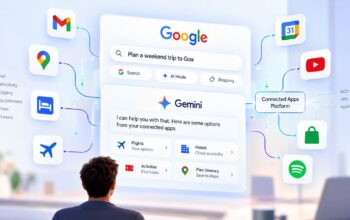
Imagine a homeowner waking up to a pest problem – a rat in the kitchen or ants marching across the counter. Their first move is rarely to open a phone book. Instead, they grab their smartphone and search for ‘pest control near me.’
For pest control businesses, winning these urgent local searches is not just an advantage; it’s essential for survival and growth in today’s digital world. Without strong online visibility, especially through local SEO pest control strategies, potential customers in your service area might never find you.
This extensive guide will show you how to dominate local search results and turn urgent searches into booked jobs, helping you to Achieve local SEO goals. To understand how we help businesses thrive, explore our comprehensive guide on further services or discover how to get started with a personalized strategy by contacting us today at our solutions page.
When it comes to attracting new customers, pest control companies often weigh the options between organic local SEO and paid advertising, such as Google Ads. While both can generate leads, their economic models and long-term impacts differ significantly. Organic local SEO is a strategy that builds a sustainable digital asset, often yielding leads at a fraction of the cost of paid ads, with higher conversion rates and greater customer lifetime value. Paid advertising, conversely, offers immediate visibility but can be expensive and stops delivering leads the moment the budget runs out.
Consider the data: organic search delivers leads for pest control companies at a significantly lower cost, often ranging from $15–40 each, compared to Google Ads, which can run $45–150 per lead in competitive markets. Beyond the initial lead cost, the quality of these leads also varies. Organic leads tend to close at a higher rate, typically 20-25%, whereas paid ad clicks convert at just 8-12%. This means that for every dollar spent, local SEO often provides a better return on investment and a more loyal customer base. A customer acquired through organic search who signs up for a prevention plan, for instance, can be worth an average of $1,500 in lifetime value. Paid ads can provide immediate visibility, which is crucial for emergency services, but they don’t build long-term authority or brand equity in the same way that a robust SEO strategy does.
The compounding nature of SEO is another key differentiator. As your website and Google Business Profile (GBP) gain authority and relevance over time, your rankings improve, leading to a continuous flow of organic leads without additional per-click costs. Paid ads, however, require constant investment to maintain visibility, and their effectiveness can diminish due to “ad fatigue” among consumers. For commercial accounts or recurring contracts, where client relationships are long-term, the higher close rates and sustained visibility from SEO make it an indispensable strategy.
Here’s a comparison to illustrate the distinct advantages:
Organic Local SEO vs. Paid Search Advertising
| Feature | Organic Local SEO | Paid Search Advertising |
|---|---|---|
| Lead Cost | Generally lower ($15–40 per lead) | Significantly higher ($45–150 per lead in competitive markets) |
| Conversion Rate | Higher (20–25% close rate) | Lower (8–12% close rate) |
| Sustainability | Builds a long-term digital asset that compounds over time | Stops generating leads when the advertising budget runs out |
| ROI | Sustainable, compounding returns; potentially higher customer lifetime value | Immediate visibility, but ROI depends on continuous spending |
| Brand Equity | Builds trust, authority and brand recognition over time | Primarily transactional, with less impact on long-term brand building |
| Control | Requires ongoing optimization; results are influenced by algorithms and competition | Direct control over ad spend, targeting and immediate visibility |
Effective local SEO for pest control hinges on understanding how search engines, particularly Google, connect users with local businesses. This involves a framework built on three pillars: proximity, relevance, and prominence. Proximity refers to how close your business is to the searcher or the location they’re searching for. Relevance is how well your business’s services match the search query. Prominence is a measure of your business’s overall authority and reputation, often influenced by factors like reviews, backlinks, and online mentions.
In 2026, user behavior also plays a significant role. With 97% of potential customers finding businesses through local search, often in moments of urgent need, appearing in the “Map Pack” (the top 3-4 local business listings shown directly on Google Maps results) is paramount. Nearly 70% of all local service searches begin on Google, and 75% of consumers contact only the top three results. This highlights the critical importance of optimizing for these core frameworks.
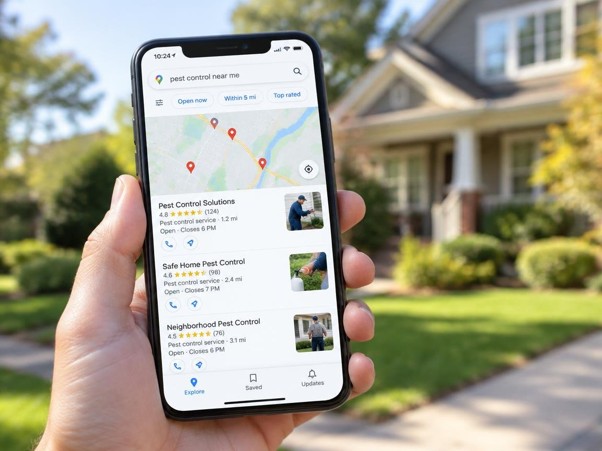
How Google Business Profile Optimization Helps Achieve Local SEO Goals
Your Google Business Profile (GBP) is arguably your most critical local SEO asset. Think of it as your digital storefront on Google. An optimized GBP provides Google with essential information about your business, directly influencing your visibility in the Map Pack and local organic search results.
Key elements for optimization include:
- Primary and Secondary Categories: Accurately select the most specific categories for your pest control services (e.g., “Pest Control Service,” “Exterminator,” “Termite Control Service”). This signals relevance to Google.
- Service Areas: Clearly define the cities, counties, and neighborhoods you serve. While adding many service areas doesn’t guarantee ranking in all of them, it helps Google understand your operational reach.
- NAP Consistency: Ensure your Name, Address, and Phone number are identical across your GBP, website, and all other online directories. Inconsistent information can confuse search engines and dilute your authority.
- Photo Uploads: Regularly upload high-quality photos of your team, vehicles, office, and successful pest control jobs. Businesses with more photos on their GBP receive significantly more clicks and direction requests.
- Profile Attributes: Fill out all relevant attributes, such as “wheelchair accessible,” “women-led business,” or specific service offerings.
- Weekly Updates/Posts: Use the GBP posts feature to share updates, offers, seasonal pest tips, and educational content. While not a primary ranking factor, it keeps your profile active and engaging.
- Business Description: Craft a compelling, keyword-rich description that accurately summarizes your services and unique selling propositions.
- Q&A Management: Actively monitor and answer questions posed by users. This demonstrates responsiveness and provides valuable information to potential customers.
Review Generation, Citations, and Local Trust Signals
Reviews and citations are powerful trust signals that significantly impact your local search rankings and conversion rates. Consumers heavily rely on them: 87% search online for a pest control company, and 93% read reviews before making a decision.
- Review Velocity and Recency: Google favors businesses with a consistent stream of new, positive reviews. Implement a strategy to regularly solicit reviews from satisfied customers. Automated SMS or email requests after service completion are highly effective.
- Review Sentiment Analysis: The content of your reviews matters. Google’s algorithms can analyze the sentiment, looking for keywords related to your services and customer satisfaction.
- Response to Reviews: Respond to all reviews, both positive and negative, promptly and professionally. This shows you value customer feedback and are engaged with your clientele.
- Citation Aggregators and Directory Listings: Citations are online mentions of your business’s NAP information. Ensure consistency across major data aggregators (like Yelp, Yellow Pages, Facebook) and industry-specific directories.
- Profile Verification and Dispute Management: Verify all your business listings to ensure accuracy and control. Actively monitor for duplicate listings or incorrect information and work to resolve them.
- Local Trust Signals: Beyond reviews and citations, local backlinks from reputable local businesses, community organizations, and news outlets further enhance your prominence and trust with search engines.
Site Architecture: Structuring Service Pages vs. Multi-City Location Pages
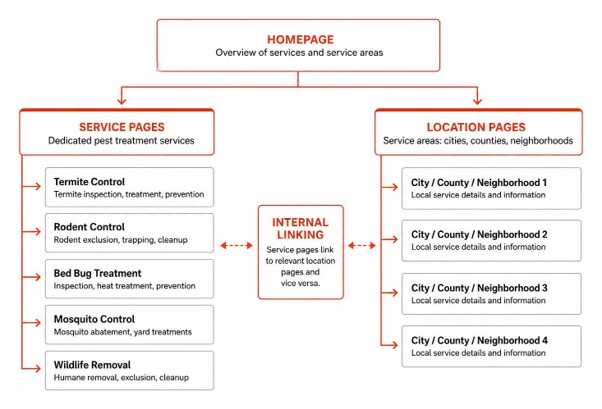
A well-planned website architecture is crucial for local SEO, especially for pest control companies that offer multiple services across various geographic areas. A common pitfall is keyword cannibalization, where multiple pages on your site compete for the same keywords, confusing search engines and diluting your ranking potential. The solution lies in a clear hierarchy that differentiates between service-specific content and location-specific content.
The goal is to create a logical structure that signals to Google exactly what services you offer and where you offer them. This involves dedicated service pages for each major pest issue and, for businesses serving multiple distinct cities or neighborhoods, dedicated location pages. Effective internal linking between these pages reinforces their relevance and authority.
Dedicated Pest Treatment Service Pages
Each core pest control service you offer should have its own dedicated page. This allows you to target specific, high-intent keywords (e.g., “termite inspection,” “rodent exclusion,” “bed bug treatment,” “mosquito abatement,” “wildlife removal”).
On these pages, we recommend including:
- Detailed Information: Comprehensive descriptions of the pest, the problems it causes, your treatment methods, and prevention tips.
- Service-Specific Keywords: Optimize titles, headings, and body content for relevant keywords.
- Emergency Response: Clearly communicate your ability to provide urgent services, as many pest control searches are time-sensitive.
- Pricing Transparency: While avoiding exact figures, discuss your approach to pricing or offer free estimates to manage customer expectations.
- Visuals: Use high-quality images or videos of the pest, your technicians in action, or successful treatment outcomes.
- FAQs: Address common questions related to that specific pest.
For instance, instead of a single “Services” page, you would have separate pages for “Termite Control Services,” “Ant Extermination,” “Rodent Control,” and “Bed Bug Treatment.” This approach allows you to capture a broader range of specific search queries and demonstrate deep expertise in each area.
Multi-Location and Service Area Page Optimization
For pest control companies serving multiple cities or distinct neighborhoods, creating dedicated location pages is essential. These pages should be unique and provide genuine value to users in that specific geographic area, rather than being “thin content” pages that simply swap out city names.
Effective location pages should include:
- Localized Content: Discuss pest issues specific to that city or neighborhood (e.g., “scorpion control in Las Vegas,” “mosquito season in Denver”).
- Local Landmarks and Features: Mention local landmarks, parks, or community aspects to establish geographic relevance.
- Localized Testimonials: Feature reviews from customers in that specific area.
- Area Maps: Embed a Google Map showing your service coverage within that city.
- Unique Selling Propositions: Highlight any services or expertise particularly relevant to that location.
- Internal Linking: Link from your location pages to relevant service pages and vice-versa, creating a robust internal link structure.
The goal is to provide a local user with all the information they need without leaving your site, building trust and signaling to Google that you are a legitimate and relevant service provider in that specific area.
Technical SEO, Core Web Vitals, and Local Schema Implementation
Technical SEO forms the bedrock of any successful local SEO strategy. Even with excellent content and a strong GBP, a technically flawed website can hinder your rankings. This involves ensuring search engines can easily crawl, index, and understand your website’s content. Key elements include SSL security, a well-structured XML sitemap, proper canonical tags to prevent duplicate content issues, and efficient crawl budget management. A robust technical foundation helps to achieve local SEO goals by ensuring your site is accessible and performs well for both users and search engine bots.
Mobile Optimization and Page Speed Requirements
In 2026, mobile-first indexing is standard, and the majority of urgent pest control searches happen on mobile devices. This makes mobile optimization and page speed critical. Google’s Core Web Vitals (CWV) are a set of performance metrics that evaluate the user experience of a website. They measure loading performance through Largest Contentful Paint (LCP), interactivity through Interaction to Next Paint (INP), and visual stability through Cumulative Layout Shift (CLS). These metrics help assess how quickly a page loads, how responsive it is to user interactions, and whether its layout remains stable during browsing. Maintaining good Core Web Vitals contributes to a better page experience and supports overall website quality.
Also update the following technical recommendations:
| Metric | Recommended threshold |
|---|---|
| LCP | 2.5 seconds or less |
| INP | 200 milliseconds or less |
| CLS | 0.1 or less |
To excel here:
- Fast Loading Times: Aim for page load times under 2.5 seconds. Optimize images (compression), minimize JavaScript and CSS, and leverage browser caching.
- Mobile-First Design: Ensure your website is responsive and provides an excellent user experience on all screen sizes.
- Click-to-Call Buttons: Implement prominent, easily tappable click-to-call buttons on mobile pages for immediate lead generation.
- Reduced Bounce Rate: A fast, user-friendly mobile experience reduces bounce rates, signaling to Google that your site is valuable.
- Optimized Touch Targets: Ensure buttons and links are large enough and spaced appropriately for easy tapping on mobile devices.
LocalBusiness Structured Data and Schema Markup
Structured data, or schema markup, is code that you add to your website to help search engines better understand your content. For local SEO, LocalBusiness schema is essential.
Implement schema for:
- LocalBusiness Schema: This markup explicitly tells Google your business’s name, address, phone number, website, hours of operation, and service areas.
- Service Schema: For each dedicated service page, use Service schema to describe the specific pest control service offered, including its type, description, and area served.
- FAQPage Schema: For pages with FAQs, this schema can help your questions and answers appear directly in search results as rich snippets, increasing visibility and click-through rates.
- GeoCoordinates and areaServed: These properties within your schema further reinforce your geographic relevance.
Properly implemented schema can enhance your visibility in search results, contribute to “answer engine optimization” (AEO) by making your content more easily extractable by AI-powered search, and help you appear in structured snippets.
Measuring Strategy and Partnering for Long-Term Success
Local SEO is not a “set it and forget it” strategy. It requires continuous monitoring, adaptation, and a clear understanding of performance metrics. Tracking your efforts allows you to identify what’s working, what needs adjustment, and how your investment is translating into tangible business growth. Integrating your SEO data with call tracking and CRM systems provides a holistic view of your customer acquisition funnel, from initial search to booked job. We also need to consider seasonal variances in pest activity, which directly impact search volumes and should inform content calendars and budget allocation.
Measuring Performance Metrics to Achieve Local SEO Goals
To effectively measure your local SEO success, focus on a blend of visibility, engagement, and conversion metrics:
- Organic Traffic: Monitor the volume of visitors coming to your website from organic search.
- Call Volume: Use call tracking software to attribute phone calls directly to your SEO efforts, especially from your GBP. The Map Pack alone can drive 40-60% of inbound calls for pest control.
- Form Submissions: Track leads generated through contact forms on your website.
- Keyword Rankings: Monitor your position for target keywords in local search results and the Map Pack.
- Cost Per Acquisition (CPA): Calculate the cost to acquire a new customer through SEO, comparing it to other marketing channels.
- Revenue Attribution: Connect SEO-generated leads to actual booked jobs and revenue to demonstrate ROI.
- Google Business Profile Insights: Regularly review GBP data for views, searches, website clicks, and direction requests.
Evaluating SEO Agencies and Avoiding Common Industry Pitfalls
Choosing the right SEO partner is crucial. Many pest control companies make common mistakes that can derail their SEO efforts, such as neglecting GBP, creating thin or duplicate content, ignoring negative reviews, or falling for “black hat” tactics.
When evaluating SEO agencies, look for:
- Industry Experience: An agency with specific experience in pest control or home services will understand the nuances of urgent searches, seasonality, and local competition.
- Transparent Reporting: Demand clear, actionable reports that show progress on key metrics, not just vanity metrics.
- Customized Strategies: Avoid agencies offering “cookie-cutter” templates. Your business is unique, and your SEO strategy should be too.
- Ethical Practices: Steer clear of agencies that promise guaranteed rankings (which Google does not allow) or suggest tactics like buying reviews or backlinks.
- Communication Cadence: A good agency will communicate regularly, explaining their actions and the rationale behind them.
- Contract Transparency: Understand the terms of your agreement, including minimum commitments and cancellation policies.
Frequently Asked Questions About Pest Control Local SEO
Why is local SEO more effective than paid ads for pest control companies?
While paid ads offer immediate visibility, local SEO builds a sustainable, compounding asset that delivers leads at a significantly lower cost ($15–40 vs. $45–150 per lead) and converts at a higher rate (20–25% vs. 8–12%). It also builds long-term brand authority and trust, which paid ads alone cannot achieve. For urgent, high-intent services like pest control, appearing organically in the top local results is often more trusted by consumers.
What are the most important technical SEO elements for a pest control website?
Key technical elements include mobile-first design, fast page load speeds (meeting Core Web Vitals), SSL security, a well-structured XML sitemap, proper canonicalization, and the implementation of local business schema markup. These ensure search engines can easily crawl, index, and understand your site, and that users have a seamless experience, especially on mobile devices.
How do you optimize a Google Business Profile for a pest control business?
Optimization involves claiming and verifying your profile, accurately selecting primary and secondary categories, clearly defining service areas, ensuring NAP consistency, uploading high-quality photos, regularly posting updates, actively managing Q&A, and consistently responding to all reviews.
What is the difference between service pages and location pages, and why do both matter?
Service pages focus on specific pest treatments (e.g., “Termite Control,” “Rodent Extermination”), targeting keywords related to those services. Location pages focus on specific geographic areas (e.g., “Pest Control in Denver,” “Bed Bug Treatment in Aurora”), targeting local-specific keywords. Both matter because they allow you to capture different types of search intent: service-specific intent and geographic-specific intent, signaling comprehensive relevance to search engines.
How long does it take to see results from local SEO for pest control?
Initial ranking improvements, especially in the Google Business Profile and for long-tail keywords, can often be seen within 30-90 days. More significant visibility changes and a consistent flow of leads typically take 4-8 months, with stable, compounding results maturing over 9-18 months of consistent effort.
What are the most common mistakes pest control companies make with their SEO?
Common mistakes include neglecting Google Business Profile optimization after initial setup, using a single generic “Services” page for all pest types, creating thin or duplicate location pages, ignoring review generation and response, failing to target specific service areas beyond their main city, and not tracking real lead conversions.
How do reviews and citations impact local search rankings for pest control?
Reviews (quantity, recency, sentiment, and response) and citations (consistent NAP across directories) are crucial prominence signals. They build trust with both search engines and potential customers. Businesses with 50+ Google reviews, for example, generate significantly more leads than those with fewer.
What is the role of content (blog posts, guides) in a pest control SEO strategy?
Content plays a vital role in demonstrating expertise, attracting backlinks, and signaling relevance. Blog posts and guides on seasonal pest issues, prevention tips, or pest identification can answer common customer questions, attract organic traffic, and establish your business as an authority in the field. This content also supports your service and location pages by providing valuable context and internal links.
How can pest control companies target multiple service areas or cities effectively?
Effectively targeting multiple areas involves creating unique, valuable location-specific pages for each target city or neighborhood. These pages should feature localized content, testimonials, and contact information. Additionally, optimizing your Google Business Profile to accurately reflect your service areas and building local citations for each location is essential.
What should a pest control business look for when choosing an SEO agency?
Look for an agency with specific experience in pest control or home services, transparent reporting, customized strategies (not generic templates), ethical practices (no guaranteed rankings), clear communication, and flexible contract terms. They should focus on measurable results like lead volume and revenue attribution, not just keyword rankings.
Conclusion
In the dynamic digital landscape of 2026, local SEO is no longer an optional marketing tactic for pest control companies; it is a fundamental requirement for survival and sustainable growth. By prioritizing a robust local SEO strategy – optimizing your Google Business Profile, cultivating reviews, structuring your website for local intent, and ensuring technical excellence – you can effectively capture the urgent, high-intent searches that drive business. This approach not only delivers a superior return on investment compared to paid advertising but also builds a lasting digital footprint that compounds over time, ensuring your business is the first one homeowners see when pests invade. Continuous optimization and a clear understanding of your performance metrics will empower your pest control business to dominate your service area and achieve long-term operational success.
Enjoy Worthview?
Add Worthview as a Preferred Source on Google to see more of our stories in Search.

Worthview Editorial Team is the shared byline for content created collaboratively by Worthview’s editors and contributors. Since 2008, we’ve published thousands of articles across technology, AI, finance, health, home, travel, and lifestyle. Our editorial process emphasizes original research, reputable sources, regular content updates, and clear attribution. Articles covering higher-trust topics, including health and finance, may also undergo review by qualified subject-matter experts.