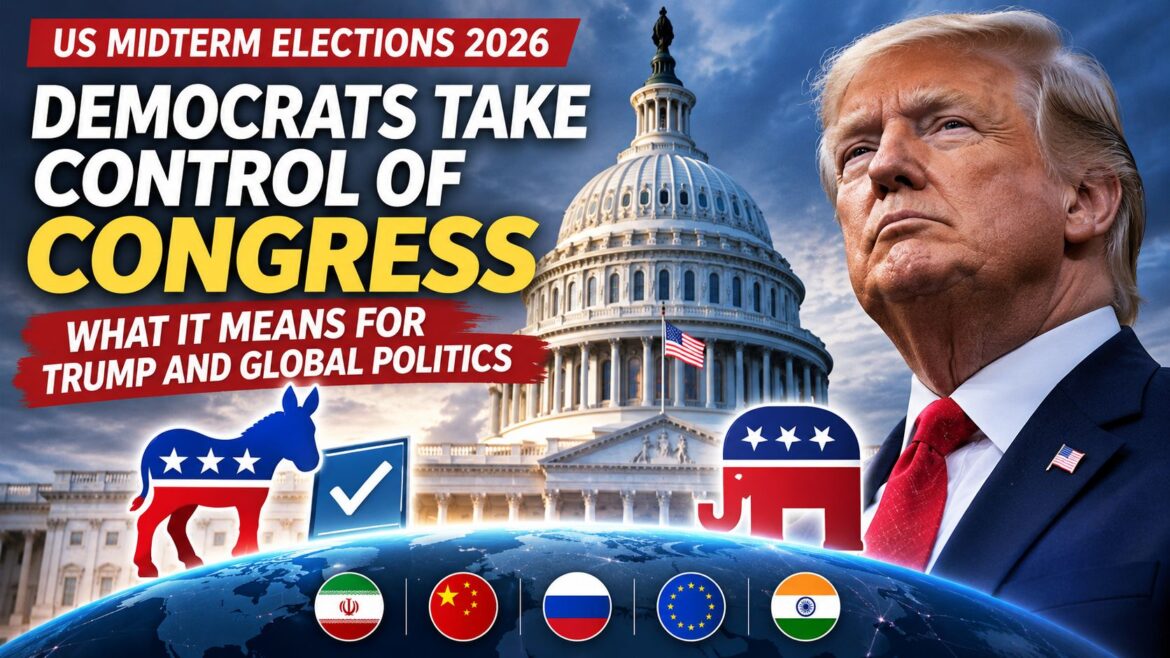
The 2026 US midterm elections have delivered a major political setback to President Donald Trump. In a significant shift in American politics, the Democratic Party has won control of both the US House of Representatives and the Senate, ending two years of Republican control of Congress.
The results represent a major test of Trump’s second presidency. With Democrats preparing to take control of both chambers in January 2027, the president will face a Congress that can challenge his legislative agenda, investigate his administration and scrutinise his foreign policy decisions.
2026 US Midterm Elections
House of Representatives
US Senate
Source: The Indian Express election results tracker.
Figures are provisional reported results, not final certified totals.
WORTHVIEW.COM · GEOPOLITICS
But what does this mean for Trump, America’s international relationships and countries such as India?
Let’s break it down.
1. What Are the US Midterm Elections?
US midterm elections take place halfway through a president’s four-year term. They determine who controls Congress, which consists of two chambers: the House of Representatives and the Senate.
Unlike presidential elections, voters do not elect a new president during midterms. Instead, they vote for congressional representatives, senators and various state-level officials.
In the 2026 elections:
- All 435 seats in the House of Representatives were contested.
- 35 Senate seats were up for election.
- Several states also held gubernatorial and local elections.
Midterms are important because control of Congress determines how easily a president can pass legislation, approve budgets and implement domestic policies.
2. What Happened in the 2026 Elections?
The Democratic Party secured majorities in both chambers, defeating Republicans in several traditionally Republican states.
Power Shift in the US Congress
Comparing the 2024 and 2026 US midterm election outcomes
2024
REPUBLICAN CONTROL2026
DEMOCRATIC CONTROLRepublican to Democratic Control
Democrats have won both chambers of Congress, changing the balance of political power in Washington. Trump remains President, but faces a Democratic-controlled Congress.
*Democratic Senate caucus includes aligned independents.
2026 snapshot: November 4, 2026, 9:20 PM IST.
Sources: Ballotpedia | The Indian Express
WORTHVIEW.COM · GEOPOLITICS
The results were particularly significant because Democrats made gains in states that had strongly supported Trump during the 2024 presidential election.
Issues including rising living costs, inflation, tariffs and the ongoing conflict with Iran featured prominently in the election debate.
The outcome has created a divided government, with a Republican president and a Democratic-controlled Congress.
The new Congress is scheduled to begin its term on January 3, 2027.
3. What Does This Mean for Donald Trump?
Trump: What Changes vs What Doesn’t?
Losing control of Congress does not mean losing the presidency. Here’s what changes in Washington.
1. Congressional Investigations
Democratic committee chairs can lead investigations, hold hearings and issue subpoenas within their oversight authority.
2. Legislative Priorities
Democrats gain control over committee agendas and can advance their own legislative proposals.
3. Budget Negotiations
Spending bills and government funding proposals will require negotiations with the Democratic-controlled Congress.
4. Presidential Appointments
A Democratic-controlled Senate can scrutinise, delay or reject presidential nominees requiring Senate confirmation.
5. Legislative Resistance
Passing new laws aligned with Trump’s agenda becomes more difficult when both chambers are controlled by the opposition.
1. Presidency
Donald Trump remains President of the United States until the end of his constitutional term in January 2029.
2. Executive Authority
Trump retains constitutional and statutory executive powers to direct federal agencies and administer government policy.
3. Commander-in-Chief Role
He remains commander-in-chief of the US armed forces, subject to constitutional and statutory limits.
4. Presidential Veto
Trump can veto legislation passed by Congress. Overriding a veto requires two-thirds support in both chambers.
5. Foreign Policy Powers
The administration retains significant authority over diplomacy and foreign policy, although Congress controls important legislative and funding powers.
A Divided Government
Trump retains the presidency, but Democrats control both chambers of Congress. The next two years could bring more investigations, negotiations and political disagreements.
Trump remains President of the United States. Losing Congress does not mean losing the presidency.
However, his ability to implement his domestic political agenda could become considerably more complicated.
Here are three important changes:
More congressional investigations
Democrats are expected to use their control of congressional committees to investigate the Trump administration, its policies and decisions. Congressional hearings, subpoenas and oversight investigations could become a regular feature of the remaining two years.
More resistance to legislation
Trump may find it harder to pass new laws, approve budgets and secure congressional support for his domestic priorities.
Challenges to presidential appointments
The Senate has an important role in confirming presidential nominees, including senior government officials and federal judges. A Democratic-controlled Senate could block or delay appointments.
Trump also retains presidential veto powers and significant executive authority. Therefore, Democrats cannot simply reverse every presidential decision.
4. How Could the Election Results Affect Global Politics?
The consequences extend well beyond Washington. The United States plays a major role in international security, global trade, energy markets and diplomatic relationships.
Global Impact of the US Midterms
Five geopolitical areas to watch as Democrats take control of Congress.
Democratic lawmakers could increase oversight of military operations, defence spending and the administration’s approach to Iran.
Tariffs, semiconductor restrictions and technology competition could receive greater congressional attention.
Congressional control could influence discussions around Ukraine assistance, defence funding and sanctions against Russia.
Defence spending, US military commitments and transatlantic security cooperation could become major congressional debates.
India will be watching developments in US trade policy, tariff negotiations, energy security and defence cooperation. A Democratic-controlled Congress could bring additional scrutiny to some of these policy areas.
What should the world watch next?
The election changes the balance of power in Washington, but it does not automatically change America’s foreign policy. The president retains substantial executive authority, while Congress can influence legislation, funding and oversight. The practical impact will become clearer as the new Congress begins its term in January 2027.
Here are five areas to watch.
US-Iran Conflict and Middle East
The ongoing US-Iran conflict has become one of the important issues surrounding the election.
Higher energy prices and the economic consequences of the conflict have affected American households.
A Democratic-controlled Congress could increase scrutiny of military operations and use its control over government spending to challenge the administration’s approach.
However, Trump retains significant authority as commander-in-chief. Congress’s ability to immediately stop military operations is not unlimited.
The election result could create additional pressure for diplomatic negotiations, although it does not guarantee an end to the conflict.
US-China Relations
China will be closely watching the change in congressional control.
Trade restrictions, tariffs, technology competition and semiconductor exports remain important areas of disagreement between Washington and Beijing.
A Democratic Congress could push for stronger oversight of trade and technology policies. However, disagreements between Democrats and Republicans over China are not new, and a change in congressional control does not necessarily mean a softer US approach towards Beijing.
Russia-Ukraine War
The war between Russia and Ukraine is another important international issue.
Democrats have historically supported substantial US assistance to Ukraine, with bipartisan backing for several aid packages.
Their control of Congress could create opportunities to introduce new funding proposals and challenge changes to existing sanctions.
However, passing legislation would still require navigating presidential veto powers and the political divisions in Congress.
NATO and European Security
European governments will also be watching developments in Washington.
NATO members have faced continued uncertainty over US defence commitments, military spending and the future of transatlantic cooperation.
A Democratic-controlled Congress could provide another voice in debates over US support for European security.
However, America’s international commitments are shaped by the president, Congress and existing agreements, not by congressional majorities alone.
Global Trade and Tariffs
Trade could become another major battleground.
Trump’s tariff policies have affected several US trading partners, including India, China and European countries.
Democrats could push for greater congressional oversight of tariff decisions and attempt to restrict the administration’s use of certain trade powers.
However, existing laws grant the president several mechanisms to impose tariffs without obtaining fresh congressional approval for every measure.
The extent of any policy change will depend on legislation, legal challenges and negotiations.
5. What Does This Mean for India?
For India, the election outcome is particularly relevant because the United States is an important trade, technology, defence and strategic partner.
There are three major areas to watch.
Trade negotiations
India and the US have been working towards trade arrangements amid disagreements over tariffs, market access and agricultural products.
A Democratic-controlled Congress could increase scrutiny of Trump’s tariff policies. This may create a different political environment for future trade negotiations, although it does not automatically guarantee lower tariffs or a trade agreement.
Energy prices
India imports a substantial share of its crude oil requirements. Any prolonged conflict involving Iran and disruptions to energy supplies from the Gulf could increase India’s import costs.
If the election result contributes to diplomatic efforts to reduce tensions, it could eventually benefit energy-importing economies such as India. However, the situation remains uncertain.
Defence and strategic cooperation
India and the US have developed cooperation in defence, technology, intelligence and Indo-Pacific security.
A change in congressional control does not automatically reverse these relationships. Nevertheless, congressional priorities and funding decisions could influence specific defence and security initiatives.
6. What Happens Next?
The immediate political transition will take place over the coming weeks, but the real changes will begin when the new Congress convenes on January 3, 2027.
The Democrats will have opportunities to:
- Launch investigations into the Trump administration.
- Challenge government spending and budget proposals.
- Introduce legislation on trade, healthcare and other domestic issues.
- Increase oversight of US military operations and foreign policy.
- Scrutinise presidential appointments and government agencies.
Trump, meanwhile, will retain the presidency, executive powers and the ability to veto legislation.
This sets the stage for two years of negotiations, political confrontations and potential legislative gridlock.
Conclusion: A New Political Chapter for America
The 2026 US midterm elections have changed the balance of political power in Washington.
Donald Trump has not lost the presidency, but he has lost the unified Republican control of Congress that allowed his administration greater freedom during its first two years.
For the United States, the next two years could bring increased congressional oversight, political disputes and challenges to the administration’s domestic agenda.
For the rest of the world, the implications will depend on how the new Congress approaches international conflicts, trade, defence spending and America’s global commitments.
For India, the key areas to watch will be trade negotiations, energy security and strategic cooperation.
One thing is clear: the balance of power in Washington has changed, and the decisions made over the next two years could have consequences far beyond America’s borders.
Enjoy Worthview?
Add Worthview as a Preferred Source on Google to see more of our stories in Search.

Worthview Editorial Team is the shared byline for content created collaboratively by Worthview’s editors and contributors. Since 2008, we’ve published thousands of articles across technology, AI, finance, health, home, travel, and lifestyle. Our editorial process emphasizes original research, reputable sources, regular content updates, and clear attribution. Articles covering higher-trust topics, including health and finance, may also undergo review by qualified subject-matter experts.