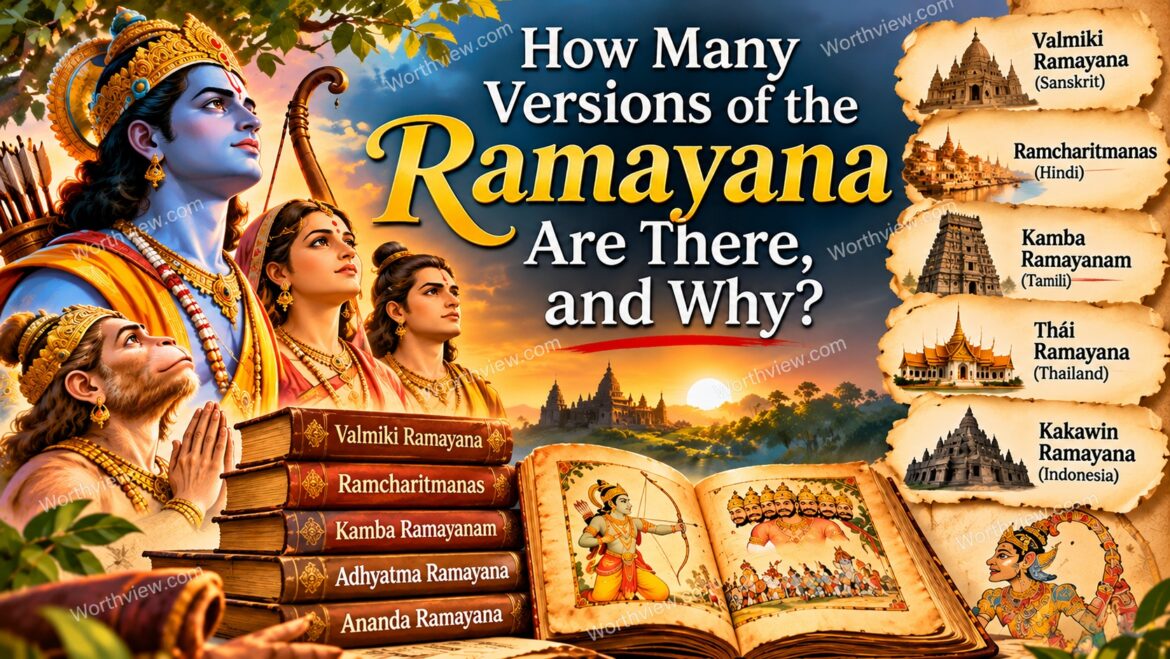
How many versions of the Ramayana exist?
No single number is agreed, because the total depends on what you count. The figure most often quoted is 300, from Camille Bulcke’s survey, cited by A.K. Ramanujan in his essay “Three Hundred Ramayanas” (written in 1987).
Counts change depending on whether you include only written poems or also dance-drama, puppet plays, temple reliefs and folk songs. Ramanujan listed languages from Balinese and Bengali to Khotanese, Santali and Tibetan. The poet K. Satchidanandan has argued that once oral and folk tellings are counted, the real number is far higher.
Ramanujan preferred the word “tellings” to “versions” or “variants”. Those words suggest one original that the rest copy, and he argued the picture is more tangled than that.
Is the Ramayana the original open-source epic?
In practice, yes. The Ramayana behaves like an open-source project: a shared core (an exiled prince, an abducted wife, a rescue) that poets, kings, monks and village singers have forked, edited and republished for more than two thousand years, with no central authority approving changes.
Ramanujan’s conclusion points the same way. The tellings do not simply descend from one source; they borrow from and answer each other, forming a common pool of stories. A Tamil poet, a Jain monk, a Thai king and a Bengali balladeer each adapted the core to their own world.
That is why “which one is the real Ramayana?” is the wrong question. WorthView does not rank traditions. We describe what each one says and where it comes from.
What are the main versions of the Ramayana?
The main versions run from the Sanskrit epic of Valmiki to Jain, Buddhist, regional-language and Southeast Asian tellings. Dates for many are debated, so treat the eras below as estimates. The chart shows when each telling was composed; use the filters to narrow the cards.

Bars show approximate date ranges from the sources listed below; dots mark a single reported date. Tellings with uncertain dates appear only in the cards.
Valmiki Ramayana
Oldest surviving full text; about 24,000 verses in seven kandas. Many scholars see the first and last books as later additions.
Dasaratha Jataka (No. 461)
Rama is a previous life of the Buddha. Sita is Rama’s sister, and there is no abduction story.
Paumacariya
Jain values: Lakshmana, not Rama, kills Ravana and is reborn in hell for it.
Kakawin Ramayana
Court poetry in kakawin metre; still shapes Javanese dance and puppetry.
Adhyatma Ramayana
Blends devotion to Rama with Advaita Vedanta philosophy.
Adbhuta Ramayana
Sita is central; in one episode she takes the form of Kali.
Kamba Ramayanam (Ramavataram)
Rama is clearly divine; shaped by Tamil bhakti. Ends with the war; no Uttara Kanda.
Ranganatha Ramayanam
An early Telugu retelling that changes some incidents.
Ramachandra Charita Purana (Pampa Ramayana)
A Jain poet’s Kannada telling.
Torave Ramayana
Popular Kannada retelling.
Saptakanda Ramayana
Among the earliest renderings into an Indo-Aryan language.
Krittivasi Ramayan
Rich in Bengali social life; Rama’s autumn worship of Durga (Akal-Bodhan) first appears here.
Jagamohana (Dandi) Ramayana; Vilanka Ramayana
Colloquial Odia telling; Sarala Das’s version features a thousand-headed Ravana.
Ramcharitmanas
Devotional “lake of Rama’s deeds”; written in the spoken language, not Sanskrit.
Adhyatma Ramayanam Kilippattu
The most popular Kerala telling. Kerala also has the Kannassa Ramayanam and the Mappila Ramayanam.
Ramavatara Charita
A late regional telling.
Ramakien
Thailand’s national epic; the story is set on Siamese ground.
Reamker
Adds Hanuman’s meeting with the mermaid Sovann Maccha.
Hikayat Seri Rama
Some tellings make Lakshmana, not Rama, the hero.
Phra Lak Phra Ram
A Jataka-style telling in which Rama is a past life of the Buddha.
Why are there so many versions of the Ramayana?
There are so many versions because the story travelled through oral retelling, new languages, different religions, local rulers and live performance, and each of those reshaped it.
Oral transmission
The epic is thought to have been told aloud before it was written down, and Britannica notes that this probably led to additions and deletions. Even Valmiki’s text split into regional recensions, which scholars group into northern and southern streams.
Regional languages
Vernacular poets did not just translate. Tulsidas chose Awadhi, the spoken language, over Sanskrit and reportedly faced criticism for it. Kambar’s Tamil telling reflects Tamil devotional poetry. Each language brought its own metre, imagery and landscape.
Religious traditions
Jain authors reworked the story around non-violence and karma. The Buddhist Dasaratha Jataka makes Rama a previous life of the Buddha. The Adhyatma Ramayana leans on Vedanta, while the Adbhuta Ramayana is a Shakta text that puts Sita at the centre. A Mappila Ramayanam survives among Kerala’s Muslims.
Local politics and values
In Thailand, kings took “Rama” as a royal title, and the Ramakien places the story in Siam. In Laos, the epic becomes a Buddhist birth story. Ramanujan used the Thai telling to show how differences reflect the concerns of the society telling the story.
Performance traditions
Khon dance-drama in Thailand, wayang puppetry in Java, Ramlila in North India, and the reliefs at Prambanan and Angkor each add scenes. Women’s folk songs, such as those collected in Telugu, centre Sita and leave out the war entirely.
How do Valmiki, Kamban and Tulsidas differ?
Valmiki composed in Sanskrit (scholars date the core anywhere from the 7th century BCE to around 300 BCE); Kambar wrote in Tamil around the 12th century; Tulsidas wrote in Awadhi from 1574. They share a story but differ in language, in how divine Rama is, and in which episodes they keep.
Valmiki
- Language and period
- Sanskrit; core c. 7th century–300 BCE (debated)
- Rama’s nature
- In Ramanujan’s reading, a god-man living within human limits
- Structure
- Seven kandas
- Example difference
- Tara marries Sugriva after Vali’s death
Kamban
- Language and period
- Tamil; late 12th century
- Rama’s nature
- Clearly a god, in the Tamil bhakti mould
- Structure
- Six kandas; ends after the war, with no Uttara Kanda
- Example difference
- Tara remains a widow
Tulsidas
- Language and period
- Awadhi; begun 1574
- Rama’s nature
- Centred on devotion; the poem is framed as a story Shiva told Parvati
- Structure
- Seven kandas
- Example difference
- Mandodari mentions a line drawn by Lakshmana late in the story
What does this mean for the new Ramayana film?
Any film adaptation has to choose a base telling, a tone, and which episodes to keep. With 300-plus tellings, there is no neutral option.
Ramayana: Rise of a Legend, the first part of a two-part film from director Nitesh Tiwari, has been described by outlets as adapted from Valmiki’s epic. Tiwari has said publicly that the team took creative liberties with world-building and visuals, and that Sita’s warrior side draws on the Adbhuta Ramayana. We cannot say how the unreleased film handles any other episode, and we do not rate it as “accurate” or “inaccurate”. What the many tellings show is that adapting this story has always meant choosing.
For what is publicly known about the film, including the cast and the Sita question, read our Ramayana (2026) movie guide.
Where should you start reading?
Start with a retelling in a language you enjoy, then compare. These are good next steps.
Frequently asked questions
How many versions of the Ramayana are there?
About 300 is the figure most often cited, from Camille Bulcke’s survey as quoted by A.K. Ramanujan. The true total is unknowable, because it depends on whether folk songs, dance-dramas, puppet plays and temple reliefs count alongside written poems. Some scholars believe the real number is much higher.
Which is the oldest Ramayana?
The Valmiki Ramayana is generally treated as the oldest surviving full version. Scholars date its core variously from about the 7th century BCE to around 300 BCE, with additions up to about the 3rd century CE. The Dasaratha Jataka is an early Buddhist telling, though scholars debate how it relates to Valmiki.
What is the difference between Valmiki’s Ramayana and Tulsidas’s Ramcharitmanas?
Valmiki’s epic is in Sanskrit and is far older. Tulsidas’s Ramcharitmanas is in Awadhi, begun in 1574, and is a devotional retelling. They share the main story but differ in emphasis, language and some episodes, such as the Lakshmana Rekha, which neither includes in the abduction scene.
Why are there different versions of the Ramayana?
Because the story spread through oral retelling and many languages, passed between Hindu, Jain and Buddhist traditions, and was adapted by regional poets, rulers and performers. Each adaptation reflected local values, religion and taste. Scholars describe the tellings as a shared pool of stories rather than copies of one original.
Is there a Buddhist Ramayana?
Yes. The Dasaratha Jataka, number 461 in the Pali Jataka collection, tells the Rama story as a past life of the Buddha. In it, Sita is Rama’s sister and there is no abduction. In Laos, Phra Lak Phra Ram also frames Rama as a past life of the Buddha.
Is there a Jain Ramayana?
Yes. Vimalasuri’s Paumacariya, in Prakrit and usually dated to about the 3rd–5th century CE, is the earliest surviving Jain telling. It retells the story with Jain values: Lakshmana, not Rama, kills Ravana. Later Jain authors, such as Ravisena, built on it.
Are there Ramayanas outside India?
Yes. Thailand has the Ramakien, Cambodia the Reamker, Laos the Phra Lak Phra Ram, Malaysia the Hikayat Seri Rama, and Java the Kakawin Ramayana. Myanmar’s Yama Zatdaw is another. Each adapts the story to local religion, landscape and performance, from Thai khon dance-drama to Javanese shadow puppetry.
Is the Lakshmana Rekha in Valmiki’s Ramayana?
No. The line Lakshmana draws around the hut does not appear in Valmiki’s Ramayana, and it is not in the abduction scene of Tulsidas’s Ramcharitmanas either. Tulsidas does mention a line later, when Mandodari speaks to Ravana. The popular image of the Rekha comes from later retellings and television.
How we researched this
We checked each version against scholarly or reference sources, including Britannica, a university summary of the epic by Robert Goldman, a critical study of the Paumacariya, and Ramanujan’s essay (paraphrased, not quoted). Dates for many texts are contested, so the explorer gives ranges and flags uncertainty. Film details come from reports in major Indian and trade outlets. Where we could not verify a claim, we left it out.
Sources
- A.K. Ramanujan, “Three Hundred Ramayanas” (PARI library)
- Encyclopaedia Britannica, Ramayana
- Robert Goldman, summary on the Ramayana (UC Berkeley ORIAS)
- K.R. Chandra, Paumacariya: a critical study (WisdomLib)
- Dasaratha Jataka, translated by W.H.D. Rouse (Sacred Texts)
- University of Washington, Ramayanas of Southeast Asia
- Sahapedia, K. Satchidanandan on alternative Ramayana narratives
- Bollywood Hungama, Nitesh Tiwari on Sita and creative liberties
Enjoy Worthview?
Add Worthview as a Preferred Source on Google to see more of our stories in Search.

Worthview Editorial Team is the shared byline for content created collaboratively by Worthview’s editors and contributors. Since 2008, we’ve published thousands of articles across technology, AI, finance, health, home, travel, and lifestyle. Our editorial process emphasizes original research, reputable sources, regular content updates, and clear attribution. Articles covering higher-trust topics, including health and finance, may also undergo review by qualified subject-matter experts.





One thought on “How many versions of the Ramayana are there, and why?”