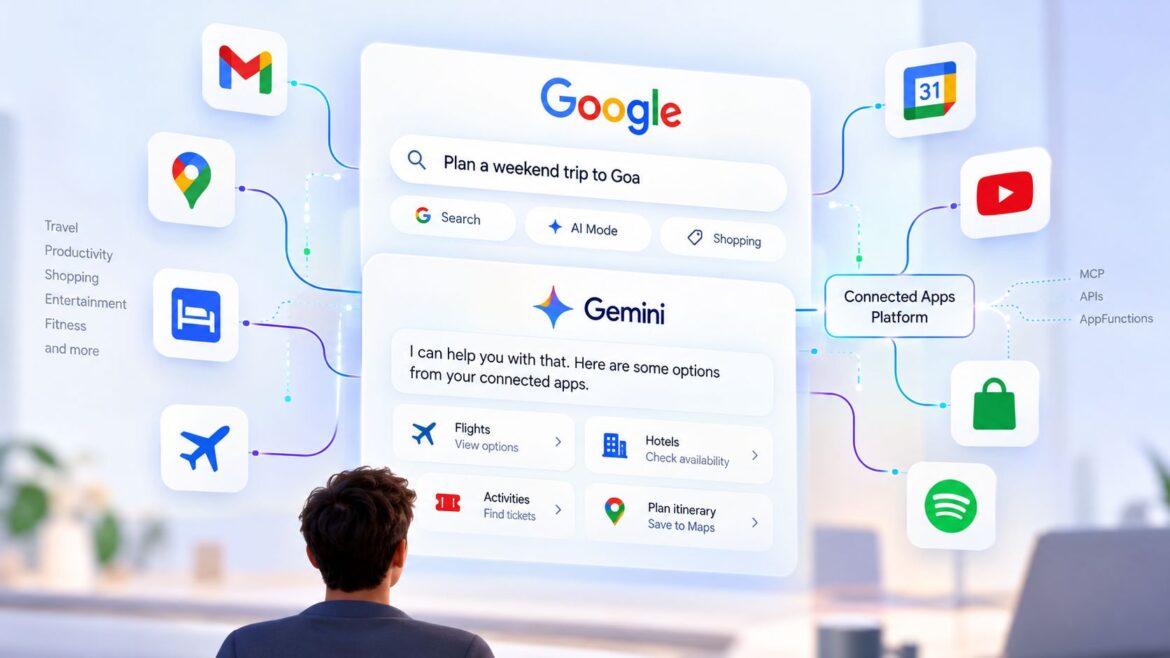
Search is becoming a place where users get tasks done, not only a place that sends clicks. It is evolving beyond finding information and visiting websites. With the growing adoption of AI assistants, users are increasingly expecting AI to help them complete tasks rather than simply provide answers.
Google’s latest announcement, the Connected Apps Platform, signals another step in this direction.
Announced on October 28, 2026, the platform provides developers and businesses with a unified way to connect their applications and services to Google Search and the Gemini app. Instead of navigating between multiple applications, users can interact with supported third-party services directly through Google’s AI-powered experiences.
For SEO professionals, this development raises an important question: What happens when search engines move beyond recommending websites and start helping users interact with the services behind them?
Let’s explore how Google’s Connected Apps Platform works, why it matters for SEO, and how businesses and SEO teams can prepare for the emerging era of agentic search.
What Is Google’s Connected Apps Platform?
Google’s Connected Apps Platform is a developer platform that allows businesses to integrate their applications and services with Google products, including Google Search and the Gemini app.
These integrations allow users to securely connect their accounts and access supported features or perform specific actions through Google’s AI interfaces.
Until now, if you wanted to use different services, you generally had to:
- Open Canva to create a design.
- Open Spotify or YouTube Music to create a playlist.
- Open Instacart to order groceries.
- Open another application to manage your fitness activities.
With Connected Apps, you can ask Gemini or Google Search to perform supported tasks using these services.
For example:
You: “Create a Diwali promotional poster for my business.”
Gemini: Uses the connected Canva application to help create the design.
You: “Create a playlist of 1990s Telugu songs.”
Gemini: Uses YouTube Music to create the playlist.
You: “Add ingredients for making dosa to my grocery cart.”
Gemini: Uses a connected grocery service to prepare your cart.
You can interact with these services through Google’s AI interface.
The important difference is that users are not simply receiving links to these applications. They can access supported functionality through an AI-powered interface.
Google says more than 50 Connected Apps are available across Search and Gemini, covering areas such as productivity, shopping, fitness and event ticketing.
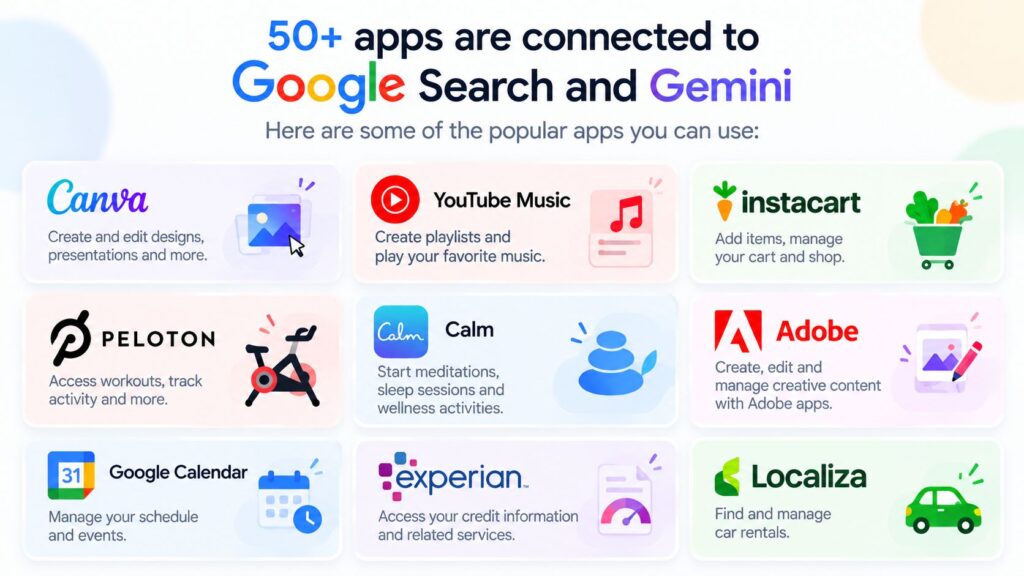
The October announcement introduces a unified developer platform to make it easier for businesses to build, manage and submit these integrations.
Official announcement: Google – Build and manage Connected Apps in one place.
How Does Google’s Connected Apps Platform Work?
Google provides two primary integration approaches for developers.
1. Model Context Protocol (MCP)
The Model Context Protocol (MCP) is an open standard that allows AI systems to communicate with external applications, services and tools.
Developers can create a cloud-hosted MCP server to expose specific application capabilities to AI systems.
For example, a travel booking platform could expose tools such as:
- Search available flights.
- Find hotels.
- Check room availability.
- Retrieve booking information.
- Initiate a booking.
When a user makes a relevant request, the AI assistant can identify and invoke the appropriate tools, subject to authorization and the application’s permissions.
MCP is particularly useful because it provides a standardized way to expose functionality across different platforms.
2. Android AppFunctions
Google also supports Android MCP through AppFunctions APIs.
This approach allows Android applications to expose specific functions to intelligent assistants and other system experiences.
For example, an Android fitness application could expose functionality that allows an assistant to retrieve activity information or interact with supported features.
While MCP servers provide a cloud-based integration approach, AppFunctions enable deeper integration with native Android applications.
3. Google Connected Console
Developers can use the Google Connected Console to manage their integrations.
The console provides capabilities to:
- Register connected applications.
- Configure MCP endpoints.
- Select Google products where integrations should be available.
- Test integrations before submission.
- Manage publishing and review.
- Monitor traffic, latency and errors.
Developers can choose whether their applications should be available through Google Search, Gemini or both.
In simple terms: MCP and AppFunctions expose application functionality, while Google Connected Console provides the tools to register, test and manage those integrations.
Connected Apps vs Traditional Google Search: What’s Changing?
Traditional search primarily connects users with information available across websites.
Users search for something, review results, visit websites and complete their desired actions.
Connected Apps introduce another layer to this experience: interacting with services directly through AI-powered interfaces.
Consider someone planning a holiday.
Traditional search journey:
- Search for hotels in Goa.
- Visit multiple hotel websites.
- Compare prices and availability.
- Select a hotel.
- Complete the booking.
AI-powered connected app journey:
- Ask an AI assistant to find hotels in Goa within a specific budget.
- The assistant interacts with supported connected services.
- It retrieves relevant information and available options.
- The user reviews the options and can proceed with supported booking actions.
This represents a shift from information discovery towards task completion.
| Traditional search | Agentic search |
|---|---|
| Finds relevant webpages | Can interact with connected services |
| Focuses on information discovery | Focuses on completing tasks |
| Users navigate between websites | AI can coordinate supported actions |
| Website visits are central to the journey | Some interactions happen within AI interfaces |
This does not mean traditional search is disappearing. Instead, AI-powered experiences are adding new ways for users to discover information and interact with businesses.
Why Should SEO Professionals Care About Connected Apps?
The Connected Apps Platform is not a new Google ranking algorithm or a direct SEO ranking factor.
However, it introduces an important development that SEO professionals should understand: search experiences are gradually expanding beyond webpages and into application functionality.
For years, SEO strategies have focused on improving website visibility through technical optimization, content quality, backlinks, structured data and entity signals.
With AI-powered search and connected services, businesses may also need to consider how their products, services and functionality can be accessed by AI systems.
Here are four important implications.
1. Website Visibility May No Longer Be the Only Consideration
Traditionally, businesses compete for visibility in search results to attract website visitors.
In an agentic search environment, users may increasingly discover and interact with business services without navigating through multiple webpages.
For example, a user looking for a nearby hotel may receive recommendations and interact with connected booking services through an AI interface.
This creates an additional opportunity for businesses to reach customers through their actual services, rather than relying exclusively on website visits.
2. APIs and MCP Could Become More Relevant to Technical SEO
Technical SEO specialists already work with website architecture, crawling, indexing, structured data and APIs.
As AI integrations expand, understanding how applications expose their functionality could become another useful technical skill.
Businesses may need to evaluate whether important services can be accessed through well-documented APIs or MCP integrations.
MCP is not an SEO requirement today, but understanding it could help technical SEO teams work more effectively with developers building agent-ready services.
3. Structured Data and Entity Clarity Remain Important
AI systems need reliable information to understand businesses, products, services and their relationships.
Structured data can help search engines interpret information such as:
- Product names and availability.
- Business locations and contact details.
- Service descriptions.
- Pricing information.
- Reviews and ratings.
Clear entity information, consistent business details and well-structured website content remain valuable foundations.
Connected Apps do not replace these SEO fundamentals. They introduce another potential layer of interaction.
4. Organic Traffic Measurement May Need to Evolve
If users increasingly complete certain tasks through AI interfaces, traditional website traffic metrics may not capture the entire customer journey.
Businesses may need to pay greater attention to:
- AI-assisted conversions.
- Application interactions.
- Leads generated through AI experiences.
- Assisted revenue.
- Actions completed through connected services.
Google’s Connected Console already provides developers with integration-level metrics such as traffic, latency and errors. How these measurements will eventually connect with broader SEO and marketing attribution remains an open question.
How Should SEO Professionals Prepare for Agentic Search?
SEO professionals do not need to abandon traditional SEO strategies. Instead, they should expand their technical understanding and prepare for new ways in which AI systems may interact with websites and applications.
Here are seven practical steps.
1. Learn Model Context Protocol (MCP)
MCP is becoming an important technology in the AI ecosystem.
SEO professionals working closely with developers should understand:
- What MCP servers do.
- How AI agents discover and invoke tools.
- How applications expose functionality.
- How authentication and permissions work.
- How MCP differs from traditional APIs.
Understanding MCP will help SEO teams participate in conversations about making digital services accessible to AI agents.
2. Make Websites and Services Machine-Readable
Ensure important business information is clearly structured and accessible.
Focus on:
- Descriptive page titles and headings.
- Clear product and service descriptions.
- Consistent brand and entity information.
- Relevant Schema.org structured data.
- Accurate pricing and availability information.
- Logical website architecture.
These practices help search engines and other systems interpret website information more effectively.
3. Evaluate Your Website’s API Capabilities
Identify which business functions could potentially be exposed to AI agents.
For an e-commerce website, these might include:
- Product search.
- Inventory availability.
- Product comparisons.
- Order tracking.
- Customer support.
For a travel website, possible functions include flight searches, hotel availability and booking information.
Not every website needs an MCP server. The priority should be identifying whether exposing specific functionality would provide genuine value to customers.
4. Strengthen Entity SEO
AI systems need to understand who you are, what your business offers and how your services relate to other entities.
Maintain consistent information across your website, business profiles and trusted external sources.
Use appropriate structured data, maintain clear brand information and build authoritative content around your core topics.
Entity clarity is a useful foundation for both traditional search and AI-powered discovery.
5. Experiment With AI Agents
SEO teams should start experimenting with agentic workflows rather than treating them as a distant technology.
Useful experiments include:
- Building an MCP-powered website analysis tool.
- Creating an AI agent that performs technical SEO checks.
- Connecting an AI assistant to Google Search Console data through supported APIs.
- Developing automated content auditing workflows.
- Testing how AI agents retrieve and interpret website information.
These projects can help SEO professionals understand how agents interact with real-world digital services.
6. Collaborate More Closely With Developers
Agentic search introduces a stronger connection between SEO, application development and AI engineering.
SEO teams should work with developers to identify opportunities for API integrations, structured data improvements, authentication, data accessibility and application functionality.
Technical SEO is likely to become even more collaborative as businesses explore AI-powered experiences.
7. Rethink SEO Performance Measurement
Do not focus exclusively on rankings, impressions and organic clicks.
Continue monitoring traditional SEO KPIs while exploring additional measurements such as qualified leads, assisted conversions and AI-driven interactions where reliable data is available.
The objective is to understand the complete customer journey, including interactions that may happen outside the traditional website experience.
Is Agentic SEO the Next Evolution of SEO?
Agentic SEO is an emerging concept rather than an officially established Google optimization discipline.
It describes the idea of preparing digital businesses, websites and services to be understood and interacted with by AI agents.
Traditional SEO focuses on improving the visibility of webpages in search engines.
Generative Engine Optimization (GEO) focuses on improving the likelihood that content and brands are represented in AI-generated answers.
Agentic SEO extends the discussion towards making services and functionality accessible to AI-powered agents.
These approaches are not mutually exclusive.
| SEO approach | Primary focus |
|---|---|
| Traditional SEO | Search visibility and organic traffic |
| AEO | Visibility in answer-based search experiences |
| GEO | Representation in generative AI responses |
| Agentic SEO | Accessibility and interaction with AI agents |
Agentic SEO should be viewed as an emerging area of opportunity, not a replacement for established SEO practices.
Google’s Connected Apps Platform is one development that makes this discussion increasingly relevant.
What Does the Future of Organic Search Look Like?
The Connected Apps Platform reflects a broader change in how people may interact with digital services.
Search engines are increasingly incorporating AI assistants, conversational interfaces and capabilities that allow users to complete tasks.
This could have several implications for businesses:
- Websites may need to serve both human visitors and AI-powered experiences.
- Application functionality could become another way for businesses to reach customers.
- Developers may increasingly build standardized integrations for AI platforms.
- SEO teams may need to collaborate more closely with AI and application development teams.
- Organic traffic measurement may need to account for customer interactions beyond website visits.
However, the extent of these changes remains uncertain.
Connected Apps is still in its early stages, and Google is gradually expanding developer access and product availability.
Businesses should monitor the platform’s development while continuing to invest in established SEO fundamentals.
Frequently Asked Questions (FAQs)
1. What is Google’s Connected Apps Platform?
Google’s Connected Apps Platform is a developer platform that allows businesses to connect their applications and services to Google products such as Search and Gemini. Users can securely link supported services and perform specific actions through Google’s AI interfaces.
2. How does Google’s Connected Apps Platform work?
Developers can integrate their applications using cloud-hosted Model Context Protocol (MCP) servers or Android AppFunctions APIs. They can then register, test and submit their integrations through Google Connected Console.
3. What is MCP and why is it important for SEO?
Model Context Protocol (MCP) is an open standard that allows AI systems to communicate with external applications and tools. It is relevant to SEO because it introduces opportunities for businesses to make their services and functionality accessible to AI agents.
4. Will Connected Apps affect Google search rankings?
Google has not announced Connected Apps as a direct search ranking factor. It is a developer integration platform, not a new ranking algorithm. However, it could influence how users discover and interact with businesses through AI-powered search experiences.
5. What is Agentic SEO?
Agentic SEO is an emerging concept focused on preparing websites, digital services and business functionality for interaction with AI agents. It extends the discussion beyond webpage visibility towards enabling AI systems to access and use supported services.
6. Should businesses implement MCP on their websites?
Not every business needs an MCP integration. Companies should first identify whether exposing specific services through APIs or MCP would improve customer experiences or support useful AI-powered workflows.
7. Is Google’s Connected Apps Platform available to everyone?
Google announced the platform in preview on October 28, 2026. Developer access is being rolled out in phases, initially focusing on developers in the United States. Google plans to expand access to more developers, markets and products over time.
Final Thoughts
Google’s Connected Apps Platform is another indication that the search experience is evolving.
For years, businesses focused on making their websites discoverable. With the emergence of AI agents, there is growing interest in making business services and functionality accessible through intelligent interfaces.
This does not mean SEO is becoming irrelevant. It means the scope of digital discoverability could expand beyond traditional search rankings.
For SEO professionals, the opportunity is to understand this transition early, develop technical AI skills, experiment with MCP and agentic workflows, and help businesses prepare for the next generation of search.
The future of search may not be just about helping users find the right website. It could also be about helping them get things done.
Enjoy Worthview?
Add Worthview as a Preferred Source on Google to see more of our stories in Search.

Sethuram Kishore is the founder and editor of Worthview, an online publication established in 2008. With over 18 years of experience in SEO, digital marketing, and online publishing, he writes about AI, technology, business, and digital trends. He is also the founder of MoneyHulk, a personal finance and business publication.