
Black Friday is the Friday after US Thanksgiving, and Cyber Monday is the Monday after that. In 2026 they fall on November 27 and November 30. Together they open the US holiday shopping season, and both have spread across the world, including India. This article explains where each name came from, why these particular days, and how the sales have grown.
Where the name Black Friday came from
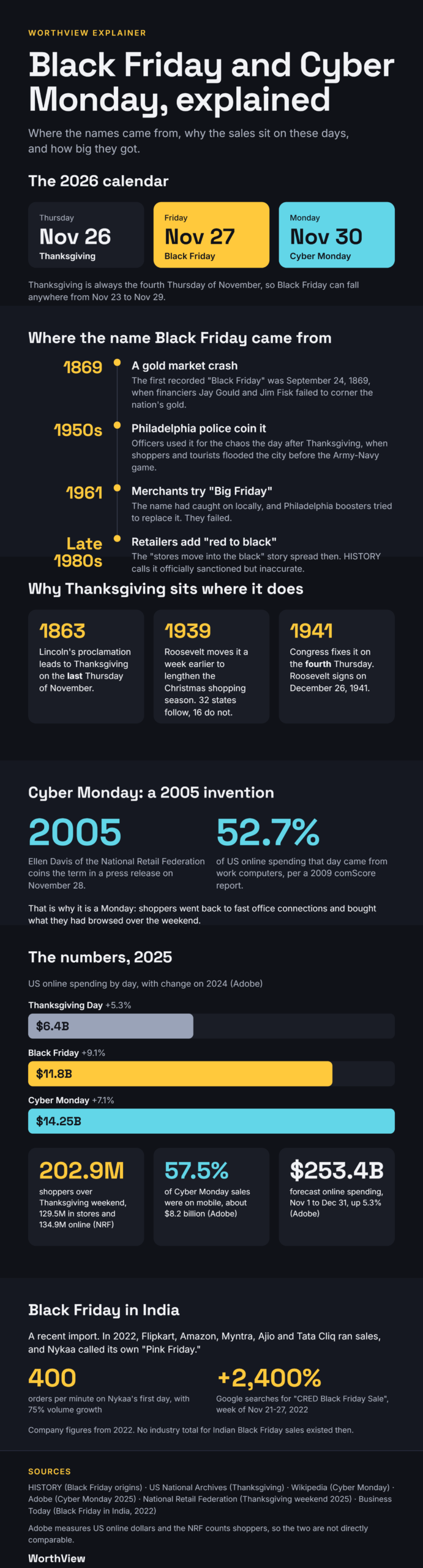
The name did not start with shopping. According to HISTORY, the first recorded use of “Black Friday” was for the US gold market crash of September 24, 1869, when financiers Jay Gould and Jim Fisk failed to corner the nation’s gold.
The retail meaning came later, in Philadelphia. In the 1950s, city police used the term for the chaos on the day after Thanksgiving, when suburban shoppers and tourists flooded the city before the Army-Navy football game that Saturday. By 1961 the name had caught on locally, and Philadelphia merchants tried and failed to rename the day “Big Friday.”
The story most people hear is different: stores ran at a loss for most of the year, then moved “into the black” on the day after Thanksgiving. HISTORY calls this explanation officially sanctioned but inaccurate. It says retailers adopted the “red to black” framing in the late 1980s because it made the name sound positive, and that the term was not in common use nationwide as recently as 1985.
Why the day after Thanksgiving
Black Friday follows Thanksgiving, and the date of Thanksgiving was fixed partly with shopping in mind. The US National Archives records the key steps:
- 1863: Lincoln’s proclamation led to Thanksgiving being observed on the last Thursday of November.
- 1939: The last Thursday fell on November 30. To lengthen the Christmas shopping season, President Franklin D. Roosevelt moved the holiday a week earlier. Thirty-two states followed and 16 kept the last Thursday, so some years had two Thanksgivings.
- 1941: Congress made it the law, and after the Senate changed “last” to “fourth” Thursday, Roosevelt signed it on December 26, 1941.
Because Thanksgiving is always the fourth Thursday of November, it falls between November 22 and 28. That puts Black Friday between November 23 and 29, and the Monday after it between November 26 and December 2. The sales sit on the first weekend of the holiday shopping season, and the calendar rule decides which date that is each year.
Why Cyber Monday is on a Monday
Cyber Monday is much younger. Per Wikipedia’s account, Ellen Davis of the National Retail Federation (NRF) coined the term in a press release on November 28, 2005. Scott Silverman, head of the NRF’s Shop.org, said it was based on 2004 research showing that the Monday after Thanksgiving was one of the biggest online shopping days of the year.
The reason was the office. A New York Times report from late 2005 described millions of working Americans returning to fast internet connections at work and buying what they had browsed over the weekend. A 2009 comScore report cited on the same page found that 52.7% of US online spending that day came from work computers.
The name stuck as home broadband and mobile shopping spread. In 2020, Cyber Monday became the biggest online shopping day in US history, with $10.7 billion in online spending, and in 2025 it reached $14.25 billion according to Adobe.
Dates and timing in 2026
The two sales are one weekend apart. In 2026 the calendar runs like this:
| Day | Date |
|---|---|
| Thanksgiving (fourth Thursday) | Thursday, November 26, 2026 |
| Black Friday | Friday, November 27, 2026 |
| Cyber Monday | Monday, November 30, 2026 |
The sales no longer wait for those days. Hostinger, for example, lists its own Black Friday sale on its official page as running from October 19 to December 14, 2026, and other vendors start weeks early. Adobe’s season forecast likewise covers all of November and December, from November 1 to December 31. The two named days are now the peak of a long season, not its start.
Facts and numbers from 2025
Cyber Monday 2025 was the biggest of the three days online. Figures from Adobe, which tracks US online sales:
| Day | US online spending | Change on 2024 |
|---|---|---|
| Thanksgiving Day | $6.4 billion | +5.3% |
| Black Friday | $11.8 billion | +9.1% |
| Cyber Monday | $14.25 billion | +7.1% |
Adobe also reported that 57.5% of Cyber Monday sales, about $8.2 billion, were made on mobile, and that buy-now-pay-later accounted for $1.03 billion. Its forecast for the whole season, November 1 to December 31, was $253.4 billion online, up 5.3%.
The National Retail Federation counted people, not dollars. Its survey with Prosper Insights & Analytics estimated 202.9 million shoppers over the Thanksgiving-to-Cyber-Monday weekend. Of those, 129.5 million shopped in stores and 134.9 million online (many did both). On Black Friday itself, 80.3 million shopped in stores and 85.7 million online, and 75.9 million shopped online on Cyber Monday. The survey covered 3,099 adults, with a margin of error of 1.8 percentage points.
The two sources measure different things, so the Adobe dollars and the NRF headcounts should not be compared directly.
Black Friday in India
In India, Black Friday is a recent import. Business Today described it in November 2022 as newly part of the retail calendar, with Gen Z and millennial shoppers increasingly joining in. That year Flipkart, Amazon, Myntra, Ajio and Tata Cliq ran sales, Nykaa branded its own as “Pink Friday,” and small direct-to-consumer brands offered 50-60% discounts.
The article gave company figures, not market totals. Nykaa reported 400 orders per minute on the first day and 75% year-on-year volume growth, and Google Trends showed searches for the “CRED Black Friday Sale” up 2,400% in the week of November 21-27. It noted that no industry data existed for total Indian Black Friday sales.
India’s timing is different from the US. The sale comes just after Diwali and in the wedding season, and the article said it gave platforms a chance to clear leftover post-Diwali stock. These figures are from 2022 and may have changed since.
What to take from it
Black Friday gets its name from 1950s Philadelphia police, not from accounting, and its place on the calendar from a 1941 law fixing Thanksgiving on the fourth Thursday. Cyber Monday is a 2005 invention named for shoppers using office computers. Both have outgrown their dates, so the sensible habit is to check the price and the end date on the seller’s own page, whichever day it is.
We track which 2026 offers are confirmed, with their check dates, on BlackFriday2026.deals, a site we also run.
Sources
All pages below were opened for this article.
- HISTORY: Black Friday origins
- US National Archives: Thanksgiving
- Wikipedia: Cyber Monday
- Adobe: Cyber Monday 2025
- NRF: Thanksgiving weekend 2025
- Business Today: Black Friday in India, 2022
- Hostinger: Black Friday 2026
Enjoy Worthview?
Add Worthview as a Preferred Source on Google to see more of our stories in Search.

Worthview Editorial Team is the shared byline for content created collaboratively by Worthview’s editors and contributors. Since 2008, we’ve published thousands of articles across technology, AI, finance, health, home, travel, and lifestyle. Our editorial process emphasizes original research, reputable sources, regular content updates, and clear attribution. Articles covering higher-trust topics, including health and finance, may also undergo review by qualified subject-matter experts.