Gemini 4 Hydrogen is Google’s latest AI model upgrade for Search, designed to improve how the search engine understands complex queries, explores related topics and delivers AI-generated responses.
For SEO professionals, its improved query fan-out could make topical coverage, search intent, contextual relevance and content discoverability increasingly important. However, Google has not announced a replacement of its traditional organic ranking algorithm.
Google is taking another major step towards AI-powered search with Gemini 4 Hydrogen, a new model that the company describes as its biggest model improvement to Google Search yet. The upgrade strengthens how Search handles complex questions, explores related topics and delivers AI-generated responses.
For SEO professionals and website owners, the development deserves attention beyond the introduction of another Gemini model. Improvements to query understanding and query fan-out could influence how Google discovers relevant web content and selects sources for AI-powered search experiences.
But what exactly is changing, and what does it mean for organic search visibility? Here’s what SEO professionals need to know.
What Is Gemini 4 Hydrogen?
Gemini 4 Hydrogen is Google’s latest AI model variant designed to bring faster and more efficient AI processing to Search. It is part of the Gemini 4 model family and is designed to handle complex queries while maintaining the speed required for everyday search experiences.
Unlike a conventional search update focused on indexing or ranking changes, this upgrade centres on improving the AI model responsible for understanding questions and generating responses.
For users, this means more capable conversational searches. For website owners, it introduces another important consideration: how effectively their content answers related questions and supports broader search intent.
Google positions Hydrogen as a model built for rapid execution rather than the long, intensive reasoning associated with its more powerful models. It is now available globally in Google Search, alongside other Google products.
What’s Changing in Google Search?
Google says Gemini 4 Hydrogen introduces four major improvements to Search. These changes focus on understanding user intent, discovering relevant websites and presenting information in more useful formats.
1. Better understanding of search intent
Search can now handle more complicated, multi-part questions, specific instructions and even queries containing difficult-to-understand typos.
Instead of relying heavily on individual keywords, the AI model can better interpret what users actually want and address different parts of a question.
2. Improved query fan-out and website discovery
This is arguably the most important development from an SEO perspective.
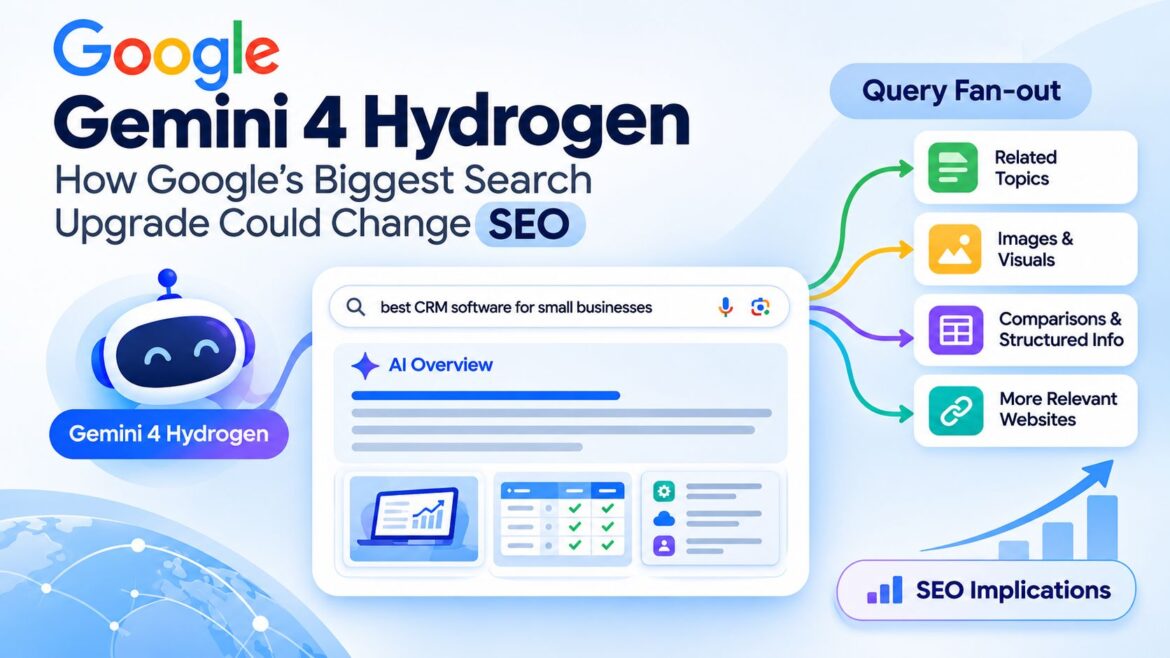
Google uses query fan-out to break a complex search into multiple related queries and explore different subtopics simultaneously. Gemini 4 Hydrogen improves this process through stronger reasoning, helping Search connect users with a broader range of relevant websites.
For example, a search for best CRM software for small businesses could involve exploring pricing, automation features, integrations, ease of use and customer support.
This allows Google to discover useful content across several related topics instead of depending only on pages targeting the original search phrase.
3. More visual and structured responses
Google Search will provide more adaptive responses, including:
- Relevant images and visual content.
- Structured information and comparison tables.
- Custom tools designed around specific user requirements.
For publishers, this makes relevant visual assets and well-organized information increasingly useful components of content strategy.
4. Improved language understanding
Google says Hydrogen delivers more nuanced responses across all languages supported by its AI Mode.
This could improve how Search interprets regional expressions, conversational questions and language-specific context.
It also reinforces the importance of creating content that addresses users naturally rather than simply repeating exact-match keywords.blog.google
SEO takeaway: The biggest change is not simply better AI-generated answers. It is Google’s stated ability to explore more related subtopics and connect users with a wider range of websites.
Why Gemini 4 Hydrogen Matters for SEO
The biggest SEO implication of Gemini 4 Hydrogen is the potential improvement in how Google connects complex search queries with relevant web content.
Here are four areas worth watching.
1. Topical coverage becomes more important
When Google explores multiple related queries, a page targeting one keyword may not provide enough information to satisfy the broader search intent.
Websites covering a topic comprehensively, including related questions, use cases, comparisons and supporting information, may have more opportunities to be considered relevant sources.
This makes well-planned topic clusters more valuable than publishing disconnected articles around individual keywords.
2. Content discovery could expand beyond exact-match queries
Query fan-out creates opportunities for relevant pages that address supporting questions rather than the original search phrase.
For example, an article about CRM software integrations could potentially become relevant when Google explores a broader query about choosing CRM software.
This makes contextual relevance and useful supporting content important considerations for publishers.
3. Internal linking and entity relationships matter
Related articles should be connected through meaningful internal links.
Clear relationships between products, services, brands, concepts and supporting topics can help establish the context of a website’s content.
However, internal linking and entity optimization should be treated as sound SEO practices, not guaranteed ways to get selected in AI responses.
4. Organic traffic measurement needs a broader view
As AI-powered Search experiences evolve, traditional rankings alone may not provide a complete picture of search visibility.
SEO teams should monitor:
- Organic clicks and impressions in Google Search Console.
- Changes in click-through rates.
- Visibility in AI Overviews and AI Mode, where measurable.
- Referral traffic from AI-powered search experiences.
- Performance across informational and commercial search queries.
The objective is to understand whether a website is gaining visibility across the broader search journey, not just individual keyword positions.
What SEO professionals should understand: Gemini 4 Hydrogen does not mean that Google will automatically favour longer articles or websites with more internal links. The opportunity is to publish genuinely useful content that addresses the different dimensions of a topic.
Google explicitly says its improved query fan-out can connect users to a broader range of relevant websites. This makes content relevance and discoverability particularly important.
Google’s evolving AI ecosystem is also opening new possibilities for automated SEO workflows. Its Gemini Decisions API is another development worth watching, particularly for how agentic AI could support decision-making and automation across SEO tasks.
What Gemini 4 Hydrogen Means for the Future of Search
Gemini 4 Hydrogen represents another step in Google’s transition towards AI-powered Search. Its improvements to query understanding and query fan-out could change how users discover information and how relevant websites are surfaced across complex search journeys.
For SEO professionals, the takeaway is straightforward: focus on search intent, topical relevance, useful content and strong contextual connections between pages.
Traditional SEO fundamentals still matter, but visibility in an increasingly AI-driven search environment will require websites to become useful sources across a broader range of related questions.
Google’s Search evolution is no longer just about ranking pages. It’s increasingly about understanding information and connecting users with the most relevant sources.
Enjoy Worthview?
Add Worthview as a Preferred Source on Google to see more of our stories in Search.

Worthview Editorial Team is the shared byline for content created collaboratively by Worthview’s editors and contributors. Since 2008, we’ve published thousands of articles across technology, AI, finance, health, home, travel, and lifestyle. Our editorial process emphasizes original research, reputable sources, regular content updates, and clear attribution. Articles covering higher-trust topics, including health and finance, may also undergo review by qualified subject-matter experts.