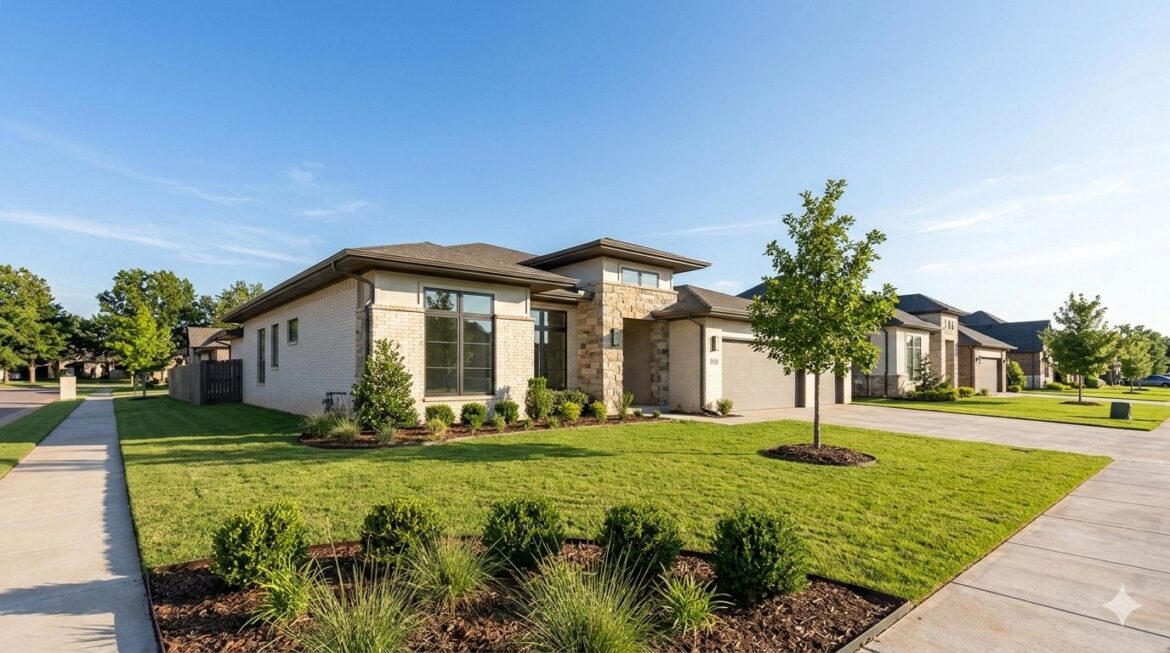
A $300,000 housing budget means very different things depending on where you are buying. Recent housing market data puts Oklahoma City’s median home price at $271,000 in March 2026. So, a buyer with a budget in the high-$200,000s is closer to the mid-range to expensive end of the market than the affordable side.
The difference shows up in the kind of homes buyers can consider. Single-family homes average about $275,000, while condos average closer to $150,000. This changes the conversation from “Can I afford a house here?” to “What am I willing to compromise on: space, location, or size?”
What $271,000 Actually Buys in Oklahoma City
A citywide median becomes useful only when buyers can connect it to actual properties.
Around Oklahoma City’s median price, buyers can opt for detached homes instead of being pushed towards condos or smaller attached properties. A buyer with a budget of under $300,000 will still give something up, but probably not everything. A first-time buyer may keep the extra bedroom on the list. A family may get the backyard or garage without stretching to a much bigger budget.
But the choices will not all look the same. One house may offer more square footage but would need updating. Another may sacrifice space for a shorter commute.
People compare homes based on factors that fit the homeowner’s lifestyle. Things like access to schools, commute time, lot sizes, and necessary renovations become important.
Looking at the homes for sale in Oklahoma City provides an example of this beyond the city average.
Buyers Are Not Routinely Paying Far Above the List Price
An affordable asking price matters less if competition pushes the final price much higher.
That is not the pattern across Oklahoma City right now. In March 2026, Oklahoma City’s sale-to-list ratio was 98.32%, and 18.04% of homes sold above the listing price. While above-list sales clearly still occur, they aren’t that common. For someone shopping with a firm ceiling, the listing price is more useful.
A buyer looking at a $275,000 house does not have to assume that another $20,000 or $30,000 will automatically be needed to compete. There is still room for individual listings to run hot, but the wider market is not turning every asking price into the opening number of an auction.
It also helps buyers plan more realistically. A household can set a ceiling based on what it can actually afford rather than building an extra bidding-war cushion into every search.
More Time on the Market Can Lead to Better Comparisons
Buyers also have some room to think.
Homes in Oklahoma City spent a median of 58 days on the market in March 2026. Some properties will sell much faster, but the citywide pace gives buyers a chance to compare more than the asking price.
Consider two homes. One costs $250,000 but needs a new roof, an updated HVAC system, and cosmetic work. Another costs $285,000 and is in better condition. Choosing the cheaper house simply because the number is lower may not save money once repairs are added. Location works the same way. A bigger house farther out can look like better value until you add the daily commute.
It is important to have enough time to make these comparisons, as the most affordable property and the best-value property may not be the same.
Your Budget Matters More Than the Citywide Average
Two buyers with similar purchasing budgets may make quite different choices when evaluating the same market in Oklahoma City. For instance, a buyer with a budget of $200,000 may have to choose from smaller homes, condos, or fixer-upper homes. With an increased budget of up to $300,000, detached homes can be added to the mix.
That is why filtering by budget on Houzeo tells a buyer more than looking at the $271,000 median alone. The useful question is not whether Oklahoma City is “cheap.” It is what a specific budget buys here.
For someone with $275,000 available, that could mean comparing several single-family homes instead of deciding whether buying a detached house is possible at all. Someone shopping closer to the condo average has a different route into ownership without having to use the citywide median as the starting point. Those price bands show the market more clearly than one headline number.
They also make it easier to spot where the trade-offs begin. A buyer can see how much more they would have to spend to move from a condo to a detached house, or from an older property to something newer and move-in ready.
The Real Advantage Is What Buyers Do Not Have to Give Up
Price is more important when it enables the buyer to make fewer compromises. If prices are high, then adhering to the budget would entail either compromising on the size of the property, the type of property, the distance from the place of employment, or the quality of the property. Oklahoma City does not remove those choices, but its price level can make them less severe.
One buyer might utilize their budget to add a bedroom to their home. Others might pick a less expensive home and retain more money from closing the deal. One might accept the older finishings in order to purchase the desired plot of land and location. This is a much more realistic measure of the value of the money than the definition of affordability of the housing market.
Enjoy Worthview?
Add Worthview as a Preferred Source on Google to see more of our stories in Search.

Worthview Editorial Team is the shared byline for content created collaboratively by Worthview’s editors and contributors. Since 2008, we’ve published thousands of articles across technology, AI, finance, health, home, travel, and lifestyle. Our editorial process emphasizes original research, reputable sources, regular content updates, and clear attribution. Articles covering higher-trust topics, including health and finance, may also undergo review by qualified subject-matter experts.