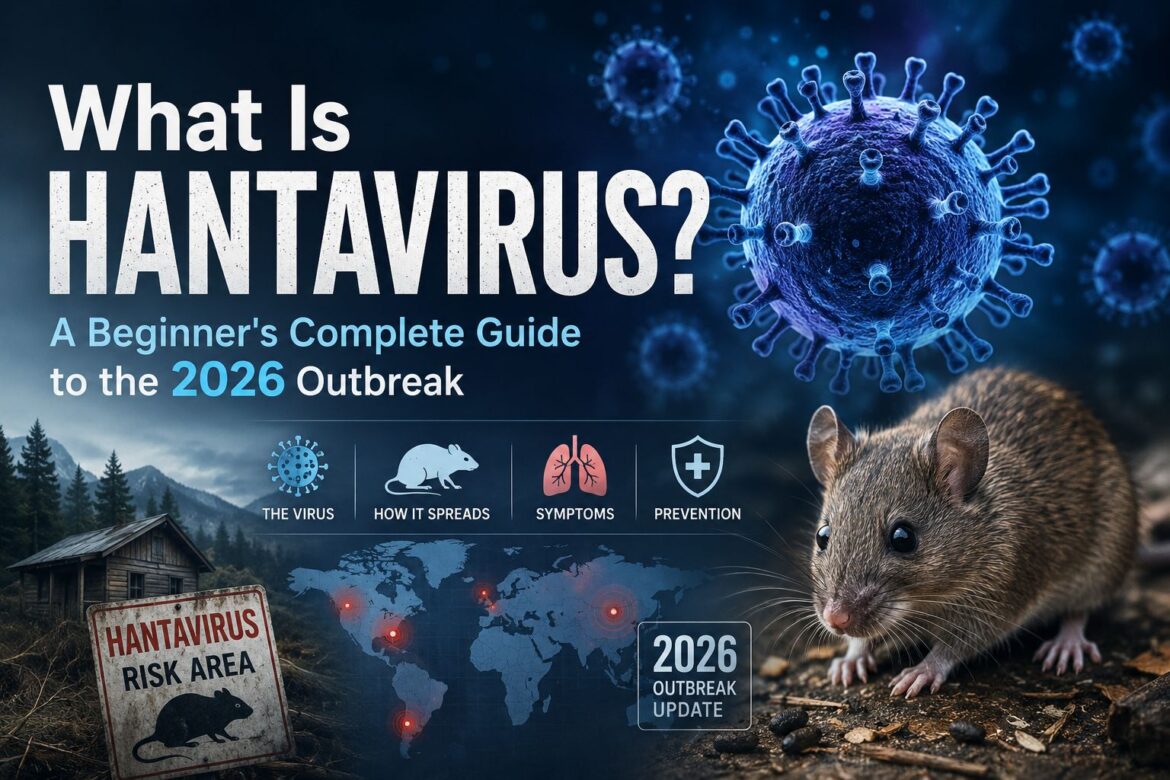
Hantavirus is a rare but potentially deadly virus mainly spread through contact with infected rodent urine, droppings, or saliva. In 2026, a global outbreak linked to the expedition ship MV Hondius raised concerns after multiple passengers became sick with the Andes virus strain — the only hantavirus known to spread between humans in rare cases. Symptoms usually begin like the flu but can quickly turn into severe breathing problems called Hantavirus Pulmonary Syndrome (HPS). Health officials say the overall public risk remains low, but the outbreak has increased worldwide awareness about rodent-borne diseases and early symptom detection.
If you have been following the news in May 2026, you have probably seen the word Hantavirus everywhere. A cruise ship in the Atlantic Ocean, three deaths, passengers being evacuated to multiple countries, and health agencies on high alert. It sounds alarming — but what exactly is Hantavirus, and should you be worried?
This guide starts from the very beginning and explains everything in plain language. By the end, you will know what the virus is, how it spreads, what symptoms to watch for, and what the current outbreak is really about.
What Is Hantavirus?
Hantavirus is not one single virus — it is a family of viruses, each carried by a specific type of rodent. Think of it as an umbrella term, the way “flu” covers many influenza strains.
These viruses live quietly inside their rodent hosts — rats, mice, voles, and other small mammals. The infected animal feels no symptoms at all. It eats, breeds, and goes about its life while shedding the virus in its urine, droppings, and saliva. The virus does not harm the rodent. But when a human accidentally comes into contact with those secretions, the story changes dramatically.
Humans most often get infected by breathing in dust or tiny airborne particles contaminated with rodent excretions. You do not have to be bitten. Simply cleaning out an old shed, working in a field, or camping in an area with infected rodents can be enough exposure.
Two Types of Hantavirus Disease in Humans
Different strains of Hantavirus cause different diseases depending on where they are found in the world.
1. Hemorrhagic Fever with Renal Syndrome (HFRS)
Found mainly in Asia and Europe, this form attacks the kidneys. Symptoms include high fever, back and abdominal pain, and in severe cases, kidney failure. Fatality rates range from under 1% to around 15% depending on the strain.
2. Hantavirus Pulmonary Syndrome (HPS)
Found mainly in the Americas, this form attacks the lungs. It is the more dangerous form. The disease can progress from flu-like symptoms to severe respiratory failure within days. The Andes virus — the one behind the current 2026 outbreak — causes HPS.
The fatality rate for HPS caused by Andes virus is around 38%, meaning roughly 1 in 3 people who develop serious lung symptoms may die from it.
|
What Makes Andes Virus Different from All Other Hantaviruses?
Here is the detail that has health agencies most alert about the 2026 outbreak: Andes virus is the only known Hantavirus strain that can spread from person to person.
Every other Hantavirus strain requires a rodent as the source. You cannot catch Sin Nombre virus (common in the American Southwest) or the Hantaan virus (Asia) from another sick person. But Andes virus is the exception.
That said, person-to-person spread is not easy or casual. It requires:
- Direct physical contact with a symptomatic person
- Prolonged time in a close or enclosed space with them
- Exposure to their saliva, respiratory secretions, or other body fluids — such as kissing, sharing utensils, or handling contaminated bedding
It does not spread through a cough across a room the way COVID-19 does. It needs sustained, close proximity. This distinction is exactly why WHO and CDC have repeatedly stressed that a global pandemic from this outbreak is highly unlikely.
Symptoms — What Does Hantavirus Feel Like?
The tricky part about Hantavirus is that early symptoms look almost identical to a bad flu. This is what makes it dangerous — people may not seek care quickly enough.
Early Stage (Days 1–7 after symptoms begin)
- Fever and chills
- Severe muscle aches, especially in the thighs, hips, back, and shoulders
- Fatigue and weakness
- Headache
- Nausea, vomiting, or diarrhoea in some cases
Late Stage (Days 7–14 — the critical window)
- Shortness of breath
- Chest tightness
- Rapid progression to fluid in the lungs
- Respiratory failure requiring oxygen support or a ventilator
Symptoms typically appear 4 to 42 days after exposure. This wide window is part of why contact tracing in the current outbreak is so complex — people may have been exposed weeks before they feel anything.
Important: If you have had recent exposure to rodent-infested areas or contact with a confirmed Hantavirus patient, and you develop fever and muscle aches, seek medical attention immediately. Do not wait for breathing symptoms to appear.
Is There a Treatment or Vaccine?
Currently, there is no approved antiviral drug specifically for Hantavirus, and no licensed vaccine available globally.
Treatment is entirely supportive: rest, hydration, oxygen therapy, and in severe cases, mechanical ventilation (a machine that breathes for the patient). The earlier a patient reaches a hospital, the better their chances. Once the lungs begin to fail, survival becomes a race against time.
Research into antiviral treatments continues, but as of May 2026, doctors rely entirely on keeping the patient stable while the immune system fights the infection.
The 2026 Outbreak — What Happened on the MV Hondius
The current outbreak is what has put Hantavirus on front pages globally. Here is the full story, told simply.
The Cruise Ship
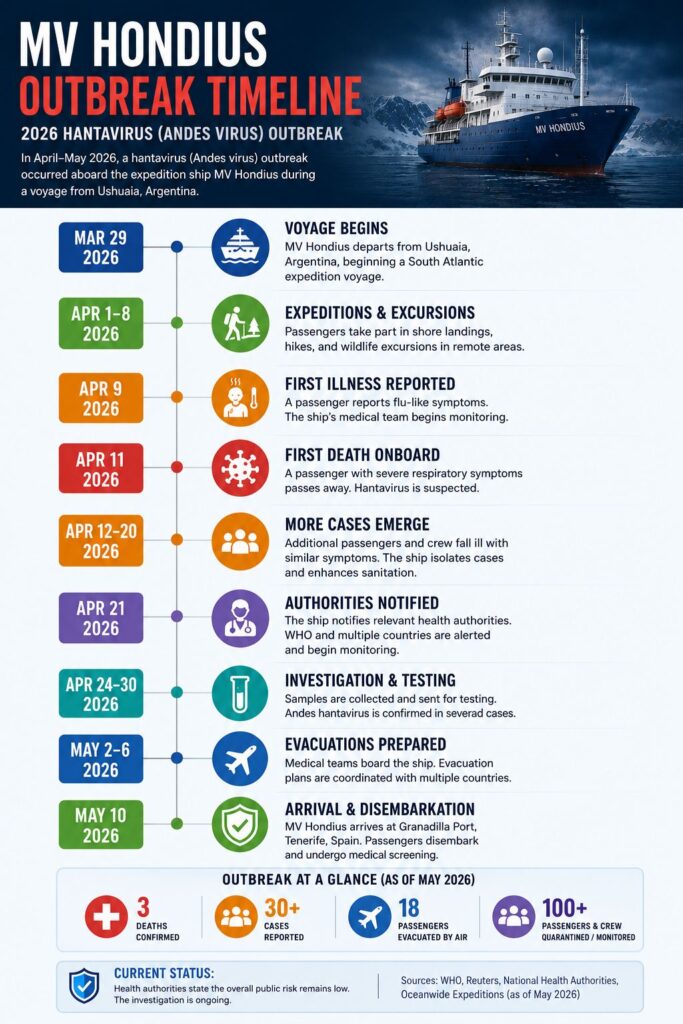
The MV Hondius, a Dutch expedition cruise vessel, departed from Ushuaia, Argentina on April 1, 2026. It carried 147 people — 86 passengers and 61 crew — from 23 different countries. The route was an expedition through some of the world’s most remote and wildlife-rich locations: Antarctica, South Georgia Island, Tristan da Cunha, Saint Helena, and Ascension Island.
How It Started
The index case — the first person infected — is believed to be a Dutch passenger who had spent four months travelling through Argentina, Chile, and Uruguay by road before boarding the ship. He returned to Argentina from Uruguay just four days before departure. During that road trip, he most likely came into contact with infected rodents or their excretions at some point.
He boarded the ship already carrying the virus but not yet showing symptoms. Within days of the voyage, he became ill. Person-to-person transmission then occurred among passengers in close contact with him.
The Deaths and Escalation
The first passenger died on April 11. His body was removed when the ship stopped at Saint Helena on April 24, where his wife also disembarked and died two days later in a hospital in Johannesburg. A third passenger later died on board.
WHO was officially notified on May 2, 2026. By May 6, the Andes virus was confirmed as the cause. As of May 8, eight cases were confirmed or suspected — six confirmed and two suspected — with three deaths.
The Evacuation
After stops in Cape Verde and the Canary Islands, the ship finally docked at Tenerife, Spain on May 10. Passengers were evacuated to their home countries on military and government aircraft. American passengers were flown to a specialised quarantine facility at the University of Nebraska Medical Center, one of the few facilities in the US equipped to handle high-consequence infectious disease cases. The ship is en route to Rotterdam to be thoroughly disinfected.
Scale of Response: Passengers from 23 countries had to be individually repatriated, with each nation’s health agency coordinating quarantine and monitoring. Spanish health authorities called the containment planning ‘unprecedented.’
Should You Be Worried? What the Experts Say
The honest answer is: not about this specific outbreak spreading widely, but Hantavirus itself deserves to be taken seriously as a public health topic.
WHO has assessed the risk to the global population from this cruise ship cluster as low. The CDC has said the risk to the American public is extremely low. Experts point to a few reasons:
- Person-to-person spread of Andes virus, while possible, requires prolonged close contact — not casual everyday interaction
- The cluster is geographically contained to people on a specific vessel, and all are being traced and monitored
- Historical outbreaks of Andes virus have been small — the largest known outbreak, in Patagonia in 2018, resulted in 34 cases and 11 deaths
- This is not a respiratory pathogen designed for easy airborne transmission the way influenza or COVID-19 is
The reason this outbreak is globally significant is not because of its size — eight cases is a tiny cluster by pandemic standards — but because it happened in an international setting with passengers from 23 countries, requiring extraordinary coordination. It is a test of global health preparedness, not a signal of a coming epidemic.
How to Protect Yourself from Hantavirus
Since most Hantavirus infections worldwide come from rodent exposure (not person-to-person spread), the following precautions apply to everyone, especially in areas where Hantavirus is endemic:
- Seal gaps and holes in your home that could allow rodents to enter
- Store food, including pet food, in rodent-proof containers
- When cleaning areas with rodent droppings, do NOT sweep or vacuum — this throws particles into the air. Instead, wet the area with a disinfectant, then wipe and dispose carefully using gloves
- Wear gloves when handling dead rodents
- Avoid sleeping on the ground in rodent-infested areas
- If camping or working in rural or forested areas in South America, take extra precautions
For the current outbreak, if you were on the MV Hondius voyage or had close contact with someone who was, follow the guidance of your national health authority immediately.
India-Specific Note
Hantavirus is not endemic to India in any documented significant form, and no Indian nationals have been reported among the MV Hondius cases. However, as a global health story that could affect travellers, Indian authorities and frequent international travellers should be aware of the virus, particularly those planning trips to South America, which is the natural habitat of the Andes virus.
India’s One Health surveillance framework, which monitors animal-to-human disease transmission, currently does not flag Hantavirus as a domestic threat. That said, with climate change expanding rodent habitats and more international travel, it is a disease worth understanding.
Frequently Asked Questions
Can I catch Hantavirus from someone who is coughing near me?
Not from regular Hantavirus strains — and even with Andes virus, a brief encounter or casual contact is not considered high-risk. Transmission requires sustained, close contact with a symptomatic person.
Is Hantavirus the next pandemic?
Experts say no. The virus lacks the efficient airborne transmissibility that pandemic pathogens require. Its historical spread has always been contained and limited.
Are there any cases in India?
As of May 2026, there are no reported Hantavirus cases in India linked to the MV Hondius outbreak or otherwise.
What should I do if I think I have been exposed?
Contact your doctor or the nearest government hospital immediately. Mention your travel history and any contact with rodents or people on the affected cruise ship. Do not self-medicate.
Is there any treatment available?
There is no approved antiviral treatment for Hantavirus. Supportive hospital care — oxygen, fluids, and in severe cases, mechanical ventilation — is the current standard. Early hospitalisation significantly improves survival chances.
Enjoy Worthview?
Add Worthview as a Preferred Source on Google to see more of our stories in Search.

Worthview Editorial Team is the shared byline for content created collaboratively by Worthview’s editors and contributors. Since 2008, we’ve published thousands of articles across technology, AI, finance, health, home, travel, and lifestyle. Our editorial process emphasizes original research, reputable sources, regular content updates, and clear attribution. Articles covering higher-trust topics, including health and finance, may also undergo review by qualified subject-matter experts.







2 thoughts on “What Is Hantavirus? A Beginner’s Complete Guide to the 2026 Outbreak”
Comments are closed.