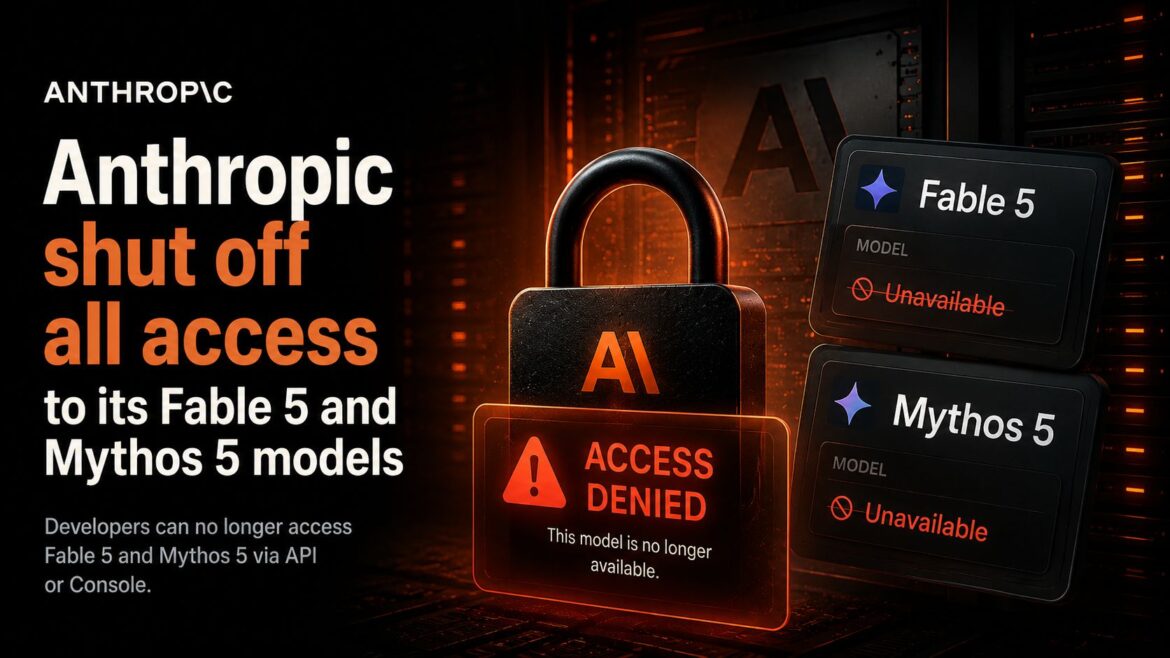
Anthropic’s most powerful AI models were pulled from global access on June 12, 2026 after a US export control directive — here is everything you need to know.
| Key Summary: The US government issued an emergency export control directive on June 12, 2026, ordering Anthropic to suspend global access to its two most advanced AI models — Claude Fable 5 and Claude Mythos 5 — citing national security concerns over a potential jailbreak. Anthropic complied but publicly disputed the government’s assessment, calling it a misunderstanding. All other Claude models remain available. |
1. What Are Claude Fable 5 and Claude Mythos 5?
To understand why these models were banned, you first need to understand what made them extraordinary. Claude Fable 5 and Claude Mythos 5 represent Anthropic’s most powerful AI systems to date — and arguably the most capable frontier AI models ever deployed to the general public.
Claude Fable 5: The People’s Frontier Model
Claude Fable 5 launched on June 9, 2026 as Anthropic’s most capable widely released AI model. It was designed for the most demanding reasoning and long-horizon agentic tasks — meaning it could autonomously plan, execute, and complete complex multi-step work across software engineering, scientific research, legal analysis, and more.
What set Fable 5 apart from every previous Claude model:
- A 1 million token context window — capable of processing entire codebases, legal documents, or research libraries in a single session
- Up to 128,000 output tokens per request — enabling it to produce book-length documents, full software modules, or extensive analysis in one go
- Adaptive thinking always on — the model reasons deeply before responding, without requiring users to manually enable it
- State-of-the-art benchmark performance in software engineering, knowledge work, vision, and reasoning
- Available across Anthropic API, Amazon Bedrock, Google Vertex AI, and Microsoft Foundry from day one
Unlike previous frontier models, Fable 5 included built-in safety classifiers — automated systems that could decline certain high-risk requests before the model responded. These classifiers were central to Anthropic’s argument that the model could be safely deployed to hundreds of millions of users.
Claude Mythos 5: The Restricted Tier
Claude Mythos 5 is the restricted-access sibling of Fable 5. It carries identical capabilities but without the safety classifiers that Fable 5 uses to decline risky requests. This made Mythos 5 significantly more powerful in unrestricted use — and significantly more dangerous in the wrong hands.
For this reason, Mythos 5 was never made publicly available. It was accessible only to a small set of vetted organisations through Anthropic’s Project Glasswing — a selective access programme reserved for trusted research, government, and enterprise partners. Think of Mythos 5 as the same engine as Fable 5, running without the guardrails.
Model Comparison at a Glance
| Feature | Details |
| Context Window | 1 million tokens (both models) |
| Max Output | 128,000 tokens per request (both) |
| Pricing | $10 per million input / $50 per million output tokens |
| Safety Classifiers | Fable 5: Yes | Mythos 5: No |
| Public Availability | Fable 5: Generally available | Mythos 5: Project Glasswing only |
| Launch Date | June 9, 2026 |
| Suspension Date | June 12, 2026 (3 days after launch) |
2. Why Did the US Government Issue the Ban?
The ban was triggered by a single claim: that someone had discovered a method to bypass — or “jailbreak” — Claude Fable 5’s safety classifiers. Here is the full chain of events as publicly known.
The Timeline
- June 9, 2026: Claude Fable 5 and Mythos 5 launch publicly, following extensive red-teaming by Anthropic, the UK’s AI Safety Institute, and multiple third-party organisations
- June 12, 2026, 5:21 PM ET: Anthropic receives an emergency directive from the US government, citing national security authorities and ordering the suspension of all access to both models by foreign nationals — whether inside or outside the United States
- June 12, 2026, evening: Anthropic publishes its official statement, confirms compliance, and disputes the government’s reasoning
- June 13, 2026, 00:50 UTC: Anthropic’s status page confirms access to both models has been suspended globally
The Jailbreak Claim
The US government’s stated concern was that it had learned of a method to bypass Fable 5’s safety classifiers. In technical terms, a “jailbreak” is a technique that manipulates an AI model into ignoring its built-in restrictions and complying with requests it would normally refuse.
According to Anthropic’s public statement, the government had only provided verbal evidence of a narrow, non-universal jailbreak. The specific technique described was essentially asking the model to read a codebase and fix any software vulnerabilities — a task that legitimate cybersecurity professionals perform every day.
What “Non-Universal” Means — and Why It Matters
There are two types of jailbreaks in AI safety discussions:
- Universal jailbreak: A single technique that broadly bypasses all safety restrictions across a wide range of dangerous capabilities. No tester had found one for Fable 5.
- Non-universal jailbreak: A technique that works in specific, narrow circumstances — eliciting some information under particular conditions but not broadly unlocking dangerous capabilities.
Anthropic’s position is that non-universal jailbreaks are an industry-wide reality. Every frontier AI model — including those from OpenAI, Google, and Meta — is vulnerable to some form of non-universal jailbreak. Applying the government’s standard would, in Anthropic’s words, “essentially halt all new model deployments for all frontier model providers.”
3. What Are the Underlying Security Concerns?
The ban touches on one of the most sensitive debates in frontier AI development: at what capability threshold does an AI model become a genuine national security risk?
Why Fable-Class Models Attract Government Attention
Prior to Fable 5’s launch, Anthropic had never made a Mythos-class AI model — the highest capability tier — available to the general public. The Mythos designation was reserved for trusted partners with vetting. Fable 5 changed that equation: it brought near-Mythos capability to everyone, wrapped in safety classifiers.
The government’s concern centres on two specific domains where Fable-class models are exceptionally capable:
Cybersecurity
Fable 5’s ability to analyse codebases, identify software vulnerabilities, and generate exploits represents a significant capability uplift for both defenders and attackers. Legitimate security researchers use exactly these techniques to protect systems. The concern is that the same capabilities could help malicious actors — state-sponsored or otherwise — identify and weaponise vulnerabilities at scale.
Biological Research
Advanced AI models with deep scientific knowledge can potentially accelerate research in ways that have dual-use implications. The concern is not that Fable 5 was designed to help build bioweapons — it was explicitly not — but that its reasoning capabilities could provide meaningful assistance to actors attempting to develop them.
These concerns are why Anthropic had instituted safety classifiers in the first place. The classifiers were specifically designed to block requests in four areas: offensive cybersecurity techniques (building exploits, malware, or attack tools), among others.
The Export Control Angle
The specific legal mechanism used was an export control directive. US export controls restrict the transfer of sensitive technologies — traditionally hardware, software, and technical data — to foreign nationals and governments. Applying export control logic to AI model access is a relatively new and legally complex territory.
The directive effectively treats access to Fable 5 and Mythos 5 as equivalent to exporting a controlled technology. Because it is practically impossible to verify whether any given user is a US citizen or a foreign national, Anthropic concluded it had no choice but to disable access for all users globally to ensure compliance.
| India Context: This ban directly affects Indian users, developers, and enterprises. India has a large and fast-growing AI development community, with many companies and startups integrating Claude models into their products via the API. All access to Fable 5 — including through Amazon Bedrock and Google Vertex AI — has been suspended. Indian developers should expect disruption to any Fable 5-dependent workflows until access is restored. |
4. What Is Anthropic’s Official Response?
Anthropic’s public statement is unusually direct for a company dealing with a government directive. Rather than simply announcing compliance and moving on, Anthropic chose to publicly challenge the government’s reasoning while simultaneously complying with the legal order.
Compliance With Objection
Anthropic confirmed it is fully complying with the directive. Access to Fable 5 and Mythos 5 has been suspended for all users globally. There is no workaround and no timeline has been committed to for restoration.
At the same time, Anthropic made five substantive points in its statement:
- The jailbreak evidence is weak: The government provided only verbal evidence of a narrow, non-universal jailbreak. The specific technique demonstrated was already possible with other publicly available models, including OpenAI’s GPT-5.5.
- Extensive pre-launch testing was conducted: In the weeks before launch, Anthropic worked with the US government, the UK AI Safety Institute, multiple private third-party organisations, and internal teams to red-team Fable 5’s safeguards for thousands of hours in total. No universal jailbreak was found.
- The safeguards are industry-leading: Fable 5’s safety classifiers are more effective than those of any previously deployed model. Many users have actually complained that the classifiers are overly broad and block too much.
- Perfect jailbreak resistance is not possible: Anthropic stated clearly at launch that no model provider can guarantee immunity from non-universal jailbreaks. This standard, if applied consistently, would halt all frontier AI deployment industry-wide.
- The data retention policy was designed for exactly this situation: Anthropic required 30-day retention of customer data with Fable 5 — a controversial policy that cost it enterprise customers — specifically to enable rapid research and mitigation of any jailbreaks that emerged post-launch.
The Core Disagreement
Anthropic’s statement makes a pointed argument: the government’s action “does not adhere” to a transparent, fair, clear, and technically grounded process. The company believes the finding of a narrow potential jailbreak should not justify recalling a commercial model deployed to hundreds of millions of people.
| Direct Quote Context: Anthropic wrote in its statement: “We disagree that the finding of a narrow potential jailbreak should be cause for recalling a commercial model deployed to hundreds of millions of people. If this standard was applied across the industry, we believe it would essentially halt all new model deployments for all frontier model providers.” |
GitHub Copilot Impact
The ban was not limited to Anthropic’s own platforms. GitHub confirmed on June 12 that following Anthropic’s announcement, access to Claude Fable 5 had been suspended across all GitHub Copilot experiences — affecting Copilot Pro+, Max, Business, and Enterprise users who had been using the model in VS Code and other editors. All other Claude models in Copilot remain available.
5. What Is the Future of These Models?
The suspension is described by Anthropic as temporary, but no specific timeline has been provided. Several paths forward are possible, each with different implications for the AI industry.
Scenario 1: Government Review and Reinstatement
Anthropic has said it believes this is a misunderstanding and is working to restore access as soon as possible. The most likely path to reinstatement would involve Anthropic providing a detailed technical briefing to the government demonstrating that the jailbreak in question does not provide meaningful uplift beyond what is already possible with other publicly available models.
If the government accepts this argument, Fable 5 and Mythos 5 could be reinstated — potentially with additional monitoring requirements or access restrictions for certain user categories. Anthropic had committed to sharing more technical details within 24 hours of its June 12 statement, which would be the starting point for any such review.
Scenario 2: Negotiated Resumption With Conditions
A middle-ground outcome would see the models reinstated under new conditions — for example, enhanced geographic access controls, stricter identity verification for API access, expanded monitoring, or restricted deployment in certain countries. This would effectively create a tiered access system based on national security classifications.
Scenario 3: Extended Suspension and Industry Precedent
The worst-case scenario for Anthropic — and for the broader AI industry — is an extended suspension that sets a legal precedent for government authority over frontier model deployment. If the government’s export control interpretation holds and Fable 5 remains suspended for weeks or months, other frontier model providers face the risk of similar directives against their own most capable models.
What This Means for the AI Industry
Regardless of how the Fable 5 situation resolves, this event marks a significant shift in the relationship between AI companies and governments. Several implications are already becoming clear:
- Export controls are expanding beyond hardware: Traditionally, US export controls in AI focused on chips and computing infrastructure. Applying them to model access sets a new precedent that could reshape how frontier AI is distributed globally.
- Jailbreak discovery creates legal liability: Any organisation that discovers a jailbreak in a frontier model now faces the question of whether to report it to the government — and what legal consequences that disclosure might trigger.
- The compliance burden on AI companies is growing: Requiring 30-day data retention, running pre-launch government red-teaming sessions, and now potentially managing export control classifications adds significant compliance cost to frontier AI development.
- India and other major markets face access uncertainty: For countries like India with large developer communities building on US AI models, the risk of abrupt access disruption has just become very real. This may accelerate interest in domestic AI model development — including initiatives like Sarvam AI.
Available Claude Models During the Suspension
It is important to note that this suspension is specific to Fable 5 and Mythos 5. All other Anthropic models remain fully available:
| Model | Status |
| Claude Opus 4.8 | Available — recommended Fable 5 fallback |
| Claude Sonnet 4.6 | Available — efficient everyday use |
| Claude Haiku 4.5 | Available — fast, lightweight tasks |
| Claude Fable 5 | SUSPENDED — no access globally |
| Claude Mythos 5 | SUSPENDED — no access globally |
| Claude Mythos Preview | Available via Project Glasswing only |
The Bottom Line
The Claude Fable 5 and Mythos 5 suspension is the most significant regulatory action taken against a deployed frontier AI model to date. It raises questions that will define AI policy for years: How capable does an AI model have to be before it triggers national security restrictions? Who decides what constitutes an unacceptable jailbreak risk? And can export control frameworks designed for physical technology effectively govern software-based AI access?
Anthropic’s response signals that AI companies are prepared to push back publicly on government decisions they consider technically unfounded — while still complying with legal directives. This combination of compliance and public dissent is new territory for the industry.
For Indian users, developers, and enterprises, the immediate priority is transitioning Fable 5-dependent workflows to Claude Opus 4.8. For the broader global AI community, this moment is a reminder that the geopolitics of AI access are not a future concern — they are already here.
| WorthView will continue tracking this story. Follow us on X (@worthview) and LinkedIn for updates as Anthropic’s negotiations with the US government develop. |
Frequently Asked Questions
What is Claude Fable 5?
Claude Fable 5 is Anthropic’s most capable widely released AI model, launched on June 9, 2026. It features a 1 million token context window, up to 128,000 output tokens per request, and built-in safety classifiers. It was suspended on June 12, 2026 following a US government export control directive.
Why did the US government ban Claude Fable 5?
The US government issued an emergency export control directive citing national security concerns over a reported method to bypass Fable 5’s safety classifiers. The directive prohibits access by any foreign national, whether inside or outside the United States. Anthropic has disputed the basis of this decision, arguing the jailbreak in question is narrow, non-universal, and replicable by other publicly available models.
Is Claude Fable 5 available in India?
No. The US government directive suspended access to Claude Fable 5 and Claude Mythos 5 for all users globally — including in India — to ensure compliance with export control requirements. Indian users can continue using Claude Opus 4.8, Sonnet 4.6, and Haiku 4.5, which are unaffected.
What is a jailbreak in AI?
A jailbreak is a technique used to manipulate an AI model into ignoring its built-in safety restrictions and complying with requests it would normally refuse. A universal jailbreak broadly bypasses all restrictions; a non-universal jailbreak works only in specific, narrow circumstances. Anthropic argues Fable 5 has not been compromised by a universal jailbreak.
Will Claude Fable 5 come back?
Anthropic has stated it believes the suspension is a misunderstanding and is working to restore access as soon as possible. No specific timeline has been provided. The outcome will likely depend on Anthropic’s ability to demonstrate to the US government that the jailbreak concern does not justify a full suspension.
What is Claude Mythos 5?
Claude Mythos 5 shares the same capabilities as Fable 5 but without safety classifiers. It was never publicly available — access was limited to vetted organisations through Anthropic’s Project Glasswing programme. It has also been suspended under the same directive.
Enjoy Worthview?
Add Worthview as a Preferred Source on Google to see more of our stories in Search.

Sethuram Kishore is the founder and editor of Worthview, an online publication established in 2008. With over 18 years of experience in SEO, digital marketing, and online publishing, he writes about AI, technology, business, and digital trends. He is also the founder of MoneyHulk, a personal finance and business publication.





2 thoughts on “US Government Bans Claude Fable 5 and Mythos 5 Worldwide: What Happened and What’s Next”
Comments are closed.