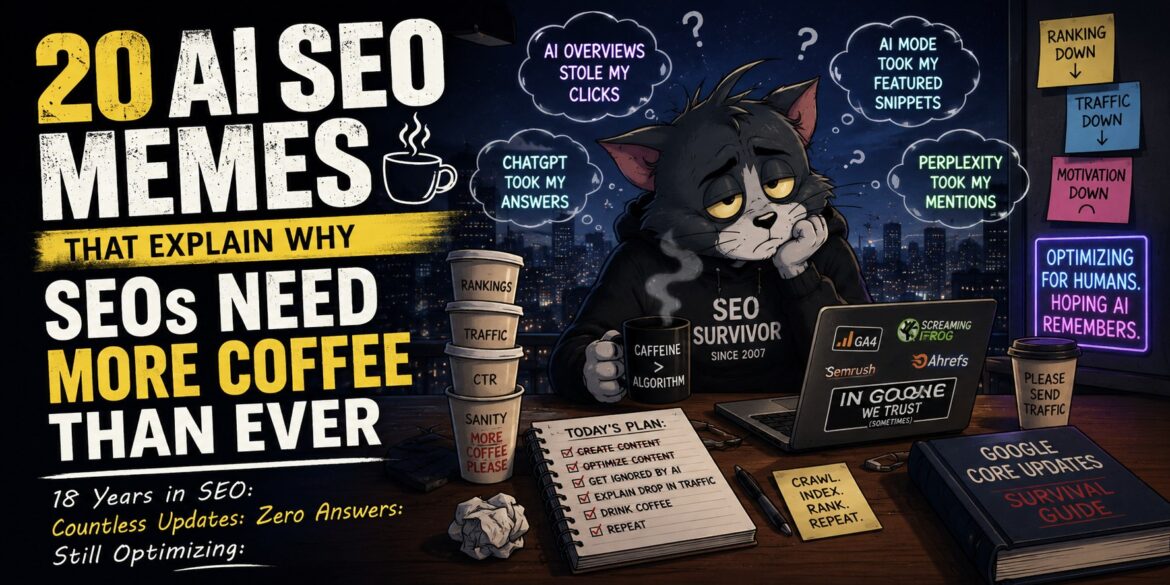
I started ranking websites back in 2008. Over the last 18 years, I’ve watched the digital landscape rewrite its rules a thousand times. I survived the brutal hand of the original Florida update, successfully navigated the absolute wreckage of Panda and Penguin, lived through the structural shift to mobile-first indexing, and witnessed the complete homogenization of the SERPs. Every single time Google shook the table, the industry panicked, adjusted its strategies, and found a way to win. We always did.
But this current era? The dawn of zero-click Search Generative Experience, LLM web scrapers acting as answers, and programmatic AI optimization? This is a completely different beast.
We aren’t just adjusting the knobs on keyword density or link-building vectors anymore; we are actively treating a multi-trillion parameter neural network like a temperamental client who refuses to leave a link behind.
If you don’t laugh through the algorithm updates, you’ll end up changing careers to artisanal woodworking. So, to my fellow veterans and the brave newcomers staring into the void of the Search Console, I compiled 20 brutally real memes and insights to capture our collective collective trauma. Grab a fresh cup of coffee—you are absolutely going to need it.
PHASE 1: THE AI VS. SEO REALITY CHECK
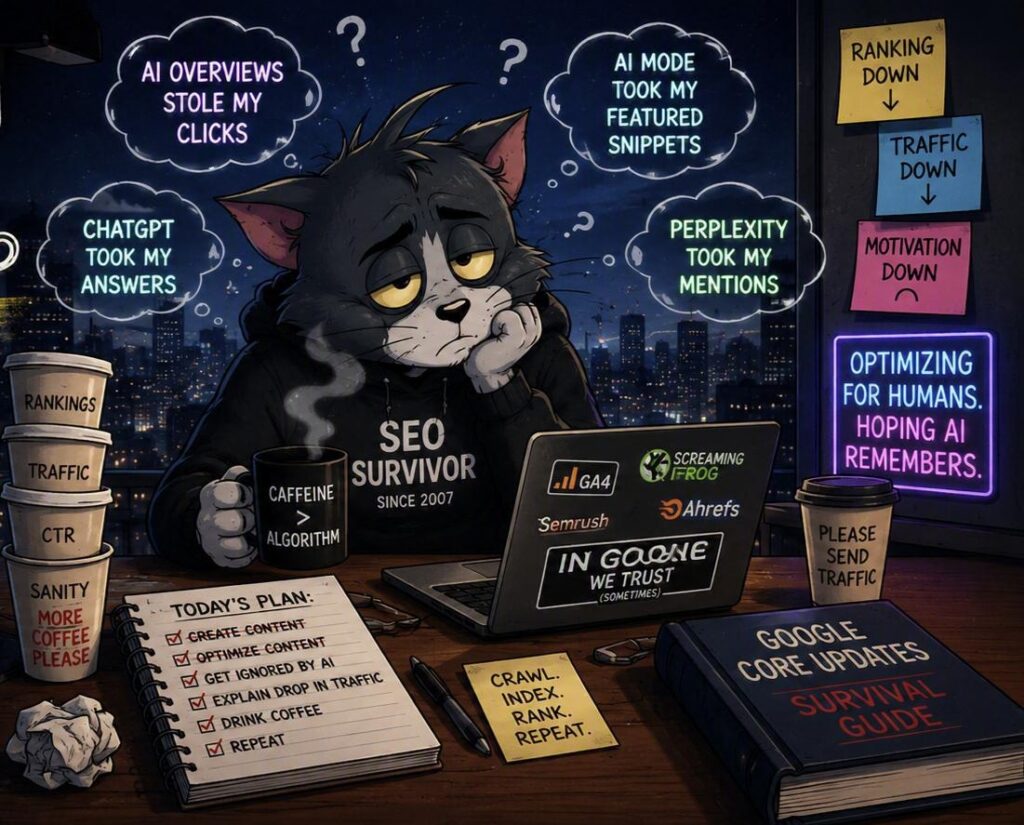
SEO in 2026: We write the content, AI gets the clicks, and clients ask why organic traffic is down.
The ultimate distribution of labor in the modern era. We do the primary research, and a scraper synthesizes it into a neat paragraph so the user never has to discover our URL exists.
Client: “Can we rank #1 for this high-intent commercial keyword?”
SEO: “Best I can do is get cited as ‘Source [3]’ inside a 4-point bulleted summary that the user skims without ever clicking through.”
Remember when ranking #3 meant a steady stream of organic conversions? Now it just means you’re an unclickable footnote in an automated answer engine.
“I used to spend 80% of my time finding high-volume keywords and 20% writing content.
Now I spend:
5% prompting an LLM,
5% heavy editing, and
90% explaining to stakeholders why Google’s AI Overviews just legally stole our organic traffic.”
The modern workflow involves less technical optimization and significantly more corporate diplomacy to preserve your marketing budget.
Google: Create helpful content for users.
Also Google: Thanks, we’ll answer the query ourselves. 🫠
Mixed signals don’t even begin to cover it. It’s like being invited to a dinner party only to find out you’re locked in the pantry while someone else eats your dish.
SEO in 2026: We optimize for search engines. Search engines optimize for AI. AI optimizes for itself. Meanwhile, we’re just over here optimizing our LinkedIn profiles.
The existential loop of modern optimization. When the platform abstracts the user entirely, who are we actually building for?
PHASE 2: THE SEARCH CONSOLE DESPAIR
The 2026 SEO Dashboard KPI Breakdown:
CTR Down 45%
Impressions Down 30%
Rankings Down 12%
“It Depends” Answers Up 10,000%
Coffee Consumption All-Time High
If “It depends” could be monetized, every single veteran consultant from the early 2000s would own a private island by now.
My therapist told me to avoid toxic and abusive relationships that manipulate my emotions, so I completely uninstalled Google Search Console.
Logging in on a Monday morning after an unannounced core algorithm update is an extreme sport that requires deep breathing exercises.
SEO Manager: “Incredible news! Our deep-dive industry report was used to train the latest foundation LLM!”
Client: “Awesome! So how much organic referral traffic did that drive?”
SEO Manager: *[Changes Slack status to ‘Away’ indefinitely]*
The ultimate bittersweet victory: your content is so authoritative that machines eat it to replace you, yielding zero traffic attribution in return.
Checking the real-time analytics real-time traffic graph during a core update rollout feels exactly like watching a volatile cryptocurrency ticker during a market crash. Just pure chaos.
Eighteen years of doing this, and that specific stomach-drop feeling when lines trend down never truly goes away.
The 5 Stages of an SEO Core Update:
1. Denial: “It’s just a temporary tracking glitch.”
2. Anger: “Why does Reddit rank for commercial intent?!”
3. Bargaining: “Maybe if I disavow these links…”
4. Depression: “AI won.”
5. Acceptance: *Orders a triple-shot espresso and rewrites the content architecture.*
We cycle through all five stages in roughly forty-five minutes every single time a fresh announcement hits the search status dashboard.
PHASE 3: THE REALITY OF “ANSWER ENGINE OPTIMIZATION”
Explaining my job to my parents over the years:
• 2010: “I help websites rank on Google.”
• 2018: “I optimize user experiences for organic intent.”
• 2026: “I perform digital rituals to convince a trillion-parameter robot that our local plumbing client is a trustworthy entity.”
The technical reality has shifted from clean semantic markup to conversational manipulation of latent semantic spaces.
LLM Chatbot: *Instantly copy-pastes my 3,500-word skyscraper guide into a tidy 3- sentence summary.*
User: “Wow, AI is absolutely brilliant!”
Me, weeping softly: “I spent three solid weeks interviewing subject matter experts to synthesize those three sentences.”
The value extraction is real. The AI isn’t inherently brilliant; it just has perfect access to the digital labor of thousands of writers.
“Remember when our primary competition was just other companies in our niche?
Good times. Now my primary organic search competitor is the search engine itself.”
The ultimate conflict of interest: the platform hosting the marketplace has decided it wants to sell all the goods directly using your inventory notes.
SEO Content Brief in 2026: “Write a definitive guide on enterprise tax structures, but structure it specifically so an AI agent can read it, extract the semantic entity, and surface it without needing a human to click.”
We are literally ghostwriting for the machines that are actively trying to bypass human attention entirely.
“Optimize for the user,” they said. What they omitted was that the modern user has completely outsourced their reading, clicking, and thinking habits to an automated browser extension.
When bots optimize pages for other bots to read on behalf of human users, traditional conversion rate optimization goes right out the window.
PHASE 4: AGENCIES, CLIENTS, AND THE FUTURE
SEO Agency Job Postings in 2026:
• Required: 5+ years experience in technical architecture, programmatic data, and advanced vector search mechanics.
• Highly Desired: Extreme emotional resilience for when the SERP layout shifts entirely on a Tuesday afternoon.
A background in psychological counseling or crisis management is rapidly becoming a vital competitive asset for search teams.
Client: “I read an article saying AI completely killed SEO forever. Should we fire you and just buy a ChatGPT team license instead?”
Me (with 18 years experience): “Who do you think prompts the AI to write the content that tries to rank on the engine that’s trying to hide it?”
The loop never ends. The complexity hasn’t vanished; it has merely compounded into layers of prompt management and systemic navigation.
“Nothing balances your morning coffee quite like an unexpected, unannounced, un-documented foundational algorithm pivot that fundamentally alters how structured data behaves.”
Who needs pre-workout when you can just check your position tracking software and see half your absolute keyword visibility vanish overnight?
AI: “I can spin up 500 programmatic localized landing pages in under four minutes!”
Indexation Queue: “Fantastic, I will look at exactly three of them sometime over the next six fiscal months.”
Production is incredibly cheap now, but discovery and indexation remain the ultimate scarce premium commodities in the search ecosystem.
Eighteen years in this industry has taught me one profound truth: SEO isn’t dying; it’s just transitioning into a high-stakes chess match where the board changes shape while you’re trying to move your knight. Pour another cup.
We will adapt, rebuild our tracking setups, re-engineer our content hubs, and keep winning. But we are absolutely going to burn through a lot of dark roast doing it.
Bonus: Fresh Ones for the Article
21. We optimized for search engines. Nobody told us we’d have to optimize for conversations.
22. Google says don’t write for algorithms. The algorithms keep sending me requirements.
23. Every AI tool promises to save time. I spend that time learning the next AI tool.
24. My content ranks #1… inside Google’s AI answer.
25. In SEO, yesterday’s best practice is tomorrow’s LinkedIn apology post.
26. SEO veterans don’t fear change. We fear another “helpful” update.
27. AI took my clicks but somehow increased my reporting workload.
28. The new SEO funnel: Create → Rank → Get summarized → Cry → Repeat.
29. I wanted to become a marketer. Somehow I became an algorithm therapist.
30. The real SEO KPI in 2026: Mentions, citations, and maintaining your sanity.
The Ultimate Verdict
Eighteen years in this game teaches you one undeniable truth: search optimization isn’t dying, it’s just shedding its old skin again. We survived the text-heavy chaos of the early 2000s, the destructive cleanups of Panda and Penguin, and the shift to mobile. Navigating AI models and answer engines is simply the next high-stakes layer of the matrix.
Production has become incredibly cheap, but real authority, discovery, and indexation are more premium commodities than ever. So, let the algorithms shift and let the AI bots summarize. We’ll keep tracking the changes, editing the prompts, adjusting the architectures, and finding the gaps to win—just like we always have.
Now, raise your mug, check your Search Console one last time before the weekend, and go get that refill. We’ve got work to do. ☕
Enjoy Worthview?
Add Worthview as a Preferred Source on Google to see more of our stories in Search.

Sethuram Kishore is the founder and editor of Worthview, an online publication established in 2008. With over 18 years of experience in SEO, digital marketing, and online publishing, he writes about AI, technology, business, and digital trends. He is also the founder of MoneyHulk, a personal finance and business publication.