Artificial Intelligence (AI) is everywhere—helping us with directions, recommending shows, answering our questions, and more. But there’s a new buzzword in the AI world: Agentic AI. And people are often confused between AI Agents and Agentic AI.
If you’re one of them, don’t worry. In this article, we’ll break down the basics in the simplest way possible. No jargon, no technical talk—just clear, easy-to-understand language.
What is an AI Agent?
Let’s start simple.
An AI Agent is a computer program designed to do a specific task. Think of it like a helpful robot assistant that follows instructions.
For example:
-
A chatbot that answers questions on a website.
-
A voice assistant like Siri or Alexa that sets alarms or tells you the weather.
-
A recommendation system on Netflix or Amazon.
👉 These agents are good at one job and usually wait for a command to act.
What is Agentic AI?
Now, here’s where it gets interesting.
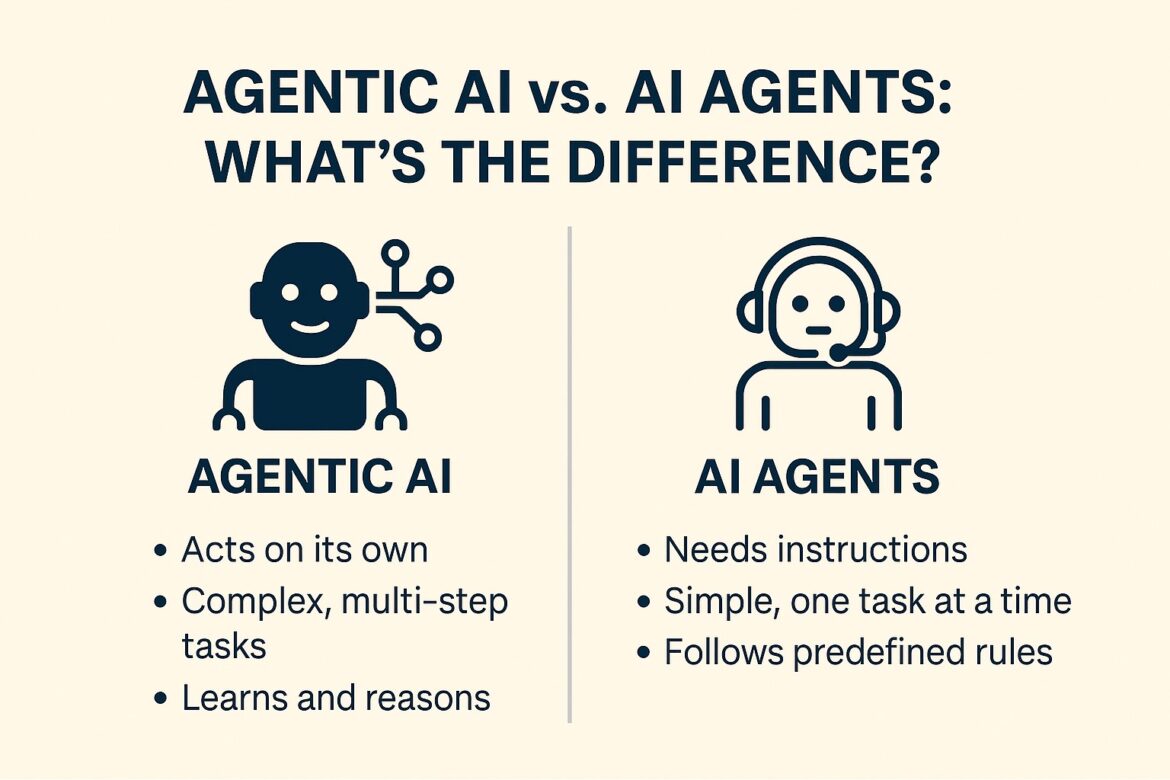
Agentic AI is more advanced. It doesn’t just wait for instructions—it takes the lead.
Imagine a super-smart assistant that not only follows your orders but also:
-
Plans ahead.
-
Learns from past actions.
-
Makes decisions by itself.
-
Takes action without being told every time.
It’s like having a project manager instead of just a helper. Agentic AI can coordinate multiple tasks and handle complex goals—all with little or no human help.
🆚 So, What’s the Difference?
| Feature | AI Agents | Agentic AI |
|---|---|---|
| Task type | Simple, one task at a time | Complex, multi-step tasks |
| Initiative | Waits for human instruction | Can act on its own |
| Decision making | Basic (pre-programmed rules) | Smart (learns and reasons) |
| Adaptability | Low | High |
| Example | Chatbot, voice assistant | Virtual researcher, auto-manager |
Real-Life Example
AI Agent: You ask your voice assistant, “What’s the weather today?” It checks and tells you.
Agentic AI: It knows your schedule, checks the weather before you ask, and sends a notification: “It might rain during your 3 PM meeting—carry an umbrella.”
See the difference?
Are AI Agents Part of Agentic AI?
Yes! You can think of AI Agents as building blocks. Agentic AI is the full system that brings these blocks together and makes them work as a smart, independent unit.
🔧 Tools for AI Agents
These tools are designed to perform specific tasks, often triggered by a user prompt or predefined rule.
Examples:
| Tool / Platform | What it Does |
|---|---|
| ChatGPT (classic use) | Responds to questions or prompts. Doesn’t act on its own. |
| Siri / Alexa / Google Assistant | Voice-based assistants that follow your commands. |
| Zapier Bots | Automates specific workflows (e.g., send an email when a form is filled). |
| Replika AI | Chatbot that holds conversations, mimics a companion. |
| IFTTT (If This Then That) | Triggers actions based on user-defined conditions. |
| Google Bard / Gemini (prompt-based) | Responds to inputs but doesn’t plan or act independently. |
Practical Implications
The rise of Agentic AI has profound implications across various sectors:
-
Workplace Transformation: Agentic AI systems are reshaping job roles by taking on complex tasks, thereby allowing human workers to focus on higher-level strategic activities.
-
Cybersecurity Enhancements: In cybersecurity, Agentic AI enables faster and more autonomous threat detection and response, improving defense mechanisms against sophisticated attacks.
-
Enterprise Automation: Businesses are leveraging Agentic AI to automate intricate processes, leading to increased efficiency and the potential for new business models.
Why It Matters
As technology grows, we’re moving from tools that assist us to systems that can think, decide, and act with us—or even for us.
Understanding the difference between AI agents and Agentic AI helps you:
-
Stay updated with tech trends.
-
Make smarter choices when using AI tools.
-
Know what to expect in the near future.
Enjoy Worthview?
Add Worthview as a Preferred Source on Google to see more of our stories in Search.

Worthview Editorial Team is the shared byline for content created collaboratively by Worthview’s editors and contributors. Since 2008, we’ve published thousands of articles across technology, AI, finance, health, home, travel, and lifestyle. Our editorial process emphasizes original research, reputable sources, regular content updates, and clear attribution. Articles covering higher-trust topics, including health and finance, may also undergo review by qualified subject-matter experts.