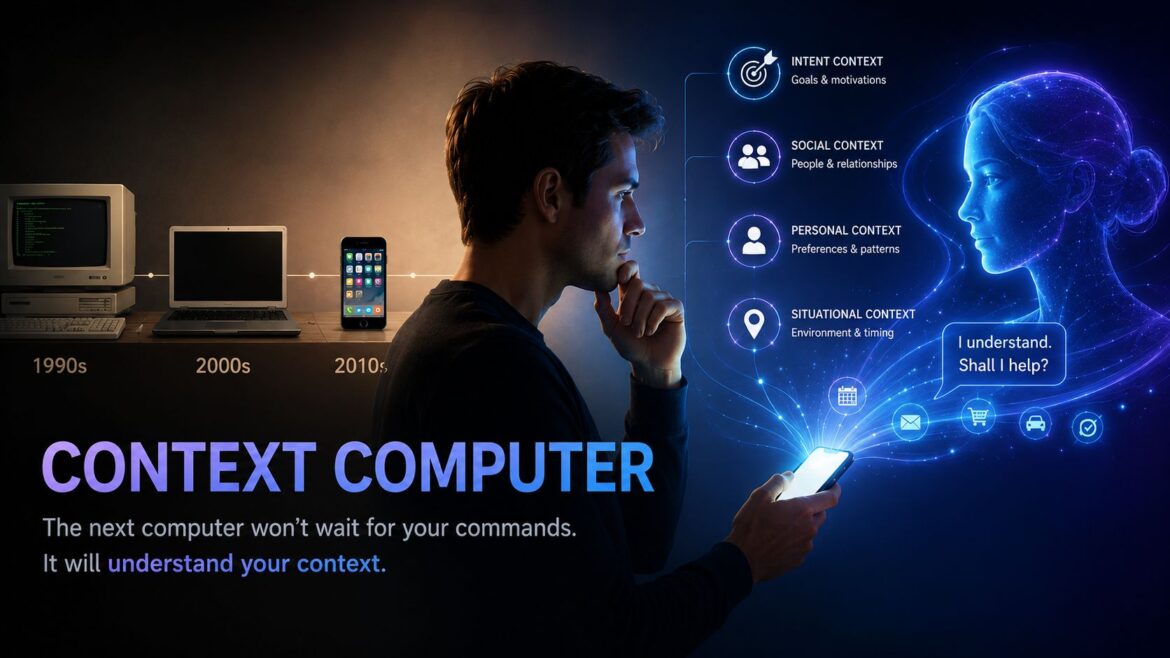
The next era of computing won’t be powered by faster processors or bigger screens. It will be powered by context.
Computers Have Always Waited
If you pause for a moment and think about every computer you’ve ever owned—whether it was a bulky desktop from the early 2000s, a sleek MacBook, or the smartphone in your pocket—you’ll notice they all have one thing in common.
They wait.
They wait for you to unlock the screen.
They wait for you to open an app.
They wait for you to type a question, tap a button, or tell them exactly what you want.
For decades, we’ve accepted this as the natural way to interact with technology. Computers don’t act until we ask them to. Every improvement over the last forty years—from faster processors to brighter displays and smarter software—has made those interactions quicker, but it hasn’t fundamentally changed the relationship.
The human still does most of the work.
That assumption is now beginning to crack.
When OpenAI announced its partnership with legendary designer Jony Ive and acquired the hardware startup io, much of the conversation focused on a simple question: What kind of device are they building? People speculated about AI phones, smart glasses, wearable assistants, and entirely new gadgets.
It’s an understandable question, but it may also be the wrong one.
The more interesting story isn’t the hardware itself. It’s the shift in thinking behind it.
What if the next generation of computers didn’t wait for instructions?
What if they understood enough about your day, your habits, your relationships, and your goals to help before you even thought to ask?
That idea deserves a new name.
In this article, we’ll call it the Context Computer—a new way of thinking about personal computing where understanding your situation becomes just as important as processing your commands.
Whether OpenAI’s first device succeeds or not is almost beside the point. The bigger story is that, for the first time since the smartphone changed our lives, one of the world’s leading AI companies is challenging a basic assumption we’ve lived with for decades:
Maybe the future of computing isn’t about opening better apps. Maybe it’s about needing fewer of them in the first place.
Key Takeaways
- The next generation of computers won’t just follow instructions—they’ll understand context.
- OpenAI’s hardware strategy is less about building a new gadget and more about redefining personal computing.
- The Context Computer is a new model where AI understands your situation, preferences, relationships, and intent.
- The Context Pyramid explains the four layers that make context-aware AI possible.
- Smartphones won’t disappear—they’ll evolve into gateways for AI-driven decisions.
- Search and SEO will shift from matching keywords to understanding user goals and context.
We’ve Been Living in the Instruction Economy
Imagine it’s 7:30 on a weekday morning.
You’re running late for work. You remember that you promised to book a table for dinner, pay your electricity bill, and send your manager a message saying you’ll arrive ten minutes late.
None of these tasks are particularly difficult.
But watch what actually happens.
You unlock your phone.
Open WhatsApp.
Send the message.
Close it.
Open your banking app.
Pay the bill.
Close it.
Open Google.
Search for restaurants.
Read reviews.
Open Maps.
Check the distance.
Switch to your calendar.
Confirm you’re free.
Go back.
Reserve the table.
In less than five minutes, you’ve opened half a dozen apps, repeated the same information several times, and made dozens of tiny decisions. None of them required much intelligence. They were simply the cost of coordinating software.
We’ve become so used to this routine that we rarely question it.
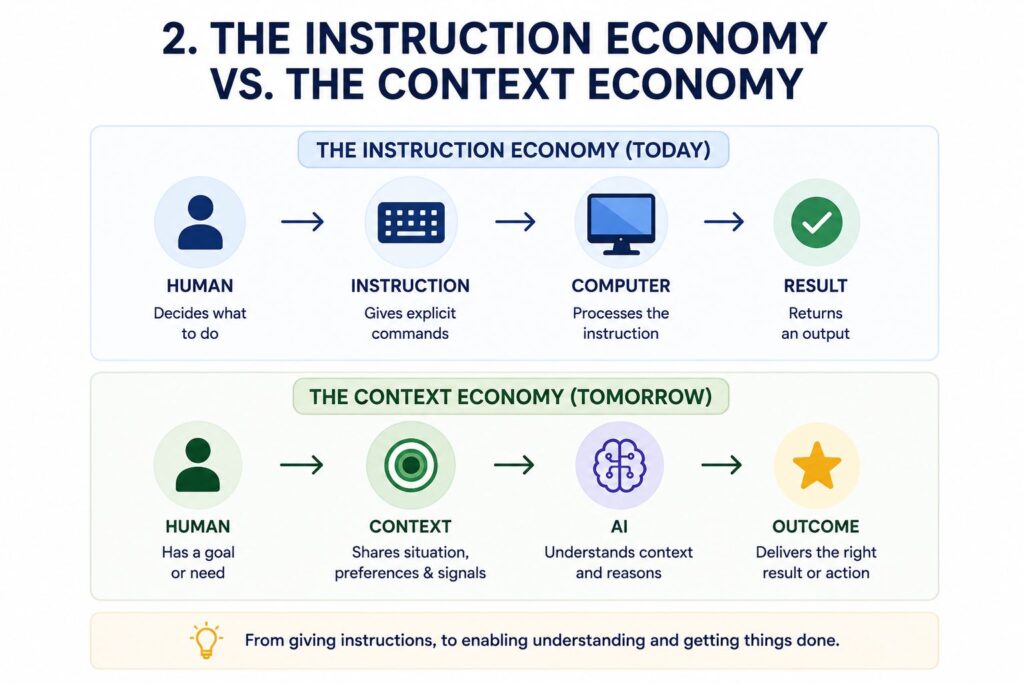
For decades, computers have operated on a simple agreement:
You provide the instructions. I’ll do exactly what you tell me.
That agreement shaped the entire digital world.
Every app on your phone waits to be opened.
Every website waits to be visited.
Every search engine waits for a query.
Even today’s AI assistants, despite sounding remarkably human, still begin most conversations with the same question:
“How can I help you?”
It’s a polite question—but it reveals an old way of thinking.
The computer still expects you to recognize a problem, decide what information is relevant, and translate your need into a prompt or command.
In other words, the human remains the operating system.
I like to think of this as the Instruction Economy—an era where the value of technology came from how efficiently it could follow commands.
The command line required typed instructions.
The graphical interface replaced commands with clicks.
Smartphones replaced clicks with taps.
Voice assistants replaced taps with spoken requests.
Each generation made computers easier to instruct.
But none of them questioned the assumption that the instruction must always come first.
That’s why today’s AI can feel both magical and strangely exhausting.
It can write an essay, summarize a meeting, generate software, or plan a vacation in seconds. Yet before it can do any of that, you still have to explain your situation. You have to provide the context that only you possess.
And that’s where the next shift in computing begins.
Perhaps the future isn’t about making computers better at following instructions.
Perhaps it’s about building computers that need fewer instructions in the first place.
Context Is the Interface
Imagine calling your best friend and saying only one sentence.
“Let’s go to our usual place.”
You don’t mention the restaurant.
You don’t share the address.
You don’t explain what time.
You don’t even need to say who “we” is.
Yet somehow, your friend understands exactly what you mean.
Not because the sentence contains all the information.
But because your friend already knows the context.
Humans communicate this way every day.
We don’t exchange perfectly detailed instructions. We rely on shared experiences, habits, memories, relationships, and expectations. Context fills in the blanks.
Computers have never been good at this.
If you’ve ever used a GPS app, you know the routine.
You type the destination.
Select the location.
Choose the route.
Confirm the journey.
Every single trip starts from scratch.
The computer doesn’t know that every weekday at 8:30 a.m. you’re probably driving to work. It doesn’t know that on Friday evenings you often stop for groceries on the way home. It doesn’t know that your daughter has swimming lessons every Saturday morning or that you prefer taking the scenic route when you’re not in a hurry.
Not because it’s impossible.
Because traditional computers were never designed to think that way.
For decades, the interface between humans and computers has been visible.
First it was a keyboard.
Then a mouse.
Then icons.
Then touchscreens.
Then voice.
Each generation made interaction easier, but the interface itself remained something you had to consciously use.
What if the next interface wasn’t something you could see at all?
What if the interface was simply understanding?
That’s the idea behind what I’m calling the Context Computer.
Instead of waiting for complete instructions, a Context Computer begins with what it already knows—with your calendar, location, routines, preferences, relationships, devices, and recent conversations. It combines those pieces into a picture of your current situation before deciding how it can help.
Notice the difference.
Today’s AI often asks:
“What would you like me to do?”
A Context Computer might say:
“You usually leave for the airport an hour before your flight. Traffic is unusually heavy today. If you leave in the next fifteen minutes, you’ll still arrive on time.”
The goal isn’t to make computers smarter for the sake of it.
The goal is to make interactions feel more human.
When a close friend reminds you to carry an umbrella because they noticed dark clouds outside, you don’t think they’re showing off their intelligence. You think they’re being thoughtful.
That’s the kind of relationship future AI systems are trying to create—not one based on commands, but one based on awareness.
This is why I believe context will become the next great interface in computing.
The keyboard reduced physical effort.
The touchscreen reduced mechanical effort.
Artificial intelligence reduces cognitive effort.
Context reduces explanatory effort.
And that may be the biggest leap of all.
The Context Pyramid: The Four Layers That Make AI Truly Intelligent
One of the biggest misconceptions about artificial intelligence is that context is just another feature.
It isn’t.
In fact, context may become the most valuable ingredient in the next generation of personal computing.
When people hear that AI will “understand context,” they often imagine a device that knows their location or remembers a previous conversation. While those capabilities matter, they’re only small pieces of a much larger picture.
Context isn’t a single piece of information.
It’s a collection of signals that help a computer understand where you are, who you are, who you’re with, and what you’re ultimately want to accomplish.
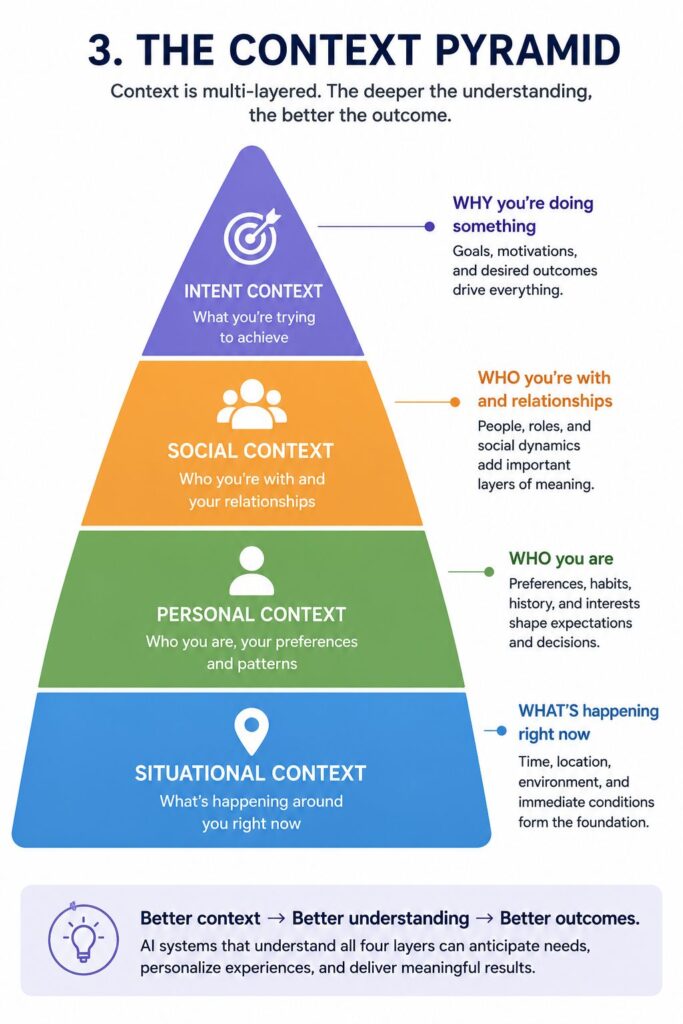
I like to think of this as The Context Pyramid.
Just as a building needs a strong foundation before adding higher floors, a Context Computer builds understanding layer by layer. Each level depends on the one below it. Remove one layer, and the assistant becomes a little less helpful. Remove several, and it becomes just another chatbot waiting for instructions.
Layer 1: Situational Context
At the base of the pyramid is Situational Context—everything happening around you right now.
Where are you?
What time is it?
What’s the weather like?
How much battery does your device have left?
Are you walking, driving, sitting in a meeting, or relaxing at home?
These details change constantly, yet they shape almost every decision we make.
Imagine asking your assistant for the fastest route home.
Without situational context, it simply provides directions.
With situational context, it notices there’s an accident on your usual route, heavy rain is slowing traffic, and your battery is running low. Instead of giving generic directions, it suggests a faster route that passes a charging station on the way.
The request didn’t change.
The quality of the answer did.
Layer 2: Personal Context
The second layer is Personal Context.
This is everything that makes your digital life uniquely yours.
Your daily routines.
Your work schedule.
Your preferred airline.
The coffee you always order.
The fact that you usually exercise after work.
The playlists you listen to during long drives.
Unlike situational context, these patterns don’t change every hour. They develop over weeks, months, and years.
This isn’t about collecting random facts.
It’s about recognizing habits.
A helpful assistant doesn’t need to ask where you work every Monday morning or which music you prefer while studying. Over time, it quietly learns the patterns that make your life feel familiar.
The goal isn’t personalization for the sake of convenience.
It’s reducing repetition.
Layer 3: Social Context
Humans rarely make decisions in isolation.
Our lives revolve around family, friends, colleagues, classmates, and communities.
That’s why the third layer is Social Context.
Imagine receiving a message that simply says:
“Are we still meeting at the usual place?”
You instantly know who sent it.
You know what “usual place” means.
You know what meeting they’re referring to.
A traditional computer doesn’t.
For a Context Computer, understanding relationships becomes just as important as understanding language.
It knows who your closest contacts are, who you work with, which school your children attend, and which conversations are connected to one another.
Not because it’s reading your mind, but because it’s building a map of the relationships that shape your daily life.
Social context transforms isolated pieces of information into meaningful conversations.
Layer 4: Intent Context
At the top of the pyramid sits the most difficult layer of all.
Intent Context.
This is where AI stops asking, “What did you say?” and starts asking, “What are you really trying to achieve?”
Consider this simple search:
“Hotels near Heathrow Airport.”
At first glance, it looks like a request for hotel recommendations.
But the real objective is probably something else.
Perhaps you have an early morning flight.
Maybe your flight was delayed and you need a place to stay overnight.
Or perhaps you’re meeting someone arriving from another country.
The search query tells the computer what you asked.
Intent tells it why you asked.
That difference is enormous.
A Context Computer doesn’t just retrieve information. It tries to understand the problem behind the question.
When it understands your intent, it can begin solving problems instead of simply answering queries.
The Pyramid Changes Everything
For decades, we’ve judged computers by how quickly they process information.
In the age of AI, we’ll increasingly judge them by how well they understand us.
The companies that build the best AI won’t necessarily be the ones with the fastest processors or the biggest language models.
They’ll be the ones that can responsibly combine these four layers of context into a complete picture of your situation—while giving you meaningful control over your privacy and data.
That’s why I believe The Context Pyramid is a useful way to think about the future of personal computing.
The intelligence of tomorrow’s devices won’t come from knowing more facts than today’s computers.
It will come from understanding more of the story behind every interaction.
Why OpenAI Is Thinking Beyond the Smartphone
When OpenAI announced its partnership with legendary Apple designer Jony Ive, the internet immediately began playing a familiar guessing game.
Is it a phone?
Smart glasses?
A wearable assistant?
A screenless device?
Those questions generated thousands of headlines.
But they all assumed that the hardware itself was the story.
It probably isn’t.
The more interesting question is why OpenAI—one of the world’s most successful software companies—felt the need to build hardware at all.
After all, ChatGPT already reaches hundreds of millions of people through browsers, mobile apps, and desktops. If software alone were enough, there would be little reason to invest billions of dollars in designing a completely new kind of device.
That decision hints at something much bigger.
It suggests that the current generation of devices may not be the ideal home for AI.
Think about how we use our phones today.
Every task begins with a ritual.
Wake the screen.
Unlock it.
Find the right app.
Navigate to the right page.
Type or tap your way to what you need.
For social media, shopping, banking, and messaging, this model works remarkably well.
But AI is different.
An intelligent assistant doesn’t naturally fit inside a single app because your life doesn’t happen inside a single app.
Planning a vacation might involve your calendar, email, maps, weather forecasts, airline bookings, currency exchange rates, hotel reservations, and conversations with your family.
Replying to a work message may require understanding your schedule, your location, your previous discussions, and whether you’re currently driving, in a meeting, or at home.
AI isn’t just another application. It’s something that sits across all the applications. That’s an important distinction.
For years, software has been organized into digital islands. Your photos live in one place. Your messages in another. Your calendar somewhere else. Every app knows a little about you, but none of them sees the whole picture.
An AI assistant becomes dramatically more useful when it can connect those islands together.
That’s where hardware begins to matter.
Not because better hardware automatically makes AI smarter, but because hardware determines how naturally AI fits into your daily life.
The smartphone organizes your digital tools.
A Context Computer is designed around awareness. It organizes your digital life.
Those are fundamentally different ideas.
One organizes software.
The other organizes understanding.
This doesn’t necessarily mean smartphones are disappearing. They’re likely to remain one of the most important devices we own for years to come.
But history suggests that every major shift in computing begins with a simple realization: the old interface is no longer the best one.
The mouse didn’t eliminate the keyboard.
Touchscreens didn’t eliminate laptops.
Voice assistants didn’t eliminate touchscreens.
Instead, each new interface expanded what computers could do and how naturally we could interact with them.
OpenAI’s hardware project may represent the next step in that evolution—not because it replaces the smartphone, but because it challenges the assumption that the smartphone should always be the center of our digital lives.
That’s a subtle difference.
And it might turn out to be the most important one.
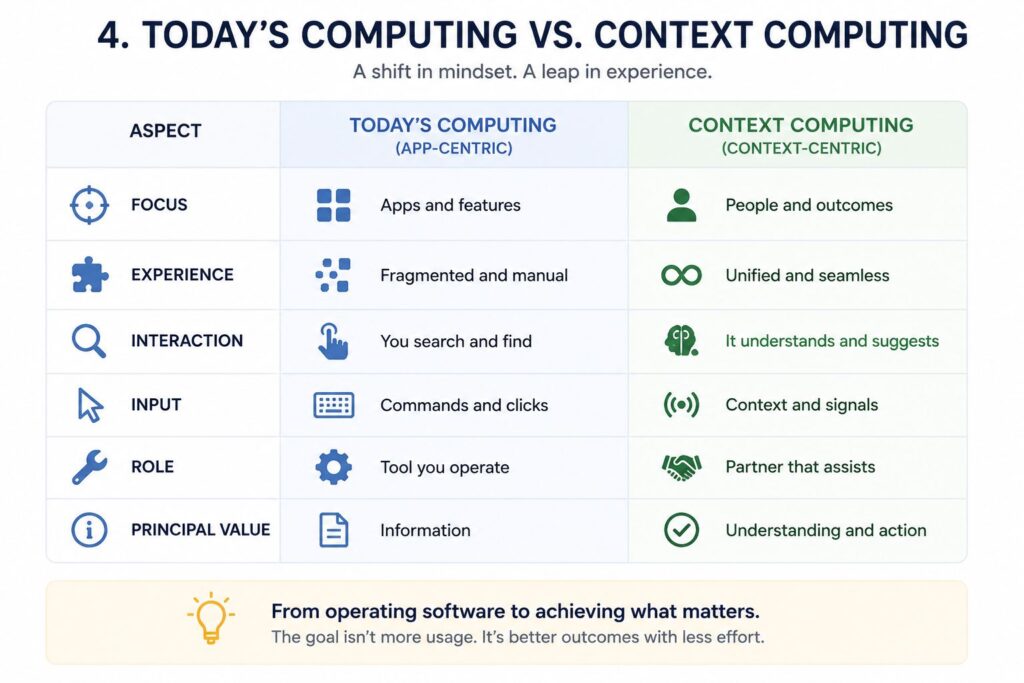
The Smartphone Isn’t Dead. It’s Becoming a Gateway.
Every time a new technology emerges, someone predicts the death of the one that came before it.
When laptops became popular, people said desktop computers were finished.
When smartphones arrived, many believed laptops would become irrelevant.
Neither happened.
Instead, each device found a new role.
The same pattern is likely to repeat with AI.
Over the past two decades, the smartphone has become the control center of our digital lives. It stores our photos, connects us with friends, manages our finances, guides us through unfamiliar cities, and gives us access to millions of apps.
That isn’t going to disappear overnight
But the way we interact with our phones may change dramatically.
Today, the smartphone is the place where we do things. Tomorrow, it may become the place where we approve things.
That’s an important distinction.
Imagine it’s Friday afternoon.
You finish work and decide you’d like to spend the weekend somewhere quiet.
With today’s technology, you’ll probably search for destinations, compare hotel prices, read reviews, check the weather, browse flights, coordinate with your family, and finally complete a series of bookings.
Your phone becomes a tool you actively operate.
Now imagine the same situation a few years from now.
Your AI assistant already knows you have a free weekend.
It remembers that you’ve been talking about taking a short break.
It notices that the weather will be pleasant within a few hours’ drive.
It finds a hotel you’ve stayed at before, checks that the price is lower than usual, and confirms that your calendar is clear.
Instead of asking you to begin the process, it presents a simple suggestion:
“I’ve found a weekend getaway that matches your usual travel preferences. Would you like me to book it?”
At that moment, your phone isn’t acting as a search engine.
It’s acting as a confirmation device.
You’re no longer coordinating ten different services.
You’re reviewing a recommendation that has already been assembled for you.
This shift changes the role of apps as well.
For years, apps have been the primary way we interacted with digital services.
Need food?
Open a delivery app.
Need a ride?
Open another app.
Need to transfer money?
There’s an app for that too.
In a context-driven world, those services don’t necessarily disappear.
They simply move into the background.
The AI becomes the layer that connects them.
The apps become the infrastructure.
Think of it like electricity in your home.
You don’t think about which power station generated the electricity that lights your living room.
You simply turn on the switch.
In the same way, future AI systems may quietly coordinate dozens of services without requiring you to open each one individually.
The individual apps still exist.
They just become less visible.
This is why I see the smartphone evolving into something new.
Not the center of every digital interaction, but the trusted gateway where important decisions are reviewed, sensitive actions are approved, and personal control is maintained.
That future feels far more realistic than a world where smartphones suddenly disappear.
History shows that successful technologies rarely erase what came before them.
They absorb the best parts, redefine their purpose, and make them feel almost invisible.
The smartphone transformed the personal computer.
The Context Computer may do something similar to the smartphone. Not by replacing it, but by changing what we expect it to do.
And if that happens, the biggest innovation won’t be a new device in your pocket.
It will be the fact that you spend far less time managing technology—and far more time simply living your life.
What does this mean for the web, search, and SEO?
For more than two decades, the web has been built around a simple assumption.
When people need information, they search for it.
Every search engine, every SEO strategy, and millions of websites exist because of that single behavior.
A question appears in your mind.
You type it into Google.
You browse a few results.
You choose the answer that best matches what you’re looking for.
That workflow shaped the modern internet.
But what happens when people stop searching—not because they need less information, but because their devices already understand what they’re trying to accomplish?
That’s the question the Context Computer forces us to ask.
Imagine you’re leaving work at 6 p.m.
Today, you might search:
“Best restaurants near me.”
A traditional search engine returns thousands of results.
It doesn’t know whether you’re meeting friends, celebrating an anniversary, taking your family out for dinner, or simply looking for the quickest meal before heading home.
The burden of making the final decision still falls on you.
A Context Computer approaches the same situation differently.
It already knows your location.
It knows who you’re meeting because the dinner is on your calendar.
It remembers that one of your friends is vegetarian.
It notices that traffic is unusually heavy across the city.
It knows you usually prefer quieter places on weekdays.
Instead of presenting hundreds of options, it simply says:
“Based on everyone’s preferences and today’s traffic, I’ve found a restaurant ten minutes away with available seating at 7:00 p.m. Would you like me to reserve a table?”
Notice what just happened.
You never searched.
You never compared reviews.
You never filtered results.
The assistant didn’t replace the web.
It navigated the web on your behalf.
That’s a subtle but profound shift.
For decades, search engines have been optimized to answer explicit questions.
Context Computers will increasingly solve implicit problems.
Those aren’t the same thing.
Search Doesn’t Disappear. It Evolves.
This doesn’t mean Google disappears.
It doesn’t mean websites suddenly become irrelevant.
In fact, AI assistants will need high-quality information more than ever.
The difference is who consumes that information first.
Today, humans visit websites to gather facts.
Tomorrow, AI systems may gather those facts, compare them across multiple trusted sources, and present a recommendation before a human ever opens a browser.
The website remains valuable.
The journey to that website changes.
For publishers, this is both an opportunity and a challenge.
Success will no longer depend solely on attracting clicks.
It will increasingly depend on becoming a trusted source that AI systems choose to reference, summarize, and recommend.
Authority becomes more important than visibility.
Trust becomes more important than traffic.
The Future of SEO Is Understanding Intent
For years, SEO has focused on matching keywords.
Then it evolved toward understanding topics, entities, and search intent.
The Context Computer pushes that evolution even further.
It doesn’t ask:
“Which page best matches this keyword?”
It asks:
“Which information best helps this person achieve their goal right now?”
That’s a fundamentally different ranking problem.
The winners won’t simply publish more content.
They’ll publish more useful, trustworthy, and context-rich content.
In many ways, this future rewards the same qualities that have always created lasting value on the web:
Original thinking.
Real expertise.
First-hand experience.
Clear explanations.
Content that genuinely helps people make better decisions.
Ironically, those are the qualities that search engines have been encouraging for years.
AI simply raises the standard.
The Open Web Still Matters
Some people worry that AI assistants will make websites obsolete.
I don’t believe that’s what happens.
A recommendation still has to come from somewhere.
An answer still needs evidence.
A product still needs a manufacturer.
A news story still needs a reporter.
The Context Computer doesn’t replace the open web.
It depends on it.
The difference is that the web becomes less like a library you visit and more like the knowledge system your AI quietly consults on your behalf.
For website owners, marketers, and publishers, that changes the goal.
The question is no longer:
“How do I rank for this keyword?”
The better question becomes:
“How do I become the source an AI trusts when helping someone solve a real-world problem?”
That may be the most important SEO question of the next decade.
The next generation of digital experiences won’t be optimized only for search engines or AI models.
They’ll be optimized for context—the user’s situation, intent, relationships, and goals at the exact moment they need help.
If that future arrives, we may eventually need a new term for it.
Context Optimization.
Conclusion: The Next Computer May Understand Before You Ask
Every major era of computing has changed the way humans interact with technology.
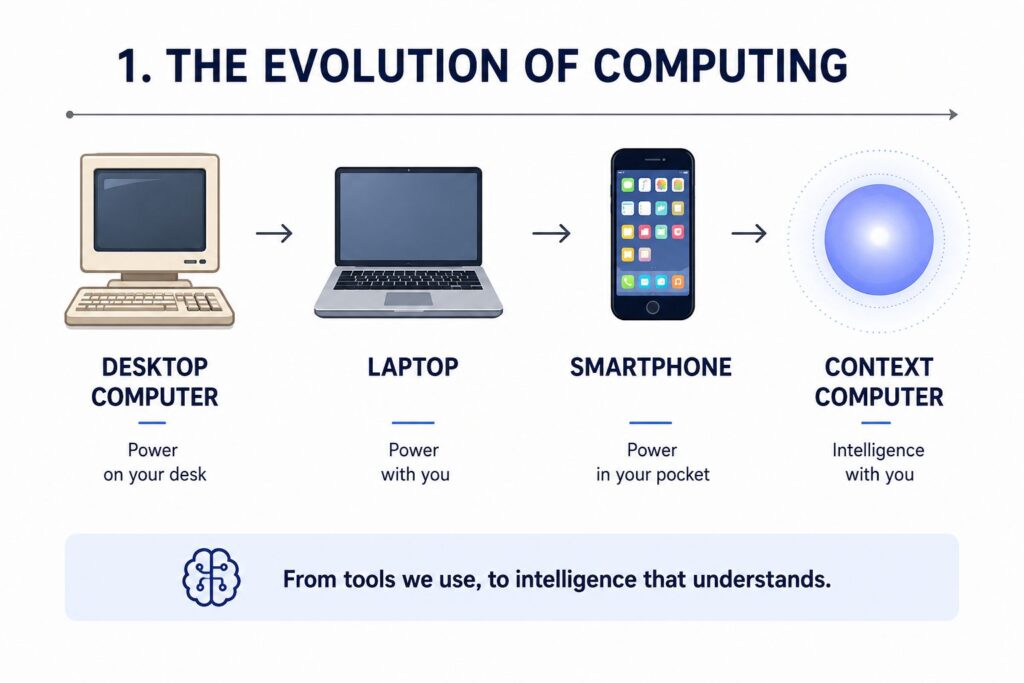
The personal computer put computing on our desks.
The internet connected us to information.
The smartphone put the internet in our pockets.
Artificial intelligence is doing something different.
It isn’t just changing where computing happens.
It’s changing how computing happens.
For decades, computers have waited patiently for instructions.
Click.
Tap.
Type.
Search.
Every interaction began with us.
The next generation of computers may begin somewhere else—with context.
They may understand where we are, who we’re with, what we’re trying to accomplish, and what matters most at that moment. Instead of waiting for perfect instructions, they’ll work with an understanding of the situation itself.
Whether OpenAI’s hardware project succeeds commercially isn’t the most important question.
History is full of products that failed while their ideas reshaped entire industries.
The more important question is this:
What happens when computers stop waiting for commands and start understanding people?
That question reaches far beyond a single device or a single company.
It challenges the assumptions that have guided personal computing for nearly half a century.
Throughout this article, I’ve used the term Context Computer to describe that shift—not as an industry standard, but as a simple way to explain a new direction in computing. I believe we’re moving toward systems where context becomes the primary interface, where understanding becomes more valuable than input, and where achieving outcomes matters more than navigating software.
If that future arrives, we may also need to rethink how we build websites, design applications, create content, and measure digital success.
The web won’t disappear.
Search won’t disappear.
Smartphones won’t disappear.
But each of them may evolve into something different as AI becomes better at connecting information, understanding intent, and quietly helping us accomplish our goals.
Perhaps the biggest innovation of the next decade won’t be a thinner device, a faster processor, or a more powerful language model.
Perhaps it will be something far less visible.
A computer that understands enough about our lives that technology finally fades into the background.
For years, we’ve been teaching humans how to use computers.
The next chapter of computing may be about teaching computers how to understand humans.
And when that happens, the most important interface we’ll ever design may not be a screen, a keyboard, or a voice assistant.
It may simply be context.
Enjoy Worthview?
Add Worthview as a Preferred Source on Google to see more of our stories in Search.

Sethuram Kishore is the founder and editor of Worthview, an online publication established in 2008. With over 18 years of experience in SEO, digital marketing, and online publishing, he writes about AI, technology, business, and digital trends. He is also the founder of MoneyHulk, a personal finance and business publication.







One thought on “The Context Computer: Why OpenAI Is Redefining Personal Computing”
Comments are closed.