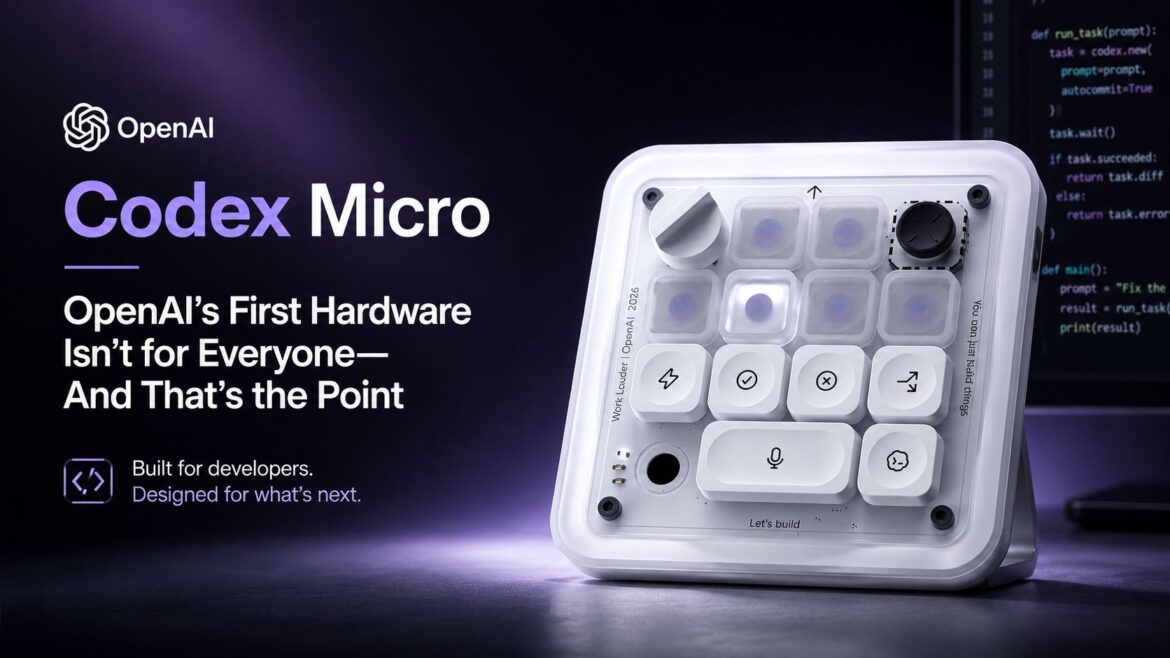
Most people expected OpenAI’s first hardware product to be something consumers would carry in their pockets—a ChatGPT device, smart glasses, or perhaps an AI companion designed with Jony Ive.
Instead, OpenAI introduced something far less glamorous.
What Is OpenAI Codex Micro?
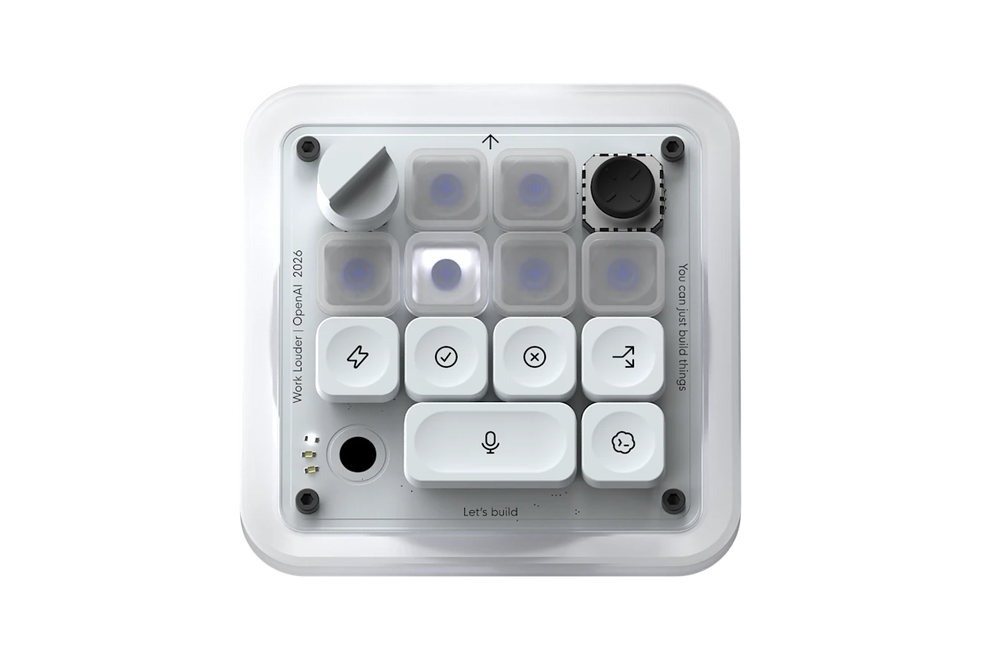
Codex Micro is a compact programmable control pad built for developers who use Codex, OpenAI’s AI coding assistant. Created in collaboration with hardware company Work Louder, it features programmable mechanical keys, a rotary dial, status LEDs, and dedicated controls that help developers interact with AI coding workflows more efficiently.
On paper, it looks like a niche accessory.
And that’s exactly why many people overlooked its significance.
Codex Micro isn’t trying to become the next smartphone or even the next keyboard. It’s designed for a much smaller audience—developers who spend their days writing code, reviewing AI-generated changes, and managing increasingly complex AI-assisted workflows.
For the average consumer, it may seem like an unnecessary gadget.
For OpenAI, however, it represents something much bigger.
It offers an early glimpse into how the company believes people will work alongside AI in the years ahead.
| OpenAI Codex Micro at a Glance | Details |
|---|---|
| Product Name | OpenAI Codex Micro |
| Product Type | AI developer control pad (programmable macropad) |
| Developed By | OpenAI in collaboration with Work Louder |
| Built For | Software developers and AI engineers |
| Primary Purpose | Speed up AI-assisted coding and agent workflows |
| Key Features | 13 programmable mechanical keys,
rotary dial, joystick, RGB status LEDs, push-to-talk, dedicated Codex shortcuts |
| Works With | OpenAI Codex (AI coding agent) |
| Price | US$230 |
| Availability | Limited-edition release |
| How to Buy | Available through Work Louder and the OpenAI Supply store (while supplies last) |
| Consumer Product? | ❌ No – Designed primarily for developers |
| Worth Buying? | Best suited for developers who use AI coding tools daily |
Why OpenAI Started With Developers
At first glance, building a product for developers instead of consumers seems like an unusual decision.
After all, ChatGPT has hundreds of millions of users worldwide. If OpenAI wanted to sell hardware, wouldn’t it make more sense to create a device for everyone?
Not necessarily.
Developers occupy a unique position in every technology revolution.
They’re often the first people to explore new platforms, test new ideas, and discover practical ways to use emerging technology. More importantly, they build the products that eventually reach everyone else.
A single developer can create software that millions of people use.
Helping one builder often has a much greater long-term impact than selling one gadget to one consumer.
That’s what makes Codex Micro so interesting.
It isn’t designed to impress the general public.
It’s designed to make AI developers more productive.
Every shortcut, programmable key, and hardware control exists to reduce friction for people who spend hours every day working alongside AI.
Seen from that perspective, Codex Micro isn’t really a hardware launch.
It’s an investment in the people who will build the next generation of AI-powered applications.
What History Can Teach Us About This Strategy
OpenAI’s decision to build its first hardware product for developers may feel surprising today, but history suggests it’s following a familiar playbook.
Some of the biggest technology revolutions didn’t begin with products designed for everyone.
They began with tools designed for builders.
Take the internet, for example.
Long before it became part of everyday life, it was a network used primarily by researchers and universities. It wasn’t built for online shopping, video streaming, or social media. Those ideas came later, after developers and entrepreneurs discovered what the technology could become.
Apple followed a similar path.
The Apple I and Apple II weren’t created for the average household. They were built for hobbyists, engineers, and computer enthusiasts who saw possibilities that most people couldn’t yet imagine. Years later, those early experiments paved the way for products like the iPhone and iPad that transformed personal computing.
More recently, consider NVIDIA.
Today, it’s one of the most valuable companies in the world because of AI. But its rise didn’t begin with everyday consumers. Its GPUs first became indispensable to researchers, machine learning engineers, and developers building AI models. Only after those builders proved the technology’s potential did AI become a mainstream conversation.
The pattern is remarkably consistent.
First, empower the builders.
Then, the builders create products for everyone else.
Viewed through this lens, Codex Micro looks less like a niche hardware accessory and more like an investment in the people who will shape AI’s next chapter.
Developers aren’t just OpenAI’s customers.
They’re OpenAI’s ecosystem.
Every AI-powered application, coding assistant, automation tool, or intelligent product built by developers expands the reach of the technology far beyond what OpenAI could create on its own.
That’s why a small device for a relatively small audience can carry much larger strategic significance than its size suggests.
If history is any guide, today’s developer tools often become tomorrow’s consumer experiences.
How Codex Micro Fits Into a Developer’s Workflow
To someone outside software development, Codex Micro may look like an expensive programmable keypad.
For developers, it’s designed to eliminate friction during AI-assisted coding.
Instead of repeatedly switching between keyboard shortcuts, menus, browser tabs, and chat windows, common AI actions can be performed using dedicated physical controls.
Depending on the workflow, developers can use Codex Micro to:
- Launch a new Codex task with a single key press.
- Approve or reject AI-generated code changes.
- Trigger voice prompts without leaving the editor.
- Adjust the AI’s reasoning level using the rotary dial.
- Monitor multiple AI coding agents through status LEDs.
- Switch between coding, debugging, and code review workflows more efficiently.
None of these features changes what AI can do.
Instead, they reduce the number of small interactions required throughout the day.
That may sound like a minor improvement, but for developers who interact with AI hundreds of times during a typical workday, removing even a few seconds from repetitive actions can have a noticeable impact on productivity and focus.
Codex Micro isn’t trying to make AI smarter.
It’s trying to make working with AI feel more natural.
Why AI Developers Need Dedicated Hardware
Artificial intelligence is changing more than the way developers write code.
It’s changing the way they work.
For years, software development followed a familiar rhythm. Developers wrote code, tested it, fixed bugs, and repeated the process. The keyboard was the primary tool because every line of code had to be written by hand.
AI is beginning to change that workflow.
Today, developers don’t just write code—they review AI-generated suggestions, compare multiple solutions, approve changes, debug issues, and coordinate different AI-powered tools throughout the day.
In many ways, they’re becoming less like programmers and more like conductors, guiding multiple systems toward the right outcome.
That shift creates a new challenge.
Managing AI isn’t always comfortable through a traditional chat window.
Imagine switching between your code editor, documentation, terminal, browser, and multiple AI conversations dozens of times an hour. Even small interruptions can break concentration and slow down complex work.
Dedicated hardware offers a different approach.
Instead of navigating menus or remembering keyboard shortcuts, developers can trigger common actions with a single button, adjust settings using a physical dial, or instantly switch between AI workflows without leaving their coding environment.
This isn’t a new idea.
Professional photographers rely on physical dials for quick adjustments.
Video editors use dedicated control panels to speed up repetitive tasks.
Music producers work with hardware controllers instead of clicking through endless software menus.
When speed, precision, and focus matter, physical controls often outperform digital interfaces.
AI development may be reaching a similar point.
As developers begin working with multiple AI agents simultaneously, the challenge shifts from writing code to managing intelligent workflows.
That’s where devices like Codex Micro become interesting.
They’re not replacing the keyboard. They’re complementing it. The keyboard remains the tool for creating.
Dedicated AI hardware becomes the tool for orchestrating. Whether Codex Micro becomes a commercial success is almost secondary.
Its real significance is that it acknowledges something many developers are already experiencing: working alongside AI is different from simply using software.
It requires new workflows. And sometimes, new tools.
Related Reading: If you’re curious about the bigger picture behind OpenAI’s hardware strategy, read our in-depth analysis: The Context Computer: Why OpenAI Is Redefining Personal Computing. It explores why AI-first devices may evolve beyond apps and screens into context-aware computing companions.
What Does Codex Micro Tell Us About OpenAI’s Future?
On its own, Codex Micro is a small piece of hardware.
But viewed as part of OpenAI’s broader strategy, it becomes much more interesting.
Over the past few years, OpenAI has evolved from building language models to building AI assistants, coding tools, and autonomous agents that can complete increasingly complex tasks.
That evolution changes the role of the user.
Instead of doing everything manually, people are gradually moving toward assigning work, reviewing results, and making decisions.
Codex Micro reflects that shift.
It isn’t designed to help developers write every line of code.
It’s designed to help them work more effectively alongside AI.
That may sound like a small distinction, but it’s an important one.
OpenAI appears to be investing in a future where humans spend less time performing repetitive tasks and more time supervising intelligent systems.
Today’s developers are among the first to experience that transition.
Tomorrow, similar workflows could extend far beyond software development.
Designers may manage AI design assistants.
Marketers may oversee AI campaign managers.
Researchers may coordinate multiple AI agents gathering and analyzing information.
Business teams may delegate routine operations to specialized AI systems while focusing on strategy and decision-making.
In each case, the human doesn’t disappear.
The role evolves.
This is why Codex Micro shouldn’t be viewed simply as a niche developer accessory.
It represents an early attempt to improve how humans collaborate with AI.
Whether future interactions happen through keyboards, wearables, voice, or entirely new devices is still an open question.
What’s becoming increasingly clear, however, is that AI is moving beyond being a tool we occasionally use.
It’s becoming a collaborator we work alongside.
And if that’s the future OpenAI is building toward, Codex Micro may be remembered not for the hardware itself, but for the shift in thinking it quietly represented.
📊 Research Note
Recent research from OpenAI’s Economic Research team found that AI work is rapidly shifting from chatbot interactions to agentic workflows, where users delegate longer, more complex tasks to AI agents. The study also found that more than 10% of Codex users manage three or more AI agents concurrently, while increasingly using AI for tasks that would take experienced professionals more than eight hours to complete.
These findings reinforce the idea that tools like Codex Micro are designed for a future where developers aren’t just writing code—they’re supervising, coordinating, and managing multiple AI agents as part of their daily workflow.
Should You Buy Codex Micro?
The answer depends less on the device itself and more on how you work.
Priced at $230 USD, Codex Micro is clearly positioned as a professional tool rather than an impulse purchase. For experienced developers who spend hours each day using AI coding assistants, that price may be justified if it helps streamline repetitive tasks and improve productivity. For casual users, however, it’s a significant investment with limited practical value.
It’s particularly useful for developers who are already comfortable using tools like Codex and regularly switch between coding, reviewing AI-generated changes, debugging, and managing multiple development tasks.
On the other hand, if you’re a casual ChatGPT user, a student learning to code, or someone looking for OpenAI’s first consumer AI device, Codex Micro is probably not the right product.
Its value comes from frequent, professional use—not occasional curiosity.
That’s also why its success shouldn’t be measured by sales alone.
OpenAI doesn’t need millions of people to buy Codex Micro for it to be considered successful.
If it helps developers build better AI-powered applications, improve productivity, and experiment with new ways of working alongside AI, it has already achieved something meaningful.
In many ways, Codex Micro is less of a consumer gadget and more of a professional tool—similar to a high-end graphics tablet for designers or a specialized control console for video editors.
For most people, it’s unnecessary.
For the right audience, it could become part of their everyday workflow.
And that’s exactly who OpenAI built it for.
Conclusion
At first glance, Codex Micro doesn’t look like the product many people expected from OpenAI.
It isn’t a sleek AI companion, a futuristic wearable, or a ChatGPT-powered smartphone. It’s a compact device built for a relatively small audience—software developers.
But that’s exactly what makes it interesting.
Throughout the history of computing, breakthrough technologies have rarely started with products designed for everyone. They began with tools for the people building the future. From the early days of the internet to personal computers and modern AI infrastructure, developers have often been the first to adopt new platforms before they reach the mainstream.
Codex Micro fits that pattern.
Rather than chasing mass-market appeal, OpenAI is investing in the people who are creating the next generation of AI-powered applications. The hardware itself may be niche, but the strategy behind it is anything but.
Whether Codex Micro becomes a commercial success isn’t the most important question.
The more important question is what it represents.
It signals that AI is evolving from a tool we occasionally use into a collaborator we work alongside every day. As that relationship grows, the way we interact with AI will continue to evolve—and dedicated hardware may become an important part of that journey.
OpenAI’s first hardware product isn’t for everyone.
It was never meant to be.
It was built for the builders.
And if history has taught us anything, it’s that today’s tools for builders often become tomorrow’s technologies for everyone else.
Frequently Asked Questions
1. What is OpenAI Codex Micro?
Answer:
OpenAI Codex Micro is a compact programmable control pad developed by OpenAI in partnership with Work Louder. It’s designed to help software developers interact more efficiently with OpenAI’s Codex coding agent through dedicated hardware controls.
2. Who is OpenAI Codex Micro designed for?
Answer:
Codex Micro is primarily designed for software developers, AI engineers, and professionals who use AI coding assistants regularly. It’s intended to streamline AI-assisted coding workflows rather than serve as a general-purpose consumer device.
3. How much does OpenAI Codex Micro cost?
Answer:
OpenAI Codex Micro is priced at US$230. It’s available as a limited-edition product through the OpenAI Supply store and Work Louder.
4. Can beginners or non-developers use Codex Micro?
Answer:
Yes, but its value is limited if you don’t use AI coding tools regularly. Most of its features are designed for developers who spend significant time working with Codex and AI-assisted software development.
5. Is Codex Micro OpenAI’s AI device with Jony Ive?
Answer:
No. Codex Micro is a developer-focused accessory for AI-assisted coding. It’s separate from OpenAI’s broader hardware initiative with Jony Ive, which is expected to focus on consumer AI experiences.
6. Why did OpenAI release a developer product first?
Answer:
History shows that many technology revolutions begin with tools for builders rather than consumers. By helping developers work more effectively with AI, OpenAI is investing in the people who will create the next generation of AI-powered applications.
7. Is Codex Micro the future of AI hardware?
Answer:
Probably not on its own. Codex Micro is better viewed as an early experiment in AI-first workflows. It reflects OpenAI’s interest in improving how humans collaborate with AI rather than representing its long-term consumer hardware vision.
Enjoy Worthview?
Add Worthview as a Preferred Source on Google to see more of our stories in Search.

Sethuram Kishore is the founder and editor of Worthview, an online publication established in 2008. With over 18 years of experience in SEO, digital marketing, and online publishing, he writes about AI, technology, business, and digital trends. He is also the founder of MoneyHulk, a personal finance and business publication.







One thought on “OpenAI’s First Hardware Codex Micro Isn’t for Everyone — And That’s the Point”
Comments are closed.