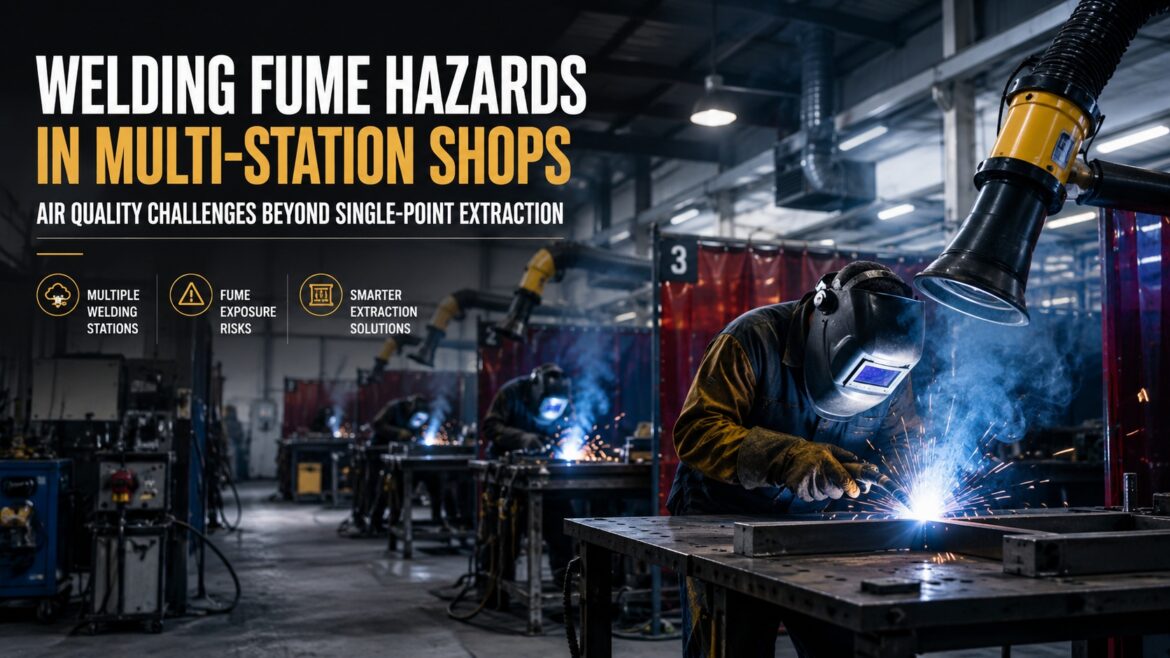
Many welding shops operate with a single fixed extraction system positioned near the primary welding station. This approach works until the shop adds a second welder, then a third, and suddenly workers on the far side of the floor are breathing air that the single extractor cannot effectively reach. The problem isn’t that the extraction system is broken; it’s that single-point solutions create coverage dead zones that expose workers at secondary stations to fume concentrations that can exceed safe limits by the time the air reaches them.
Key Takeaways
- Single fixed extraction systems create fume concentration zones that vary dramatically depending on worker position, welding process, and shop airflow patterns.
- Secondary and tertiary welding stations often have inadequate local capture, forcing fumes to travel across the shop floor and exposing nearby workers before reaching any exhaust point.
- A portable fume extractor for welding positioned at each active station delivers source capture that fixed systems cannot replicate, especially in shops with flexible layouts or seasonal workload changes.
- Multi-station air quality requires a layered approach that combines local extraction at every welding point, general shop ventilation, and real-time awareness of how fume behavior changes with setup and workload.
Why It Matters
Welding fume composition varies by process, base metal, and shielding gas, but all welding operations produce particulates and gases that accumulate in the breathing zone when capture is inadequate. In shops with multiple stations, the physical distance from a secondary welder to a central extraction unit can exceed the effective capture radius of even well-designed duct systems. This is not a minor inconvenience; workers at these stations inhale unfiltered or partially filtered fume during the entire shift, which compounds over weeks and months.
The second critical issue is operational reality. Fabrication shops often shift work between stations based on job size, skill level, or equipment availability. A fixed extraction system positioned for yesterday’s workload may be positioned poorly for today’s layout. Workers adapt by repositioning themselves or their workpieces, further reducing capture effectiveness. This constant mismatch between system design and actual work patterns is why many shops find that their fume control strategy deteriorates in practice, even though the equipment itself is sound.
Third, air quality in a multi-station environment is not uniform. Fume concentration at Station A might be acceptable while Station B, just 20 feet away, experiences exposure levels that are not. Without individual station monitoring or station-level extraction, shop managers often assume that if the primary station is compliant, the entire shop is safe. This assumption has cost fabricators in operational disruptions, worker health issues, and in some cases regulatory attention.
How Fume Transport and Capture Radius Work in Real Shops
Welding fume exits the arc as a hot plume that rises initially, then cools and spreads depending on air currents in the shop. A central extraction system with ductwork can capture fume if the plume reaches the duct inlet before it disperses too widely. The capture radius is roughly the distance from the duct outlet to the point where fume concentration drops to negligible levels.
For a typical wall-mounted or overhead exhaust system, effective capture radius is often 8 to 15 feet from the outlet, depending on system capacity, duct diameter, and air velocity. Beyond that radius, fume is only removed if secondary factors (shop air handlers, doors, windows) direct it back toward the extraction point. In a shop with three welding stations spread across 40 feet of floor space, only one station is inside the primary system’s capture radius at any given moment.
Secondary stations experience what is called “leakage” capture, where fume must travel across the shop floor, cool, and eventually drift toward the exhaust point if at all. By then, the worker at that station has already breathed the fume during the welding cycle. A worker at Station 2, located 25 feet from the central exhaust, captures only a fraction of their fume through the central system. The rest accumulates in their breathing zone.
The Multi-Station Air Quality Gap
Here is where the practical failure becomes visible. Most shops invest in a single extraction system sized for their primary operation. When they add a second or third station, they do not add proportional extraction capacity. Instead, they hope the shop’s general ventilation (doors, windows, bay exhaust) will handle the additional fume.
General shop ventilation is unreliable for fume control. It depends on weather, door positions, other equipment running, and season. In winter, a shop may be sealed for heating, with minimal outside air. General ventilation in this scenario does almost nothing to remove fume from a secondary welding station.
This creates a measurable air quality gap. Testing with a portable air quality monitor at multiple stations in a typical multi-welder shop often shows that:
- Station 1 (primary, near central extraction): Particulate levels are 2 to 4 times the baseline, acceptable range during active welding.
- Station 2 (15 to 20 feet away): Particulate levels rise to 6 to 10 times baseline, approaching or exceeding occupational exposure limits.
- Station 3 (25+ feet away or in a corner): Particulate levels can reach 12 to 20 times baseline, creating a genuine hazard.
Workers at secondary stations are not breathing filtered air. They are breathing the shop’s baseline air plus the fume that escapes local extraction at every station upwind of them. Over a career, this exposure difference matters.
Practical Solutions: Layered Extraction for Multi-Station Environments
The most effective approach is to treat each welding station as its own extraction point, supported by general shop ventilation. This requires a shift in thinking from “one system per shop” to “one capture point per work zone.”
Local capture at every station is the foundation. This means a fume extraction unit positioned within 2 to 3 feet of each active welding point. For shops with flexible layouts, portable systems offer the agility to follow work. A portable unit moved from Station 1 to Station 3 when the workload shifts takes just minutes and instantly improves air quality at the new location.
Duct design that supports multiple pull points is critical. Rather than a single central duct, many shops now use branch ductwork with multiple pickup points. When Station 2 is active, its branch duct pulls fume directly from that location. This avoids the travel distance and cooling losses that plague single-point designs.
Zone-based air handling creates positive pressure in work zones and prevents fume from drifting across the shop. When Station 1 is actively extracting, Station 2 does not experience backflow or secondary fume transport. This requires coordination between local extraction systems and shop-level air handlers, but the payoff in air quality is substantial.
Monitoring at multiple points gives real feedback on whether the system is actually working. A single measurement at the primary station tells you nothing about air quality at Station 3. Multi-point monitoring reveals gaps that are invisible to a single-system mindset.
A Practical Example: Three-Station Fabrication Shop Transformation
A mid-sized shop ran two MIG welders and one stick welder across a 3,000-square-foot floor. The central fume extraction system was a wall-mounted unit positioned 30 feet from the stick welding station. The shop owner assumed the system covered all stations because it ran every day and “the air smelled better than it used to.”
When a new worker reported persistent congestion during shifts, the shop owner conducted spot air quality testing. Results showed that the stick station was averaging 8 to 12 milligrams per cubic meter of particulate, nearly double the occupational exposure limit. The MIG stations, positioned 20 feet from the central exhaust, were at 5 to 7 milligrams per cubic meter. The central extraction system was working, but it was only adequately protecting the primary station.
The solution was not to replace the central system, but to add local extraction at each station. The shop installed a portable extractor near each MIG station and repositioned the wall unit to pull directly from the stick station. The cost was significantly less than a new central system, and the results were immediate. Within a week, all three stations showed particulate levels between 2 and 4 milligrams per cubic meter, well within safe ranges.
The shop also redesigned their workload rotation so that if a station moved, the extraction followed it. This flexibility, which would have been difficult with a fixed system, became a feature of their daily operation. Air quality stopped being a compliance checkbox and became a real operational priority that workers and management could see and measure.
Actionable Takeaways
- Audit your current air quality at every welding station, not just the primary one. Use a portable particulate monitor or arrange a professional air quality assessment. Document baseline levels at each location. If secondary stations show two to three times higher particulate than the primary station, you have a coverage gap.
- Identify which stations are outside the capture radius of your existing extraction system. Measure the distance from each welder to the nearest duct outlet. If any station is more than 15 feet away, assume that station is not being adequately captured by the central system alone.
- Plan for portable extraction at secondary stations. Whether you add a second unit immediately or over time, commit to the principle that every active welding station gets local fume capture. Position the unit within arm’s reach of the work area.
- Redesign your workload flow so that portable extractors can follow the work. Brief your team on which station gets the portable unit each day, or make it a part of setup for any new job.
- Measure again after implementing local extraction. Verify that all stations now show consistent air quality. This data becomes your baseline and helps you spot degradation from filter saturation or equipment drift over time.
- Build filter maintenance into your weekly routine. Local extraction systems only work if filters are clean. A saturated filter at a secondary station still exposes workers to fume, even though the system is technically running.
Conclusion
Multi-station welding operations create air quality challenges that single extraction points cannot solve. The physical layout of your shop, the number of simultaneous welders, and the location of work zones all determine whether a central system is sufficient or whether supplemental local extraction is necessary. The good news is that this is an engineering problem with practical solutions. Most shops do not need to replace their existing systems; they need to add targeted local capture where the primary system reaches only partially or not at all. The result is more consistent air quality, lower worker exposure, and fewer cases of mysterious congestion or complaints that point to systematic air quality problems. Starting with measurement, moving to local capture, and maintaining filters consistently transforms air quality from a reactive concern into a predictable operational reality.
FAQ
Why doesn’t a single central extraction system protect all welding stations equally?
A central extraction system has a limited capture radius, typically 8 to 15 feet from the duct outlet, depending on system power and duct design. Welding stations located beyond this radius experience only partial fume capture, with most fume escaping into the shop air before it reaches the exhaust point. Workers at distant stations inhale fume that has already dispersed and cooled, making it difficult for the central system to draw it away effectively.
How much does air quality actually vary between stations in a typical multi-welder shop?
Air quality variation between stations can be dramatic. A worker at the primary station near the extraction outlet might experience particulate levels 2 to 4 times the shop baseline during welding, while a worker at a secondary station 20 to 25 feet away experiences levels 6 to 20 times baseline. This difference compounds over an entire career and directly affects worker health outcomes and compliance standing.
Is portable extraction the only way to solve multi-station fume problems?
Portable extraction is one effective solution, especially for shops with flexible layouts. Other approaches include redesigning ductwork to include multiple pickup points, upgrading the central system to higher capacity, or creating zone-based air handling. Most shops benefit from a combination: adequate central extraction at the primary station plus portable or branch-duct capture at secondary locations.
How often should fume extraction filters be replaced when running multiple stations?
Filter life depends on welding volume, amperage, and process type. In a multi-station shop with continuous welding, filters may saturate faster than in a single-station operation because the total fume load is higher. Most shops benefit from inspecting filters weekly and replacing them every 2 to 4 weeks during active production, rather than on a fixed annual schedule. A saturated filter loses effectiveness at all stations, not just the one it is attached to.
Can shop doors, windows, and ceiling fans replace local extraction at secondary stations?
General shop ventilation is unreliable for fume control because it depends on outdoor conditions, season, and door positions. In winter when shops are sealed for heating, or on calm days with low wind, general ventilation provides minimal benefit. Local extraction at the source is always more effective than relying on general airflow to disperse and remove fume from the shop air.
What is the first step in improving air quality at a multi-station welding shop?
Measurement is the critical first step. Use a portable particulate monitor to test air quality at each welding station during active work. Compare the readings across stations. If secondary stations show significantly higher particulate levels than the primary station, you have identified a real air quality gap that needs addressing. Once you have baseline data, you can prioritize which stations need additional extraction capacity and plan your investment accordingly.