What if an entire country decided that access to generative AI should be free?
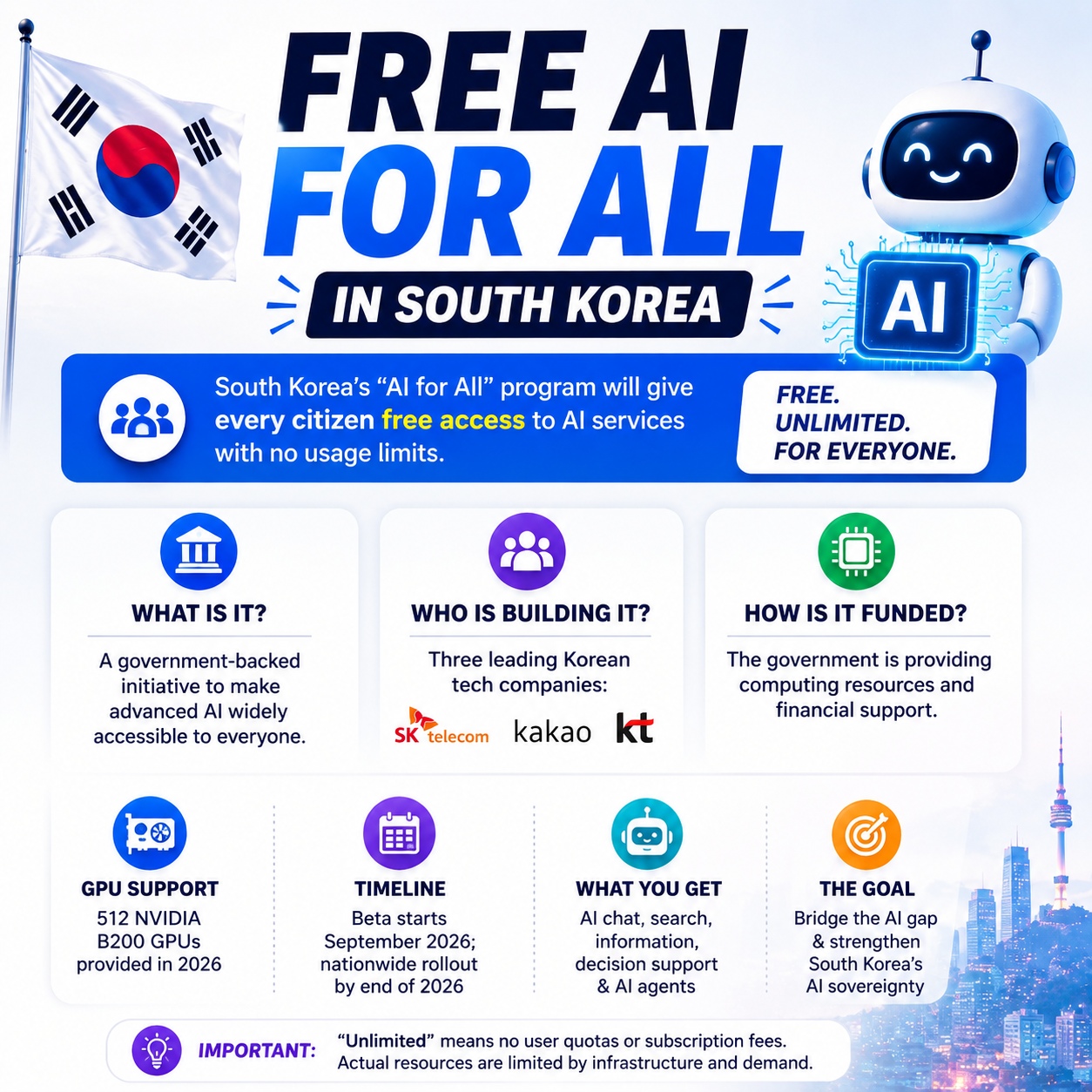
That is essentially what South Korea is attempting with its “AI for All” initiative. The government plans to make general-purpose AI services available to the public free of charge and without a consumer usage limit, with beta services expected to begin in September 2026 and nationwide rollout planned by the end of the year.
But there is an important catch behind the word “unlimited.” South Korea is not creating an infinite supply of AI computing power, nor is it simply giving everyone a free ChatGPT subscription. Instead, the government is subsidizing the infrastructure and working with private-sector companies to build and operate AI services for the population.
So, how can South Korea offer supposedly unlimited AI without the costs becoming astronomical? The answer involves government-funded computing infrastructure, domestic AI models, private-sector operators and a much bigger ambition: making AI a basic digital capability available to virtually everyone.
Key Takeaways
- South Korea is launching an “AI for All” program designed to give the public FREE access to general-purpose AI services without a consumer usage limit.
- “Unlimited” does not mean infinite computing. It means users are not given a conventional token or subscription quota; the underlying AI infrastructure still has finite capacity.
- The government has selected three private-sector consortiums led by SK Telecom, Kakao and KT to develop and operate the services.
- South Korea plans to provide 512 NVIDIA B200 GPUs in 2026 and provide further budget support for nationwide operations from 2027.
- The initiative is also about AI sovereignty: participating services must rely substantially on Korean-developed AI models.
- The bigger goal goes beyond a free chatbot. South Korea wants to make AI widely accessible and eventually provide AI agents capable of carrying out tasks for citizens.
What Is South Korea’s “AI for All” Program?
South Korea’s “AI for All” program is a government-backed initiative designed to make general-purpose artificial intelligence widely accessible to the public. Instead of requiring every citizen to pay for a premium AI subscription, the government is working with major Korean technology companies to provide AI services free of charge and without a consumer usage limit.
The program is being developed through three private-sector consortiums led by SK Telecom, Kakao and KT, which were selected by South Korea’s Ministry of Science and ICT (MSIT) in August 2026. Beta services are expected to begin in September, followed by a broader nationwide rollout by the end of 2026.
However, this isn’t simply a government-funded version of ChatGPT. The program has a broader objective: to build a Korean AI ecosystem while making AI access available to the population at large.
The government is providing computing resources, including 512 NVIDIA B200 GPUs in 2026, and plans to provide additional financial support for nationwide service operations from 2027.
The long-term ambition is even bigger than giving people a chatbot. South Korea wants to develop AI agents that can help citizens search for information, make decisions and eventually perform tasks on their behalf.
In other words, “AI for All” is as much an experiment in AI infrastructure and national AI sovereignty as it is a free-AI program.
Is South Korea Really Giving Everyone Free, Unlimited AI?
Yes, with an important qualification. South Korea’s government says the AI for All services will be available to the public free of charge and without usage limits. That makes the basic claim behind the viral headlines substantially accurate.
However, “unlimited” should NOT be interpreted as infinite AI computing power.
AI services still operate on physical servers and GPUs with finite capacity. If millions of people submit requests at the same time, the system has to manage that demand through its available computing infrastructure. There will also be technical limits such as model context windows, response capacity and safeguards against abuse.
The important distinction is between a user-facing quota and the underlying infrastructure.
A typical paid AI service might limit users to a certain number of messages, tokens or requests each day. South Korea’s AI for All initiative is designed to remove that kind of consumer usage restriction. The government is instead helping fund the computing infrastructure and operating costs needed to provide the service.
So the more accurate way to understand the announcement is:
South Korea is making AI access free to users and removing a conventional usage quota—not making AI computation literally unlimited.
That distinction matters because it leads to the obvious question: if citizens aren’t paying for their AI usage, who is paying for all the computing power behind it?
What Does “Unlimited” Actually Mean?
The word “unlimited” is easy to misunderstand when talking about AI.
In South Korea’s AI for All program, it refers primarily to the way citizens access the service. The government says the planned AI services will be provided free of charge and without a usage limit. In practical terms, users are not expected to buy a premium subscription or receive a fixed monthly allocation of AI queries.
That does not mean the AI has unlimited computing resources.
Every request still consumes computing power. If millions of people use the service simultaneously, the operators must have enough servers and GPUs to handle the traffic. They may also need to manage unusually heavy usage, automated abuse and other situations that could put excessive demand on the system.
This creates an important distinction:
| What “unlimited” means | What it does not mean |
|---|---|
| No conventional consumer usage quota | Infinite GPU capacity |
| No subscription fee for the announced service | Zero operating costs |
| Broad public access | Unlimited processing speed |
| Government-supported AI infrastructure | Every request can run at maximum capacity |
The easiest way to think about it is unlimited access rather than unlimited computing.
South Korea is effectively moving the cost away from individual users and toward a combination of government support and private-sector operation. That makes the next question particularly important: how much will it actually cost to run AI services at nationwide scale?
Who Pays for South Korea’s Free AI?
The short answer is: the government is helping pay for it, while private companies provide and operate the services.
South Korea is not expecting AI companies to absorb the entire cost of serving the country’s population for free. Under the AI for All program, the government is providing computing resources and plans to provide additional budgetary support for the costs required to deliver the service nationwide.
In August 2026, the government selected three consortiums led by SK Telecom, Kakao and KT to participate in the program. It also announced that 512 NVIDIA B200 GPUs would be provided in 2026. Further government support for nationwide service costs is planned from 2027.
This creates a different economic model from conventional consumer AI services.
Instead of:
User → pays subscription → AI company pays for computing
the AI for All model is closer to:
Government support → infrastructure + operating costs → Korean AI providers → free access for citizens
The companies still have an important role. They are responsible for developing and operating the AI services, improving the underlying models and creating useful AI agents. The program also allows participating companies to develop their own revenue models to help sustain the services over time.
That means the government is essentially helping create the initial infrastructure and access layer, rather than promising that taxpayers will necessarily cover every AI inference indefinitely.
There is also an important unanswered question: how much will nationwide AI usage actually cost?
The government has announced infrastructure and future budget support, but the full long-term operating economics of providing AI access to an entire population have not yet been demonstrated. Actual demand after the nationwide launch will be a major test.
In that sense, South Korea’s experiment is not just about whether it can make AI free. It is also testing whether AI can be operated as a large-scale public digital service without becoming financially unsustainable.
Conclusion: South Korea Is Betting on AI as Public Infrastructure
South Korea’s AI for All initiative is much more than a promise of free AI. The government is effectively testing whether advanced AI can become a widely available digital service rather than something primarily accessed through paid subscriptions.
The word “unlimited” needs some context. Citizens are not expected to face a conventional usage quota or subscription fee, but the underlying AI infrastructure will always have finite computing capacity and operating costs.
With three major Korean technology groups involved, government-backed GPU infrastructure and planned financial support for nationwide operations, South Korea has created a framework that could make AI significantly more accessible.
Whether the model can remain economically sustainable at nationwide scale is the bigger question. The answer will become clearer once millions of people begin using these services in the real world.
If successful, however, South Korea could demonstrate a new approach to AI access: government-supported infrastructure combined with private-sector technology and AI agents designed around everyday citizen needs.
FAQs About South Korea’s AI for All Program
Is South Korea really giving citizens free AI?
Yes. South Korea plans to provide general-purpose AI services free of charge and without consumer usage limits through its AI for All initiative.
Does “unlimited AI” mean unlimited computing power?
No. “Unlimited” refers to the absence of a conventional consumer usage quota. The AI services still depend on a finite supply of GPUs, servers and other infrastructure.
Which companies are building South Korea’s AI for All services?
Three consortiums led by SK Telecom, Kakao and KT were selected by the South Korean government to participate in the program.
How will South Korea pay for free AI?
The government is providing computing resources and plans additional budgetary support for the costs of delivering the service nationwide. Private-sector companies will develop and operate the AI services.
How many GPUs is South Korea providing for AI for All?
The government announced plans to provide 512 NVIDIA B200 GPUs in 2026 as part of the program.
When will South Korea’s free AI service launch?
Beta services are expected to begin in September 2026, with nationwide rollout planned within 2026.
Is South Korea creating a free version of ChatGPT?
Not exactly. The program is intended to provide Korean AI services, including general-purpose chatbots and AI agents, rather than simply distributing free access to ChatGPT.
Why is South Korea offering AI to everyone?
The initiative aims to reduce the AI access gap, increase the use of AI across society and strengthen South Korea’s AI sovereignty by supporting domestically developed AI models and infrastructure.
Enjoy Worthview?
Add Worthview as a Preferred Source on Google to see more of our stories in Search.

Sethuram Kishore is the founder and editor of Worthview, an online publication established in 2008. With over 18 years of experience in SEO, digital marketing, and online publishing, he writes about AI, technology, business, and digital trends. He is also the founder of MoneyHulk, a personal finance and business publication.