For years, the promise of AI assistants was simple: ask a question, get an answer.
You asked an AI to find a flight, and it gave you flight options. You asked it to write an email, and it wrote the email. You asked it to compare products, and it produced a list.
You still had to do the work.
That is beginning to change.
The new generation of AI agents is designed to move beyond answering questions and start completing tasks. Instead of telling an AI how to do something, you can increasingly tell it what you want accomplished and let it figure out the steps.
Tell an agent to plan a trip, and it can research flights and hotels, compare options, navigate websites, fill out forms and come back when it needs your approval. Give it a research assignment, and it can browse the web, gather information and produce a finished result. Give it a recurring goal, and some agents can continue working after you’ve left.
Meta’s Muse is the latest—and arguably one of the most ambitious—attempts to turn that idea into a personal AI agent. Meta wants Muse to operate across the digital services people use every day, from email and calendars to shopping, payments and social platforms.
But Meta isn’t entering an empty market.
OpenAI is pushing ChatGPT toward increasingly capable agentic work. Anthropic has made computer use and autonomous workflows a major part of Claude. Google has an enormous advantage of its own: Gemini can operate within an ecosystem that already includes Gmail, Calendar, Drive, Docs, Chrome, Android and other services.
So the question isn’t simply which company has the smartest AI model?
The more useful question is:
Which AI agent would you actually trust to act on your behalf?
That is a much harder question.
An agent that can browse the web is one thing. An agent that can access your inbox is another. An agent that can remember your preferences, book something, spend your money or continue working without you watching is something else entirely.
And that is what this comparison is about.
We looked at Meta Muse, ChatGPT, Claude and Gemini through the things that matter when AI stops being a chatbot and starts becoming an operator: what each can actually do, how much autonomy it has, how well it handles real-world tasks, what it costs, how it approaches privacy and security, and where each agent has a meaningful advantage.
There isn’t necessarily one winner.
Muse may be the most interesting choice for managing your personal digital life.
ChatGPT remains a remarkably versatile choice for general-purpose work and research.
Claude is particularly compelling for complex computer-based and professional workflows.
Gemini has an enormous advantage for people whose digital lives already run through Google.
The interesting part is figuring out which one fits you.
Meet the Four AI Agents
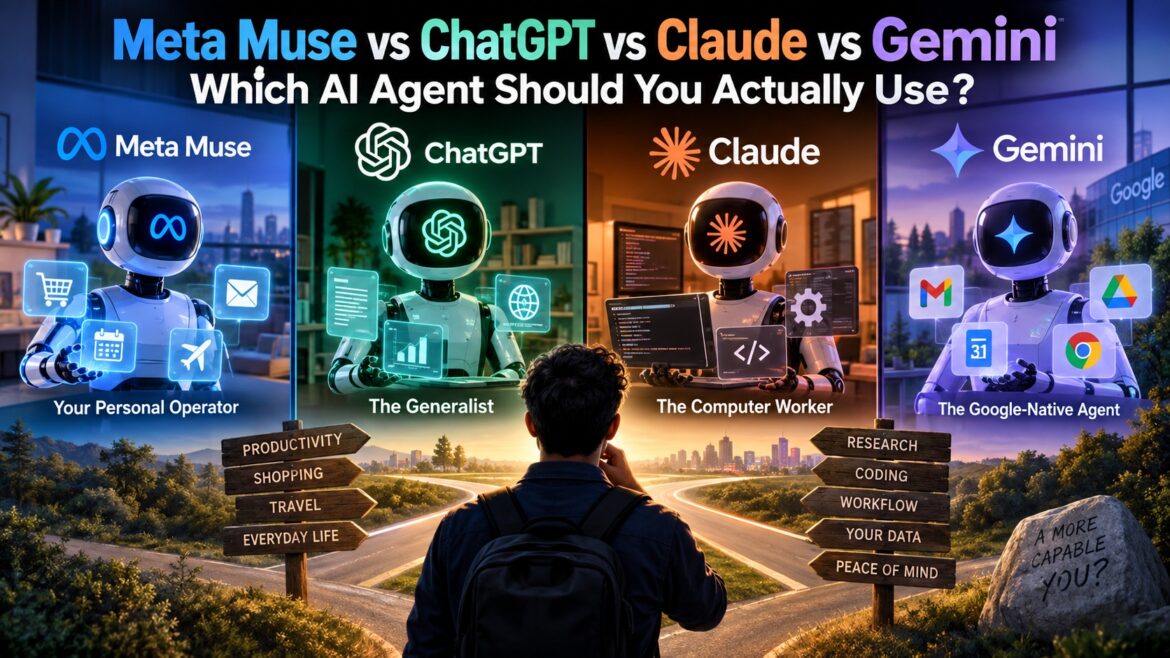
The four products may look similar, but they are pursuing different versions of the AI-agent future.
Meta Muse: Your personal operator
Muse is designed around personal-life automation. It can work across services such as email, calendars, shopping and payments, remember relevant preferences, and continue working on tasks after you leave. Meta’s vision is less “ask me a question” and more “give me a goal and I’ll work toward it.”
Best suited to: everyday personal tasks, shopping, travel and life administration.
ChatGPT: The generalist
ChatGPT’s agent capabilities are aimed at a much broader range of work, combining research, reasoning, file handling, web interaction, coding and multi-step computer tasks.
Best suited to: research, writing, analysis, business work and general-purpose automation.
Claude: The computer worker
Claude has focused heavily on computer use, coding and complex workflows. Its agentic capabilities can interact with software and websites, making it particularly interesting for professional tasks that require navigating a computer rather than simply generating an answer.
Best suited to: coding, professional workflows and complex computer tasks.
Gemini: The Google-native agent
Gemini’s biggest advantage is its ecosystem. Gmail, Calendar, Drive, Docs, Chrome and Android already contain much of a user’s digital life. Google’s agent strategy is increasingly about letting Gemini operate across those services rather than making users move their information somewhere else.
Best suited to: people deeply invested in Google’s ecosystem.
The result is an important distinction:
Muse is trying to become your personal operator. ChatGPT is trying to become your general-purpose AI worker. Claude is becoming a powerful computer-use worker. Gemini is becoming an agent for the Google ecosystem.
That difference matters more than benchmark scores when choosing which one to use.
| AI Agent | Best For | Web Browsing | Computer Use | Background Tasks | Personal Memory | Email & Calendar | Shopping & Payments | Key Advantage |
|---|---|---|---|---|---|---|---|---|
| Meta Muse | Personal life | Yes | Yes | Yes | Yes | Yes | Yes | Personal automation across Meta and connected services |
| ChatGPT | General-purpose work | Yes | Yes | Yes | Yes | Via connected apps | Limited / task-dependent | Broadest combination of research, reasoning and work tools |
| Claude | Complex computer work | Yes | Yes | Yes | Yes | Via integrations | Limited | Strong computer-use, coding and professional workflows |
| Gemini | Google ecosystem | Yes | Yes | Yes | Yes | Yes | Emerging | Deep integration with Google services |
What Can the Four AI Agents Actually Do?
The easiest way to compare AI agents is to forget the feature lists and ask a simpler question:
What can you actually hand over to them?
| Task | Meta Muse | ChatGPT | Claude | Gemini |
|---|---|---|---|---|
| Research the web | ✅ | ✅ | ✅ | ✅ |
| Navigate websites | ✅ | ✅ | Strong | ✅ |
| Manage email | ✅ | Via apps | Via integrations | Strong |
| Manage calendar | ✅ | Via apps | Via integrations | Strong |
| Shop online | Strong | ✅ | ✅ | ✅ |
| Make purchases | Yes | Task-dependent | Limited | Emerging |
| Work with files | ✅ | Strong | Strong | Strong |
| Coding | Limited | Strong | Strong | Strong |
| Long-running tasks | Strong | Strong | Strong | Strong |
| Personal preferences | Core strength | Strong | Strong | Strong |
The biggest difference: autonomy
All four can perform multi-step tasks, but autonomy is becoming the real battleground.
Muse is built around delegation. You give it a goal and it can continue working in the background, returning when it needs input or approval.
ChatGPT is the broadest generalist. It can combine research, reasoning, files, apps and browser-based work to handle complicated assignments.
Claude stands out when the computer itself is the workspace. Its computer-use capabilities make it particularly useful for navigating software and completing technical workflows.
Gemini has the ecosystem advantage. If your work and personal information already live in Gmail, Calendar, Drive, Docs and Chrome, Gemini can operate much closer to where your digital life already exists.
That leads to a simple rule:
Don’t choose an AI agent based only on what it can do. Choose based on what you want it to do without you.
And that’s where the four start to separate.
How Much Do These AI Agents Cost?
Price matters, but comparing these services purely by monthly subscription misses the bigger picture. Each company bundles agent capabilities differently.
| AI Agent | Entry Level | Paid Plans | Premium Tier | Best Value For |
|---|---|---|---|---|
| Meta Muse | Free | $20/month | $100/month | Personal-agent use |
| ChatGPT | Free | Plus / Pro | Up to $200/month | General AI + agentic work |
| Claude | Free | Pro | Max tiers | Coding & professional work |
| Gemini | Free | AI Pro | AI Ultra | Google ecosystem users |
The important takeaway
Muse is unusual because its paid tiers are explicitly positioned around how much agent work you want to delegate. Meta offers a free tier, a $20/month Power tier and a $100/month Maximum tier.
ChatGPT, Claude and Gemini bundle agent capabilities into broader AI subscriptions that also include their respective models, research tools, coding capabilities, storage or ecosystem features.
So the better question isn’t:
“Which agent is cheapest?”
It’s:
“Which subscription gives me the capabilities I will actually use?”
For someone who mainly wants an AI to handle personal errands, Muse’s free or $20 tier could be compelling. For someone doing intensive research, coding or professional work, a more expensive ChatGPT, Claude or Gemini plan may provide considerably more value beyond the agent itself.
Privacy & Security: Who Would You Trust With Your Digital Life?
The more useful an AI agent becomes, the more access it needs. That makes privacy and security just as important as intelligence.
| Agent | Privacy Approach | Sensitive Actions | Biggest Concern |
|---|---|---|---|
| Meta Muse | Secure VM, Sentinel controls, isolated credentials | Approval required | Giving Meta access to personal life |
| ChatGPT | Permissions and connected apps | Confirmation for sensitive actions | Broad access across work tools |
| Claude | Permission-based computer use | User control and confirmations | Mistakes while operating software |
| Gemini | Google security and account controls | Confirmation for sensitive actions | Concentrating personal data inside Google |
Meta has built a particularly elaborate security architecture around Muse. Each agent operates inside a dedicated Secure VM, while Meta’s Sentinel system controls what the agent can send outside that environment. Meta says credentials are kept away from the model and sensitive actions can require user approval.
Google has a different advantage: Gemini can operate within services where users already have established Google account permissions.
ChatGPT and Claude similarly rely on user-controlled permissions and confirmation mechanisms when agents interact with external services or take consequential actions.
But there’s an uncomfortable reality:
No security architecture eliminates the risk of giving an AI permission to act.
An agent can misunderstand an instruction, make the wrong purchase, send the wrong message or encounter a malicious webpage designed to manipulate it.
That’s why the most important privacy question isn’t simply:
“Which company has the best privacy policy?”
It’s:
“How much of my life am I comfortable letting this agent access?”
For someone who wants an AI to research a topic, that answer may be almost everything.
For someone who wants an AI to read email, manage appointments and spend money, the answer becomes much more consequential.
The smartest agent isn’t necessarily the safest choice. The best agent is the one whose level of access you’re comfortable with.
Which AI Agent Should You Choose?
| If you want to… | Best choice | Why |
|---|---|---|
| Manage everyday personal tasks | Meta Muse | Designed around personal goals, preferences and life administration |
| Research and complete diverse work | ChatGPT | Strong combination of reasoning, research, files and agentic tools |
| Control a computer and software | Claude | Strong focus on computer use and complex workflows |
| Automate Gmail, Calendar and Google Workspace | Gemini | Deep integration with Google’s ecosystem |
| Shop and complete purchases | Meta Muse | Payments and shopping are central to Muse’s personal-agent vision |
| Code and automate technical workflows | Claude / ChatGPT | Both are strong choices for technical and multi-step work |
| Stay inside Google’s ecosystem | Gemini | Native access to Google’s products and services |
| Build a personal AI operator | Meta Muse | Most explicitly focused on long-term personal assistance |
Enjoy Worthview?
Add Worthview as a Preferred Source on Google to see more of our stories in Search.

Sethuram Kishore is the founder and editor of Worthview, an online publication established in 2008. With over 18 years of experience in SEO, digital marketing, and online publishing, he writes about AI, technology, business, and digital trends. He is also the founder of MoneyHulk, a personal finance and business publication.







One thought on “Meta Muse vs ChatGPT vs Claude vs Gemini: Which AI Agent Should You Actually Use?”
Comments are closed.