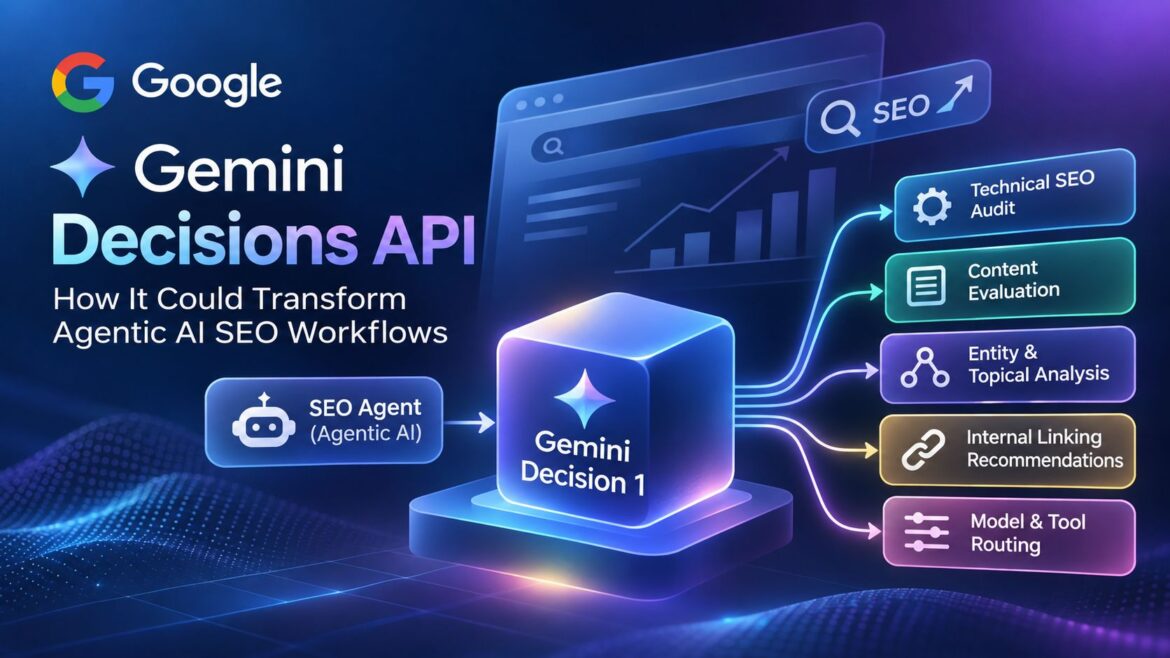
Artificial intelligence has already changed how SEO professionals research keywords, optimize content, conduct technical audits, and analyze search performance. But the next evolution of SEO automation may go beyond asking AI models to perform individual tasks. It involves building intelligent agents that can independently evaluate situations, select the right tools, and determine what should happen next.
Google’s new Gemini Decisions API, powered by the Gemini Decision 1 model, introduces an interesting development in this direction. Announced on November 11, 2026, the API is designed to help applications make fast, structured decisions without requiring a traditional generative AI response for every task.
Instead of generating paragraphs of text, Gemini Decision 1 evaluates predefined options and returns probabilities and confidence scores. Developers can use these decisions for tasks such as classification, tool selection, model routing, and content evaluation.
For SEO professionals, this opens up interesting possibilities.
In this article, we’ll explore how the Gemini Decisions API works, what makes it different from traditional LLMs, and how SEO professionals and developers could use it to build more intelligent agentic AI SEO workflows.
What Is Google’s Gemini Decisions API?
The Gemini Decisions API is a specialized API introduced by Google for making fast, bounded decisions across different types of input.
It is powered by Gemini Decision 1 (gemini-decision-1), a model designed to evaluate predefined questions and select or score available outcomes rather than generate open-ended text.
Traditional generative AI models produce responses token by token. This works well when an application needs an explanation, summary, recommendation, or piece of content. However, many applications require simpler decisions.
For example:
- Is this webpage missing a meta description?
- Is this customer query related to technical SEO or content optimization?
- Should this task be handled by a lightweight model or a more capable reasoning model?
- Does this article meet a predefined content quality standard?
- Which SEO tool should an automation agent call next?
These are bounded decision-making problems. The application already knows the possible outcomes; it needs a model to evaluate the input and select the most appropriate one.
The Gemini Decisions API is designed for this type of work.
Google allows developers to submit a shared input and evaluate up to 1,000 independent questions in a single request. The input can contain text, images, audio, video, and PDF documents, with a context limit of up to 256K tokens.
The API returns structured decision results, including probabilities and confidence scores, which an application can use to determine its next action.
Google Gemini Decisions API
A specialized decision model designed for structured evaluations and AI agent workflows.
gemini-decision-1
| Announced | November 11, 2026 |
|---|---|
| Primary purpose | Fast, structured decisions for AI applications and agent workflows |
| Decision types | Yes/No, Multiple Choice, and Rubric-based Scoring |
| Input modalities | Text, images, audio, video, and PDFs |
| Context capacity | Up to 256K tokens |
| Questions per request | Up to 1,000 independent questions |
| Response format | Structured decisions, probabilities, and confidence scores |
| Reported latency | 150–250 ms (Google-reported) |
| Input pricing | $0.10 per 1 million tokens |
| Output pricing | $0 per output tokens |
| Availability | Gemini API through Google AI Studio |
| Potential SEO applications | Technical SEO classification, content evaluation, entity analysis, internal linking, and AI tool routing |
How Is It Different from a Traditional Gemini Model?
Consider a traditional SEO automation workflow.
You provide an LLM with webpage content and ask it to classify the page, identify missing metadata, evaluate content quality, and recommend the next action.
The model generates a response, usually in text or structured JSON. Your application then parses the response, validates it, and executes the next step.
With Gemini Decision 1, you can define these evaluation questions and their possible outcomes in advance. The model evaluates them directly and returns decision results.
The distinction is important:
- Generative models: Create explanations, recommendations, summaries, and new content.
- Decision models: Evaluate predefined conditions, choose between available options, and score inputs against defined criteria.
This does not mean decision models replace generative AI. They address a different part of the workflow.
Gemini Decision 1 is also part of a broader shift towards specialized AI decision models. Google is entering a space that already includes solutions such as TypeSafe AI’s Jev, Microsoft’s Decision-1 and OpenAI’s Decisions API. Although these models share the goal of making structured decisions rather than generating conventional text responses, they differ in their underlying approaches, supported inputs, pricing and deployment options. If you want to understand how these technologies compare, read our detailed comparison of AI decision models, including Jev, Microsoft Decision-1 and OpenAI.
How Does Gemini Decision 1 Work?
Gemini Decision 1 uses a different approach from conventional token-generating models.
Instead of generating a textual answer one token at a time, it evaluates candidate outcomes in a single forward pass and returns probabilities associated with those outcomes.
Google describes three types of decisions supported by the API:
- Yes/No decisions
- Multiple-choice decisions
- Rubric-based scoring
Yes / No Decisions
Binary classificationEvaluates a question and determines whether a particular condition is true or false.
Multiple-Choice Decisions
ClassificationSelects the most appropriate answer from a predefined set of possible options.
Rubric-Based Scoring
Quality evaluationAssesses input against predefined criteria and assigns a structured score.
Developers can combine these question types in one request, provided the questions are independent and evaluate the shared input.
Let’s look at each type from an SEO perspective.
1. Yes/No Decisions
Yes/No decisions evaluate whether a particular condition is true or false.
For example, an SEO crawler could submit webpage information and ask:
- Is the title tag missing?
- Is the meta description missing?
- Does the page contain an H1 heading?
- Is the page primarily an informational article?
- Does the page appear to contain duplicate content?
The API estimates the probability that the specified condition holds.
This can be useful when an SEO automation system needs to evaluate multiple predefined conditions without generating a separate textual response for each one.
2. Multiple-Choice Decisions
Multiple-choice decisions allow developers to define a set of possible outcomes and ask the model to select the most appropriate one.
Google supports between 2 and 255 candidate choices.
For example, an SEO automation agent could classify a webpage into one of the following categories:
| Option | Description |
|---|---|
| Blog article | Informational editorial content |
| Product page | Individual product information |
| Category page | A collection of related products or content |
| Landing page | A page designed for a specific marketing objective |
| Other | Content that does not fit the defined categories |
The model evaluates the input and returns the selected option along with probabilities for the available choices.
This is particularly useful for intelligent workflow routing.
For instance, a product page could be sent to a product SEO audit workflow, while a blog article could be routed to content optimization and internal linking analysis.
3. Rubric-Based Scoring
Rubric-based scoring evaluates an input against a predefined ordered scale.
Developers define the scoring criteria, and the model returns a weighted score and probabilities across the rubric levels.
An SEO application could use this to evaluate content quality.
For example:
| Score | Content quality |
|---|---|
| 0 | Poor |
| 1 | Below average |
| 2 | Good |
| 3 | Excellent |
The model can evaluate the submitted content against the defined criteria and return a score.
This could help prioritize content reviews across a large website.
However, the quality of the result depends on how clearly the rubric is defined. Vague instructions such as “Is this good content?” are less useful than specific evaluation criteria covering topical relevance, search intent alignment, factual accuracy, depth, and usefulness.
A rubric score should also be treated as an evaluation signal rather than an objective measure of Google’s search quality assessment.
How Agentic AI SEO Workflows Can Use Gemini Decisions API
This is where Google’s Decisions API becomes particularly interesting for SEO professionals.
Traditional SEO automation typically follows predefined rules. For example, a crawler identifies pages with missing title tags, a script checks for duplicate meta descriptions, and an SEO tool generates a report highlighting potential problems.
Agentic AI introduces another layer of intelligence. Instead of simply following a fixed sequence of operations, an AI agent can evaluate the available information, decide which workflow should run next, select appropriate tools, and coordinate multiple tasks.
Gemini Decision 1 could support this process by acting as a decision-making layer within the agent architecture.
For example, consider an SEO automation system that crawls 5,000 URLs. Not every page needs the same analysis. Some pages might need technical SEO checks, others might require content optimization, and some might need entity analysis or internal linking improvements.
A decision model could help classify these pages and determine which specialist workflow should handle them.
Understanding the role of a decision model in an SEO agent
An agentic SEO system can be divided into five functional layers:
| Layer | Responsibility | Example technology |
|---|---|---|
| Data collection | Collect website and search performance data | Screaming Frog, Python, GSC API |
| Decision-making | Evaluate inputs and select appropriate workflows | Gemini Decision 1 |
| Orchestration | Coordinate tasks and workflow execution | LangGraph, LangChain |
| Execution | Perform SEO analysis and operations | Python, APIs, SEO tools |
| Reporting | Present findings and recommendations | Looker Studio, Streamlit |
The important distinction is that Gemini Decision 1 does not independently crawl websites, execute Python scripts, or make changes to a CMS. Your application or agent orchestration framework performs those operations.
The Decisions API supplies structured decision results that help the application determine what should happen next.
Five Practical SEO Automation Use Cases
Let’s explore five areas where Gemini Decision 1 could become useful in real-world SEO automation.
1. Intelligent Technical SEO Auditing
Technical SEO crawlers can collect thousands of data points, but identifying which problems require further investigation is a separate challenge.
A decision model could evaluate page information and help categorize potential issues.
For example:
| Input condition | Possible decision |
|---|---|
| Page returns HTTP 200 but has no canonical | Investigate canonical configuration |
| Page has a title but it doesn’t match the page topic | Flag for title review |
| Page has no H1 | Route for heading analysis |
| Page has substantial content but appears inaccessible to search crawlers | Investigate rendering and indexing |
| Page contains conflicting metadata signals | Escalate for technical review |
There is an important distinction here: a crawler should detect objective conditions such as missing canonicals or HTTP status codes using deterministic checks. Gemini Decision 1 can help evaluate ambiguous conditions and determine which investigation should happen next.
Potential benefit: SEO teams can prioritize deeper investigations instead of treating every detected issue as equally important.
2. Automated Content Quality Evaluation
Content optimization is one of the most interesting applications for rubric-based decision-making.
An SEO agent could submit an article along with a predefined evaluation rubric.
For example:
- Does the article address its primary search intent?
- Does it provide sufficient topical coverage?
- Is the content logically structured?
- Does it include useful examples?
- Does it demonstrate relevant subject expertise?
- Does it contain unnecessary repetition?
The model could score the content against predefined criteria.
Example rubric for an informational article — not actual Gemini output
Illustrative visualization of how a scoring workflow might present results.
A generative model could then investigate low-scoring areas and produce specific recommendations.
This creates a useful separation between initial evaluation and detailed content improvement.
One caution: content quality is multidimensional. A single score should never be treated as a direct prediction of Google rankings.
3. Entity SEO and Topical Relevance Analysis
Entity SEO involves understanding the people, organizations, products, concepts and relationships covered by a webpage.
A decision model could help an entity analysis workflow answer questions such as:
- Is the page primarily about the intended entity?
- Does it cover the important related concepts?
- Is the content focused on one topic or multiple unrelated topics?
- Does the page need deeper entity analysis?
- Should the page be routed to an entity extraction or relationship-mapping workflow?
For example, consider an article about Google’s Gemini Decisions API.
An entity analysis workflow might identify:
- Google DeepMind
- Gemini Decision 1
- Gemini API
- Agentic AI
- LangGraph
- AI workflow automation
The decision model could help classify the article’s topical focus and determine whether additional entity analysis is warranted.
An entity extraction system such as spaCy or Google’s Natural Language API can perform the actual entity extraction, while a generative model can investigate relationships and missing contextual coverage.
This is particularly relevant to SEO applications that need to evaluate topical relevance across large content libraries.
4. Intelligent Internal Linking Recommendations
Internal linking is not simply about finding pages that share a keyword.
A useful internal linking system needs to understand topical relationships, contextual relevance and the purpose of each page.
A decision model could evaluate candidate page pairs and classify their linking suitability.
For example:
| Candidate relationship | Decision |
|---|---|
| Two articles explain closely related AI technologies | Strong candidate |
| A general AI article links to an unrelated finance article | Weak candidate |
| A comparison article links to a detailed product explainer | Potentially relevant |
| Two pages target almost identical search intent | Review for cannibalization |
A more advanced workflow could evaluate hundreds of candidate internal links and shortlist those that deserve deeper review.
A generative model could then suggest contextual anchor text and appropriate placement within the content.
The final link recommendation should still be validated for relevance and usefulness rather than automatically inserting links based solely on a model score.
5. Intelligent AI Model and Tool Routing
This is arguably one of the most interesting applications for agentic SEO systems.
Not every SEO task requires the same model or tool.
Consider an AI agent that receives the following tasks:
- Extract title tags from 500 URLs.
- Identify missing metadata.
- Evaluate content quality.
- Generate an entity relationship map.
- Explain why organic traffic declined.
- Recommend a content optimization strategy.
These tasks have different computational requirements.
A decision model could evaluate the task and select the appropriate execution path.
| SEO task | Appropriate execution path |
|---|---|
| Extract title tags | Python crawler |
| Detect missing descriptions | Deterministic validation |
| Classify page intent | Decision model |
| Evaluate content quality | Decision model + rubric |
| Analyze entity relationships | NLP + generative AI |
| Investigate traffic decline | Analytics tools + reasoning model |
| Generate optimization recommendations | Generative AI |
This approach can reduce unnecessary calls to expensive reasoning models and improve workflow efficiency.
Google itself describes using Gemini Decision 1 for model routing in Gemini Notebook, demonstrating how decision-based routing can work outside SEO. blog.google
Benefits and Limitations of Using Gemini Decisions API for SEO
Before adopting this architecture, SEO developers should understand both its advantages and its limitations.
| Potential benefit | Practical SEO implication |
|---|---|
| Multiple questions per request | Evaluate several page attributes together |
| Structured decision results | Simplify workflow routing |
| No output-token charges | Potentially lower decision-processing costs |
| Low-latency evaluation | Support responsive automation |
| Multimodal inputs | Evaluate text, screenshots, PDFs and other content |
| Confidence scores | Route ambiguous cases for additional review |
However, there are important limitations:
- It cannot replace a crawler or technical SEO validation scripts.
- It requires predefined questions, candidate choices or scoring rubrics.
- It does not replace generative models for detailed recommendations.
- Confidence scores do not guarantee correctness.
- SEO evaluation criteria need careful design and testing.
- Automated website changes should have validation and human approval safeguards.
The best approach is to use Gemini Decision 1 as one component of an SEO automation architecture, not as a standalone SEO solution.
What this means for the future of SEO
The evolution from traditional SEO automation to agentic SEO is an important development to watch.
For years, SEO automation has focused primarily on collecting data, applying predefined rules and generating reports. AI introduced more sophisticated capabilities, including content analysis, semantic understanding and automated recommendations.
Decision models add another possibility: enabling applications to evaluate situations and select appropriate workflows without requiring a generative response for every decision.
This could help SEO teams build systems that:
- Continuously evaluate website health.
- Prioritize pages requiring attention.
- Select appropriate analysis tools.
- Identify content optimization opportunities.
- Coordinate technical SEO and content workflows.
- Escalate uncertain or high-impact decisions for human review.
However, this doesn’t mean SEO professionals will simply hand over their entire SEO strategy to autonomous agents.
Human expertise will remain important for defining objectives, validating recommendations, evaluating business impact and approving significant changes.
Google’s own guidance on AI search continues to emphasize useful, original content and established SEO fundamentals. Agentic automation should strengthen those practices, not replace them. Google for Developers
Conclusion
Google’s Gemini Decisions API introduces a specialized decision-making capability that could become useful in building more intelligent AI agents.
For SEO developers, its potential lies in workflow classification, content evaluation, tool routing and prioritizing deeper analysis. Combined with Python, LangGraph, crawlers and generative AI models, it offers another way to design modular and scalable SEO automation systems.
The transition from AI-assisted SEO to agentic SEO will not happen through a single model or API. It will emerge through the coordination of specialized models, automation tools, reliable data sources and human expertise.
Gemini Decision 1 is an interesting addition to that evolving architecture.
FAQs
1. What is Google’s Gemini Decisions API?
Google’s Gemini Decisions API is an API powered by Gemini Decision 1 that evaluates predefined yes/no, multiple-choice and rubric-based questions. It returns structured probabilities and confidence scores instead of generating conventional text responses.
2. How can Gemini Decisions API be used for SEO?
It can support SEO automation workflows involving page classification, content evaluation, internal linking candidate assessment, entity analysis routing and intelligent tool selection.
3. Can Gemini Decision 1 replace traditional LLMs?
No. It is designed for bounded decisions rather than open-ended generation. Traditional LLMs remain useful for content creation, explanations, complex reasoning and detailed recommendations.
4. Can Gemini Decisions API work with LangGraph?
Yes. Developers can integrate the Decisions API into custom LangGraph nodes and use its structured results to determine conditional workflow paths.
5. Does Gemini Decision 1 support multimodal inputs?
Yes. Google’s announcement describes support for text, images, audio, video and PDF inputs, with a context limit of up to 256K tokens.
6. Is Gemini Decisions API useful for technical SEO audits?
It can help interpret ambiguous page information and route investigations. However, deterministic checks such as HTTP status validation, canonical detection and missing metadata should generally remain in conventional crawler logic.
7. Will agentic AI replace SEO professionals?
Agentic AI can automate repetitive analysis and workflow coordination, but strategic decisions, quality evaluation, business understanding and oversight will continue to require human expertise.
Enjoy Worthview?
Add Worthview as a Preferred Source on Google to see more of our stories in Search.

Sethuram Kishore is the founder and editor of Worthview, an online publication established in 2008. With over 18 years of experience in SEO, digital marketing, and online publishing, he writes about AI, technology, business, and digital trends. He also runs AISearchBrief.com, an AI-curated daily news brief for SEO and AI-search professionals.






One thought on “How Google’s Gemini Decisions API Could Transform Agentic AI SEO Workflows”