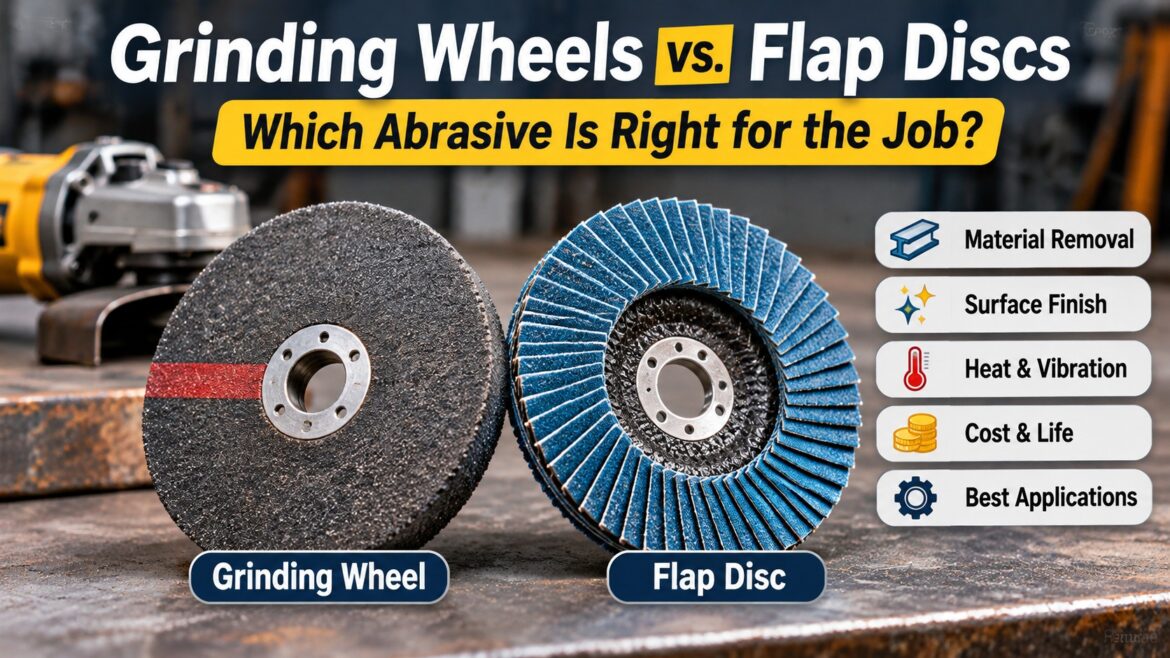
Grinding wheels are best for aggressive material removal, such as grinding down thick welds, reshaping metal, and removing substantial imperfections.
Flap discs are generally better for controlled grinding, weld blending, deburring, rust removal, and surface finishing.
Choose a grinding wheel when material removal is the priority and a flap disc when you need a smoother finish with greater control.
Choosing between a grinding wheel and a flap disc depends on the type of metalwork you’re doing, how much material you need to remove, and the surface finish you want to achieve. Whether a worker needs to remove a thick weld, smooth rough edges, eliminate surface rust, or prepare metal for finishing, the abrasive tool affects both productivity and the final result. Grinding wheels and flap discs are two common options, but they are designed differently and perform best in different situations. Reviewing available grinding wheels for metalworking can help users understand the options for heavier material removal and workshop applications.
Although both abrasives attach to compatible angle grinders, their construction, performance, and ideal uses are not interchangeable. Understanding these differences makes it easier to select the right tool for each task.
In this guide, we’ll compare grinding wheels vs. flap discs, explain their key differences, and help you choose the right abrasive for your project.
Understanding Grinding Wheels
Grinding wheels are rigid abrasive discs made by bonding abrasive grains together with materials such as resin. Their firm construction makes them suitable for demanding grinding applications where substantial material needs to be removed.
They are commonly used in metalworking and fabrication to:
- Remove thick weld beads
- Grind down uneven metal surfaces
- Reshape metal edges and components
- Remove excess material from steel parts
- Eliminate significant surface imperfections
Grinding wheels are particularly useful when speed and material removal are more important than achieving a smooth finish in a single operation. However, their aggressive cutting action can leave visible grinding marks. If the metal surface will be painted, coated, polished, or used in a visible application, additional finishing with a finer abrasive or flap disc may be necessary.
Understanding Flap Discs
Flap discs consist of overlapping pieces of abrasive material attached to a backing plate. As the disc rotates against a surface, the abrasive flaps gradually wear away and expose fresh abrasive grains.
Unlike rigid grinding wheels, flap discs offer greater flexibility and are designed for applications that combine material removal with surface finishing. They are commonly used for:
- Blending weld seams
- Deburring metal components
- Smoothing sharp edges
- Removing light rust and surface imperfections
- Preparing metal surfaces for painting or coating
This construction allows flap discs to perform grinding and finishing tasks in the same operation. They are commonly used for weld blending, deburring, rust removal, smoothing edges, and preparing metal surfaces.
Because the abrasive flaps offer more flexibility than a conventional grinding wheel, they can follow certain contours and uneven surfaces more easily. They also tend to produce a more consistent finish with less aggressive material removal.
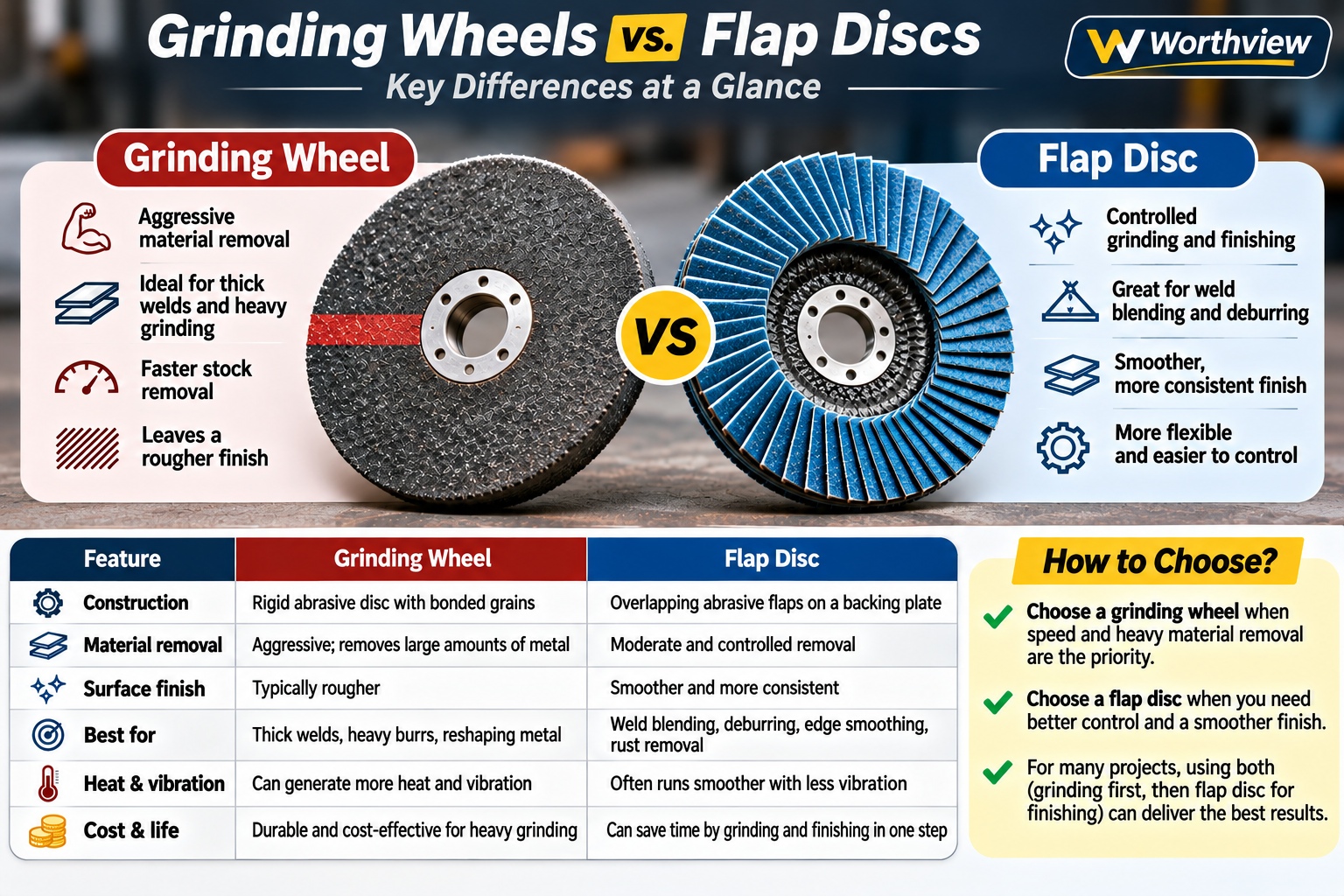
Key Differences Between Grinding Wheels and Flap Discs
| Feature | Grinding Wheels | Flap Discs |
|---|---|---|
| Construction | Rigid abrasive disc with bonded grains | Overlapping abrasive flaps attached to a backing plate |
| Material removal | Aggressive; suited for heavy material removal | More controlled; suited for moderate material removal |
| Surface finish | Typically leaves a rougher finish | Generally produces a smoother finish |
| Weld removal | Best for removing thick welds and excess material | Better for weld blending and refining weld areas |
| Flexibility | Rigid and less adaptable to contours | More flexible and better suited to certain contours |
| Heat and vibration | Can generate considerable heat and vibration during aggressive grinding | Often offers smoother operation and may reduce vibration and heat under suitable conditions |
| Precision and control | Best suited for heavy grinding tasks | Better suited for controlled grinding and finishing |
| Typical applications | Heavy weld removal, reshaping metal, grinding uneven surfaces | Weld blending, deburring, edge smoothing, rust removal, surface preparation |
| Best choice when | Speed and material removal are the priority | Surface quality, control, and finishing are important |
1. Material Removal Speed
Grinding wheels are generally the better choice when a project requires aggressive stock removal. Their rigid construction allows operators to remove substantial amounts of metal, making them useful for thick welds, heavy burrs, and significant surface irregularities.
Flap discs are also capable of removing material, but they are often selected for more controlled grinding and blending. They can handle moderate weld removal while helping produce a smoother surface.
For example, a fabricator removing a large weld bead from a steel frame may begin with a grinding wheel. A flap disc can then help refine the remaining weld area.
2. Surface Finish and Precision
The desired surface finish is another important distinction. Grinding wheels typically leave a rougher surface because they remove material more aggressively. This may be acceptable when the workpiece will undergo additional processing.
Flap discs are often preferred when the operator wants to blend welds, smooth transitions, or prepare a surface for painting. Their layered abrasive flaps help distribute contact across the workpiece, reducing the likelihood of deep gouges when used correctly.
Norton’s comparison of right-angle grinding abrasives explains how grinding wheels and flap discs differ in construction, material removal, handling, and finishing performance.
3. Heat, Vibration, and Operator Control
Grinding wheels are rigid and can generate considerable heat and vibration during aggressive grinding. Operators need appropriate technique and control, particularly when working on thin materials or surfaces where excessive grinding could cause damage.
Flap discs often provide a smoother and more controlled grinding experience. Their layered construction can reduce vibration and support cooler grinding under suitable operating conditions. This can be helpful when working on surfaces that require careful blending.
However, performance depends on the abrasive type, grit, backing material, pressure, and operating conditions. Neither option eliminates the need for proper technique and protective equipment.
4. Cost and Product Life
The initial purchase price is not the only factor worth considering. Grinding wheels may have a higher cost per unit, but their durability and aggressive material removal can make them economical for demanding applications.
Flap discs can reduce the need for separate grinding and finishing steps, potentially saving time on projects that require both operations. Their layered construction also exposes fresh abrasive material as the flaps wear.
The most economical choice depends on the amount of material being removed, the desired finish, the frequency of use, and how many abrasive changes the project requires.
5. Suitable Applications
Each abrasive has situations where it performs particularly well.
Grinding wheels are generally suitable for:
- Removing thick weld beads
- Heavy material removal
- Grinding down uneven metal surfaces
- Reshaping steel components
- Removing substantial surface imperfections
Flap discs are generally suitable for:
- Blending weld seams
- Smoothing metal edges
- Removing light rust and surface imperfections
- Deburring metal components
- Preparing surfaces for painting or coating
Some applications overlap, so the workpiece material, abrasive specifications, and manufacturer’s recommendations should guide the final choice.
Choosing the Right Abrasive for a Metalworking Project
Grinding wheels and flap discs serve different purposes in metalworking, welding, and fabrication. Grinding wheels are generally the better choice for aggressive material removal, such as removing thick welds, reshaping metal, and grinding down uneven surfaces. Flap discs are better suited for controlled grinding, weld blending, deburring, and surface finishing where a smoother result is important.
Workshop tasks involving vehicle components also require careful surface preparation. WorthvieW’s article on tools that make hub and bearing jobs more efficient discusses how appropriate grinding and cleaning tools help prepare contact surfaces during repair work.
Ultimately, the right abrasive depends on the project’s objective rather than the tool’s appearance or price alone. By considering material removal requirements, surface finish, operating conditions, and product specifications, metalworkers can select an abrasive that supports efficient work and consistent results.
Frequently Asked Questions (FAQs)
1. What is the main difference between a grinding wheel and a flap disc?
A grinding wheel is designed for aggressive material removal and heavy grinding, while a flap disc is generally used for controlled grinding, weld blending, deburring, and achieving a smoother surface finish.
2. Are grinding wheels better than flap discs for removing welds?
Grinding wheels are generally better for removing thick weld beads and excess material quickly. Flap discs are more suitable for blending the remaining weld and smoothing the surrounding surface.
3. Can flap discs remove material like grinding wheels?
Yes. Flap discs can remove material, but they typically offer more controlled removal. They are especially useful for moderate grinding, weld blending, and applications where surface finish matters.
4. Which abrasive produces a smoother finish: a grinding wheel or a flap disc?
Flap discs generally produce a smoother and more consistent finish than conventional grinding wheels. They are commonly used to blend welds, smooth edges, and prepare metal surfaces for painting or coating.
5. Can I use a flap disc to remove rust?
Yes. Flap discs can be used to remove light rust, surface imperfections, and oxidation from metal surfaces. The appropriate abrasive grit depends on the amount of rust and the desired surface finish.
6. Can I use both a grinding wheel and a flap disc on the same project?
Yes. Many metalworking tasks benefit from using both. A grinding wheel can remove heavy welds or excess metal first, while a flap disc can then blend the area, smooth rough edges, and improve the surface finish.
7. Which is more cost-effective: grinding wheels or flap discs?
The most cost-effective option depends on the task. Grinding wheels may be more economical for heavy material removal, while flap discs can save time when grinding and finishing can be completed in the same operation. Material removal requirements, abrasive life, and the number of tool changes all affect overall cost.
Enjoy Worthview?
Add Worthview as a Preferred Source on Google to see more of our stories in Search.

Worthview Editorial Team is the shared byline for content created collaboratively by Worthview’s editors and contributors. Since 2008, we’ve published thousands of articles across technology, AI, finance, health, home, travel, and lifestyle. Our editorial process emphasizes original research, reputable sources, regular content updates, and clear attribution. Articles covering higher-trust topics, including health and finance, may also undergo review by qualified subject-matter experts.