
Entering Australia’s modern workforce demands high digital literacy, but rates are falling among secondary students. 2025 NAP ICT Literacy results show that only 37 per cent of Year 10 and 50 per cent of Year 6 students met the proficient standard for digital literacy. It’s a dramatic decline since 2008. It also breeds concern about the nation’s readiness to adapt to AI, automation, and modern digital service delivery. When the typical school curriculum doesn’t lead to transferable skills in the workplace, students aren’t adequately prepared for the future. However, there is more to learning than content. The solution to teaching skills that transfer to the workplace could be in understanding the difference between modern tech startups and digital learning environments.
The walls in tech startups reflect the work in progress, with floor-to-ceiling wireframes, notes mapping user journeys too complex for memory, and Sprint boards the size of a classroom whiteboard. While the companies build things that live entirely on screens, the core work is grounded in spatial practice. The way the professional environment supports workers sets a powerful example of how schools can teach the same skills to beginners.
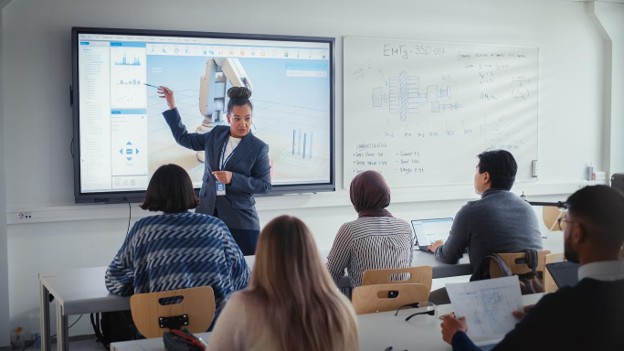
Digital Work Has Always Been a Physical, Spatial Practice
The assumption that young people who grow up with smartphones, tablets, and social media will naturally become digitally capable adults suggests that digital access is the same as digital capability. But digital skills are not purely screen-based. Professionals don’t just carry out coding, UX design, and systems architecture tasks on a screen. They rely on spatial reasoning, external memory, and the ability to see an entire structure at once.
When classrooms use screens to teach digital skills like large-scale physical visual mapping, students miss the benefits of working with spatial, physical organisation in the way real tech startups use it to manage complexity. As understanding of the nuances of learning digital skills evolves, curriculum norms are changing to include experimenting, drawing, modelling, designing, and working with equipment and software that helps students build visual and spatial thinking. This is a necessary curriculum outcome, not just a nice-to-have element.
How Physical Scale Supports Authentic Industry Practices
Research has long shown that hands-on learning and participation dramatically increase student engagement and retention. When digital technologies in classrooms mirror the workforces they’re designed to prepare students for, skills are more likely to be transferable to the workplace. Working at scale helps students understand distances, object relationships, and spatial layout more quickly and accurately than in virtual spaces.
Large visual process maps let students see work at full scale. They can annotate and iterate on designs collectively. This reflects the collaborative environments that drive innovation in technology sectors. Human-scale representations don’t require the mental effort of estimating size and distance. This makes it easier for students to learn the important concepts. Full-scale maps also reshape perception by bridging the gap between flat, pixelated interfaces and real-world physical systems.
The Growing Demand for Spatial Reasoning in Australian STEM
Spatial reasoning is the mental capacity to visualise, rotate, and manipulate shapes and spatial relationships. Learning that takes place on screens can distort these relationships, affecting student perception. Spatial reasoning skills are crucial for designing and manufacturing complex digital systems used in everything from remote controls to computers, as well as massive grids that maintain the systems we rely on.
A study of 400,000 middle school students showed that students with high spatial thinking skills were more likely to choose and pursue STEM careers. This relationship illustrates the value of integrating these concepts into digital technologies learning spaces. As project-based digital technologies units expand, students need to hold macro project structures and micro design details in view simultaneously without losing coherence. By integrating spatial relationships into digital technologies curricula, teachers can better prepare students for what they’ll see in the workplace at tech startups.
The Hidden Cost of Slow or Fragmented Visual Supports
Digital technologies evolve rapidly in the real world. Practical learning environments must keep up to replicate the skills necessary to succeed in the modern workplace. Large-scale visual maps used in conjunction with learning materials achieve the goal of integrating spatial relationships into digital learning. However, if teachers can’t access materials quickly enough to align with the curriculum, students will fall behind.
Reliance on external providers or small-scale resources creates delays that disrupt agile project cycles. It will also increase teacher workloads and slow down student progress. Attempting to create large-scale maps by connecting small images leads to inaccuracies and learning gaps. Outsourcing large-format printing for classroom learning can cause delays, slowing the learning process. School budgets also frequently lack the freedom to cover the cost of outsourcing large-format prints. Printing in-house gives teachers and school administrators the resources they need to design digital technologies learning environments that mirror modern workspaces.
Once students can physically reference and update large-scale process maps, classroom interactions shift from individual troubleshooting to team-based problem-solving and reflection. When the classroom environment is enhanced with large-scale maps, students get the resources they need to collaborate. They can better understand spatial relationships and connect images to real-world products. These connections bridge the gap between traditional screen-led digital technology learning and real-world work environments.
What Schools Need to Make This Practical
Teaching authentic digital practice means giving teachers the ability to turn any screen-based work, including code, wireframes, and robotics diagrams, into a true 1:1 scale printout on demand. With this environment, students can work the same way as the industry they’re being prepared for. To teach real digital skills, schools need the same physical infrastructure real digital companies and tech startups rely on.
The right technology will turn an individual learning environment into a collaborative one. Students will work together, share ideas, and learn from each other. Moving from small screens and individual textbook work creates the space students need for developing spatial reasoning crucial for STEM learning success. Schools that support developing classroom curriculum with physical resources give educators the power to meet the needs of students preparing to enter complex digital workplaces.
This article was developed in partnership with HP. Together, we explore the future of innovation, from advanced printing solutions to seamless collaboration tools. Equip yourself with HP to achieve your best work.
Enjoy Worthview?
Add Worthview as a Preferred Source on Google to see more of our stories in Search.

Worthview Editorial Team is the shared byline for content created collaboratively by Worthview’s editors and contributors. Since 2008, we’ve published thousands of articles across technology, AI, finance, health, home, travel, and lifestyle. Our editorial process emphasizes original research, reputable sources, regular content updates, and clear attribution. Articles covering higher-trust topics, including health and finance, may also undergo review by qualified subject-matter experts.