A parking lot is usually the largest single surface a commercial property owns and the one most often left out of the capital plan until it is already failing. In Colorado, that oversight is expensive. Between high-altitude ultraviolet exposure, dramatic daily temperature swings, and freeze-thaw cycles that can repeat dozens of times in a single winter along the Front Range, asphalt here ages on a faster clock than it does in milder climates. The lot that looked acceptable in September can show open cracks, raveling edges, and the first potholes by April.
The good news is that asphalt deterioration is predictable. It follows a sequence, and each stage has a correct, relatively inexpensive response — provided you act during that stage rather than two stages later. What follows is the order of operations that pavement professionals use, and how property owners and managers can turn it into a budget instead of a series of emergencies.
How asphalt actually fails in a freeze-thaw climate
Asphalt pavement is a flexible system: a bound surface course resting on compacted aggregate base and subgrade. Its enemy is not traffic nearly as much as it is water and oxidation.
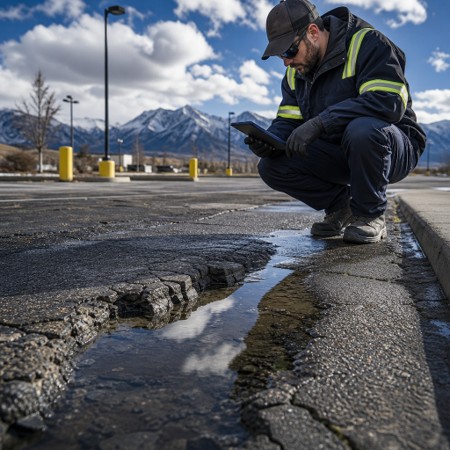
Oxidation comes first. Sunlight and air strip the lighter oils out of the asphalt binder, so the surface turns from black to gray, loses flexibility, and begins to ravel — you see loose stone collecting along curb lines and in drive aisles. A brittle surface cannot flex with thermal movement, so it cracks. Once a crack is open, meltwater runs straight through the surface into the base. In winter that water freezes, expands, and pries the crack wider; in spring the saturated base loses bearing strength under wheel loads. The crack network becomes interconnected alligator cracking, the base pumps fines upward, and a pothole appears. At that point you are no longer maintaining a surface. You are rebuilding a structure.
The practical consequence: every dollar of deferral moves the required fix one category up the cost ladder — from sealing, to patching, to overlay, to full-depth reconstruction. Federal pavement preservation guidance makes the same point for public roads, and the U.S. Department of Transportation’s pavement preservation resources are worth reading if you want to understand why timing matters more than product selection.
The maintenance sequence, in the right order
1. Fix drainage before anything else
If water ponds in a drive aisle or sheets across a stall for days after a storm, no coating or patch will survive long. Birdbaths, flattened cross-slope, clogged inlets, and curb-and-gutter that no longer carries flow are structural problems disguised as cosmetic ones. Correcting grade or inlet function is usually the least glamorous line item on a pavement proposal and the one with the highest return.
2. Seal cracks while they are still narrow
Hot-pour crack sealing is the highest-value routine treatment available for Colorado asphalt. Cracks wider than roughly a quarter inch are candidates; they should be routed or cleaned, dried, and filled with a flexible rubberized sealant that moves with the pavement through winter contraction and summer expansion. Cold-pour products poured from a bucket into a dirty crack tend to shrink and debond within a season. Crack sealing is typically a yearly or every-other-year task, not a once-in-a-decade one, because new thermal cracks form continuously.
3. Patch what has already lost its base
Potholes and alligatored areas need removal and replacement, not filling. Full-depth patching means saw-cutting a clean rectangle, excavating through the failed asphalt and any contaminated base, recompacting, and placing new hot mix in lifts. A surface skim over a soft base will fail again in the same spot, usually within one winter.
4. Sealcoat for surface protection — after repairs, never instead of them
Commercial sealcoating is a protective and cosmetic treatment: it shields the binder from UV and oxidation, resists fuel and oil, and restores the uniform black surface that makes fresh striping read clearly. What it does not do is add structural strength or bridge working cracks. Sealcoat applied over an unrepaired lot looks excellent for about four months and then telegraphs every defect underneath. Reapplication intervals of a few years are typical, driven by traffic volume and sun exposure rather than the calendar alone.
5. Restripe with compliance in mind
Striping is where pavement maintenance meets liability. Accessible stalls, access aisles, van-accessible dimensions, route-of-travel markings, fire lanes and signage are enforced regardless of how the asphalt looks. Faded layouts also cost you usable stalls, because drivers default to generous spacing when lines are ambiguous. If you are already mobilizing crews for sealcoating, that is the economical moment to correct a layout that has drifted out of compliance or to pick up a few spaces with a smarter traffic pattern.
6. Overlay or mill-and-overlay when the surface is spent but the base is sound
When cracking becomes widespread but the structure is still carrying loads, milling off the deteriorated top inches and placing new hot mix resets the surface without the cost and disruption of reconstruction. Milling also preserves existing grades and curb reveal, which matters at doorways, ADA routes and drainage structures.
Turn condition into a multi-year budget
The tool that makes all of this plannable is a Pavement Condition Index assessment. A PCI survey scores each section of a lot on observed distress and lets you rank areas by need, so a 12-acre industrial site can be phased across several fiscal years instead of hitting one budget cycle all at once. It also gives boards and ownership groups a defensible document: this zone is sealed this year, that zone is patched next year, this entrance drive is scheduled for mill-and-overlay in year three. Pavement belongs in the same long-range thinking as roofs and mechanical systems, which is the same logic behind improvement projects that support long-term property value rather than short-term curb appeal.
Choosing a contractor who plans rather than sells
Ask any bidder to walk the site with you and explain the failure mechanism behind each recommended repair. A contractor who can tell you why a crack pattern is thermal rather than load-related, who proposes drainage work before coatings, and who puts repairs ahead of sealcoating is giving you a plan; one who quotes a single square-foot number for the whole lot is selling a product. Regional experience also matters, because altitude, snowplow wear and de-icer chemistry all affect material choices. For Front Range properties, Asphalt Coatings Company has worked in Colorado since 1986 with in-house crews and PCI-based pavement management, building condition-based multi-year plans for retail centers, office parks, HOAs, schools and industrial sites — the kind of structured approach behind its Colorado Springs parking lot maintenance work, where an on-site assessment and CDOT approved sealant materials set the sequence rather than guesswork.
A realistic annual rhythm
- Early spring: walk the lot after snowmelt, photograph new potholes, note where water stood.
- Late spring: schedule patching and crack sealing while temperatures are reliable and before summer heat closes crack faces.
- Summer: sealcoating and striping, phased by zone so tenants keep access.
- Fall: sweep debris and clear inlets so winter meltwater has somewhere to go.
- Annually: update the condition survey and roll the multi-year plan forward one year.
Pavement rewards owners who are boringly consistent. Keep water out, keep the binder protected, repair small defects on schedule, and the same asphalt that fails in eight years of neglect will serve two or three times that long — with tenants, customers and insurers noticing the difference long before the next capital cycle arrives.
Enjoy Worthview?
Add Worthview as a Preferred Source on Google to see more of our stories in Search.

Worthview Editorial Team is the shared byline for content created collaboratively by Worthview’s editors and contributors. Since 2008, we’ve published thousands of articles across technology, AI, finance, health, home, travel, and lifestyle. Our editorial process emphasizes original research, reputable sources, regular content updates, and clear attribution. Articles covering higher-trust topics, including health and finance, may also undergo review by qualified subject-matter experts.