The new model matches near-frontier performance at 40% lower cost than its predecessor, Opus 5 — and arrives with a stricter safety tier that puts it in the same bracket as Anthropic’s most capable public models.
Anthropic introduced Claude Opus 5.5 on September 22, 2026, the first model in a new “5.5” generation and the company’s first release since CEO Dario Amodei’s public call to pace frontier AI development against the strength of safety practices. Opus 5.5 now performs at roughly the level of Claude Fable 5.1, Anthropic’s most capable publicly available model, on the majority of real-world work — while costing meaningfully less to run than the Opus model it replaces.
Introducing Claude Opus 5.5, the first model in our new Claude 5.5 family.
It performs at the level of Claude Fable 5.1 for most tasks, and costs 40% less to run than Opus 5. pic.twitter.com/Q9C2VKQ79f
— Claude (@claudeai) September 22, 2026
For teams that have been weighing whether to pay a premium for Anthropic’s top-tier models, Opus 5.5 changes the calculation. It closes much of the intelligence gap with Fable 5.1 while undercutting the price of the previous-generation Opus 5, a combination Anthropic is positioning as its new default recommendation for coding, research, and everyday agentic work.
What Changed From the Previous Generation
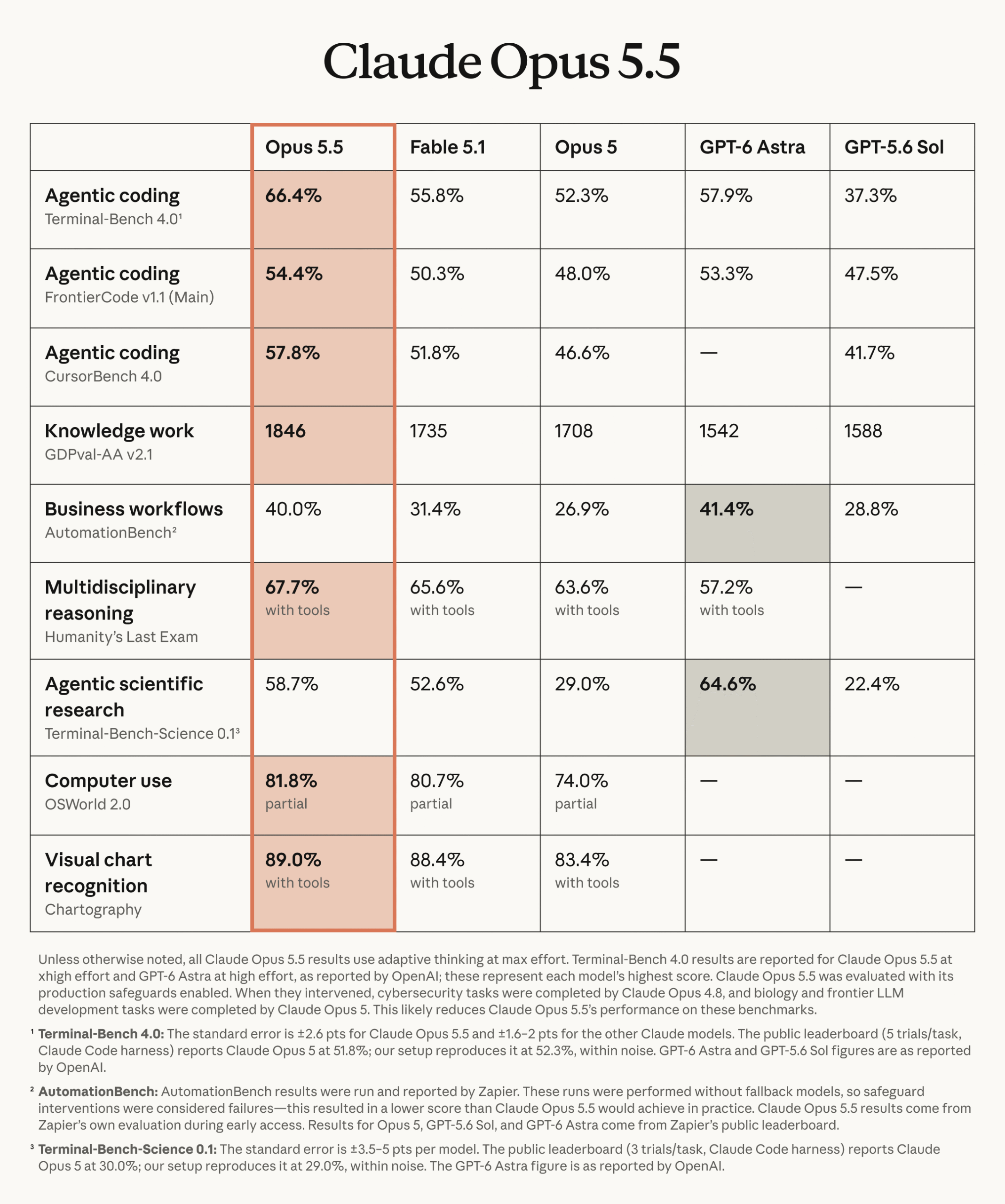
Opus 5.5 succeeds Opus 5, which launched in July 2026 as a cheaper, faster alternative to Anthropic’s flagship Fable line. Where Opus 5 traded some capability for cost savings, Opus 5.5 narrows that trade-off considerably. Anthropic’s own benchmark disclosures show clear gains across coding, computer use, and knowledge-work evaluations:
- Terminal-Bench 4.0 (agentic command-line tasks): 66.4% for Opus 5.5, up from 52.3% for Opus 5
- CursorBench 4.0 (ambiguous, multi-file coding tasks): 57.8%, up from 46.6%
- GDPval-AA v2.1 (real-world professional work across 44 occupations): 1,846 Elo, up from 1,708
- OSWorld 2.0 (computer-use tasks): 81.8%, up from 74.0%
Opus 5.5 is a major step up from Opus 5, leading on agentic coding, computer use, and knowledge work.
The gains are not just about raw scores. Anthropic reports that early testers completed a 680,000-line code migration in under a day, and that one tester’s 200,000-line codebase audit dropped from more than 20 hours on Opus 5 to under three hours on Opus 5.5, using a fraction of the tokens. In one internal test, Opus 5.5 successfully rewrote HAProxy — widely used load-balancing software — from C into Rust faster and at roughly half the cost of Fable 5.1 attempting the same task.
The Real Headline: A 40% Cost Cut
For cost-conscious operators — solo publishers, agencies, and Indian startups running lean AI budgets included — the pricing change is arguably the bigger story than the benchmark gains. Anthropic says Opus 5.5 costs 40% less than Opus 5 on typical workloads once its lower per-token pricing and improved token efficiency are combined.
| Per 1M tokens | Opus 5.5 | Opus 5 |
| Input tokens | $4 | $5 |
| Output tokens | $20 | $25 |
| Cache reads | $0.20 | $0.50 |
| Cache writes | $5 | $6.25 |
Cache reads, which Anthropic notes make up the majority of costs in agentic and coding workloads, fall by 60%. A faster “Fast mode” option is also available in Claude Code and the Claude Platform, running at up to 2.5x speed for $8 per million input tokens and $40 per million output tokens. Anthropic is also raising five-hour usage limits across Pro, Max, Team, and seat-based Enterprise subscription plans, and introducing a saveable rate-limit reset for subscribers.
A Stricter Safety Tier
Because Opus 5.5’s capabilities in biology and cybersecurity now approach those of Anthropic’s Mythos-class models, the company is deploying it with safeguards similar to those on Fable 5.1 — a first for an Opus model. Most cybersecurity-adjacent tasks are automatically rerouted to the older, less capable Opus 4.8, while routine bug-fixing during normal software development remains unaffected. Vetted organizations can apply for expanded access through Anthropic’s Life Sciences Verification Program and, in the coming weeks, an expanded Cyber Verification Program.
On Anthropic’s internal behavioral audit — its most comprehensive alignment test, run across nearly 2,000 simulated scenarios — Opus 5.5 posted the strongest results of any Claude model tested to date, including a roughly 85% drop in attempts to circumvent operational boundaries compared with Opus 5 and Mythos 5.1. The model also launches with “preserved thinking,” an anti-distillation safeguard first introduced with Fable 5.1, and continues to support zero data retention for enterprise and API customers.
Better at Explaining Itself
One of the more practical upgrades is communication style. Verbose, hard-to-follow output was a common complaint about Opus 5, and Anthropic says Opus 5.5 writes more clearly, leads with the most important information, and avoids unnecessary jargon. Multiple enterprise testers, including engineering teams at Ramp and Stripe, reported that Opus 5.5’s explanations and code reviews required far less editing before being shared with colleagues or clients — a detail that matters as much for day-to-day usability as any benchmark score.
Availability
Claude Opus 5.5 is live now across Anthropic’s own platforms as well as Amazon Web Services, Google Cloud, and Microsoft Azure, with developers able to call it via the Claude Platform as claude-opus-5-5. Anthropic says Claude Sonnet 5.5 and Claude Haiku 5.5 — the mid-tier and lightweight models in the new generation — will follow in the coming weeks, carrying over many of the same efficiency and safety improvements.
The Takeaway
Opus 5.5 is less a dramatic capability leap than a sharp correction on cost-efficiency: Anthropic is delivering performance close to its most expensive public model at a price point below its previous mid-tier flagship. For businesses and independent operators evaluating which model tier to standardize on, that combination — near-frontier output at a meaningfully lower cost per task — is likely to be the more consequential shift than any single benchmark number.
Enjoy Worthview?
Add Worthview as a Preferred Source on Google to see more of our stories in Search.

Sethuram Kishore is the founder and editor of Worthview, an online publication established in 2008. With over 18 years of experience in SEO, digital marketing, and online publishing, he writes about AI, technology, business, and digital trends. He is also the founder of MoneyHulk, a personal finance and business publication.






One thought on “Claude Opus 5.5 Is Here: Anthropic’s Cheapest Frontier Model Yet Puts Pressure on Enterprise AI Budgets”