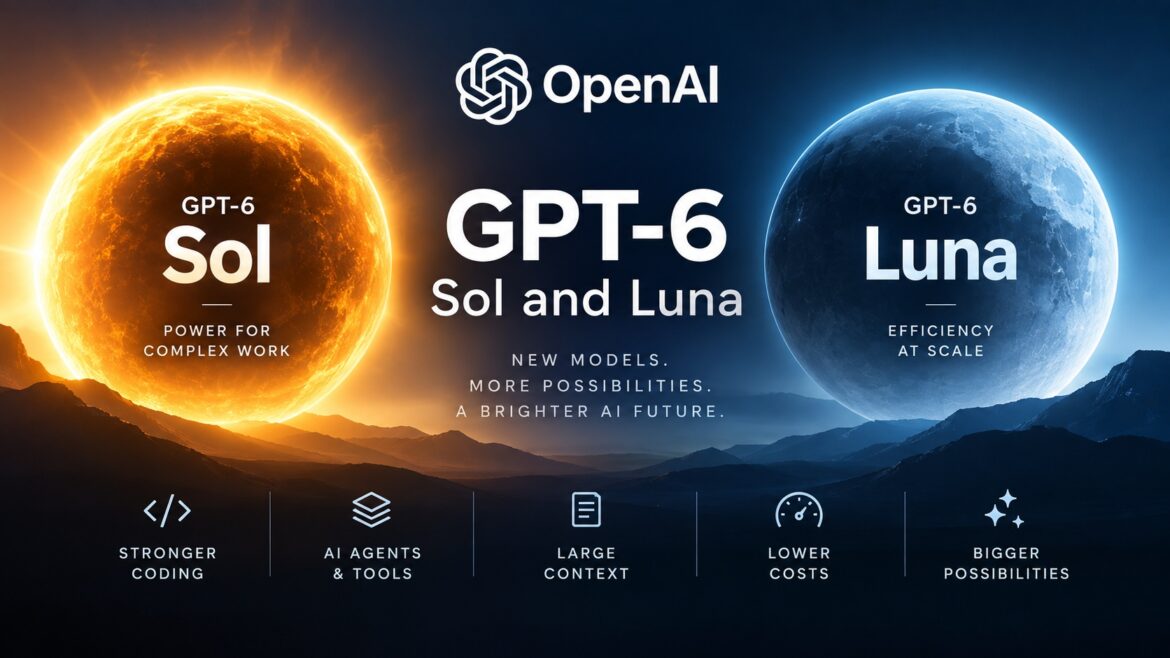
OpenAI has expanded its GPT-6 model family with two new models, GPT-6 Sol and GPT-6 Luna, bringing many of the capabilities of its latest generation of AI models to lower-cost options designed for different types of workloads.
The two models are positioned differently. GPT-6 Sol is built for complex coding and agentic workflows, while GPT-6 Luna focuses on efficient, high-volume tasks where cost and scalability are important.
Both models are now available through the OpenAI API, and they are also rolling out across OpenAI’s products.
What Are GPT-6 Sol and GPT-6 Luna?
GPT-6 Sol and GPT-6 Luna are the latest additions to OpenAI’s GPT-6 family, joining GPT-6 Astra, which OpenAI continues to position as its most capable model.
Rather than creating two models that serve exactly the same purpose, OpenAI is giving developers different options depending on the complexity, speed and cost requirements of their applications.
OpenAI describes the models as follows:
- GPT-6 Astra: Designed for the most demanding reasoning, coding and end-to-end tasks.
- GPT-6 Sol: Designed for complex coding and agentic workflows while balancing capability and cost.
- GPT-6 Luna: Designed for focused, repeatable, high-volume workloads where efficiency is especially important.
This makes the new models particularly interesting for developers building AI-powered applications and automated workflows.
GPT-6 Sol: Built for Complex Work and AI Agents
GPT-6 Sol is the more capable of the two new models and is designed for tasks that require stronger reasoning and multi-step execution.
OpenAI specifically describes Sol as a model built for complex coding and agentic workflows. It supports several levels of reasoning effort, ranging from no additional reasoning through maximum reasoning effort.
Its supported capabilities include:
- Function calling
- Structured outputs
- Web search
- File search
- Code interpreter
- Hosted shell
- Computer use
- MCP
- Tool search
- Image input
- Streaming
These capabilities make Sol suitable for applications where an AI model needs to do more than simply generate an answer.
For example, an AI agent could receive a task, analyze the requirements, call external tools, inspect the returned information and continue working through multiple steps.
OpenAI also reports improvements over its previous-generation model in coding and professional workflows. On its FrontierCode evaluation, which measures whether AI-generated software changes are suitable for merging into real codebases, OpenAI says GPT-6 Sol shows substantial improvement over GPT-5.6 Sol.
GPT-6 Luna: Designed for High-Volume AI Workloads
GPT-6 Luna takes a different approach.
OpenAI describes Luna as its most efficient model for focused, high-volume tasks.
This makes it particularly relevant when an application needs to process large numbers of requests and doesn’t require the highest level of reasoning for every individual task.
Potential applications include:
- Text classification
- Information extraction
- Summarization
- Content transformation
- Data processing
- Routine automation
- High-volume API workflows
- Repetitive AI-agent tasks
Luna also supports reasoning levels ranging from none to maximum, allowing developers to choose how much reasoning is appropriate for a particular workload.
The major attraction, however, is its cost.
At $0.10 per million input tokens and $0.50 per million output tokens, Luna is substantially cheaper than Sol and is designed to make large-scale AI processing more economical.
GPT-6 Sol vs GPT-6 Luna
The easiest way to understand the difference is to look at what each model is designed to optimize.
| Feature | GPT-6 Sol | GPT-6 Luna |
|---|---|---|
| Primary focus | Complex coding and agentic workflows | Focused, high-volume workloads |
| Reasoning | None to maximum | None to maximum |
| Context window | 1.05 million tokens | 1.05 million tokens |
| Maximum output | 128,000 tokens | 128,000 tokens |
| Input price | $2 / 1M tokens | $0.10 / 1M tokens |
| Cached input | $0.20 / 1M tokens | $0.01 / 1M tokens |
| Output price | $10 / 1M tokens | $0.50 / 1M tokens |
| Image input | Yes | Yes |
| Function calling | Yes | Yes |
| Web search | Yes | Yes |
| File search | Yes | Yes |
| Computer use | Yes | Yes |
The specifications and current standard pricing come from OpenAI’s API documentation.
GPT-6 Sol and Luna Pricing
One of the biggest parts of the announcement is the reduction in API pricing.
OpenAI says GPT-6 Sol and Luna are priced 50% lower than the promotional pricing of their GPT-5.6 counterparts.
Current standard pricing is:
GPT-6 Sol
- Input: $2 per 1 million tokens
- Cached input: $0.20 per 1 million tokens
- Output: $10 per 1 million tokens
GPT-6 Luna
- Input: $0.10 per 1 million tokens
- Cached input: $0.01 per 1 million tokens
- Output: $0.50 per 1 million tokens
For prompts exceeding 272,000 input tokens, OpenAI’s pricing changes to a higher long-context rate. OpenAI also offers Batch and Flex pricing at lower rates, while Fast mode costs more.
What Does Token Pricing Mean?
Tokens are pieces of text processed by an AI model. API providers generally charge separately for tokens sent to the model and tokens generated by the model.
For developers, the distinction between input and output costs matters because some applications send very large amounts of information to a model while generating relatively short responses.
The extremely low input and output prices of Luna make it particularly interesting for applications processing large volumes of relatively routine tasks.
Both Models Have a 1 Million-Token Context Window
Another notable specification is the context window.
Both GPT-6 Sol and GPT-6 Luna support a 1.05-million-token context window, with a maximum output of 128,000 tokens.
A large context window allows an application to provide the model with substantially more information in a single interaction.
This can be useful for applications involving:
- Large documents
- Software repositories
- Long conversations
- Research material
- Business records
- Complex instructions
- Multi-step agent workflows
For developers building AI agents, this can reduce the need to repeatedly split large tasks into smaller pieces.
Why AI Agents Are Important to the GPT-6 Sol and Luna Launch
The announcement is also part of a broader shift in how AI models are being used.
Traditional chatbots primarily respond to questions. AI agents can take a more active role by using tools and completing multiple steps.
For example, an AI-powered business workflow could look like this:
User request → AI reasoning → tool call → retrieve information → analyze results → take another action → produce final result
GPT-6 Sol is explicitly designed for these kinds of agentic workflows, while Luna provides a lower-cost option for tasks that need to be performed repeatedly at scale.
OpenAI’s developer documentation also highlights support for tools such as web search, file search, computer use, hosted shell and MCP.
This means developers can build systems in which the model isn’t just generating text but is participating in a larger automated workflow.
Improved Prompt Caching Could Reduce AI Costs Further
OpenAI has also introduced improvements to prompt caching alongside the GPT-6 models.
The new caching system is designed to provide higher cache hit rates by default. OpenAI says eligible shared prefixes can receive cache discounts when reused within a 30-minute window.
The company has also introduced diagnostics to help developers understand why a request did not receive a cache hit.
Prompt caching is important because many AI applications repeatedly send the same instructions, system prompts or background information.
Instead of processing all of that repeated information in the same way every time, caching can allow applications to reuse previously processed context.
For applications running large numbers of AI-agent interactions, improvements in caching can therefore affect both latency and operating costs.
How GPT-6 Sol and Luna Fit Into the GPT-6 Family
OpenAI now has three major models in the GPT-6 family, each aimed at a different point on the capability-versus-cost spectrum.
GPT-6 Astra
Astra remains OpenAI’s flagship model and is intended for the most demanding reasoning, coding and professional workflows.
GPT-6 Sol
Sol is positioned below Astra and focuses on strong reasoning, complex coding and agentic workflows while offering substantially lower API costs.
GPT-6 Luna
Luna focuses on efficiency and high-volume workloads, making it suitable for applications where running AI at scale is more important than using the most capable model for every request.
OpenAI’s own model guidance recommends Astra for the highest level of capability, Sol for demanding tasks that require strong reasoning, and Luna for efficient, repeatable work at scale.
What Do GPT-6 Sol and Luna Mean for Developers?
The lower prices could have an important effect on how developers design AI applications.
Previously, developers might have avoided putting an expensive reasoning model into every step of an automated workflow because the cost could grow quickly.
With lower-cost models, developers can potentially divide a workflow between different models.
For example:
GPT-6 Luna could handle routine classification, extraction or summarization.
GPT-6 Sol could handle more complicated reasoning, coding or decision-making.
GPT-6 Astra could be reserved for the most difficult tasks where maximum capability is required.
This type of model routing can help developers balance quality, speed and cost instead of relying on one model for every task.
GPT-6 Sol and Luna Availability
GPT-6 Sol and GPT-6 Luna are available through the OpenAI API.
OpenAI also announced that the models are rolling out in ChatGPT Work and Codex for Plus, Pro, Business, Enterprise and Edu users. Free and Go users can try GPT-6 Luna in the desktop app.
Availability can vary by product and plan, so users should check OpenAI’s current product documentation for the latest access information.
Frequently Asked Questions
What is GPT-6 Sol?
GPT-6 Sol is an OpenAI model designed for complex coding and agentic workflows. It provides a balance between reasoning capability and API cost.
What is GPT-6 Luna?
GPT-6 Luna is designed for focused, high-volume AI workloads where efficiency and cost are important.
What is the difference between GPT-6 Sol and GPT-6 Luna?
Sol is intended for more demanding coding, reasoning and agentic workflows, while Luna is optimized for efficient, repeatable workloads at much lower API prices.
How much does GPT-6 Sol cost?
GPT-6 Sol costs $2 per million input tokens and $10 per million output tokens under standard short-context API pricing.
How much does GPT-6 Luna cost?
GPT-6 Luna costs $0.10 per million input tokens and $0.50 per million output tokens under standard short-context API pricing.
What is the context window of GPT-6 Sol and Luna?
Both models have a 1.05-million-token context window and support up to 128,000 output tokens.
Do GPT-6 Sol and Luna support AI agents?
Yes. GPT-6 Sol is specifically designed for agentic workflows, and both models support tools and capabilities that can be used to build AI-agent applications.
Are GPT-6 Sol and Luna available through the API?
Yes. Both models are available through OpenAI’s API, including the Responses API and Chat Completions API.
Final Thoughts
GPT-6 Sol and GPT-6 Luna expand OpenAI’s model lineup beyond simply pursuing maximum model capability.
The more interesting part of the announcement is the focus on cost-efficient intelligence.
Sol targets developers who need strong reasoning, coding and agentic capabilities without using the flagship model for every task. Luna takes the idea further by offering a very low-cost option for high-volume AI processing.
Combined with a 1.05-million-token context window, tool support and improvements to prompt caching, the two models could make it easier for developers and businesses to put AI into larger, more complex workflows.
For the growing AI-agent ecosystem, that may be just as important as improvements in raw model performance.
Enjoy Worthview?
Add Worthview as a Preferred Source on Google to see more of our stories in Search.

Worthview Editorial Team is the shared byline for content created collaboratively by Worthview’s editors and contributors. Since 2008, we’ve published thousands of articles across technology, AI, finance, health, home, travel, and lifestyle. Our editorial process emphasizes original research, reputable sources, regular content updates, and clear attribution. Articles covering higher-trust topics, including health and finance, may also undergo review by qualified subject-matter experts.