Most coverage of Google Search Profiles has focused on the follow button and creator hubs. The real story is what happens to your entity data the next time an AI model trains — and why claiming your profile today could shape how AI systems cite you in 2027 and beyond.
The Launch Everyone Covered — And the Story Nobody Told
On June 4, 2026, Google quietly launched Search Profiles — a claimable, customisable page for publishers and creators inside Google Search and Discover. Within 48 hours, the coverage was predictable: here is how to claim yours, here are the follower thresholds (100,000 on YouTube, Instagram, or X; 300,000 on TikTok), here is the direct URL.
What are Search Profiles?
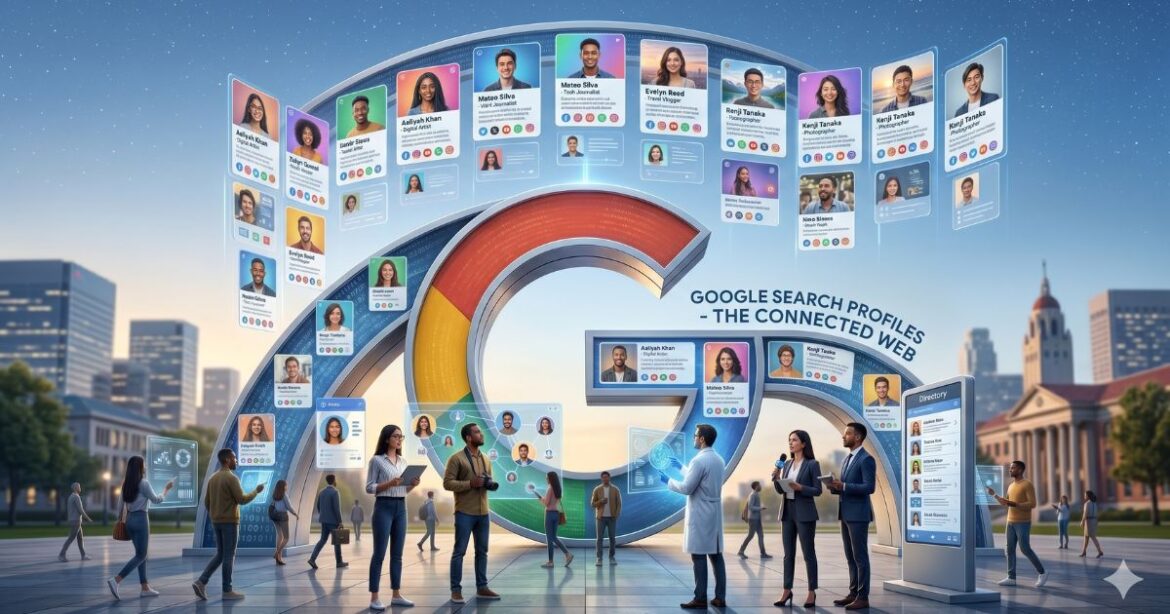
Think of a Search Profile as a verified, customizable “link-in-bio” page that lives natively on Google. Instead of users having to piece together a creator’s or publisher’s official channels, these profiles act as a dedicated, shareable space that aggregates all of their fragmented web properties.
| Launch date | June 4, 2026 |
| Availability | US only (global expansion planned) |
| Who can claim | Publishers & creators, 18 years or older |
| Follower thresholds | 100K on YouTube, Instagram, or X · 300K on TikTok |
| Claim URL | creators.google/profile |
| What you can add | Avatar, bio, website, social accounts, articles, videos, posts |
| Where it appears | Knowledge panel, Google Discover, direct URL |
| Audience action | Follow profile → see more content in Discover |
| Access on mobile | Via knowledge panel or tapping creator name on Discover |
| Announced by | Ibrahim Badr, Product Manager, Google Search |
Fair enough. But buried underneath that surface story is something far more consequential, especially for anyone thinking about search visibility in the AI era.
When you claim a Google Search Profile, you are not just setting up a nice-looking hub page. You are submitting a structured, verified entity record directly into Google’s ecosystem — one that sits uncomfortably close to the same data layer that AI models draw on when deciding who to cite, trust, and surface in generated answers.
This piece is about that angle. Not the follow button. Not the avatar. The LLM training data play.
First, Understand How AI Models Decide Who to Cite
Most people still think of search visibility as a ranking problem. If your page ranks #1, you win. That mental model is increasingly broken when applied to AI-generated answers.
AI platforms — whether that is Google’s own AI Overviews, AI Mode, Gemini, or external tools like ChatGPT Search and Perplexity — do not work by looking at a SERP and picking the top result. They work by drawing on three distinct sources simultaneously:
| Source | What It Is | Risk Without Search Profile |
| LLM Memory | Facts baked in during model training. Reliable for well-known brands, unreliable for everyone else. | AI says you ‘claim to be’ rather than you ‘are’. Outdated or absent facts. |
| Knowledge Graph | Structured, verified entity databases cross-referenced when AI wants to state confirmed facts. | Low confidence entity record — or no record at all. Excluded from authoritative answers. |
| Live Search Index | Real-time web content queried at the moment of response. Clean, crawlable pages feed this. | Even great content gets underweighted if the entity behind it lacks structured verification. |
The distinction that matters most is between the Knowledge Graph layer and LLM memory. Getting into the Knowledge Graph is, as researchers in this space have put it, the difference between an AI saying you are something versus merely claiming to be it. That is not a small distinction — it determines whether you show up in generated answers as a fact or as a hedge.
What Search Profiles Actually Do to Your Entity Record
Here is where it gets interesting. When you claim and populate a Google Search Profile, you are doing something that was previously only available through indirect, slow-burn methods like Wikipedia entries, Wikidata contributions, and structured data markup.
You are submitting a first-party, Google-verified entity record that explicitly declares:
- Who you are (name, bio, avatar)
- What you cover (your content taxonomy, linked social accounts, website)
- Where you are authoritative (your linked YouTube, Instagram, X profiles)
- What your latest output looks like (your articles, videos, social posts)
This is a structured entity declaration inside Google’s own ecosystem. And Google’s ecosystem is, to put it plainly, one of the primary inputs for how AI systems — including Google’s own Gemini — understand the world.
| Why This Matters for Future LLM Training
AI models are not static. They are retrained periodically using fresh web crawl data, updated knowledge bases, and structured entity signals. A verified, canonical Search Profile creates exactly the kind of clean, consistent, cross-referenced entity signal that training pipelines favour when establishing who is authoritative on a given topic. In practical terms: the profile you claim today may influence how the next generation of AI models represents you when someone asks a question in your niche. |
The Knowledge Graph Connection: Democratising Entity Authority
Until now, getting into Google’s Knowledge Graph as an individual creator or small publisher was genuinely difficult. The traditional routes were:
- Get a Wikipedia article written about you or your brand (high editorial bar, often rejected)
- Build a Wikidata entry with sufficient external references (technically accessible but obscure)
- Earn enough mentions in authoritative third-party sources that Google’s systems infer your entity
- Deploy Organisation/Person schema markup across your site consistently over time
All of these are slow, indirect, and often out of reach for creators who are not yet famous enough for Wikipedia but are absolutely authoritative in their niche.
Search Profiles changes this equation. It is, effectively, a direct entity registration channel — one where Google itself is the verifier. The follower threshold (100K on major platforms) acts as a proxy for demonstrated reach, replacing the editorial gatekeeping of Wikipedia with a more measurable, platform-based signal.
For creators who qualify, this is a significant shortcut into the entity layer of AI search. For those who do not yet qualify, it is a clear roadmap: build your cross-platform presence to the threshold, then claim your record.
The Gemini Angle: Why Google’s Own AI Has the Most to Gain
It is worth pausing on why Google specifically benefits from building out Search Profiles at this moment.
Gemini, Google’s flagship AI model, has a structural advantage over competitors like ChatGPT and Claude in one very specific area: it has native, real-time access to Google’s own data infrastructure — including the Knowledge Graph, Google Search, YouTube, and Google Discover.
When Gemini is asked about a creator, publisher, or topic, it does not have to rely purely on static training data. It can cross-reference live entity records. The more complete and verified those entity records are, the more confidently Gemini can surface and cite them in AI-generated responses.
Search Profiles are, from this angle, a data enrichment programme for Gemini. Google is incentivising creators to voluntarily complete their entity records — at scale, across millions of publishers — which in turn strengthens the knowledge layer that its own AI models draw on.
The Virtuous Loop Google Is Building
This is not altruism. It is a data flywheel. |
What Publishers and Creators Should Actually Do Right Now
If you are eligible (100K+ followers on YouTube, Instagram, or X; 300K+ on TikTok), the action is clear:
- claim your profile at https://creators.google/profile as soon as the feature is available in your region.
- Populate every field.
- Link every platform.
- Write a clean, accurate bio that precisely describes your topical authority.
If you are not yet eligible, this is what to work on:
| Action | Why It Matters for LLM Visibility | Timescale |
| Build cross-platform presence to the 100K threshold on at least one major network | Makes you eligible to claim a verified entity record directly with Google | 6–18 months |
| Deploy consistent Organisation/Person schema across your site | Strengthens your entity record in Google’s Knowledge Graph independently of the profile | Immediate |
| Build your Wikidata entry if possible | Provides an authoritative external reference point that both Google and other LLMs draw on | 1–4 weeks |
| Publish topically consistent, well-structured content with clear author attribution | Trains AI systems to associate your entity with specific expertise domains | Ongoing |
| Get cited in authoritative third-party publications | Creates the citation pattern signals that LLMs use to establish authority | Ongoing |
The Bigger Picture: Search Profiles as a Preview of AI-Era Trust Architecture
Zoom out and Search Profiles starts to look like something more significant than a creator tool. It looks like a preview of how Google intends to structure source trust in the AI search era.
The 100K follower threshold is not arbitrary. It is a machine-readable proxy for demonstrated authority — one that can be programmatically evaluated, updated, and used to tier sources in AI-generated responses. Today it gates profile access. Tomorrow it may gate AI Overview citation priority, AI Mode source selection, and Discover distribution weighting.
We are moving from a world where search visibility meant ranking to a world where it means being recognised as an authoritative entity by AI systems. The infrastructure for that recognition is being built right now — and Search Profiles is one of the first public-facing pieces of it.
Key Takeaway
Do not think of Google Search Profiles as a social media feature. Think of it as entity registration for the AI search era.
The creators and publishers who establish clean, verified, comprehensive entity records in Google’s ecosystem today are positioning themselves to be cited, surfaced, and trusted by AI systems over the next two to three years.
The window to do this ahead of the crowd is open right now — but it will not stay open forever.
Frequently Asked Questions
Q: Does claiming a Google Search Profile directly affect how AI models cite me?
A: Not instantaneously, and not in a direct cause-and-effect way. But it contributes to the entity record that AI systems — particularly Gemini — draw on when generating answers. Over time, as models are retrained on updated data, a clean and verified entity record strengthens the likelihood of confident citation versus hedged or absent mentions.
Q: What is the difference between a Google Search Profile and a Knowledge Panel?
A: A Knowledge Panel is generated by Google’s systems based on existing signals about an entity. A Search Profile is actively claimed and populated by the entity themselves. Claiming a Search Profile can trigger the creation of a Knowledge Panel or enrich an existing one with your latest content and verified information.
Q: I do not have 100,000 followers. Is this still relevant to me?
A: Very much so. The threshold governs who can claim a profile at launch — not who benefits from building entity authority. The underlying principles (structured schema, consistent topical publishing, third-party citations, Wikidata presence) all apply regardless of your current follower count. And Google has signalled that eligibility criteria may expand over time, especially in non-US markets.
Q: Does Google Search Profiles work for non-US publishers right now?
A: No. The initial launch is US-only. Google has explicitly stated plans to expand to more markets, but no timeline has been announced. Publishers in India, the UK, and other markets should monitor for the rollout and prepare to claim profiles as soon as access opens.
Q: Can a Search Profile help me appear in ChatGPT or Perplexity answers too?
A: Indirectly, yes. While ChatGPT and Perplexity do not directly read Google’s Search Profiles, the entity authority signals that a profile helps build — Knowledge Graph presence, structured data, consistent citations across the web — contribute to the broader entity recognition that all LLMs draw on during training and retrieval.
Enjoy Worthview?
Add Worthview as a Preferred Source on Google to see more of our stories in Search.

Sethuram Kishore is the founder and editor of Worthview, an online publication established in 2008. With over 18 years of experience in SEO, digital marketing, and online publishing, he writes about AI, technology, business, and digital trends. He is also the founder of MoneyHulk, a personal finance and business publication.