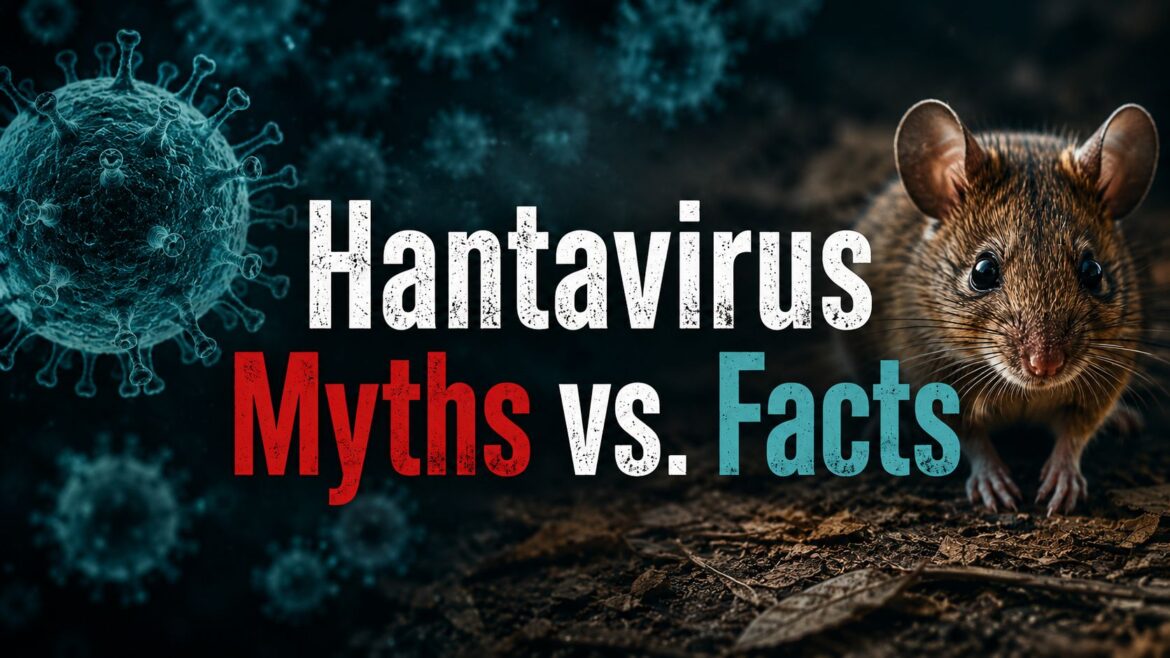
Social media is flooded with fear and misinformation about the 2026 Hantavirus outbreak. We cut through the noise — one myth at a time.
The Numbers Right Now (As of May 12, 2026)
Before we bust any myths, here is where things actually stand — straight from WHO and CDC official reports.
11
Total cases reported
3
Deaths (CFR: 38%)
23
Countries whose nationals were on board
50+
Hantavirus strains exist globally
Why Myths Spread Faster Than Viruses
The moment the word ‘Hantavirus‘ started trending, something predictable happened: panic set in faster than facts could keep up. Images of PPE-suited passengers disembarking in Tenerife triggered immediate COVID flashbacks. Screenshots with wrong information racked up millions of shares. And somewhere between WhatsApp forwards and worried dinner-table conversations, myths were born.
The good news? Most of what is circulating online is wrong — and the truth is actually less terrifying than the rumours. Let us go through them one by one.
The 9 Myths — Debunked
❌ MYTH 1 : “Hantavirus spreads just like COVID. We’re heading for another pandemic.”
✅ THE FACT
Hantavirus is fundamentally different from COVID-19. COVID was a novel airborne virus that spread efficiently with minimal contact.
Hantavirus requires either rodent exposure or — in the rare case of Andes virus — close, sustained physical contact with a symptomatic person. WHO rates global risk from this outbreak as LOW. The largest-ever Andes virus outbreak (Patagonia, 2018) resulted in just 34 cases.
Let’s break down why this comparison doesn’t hold up:
- COVID-19 was a brand-new virus — humans had zero prior immunity. Hantavirus has been known to science since the 1950s.
- COVID spread through brief, casual contact in shared air. Andes virus transmission needs intimate, prolonged contact.
- COVID had an R0 (reproduction number) of 2–3 at baseline. Andes virus has historically produced only small, contained clusters.
- As WHO’s Maria Van Kerkhove confirmed on May 8, scientists have decades of data on hantaviruses — there are no unknowns of the kind that made COVID so dangerous early on.
❌ MYTH 2 : “You can catch Hantavirus by being near someone who is infected.”
✅ THE FACT
Not from most strains. For Andes virus specifically, transmission requires close, direct physical contact with a symptomatic person — touching contaminated bedding, sharing utensils, or prolonged exposure to their respiratory secretions. A brief elevator ride or sitting nearby does not put you at risk.
This myth has a nuance worth understanding. A 2020 study in the New England Journal of Medicine — the most cited research on Andes virus spread — showed that one patient at a birthday party in Argentina did infect someone else after only a brief interaction near a bathroom. However, this was an unusual case, not the norm. The vast majority of person-to-person transmissions have occurred among household members and healthcare workers in unprotected close-contact scenarios. Casual public contact is not a documented risk factor.
❌ MYTH 3: “Hantavirus is brand new — scientists know nothing about it.”
✅ THE FACT
Hantavirus was first identified in the 1950s after the Korean War. The US has tracked hantavirus cases since a 1993 outbreak in the Four Corners region of the American Southwest. There are over 50 known strains worldwide. Andes virus specifically was identified in 1997. Scientists have nearly 30 years of data on it.
Context: In 2025, eight countries across the Americas reported 229 hantavirus cases and 59 deaths. This is a known, monitored disease — not a mysterious new pathogen.
❌ MYTH 4: “My cat or dog could give me Hantavirus.”
✅ THE FACT
Domestic pets — cats, dogs — are not known to carry or transmit hantavirus to humans. The virus lives in specific wild rodent species: deer mice, cotton rats, rice rats, and white-footed mice in the Americas. Your household pet is not a vector.
This myth likely arises from the general association between animals and zoonotic diseases. But the rodent hosts of Hantavirus are very specific. Pet store rodents are also not a known source of infection. The risk comes from wild rodents — particularly in rural, forested, or agricultural areas where these specific species live.
❌ MYTH 5: “Hantavirus is airborne — wearing a mask outdoors will protect you.”
✅ THE FACT
This is partially true but widely misunderstood. Hantavirus particles don’t float in open air the way some respiratory viruses do. The risk comes from inhaling dried dust from rodent droppings or nesting materials in enclosed, poorly ventilated spaces — like cleaning an old shed, barn, or cabin. In open air, the risk is negligible. A mask in a confined, rodent-infested space? Yes. A mask while walking outdoors? Unnecessary.
Here is the science: Hantavirus survives in the environment for 2 to 3 days at normal room temperature. Ultraviolet rays in sunlight kill it. This is why enclosed, dark, poorly-ventilated spaces with rodent activity carry the most risk — not open-air environments.
For healthcare workers treating confirmed Andes virus patients, the CDC does recommend N95 respirators in patient rooms as a precaution. But this is a clinical setting consideration — not everyday public guidance.
❌ MYTH 6: “Three deaths from 8 cases means this is the deadliest virus ever discovered.”
✅ THE FACT
The 38% case fatality rate for Hantavirus Pulmonary Syndrome caused by Andes virus is indeed high and serious — but context matters. These 8 cases represent a single contained cluster, not a population-wide estimate. The virus is rare: even in endemic South American countries, annual case counts are in the dozens, not thousands. Compare: seasonal flu kills far more people globally every year despite a much lower CFR, simply because it infects billions.
Perspective: In all of 2025, eight countries in the Americas combined reported 229 hantavirus cases total. The current cruise ship cluster of 8 is exceptional — not typical of the virus’s normal spread.
❌ MYTH 7: “There’s no point going to a hospital — there’s no treatment anyway.”
✅ THE FACT
This is dangerously wrong. While there is no approved antiviral drug for Hantavirus, early hospital care dramatically improves survival chances. In severe cases, a procedure called ECMO (Extra-Corporeal Membrane Oxygenation) — where a machine temporarily takes over the function of the lungs — has been shown to improve survival rates up to approximately 80% when started early. Waiting at home until symptoms worsen is one of the biggest preventable mistakes.
The CDC explicitly warns that patients with suspected HPS can deteriorate rapidly, and delayed care directly reduces the chance of survival. The critical illness phase is intense but often short — and survivors can recover quickly with the right support. Getting to a hospital early is the single most important action a patient can take.
❌ MYTH 8: “India needs to start panicking — this will reach here soon.”
✅ THE FACT
There is no documented Hantavirus threat to India at this time. The virus is not endemic to India in any significant known form, and no Indian nationals have been reported among the cruise ship cases. The current outbreak is geographically limited to a specific group of people from 23 countries who were on one ship. Routine travel can continue normally, per CDC guidance.
For Indian readers: the relevant precaution is awareness, not alarm. If you are travelling to South America — particularly Argentina, Chile, or Patagonia — take normal precautions around rodent exposure. Avoid handling wild rodents, be careful in rural or forested accommodations, and follow local health guidance. For domestic India, no action is required.
❌ MYTH 9: “The cruise ship passengers could have spread it globally before symptoms appeared.”
✅ THE FACT
This concern is real but being actively managed. The incubation period for Andes virus is 4 to 42 days, which means some passengers may have been exposed without yet showing symptoms when they disembarked. This is exactly why WHO activated International Health Regulations (IHR) channels, alerted 23 countries, and coordinated contact tracing internationally. All passengers are being monitored — not left to wander untracked.
That said, there is one important nuance here. An open letter from the World Health Network to WHO on May 7 raised the concern that the virus might be infectious slightly before symptoms fully appear — and recommended stronger precautions (N95 masks rather than surgical masks) for close contacts. This debate among experts is ongoing. What is not debated is that the containment effort is among the most coordinated in recent history for a non-pandemic pathogen.
So What Should You Actually Do?
Here is a clear, myth-free summary of practical actions:
| If you are in India right now | Nothing urgent. Follow normal hygiene. No local risk. |
| If you were on the MV Hondius | Contact your national health authority immediately and follow monitoring instructions. |
| If you have a fever and muscle aches after rodent exposure | Go to a hospital. Mention your exposure history. Do not wait for breathing symptoms. |
| If you are travelling to South America | Avoid enclosed spaces with rodent activity. Do not touch wild rodents. Ventilate accommodations. Wet-clean (do not sweep) any droppings. |
| If you are a healthcare worker | For suspected Andes virus patients, use N95 respirators, gown, gloves, and eye protection in airborne infection isolation rooms. |
The Bottom Line
Hantavirus is a serious virus that deserves respect — but not panic. The science is clear: this is not COVID. It does not spread through casual contact. It does not float in open air. It is not new or mysterious. And the current outbreak, while deeply tragic for the families of three people who died, is a contained cluster being handled by one of the most coordinated international public health responses in recent memory.
The best thing you can do right now is read from authoritative sources — WHO, CDC, your national health ministry — and resist the temptation to share screenshots whose source you cannot verify. In a world where misinformation travels faster than viruses, accurate information is its own kind of protection.
Enjoy Worthview?
Add Worthview as a Preferred Source on Google to see more of our stories in Search.

Worthview Editorial Team is the shared byline for content created collaboratively by Worthview’s editors and contributors. Since 2008, we’ve published thousands of articles across technology, AI, finance, health, home, travel, and lifestyle. Our editorial process emphasizes original research, reputable sources, regular content updates, and clear attribution. Articles covering higher-trust topics, including health and finance, may also undergo review by qualified subject-matter experts.






One thought on “Hantavirus Myths vs. Facts: 9 Things People Are Getting Wrong Right Now”
Comments are closed.