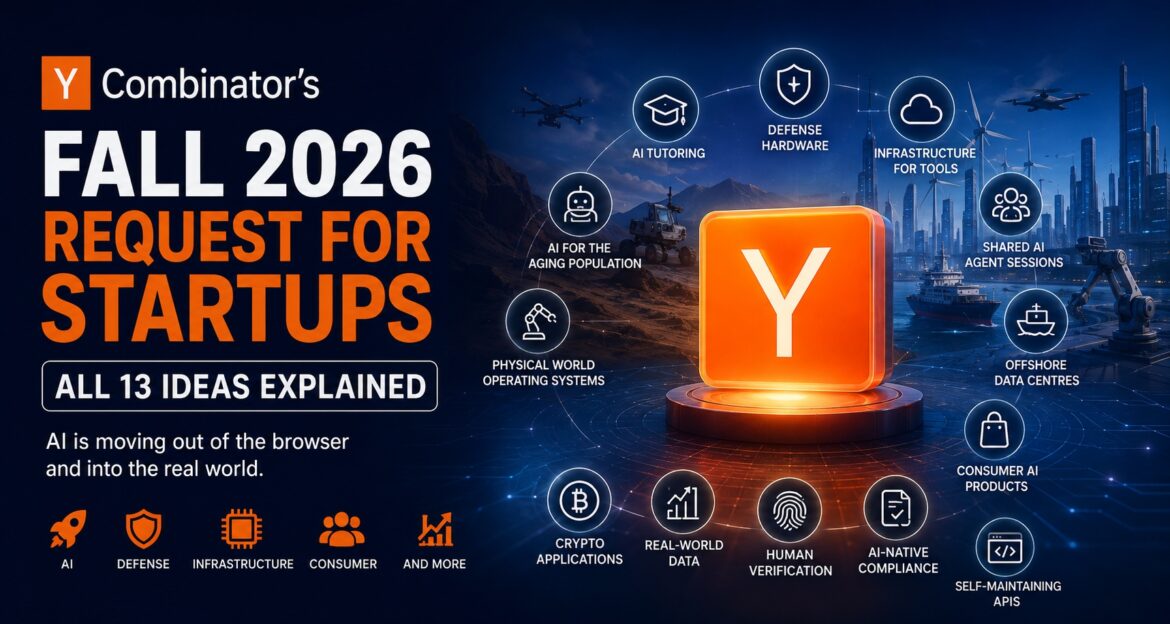
YC’s newest RFS argues AI is finally ready to leave the browser tab and rebuild education, defense, eldercare, compliance, and the physical economy. Here’s what every one of the 13 asks actually means — and where Indian founders fit in.
What the Fall 2026 RFS Actually Is
Y Combinator periodically publishes a Request for Startups, a short list of problem areas its partners and portfolio founders would personally like to see new companies tackle. It isn’t a funding guarantee, and founders don’t need to match an entry to get into the accelerator — but a listed idea does signal where YC believes a technical or market shift has just made something newly possible.
The Fall 2026 edition, covering the batch running October through December in San Francisco, carries a single theme across all 13 essays: artificial intelligence is moving out of chat windows and into education, defense, eldercare, compliance, energy, and the physical world of construction sites and shop floors. Notably, one entry comes directly from the sitting United States Secretary of the Army — the first time a RFS has included a request from a sitting cabinet-level official, underscoring how seriously AI-native defense procurement is now being taken in Washington.
YC Fall 2026 RFS: 13 Ideas at a Glance
Y Combinator’s Fall 2026 Request for Startups highlights 13 areas where the accelerator believes new technology can unlock significant opportunities. Here’s the complete list at a glance:
- AI Tutoring at Consumer Scale — Build an adaptive AI tutor that can provide high-quality, personalized education to children at consumer scale.
- Hardware for the Battlefield — Develop low-cost defense hardware, sensors, interceptors, and resilient systems for modern military environments.
- Infrastructure for Bespoke Tools — Create cloud infrastructure designed specifically for small, purpose-built software used by individual teams.
- Shared AI Agent Sessions — Build collaborative AI-agent environments where teams can work with, monitor, redirect, and hand off agent tasks.
- Offshore Data Centres — Explore modular offshore data centres that can provide AI compute without the land, power, and permitting constraints of traditional facilities.
- AI Consumer Products for a Billion People — Build affordable, agent-driven consumer products capable of serving massive global markets.
- AI for the Aging Population — Develop AI, robotics, monitoring, and coordination tools that help seniors live more independently and support their caregivers.
- Operating Systems for the Physical World — Build software that coordinates AI agents, robots, and human workers across construction, maintenance, logistics, and other field operations.
- Crypto Applications — Use crypto infrastructure and stablecoins to solve real financial problems, particularly around payments and cross-border transactions.
- Data for the Real World — Collect high-quality physical-world data through sensors for applications in agriculture, energy, logistics, construction, and other industries.
- Human Verification — Develop privacy-preserving technology that can prove a person is a real human rather than an AI-generated identity or deepfake.
- AI-Native Compliance Infrastructure — Build systems that use AI to monitor regulatory changes, identify anomalies, and maintain compliance and audit trails.
- Self-Maintaining APIs — Create developer infrastructure that automatically detects API changes, identifies affected code, and helps maintain integrations without waiting for manual updates.
YC Fall 2026 RFS Ideas: Quick Comparison
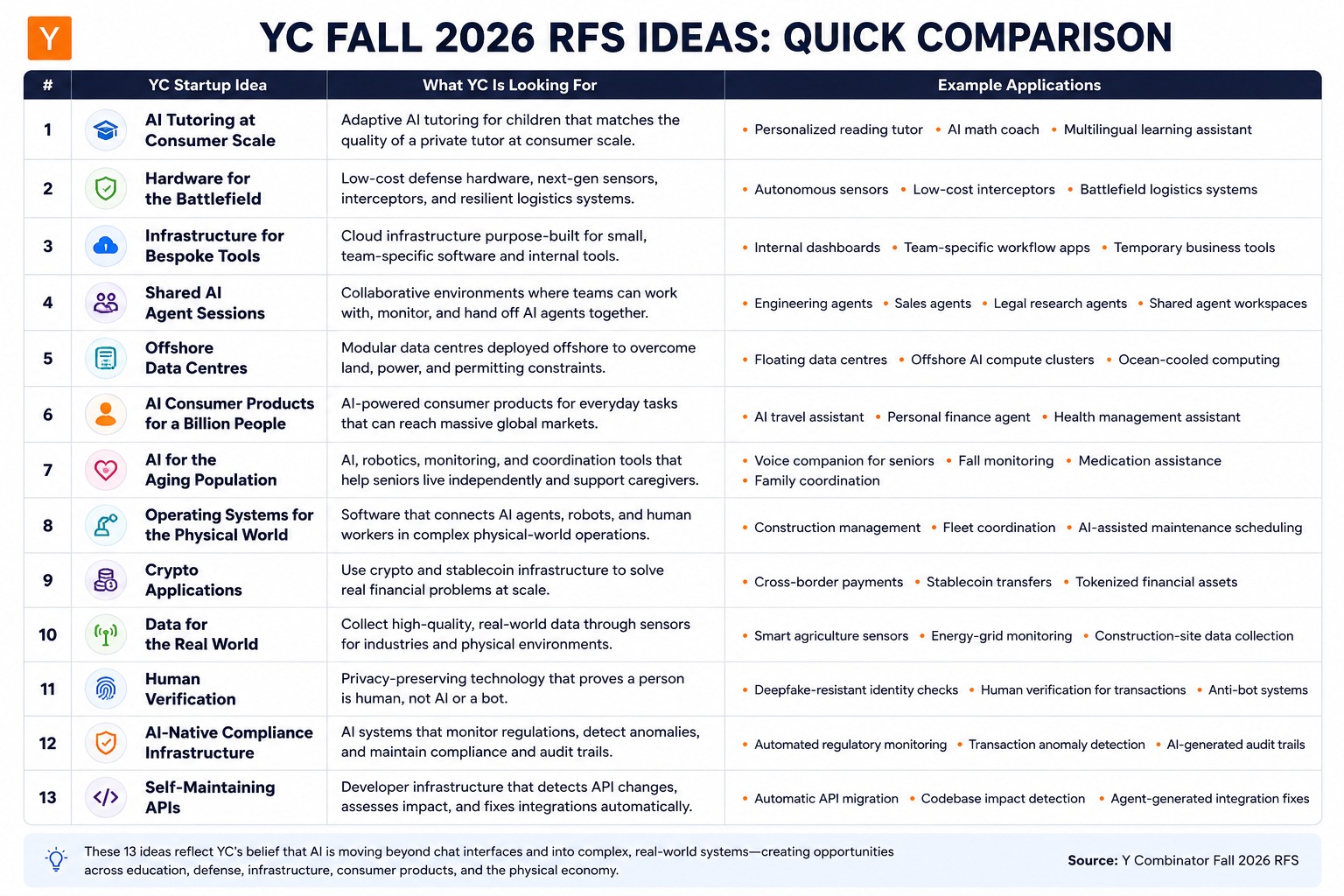
| # | YC Startup Idea | What YC Is Looking For | Example Applications |
|---|---|---|---|
| 1 | AI Tutoring at Consumer Scale | Adaptive AI tutoring for children | Personalized reading tutor, AI math coach, multilingual learning assistant |
| 2 | Hardware for the Battlefield | Low-cost defense hardware, sensors, and resilient systems | Autonomous sensors, low-cost interceptors, battlefield logistics systems |
| 3 | Infrastructure for Bespoke Tools | Cloud infrastructure for small, purpose-built software | Internal dashboards, team-specific workflow apps, temporary business tools |
| 4 | Shared AI Agent Sessions | Collaborative environments for teams working with AI agents | Engineering agents, sales agents, legal research agents, shared agent workspaces |
| 5 | Offshore Data Centres | Modular data centres deployed offshore | Floating data centres, offshore AI compute clusters, ocean-cooled computing |
| 6 | AI Consumer Products for a Billion People | Mass-market AI products for everyday tasks | AI travel assistant, personal finance agent, health management assistant |
| 7 | AI for the Aging Population | AI, monitoring, robotics, and caregiver coordination | Voice companion for seniors, fall monitoring, medication assistance, family coordination |
| 8 | Operating Systems for the Physical World | Software connecting AI agents, robots, and field workers | Construction management, fleet coordination, AI-assisted maintenance scheduling |
| 9 | Crypto Applications | Real-world applications of crypto and stablecoin infrastructure | Cross-border payments, stablecoin transfers, tokenized financial assets |
| 10 | Data for the Real World | Sensor-driven datasets for physical industries | Smart agriculture sensors, energy-grid monitoring, construction-site data collection |
| 11 | Human Verification | Privacy-preserving proof that a person is human | Deepfake-resistant identity checks, human verification for financial transactions, anti-bot systems |
| 12 | AI-Native Compliance Infrastructure | AI systems for regulatory monitoring and compliance | Automated regulatory monitoring, transaction anomaly detection, AI-generated audit trails |
| 13 | Self-Maintaining APIs | Automated detection and repair of API integration issues | Automatic API migration, codebase impact detection, agent-generated integration fixes |
Lets dive into each idea!
1. The Primer — AI Tutoring at Consumer Scale
Requested by Andrew Miklas
Modelled loosely on the adaptive teaching device from Neal Stephenson’s novel The Diamond Age, this request calls for a product that adaptively teaches young children reading, writing, and arithmetic at the standard of a devoted private tutor, delivered at consumer scale rather than as a school procurement. YC frames it as a supplement that makes existing teachers more effective, not a replacement for them.
Why it matters for India: India already runs the world’s largest tutoring and ed-tech market, from Byju’s-era platforms to a dense unorganised tuition sector serving hundreds of millions of children in regional languages. A credible AI tutor built for Hindi, Tamil, Bengali, or Kannada-medium learners, priced for Indian households, is a far larger addressable market than the US English-first version YC is describing.
2. The Future of American Defense — Hardware for the Battlefield
Requested by Daniel P. Driscoll, US Secretary of the Army
This request breaks from YC’s usual software-first tone and asks directly for low-cost interceptors, next-generation sensors, resilient logistics, and modular hardware that plugs into the Army’s open-system architecture, built to survive extreme environments from the Arctic to the subsurface.
Why it matters for India: This category is largely closed to Indian founders given export-control and citizenship restrictions on US defense contracting, but it is a strong signal for India’s own domestic defence-tech push under Atmanirbhar Bharat — the same commercial, modular procurement logic is increasingly shaping how the Indian Ministry of Defence buys from private startups.
3. A Cloud for Small Software — Infrastructure for Bespoke Tools
Requested by Pete Koomen
AI coding agents have made it trivial to build small, purpose-built internal tools for a single team, but deploying and sharing them remains hard because existing clouds like AWS and Azure were engineered for software that scales to millions of users. YC wants a cloud designed instead for lightweight, single-team software, with deployment as easy as sharing a Google Doc.
Why it matters for India: A large share of India’s IT-services and GCC (global capability centre) workforce already builds exactly this kind of internal tooling for enterprise clients. A hosting layer purpose-built for small, disposable software could become foundational infrastructure for that workflow rather than a niche US developer product.
Requested by Aaron Epstein
Today, working with an AI agent is largely a solo activity confined to a private chat window. YC wants agentic products that teams can join together in real time — watching, redirecting, and handing off long-running agent tasks the way colleagues collaborate inside Google Docs or Figma, across functions from engineering to sales to legal.
Why it matters for India: India’s IT-services and BPO sector runs on team-based, handoff-heavy workflows across shifts and time zones, which maps closely onto the multiplayer-agent model YC is describing — a genuine opening for a startup building the collaborative layer on top of existing agent frameworks.
5. Compute at Sea — Offshore Data Centres
Requested by Francois Chaubard
With AI compute demand outpacing available electricity, land, and permitting timelines onshore, this request proposes moving data centres offshore onto standardised, modular vessels — using the ocean’s abundant sunlight and natural cooling as a distributed, permit-free alternative to conventional data-centre construction.
Why it matters for India: India’s own data-centre buildout is already power- and land-constrained around hubs like Mumbai, Chennai, and Pune; an offshore or coastal compute model could be relevant to Indian cloud and energy players over the next several years, though this remains one of the most capital- and engineering-heavy ideas on the list.
6. AI-Powered Consumer Products for a Billion People
Requested by Raphael Schaad
Every computing platform shift has produced its own consumer giants — the web gave rise to Google and Airbnb, mobile to Instagram and DoorDash — yet three years into the AI shift, ChatGPT remains the only new consumer icon. YC argues that falling inference costs are about to make agent-driven consumer products for daily tasks like commuting, health, and money management economically viable at last.
Why it matters for India: This is arguably the single best-fit category for Indian founders: a billion-user AI consumer product is more plausible built for India’s price-sensitive, mobile-first, multilingual market than for the US, echoing how Indian consumer apps historically leapfrogged the West on mobile-first design.
7. AI for the Aging Population — Care Technology for Seniors
Requested by Max Kolysh
With roughly one in five Americans projected to be over 65 by 2030 and millions of caregiving jobs going unfilled, YC wants voice interfaces seniors can actually hold a conversation with, safety monitoring, physical-assistance robotics, and coordination software for the family members currently doing this work unpaid.
Why it matters for India: India’s own elderly population is projected to more than double by 2050, even as joint-family caregiving structures weaken in urban areas — an underexplored market for Indian health-tech and consumer-hardware startups building specifically for Indian-language voice interfaces and family-coordination needs.
8. New Operating Systems for the Physical World
Requested by Charlie Warren
Roughly 80% of the global workforce doesn’t sit at a desk, yet the software running construction, maintenance, and fleet operations has barely changed in two decades. YC sees an opportunity to build operating systems that coordinate three kinds of labour at once — AI agents that quote and schedule work, robots deployed in the field, and human workers wearing devices that log everything they do.
Why it matters for India: India’s construction, logistics, and field-services sectors are enormous, still largely paper- and WhatsApp-coordinated, and spend far more on labour than software — exactly the structural gap YC describes, and one that domestic operators may understand better than Silicon Valley founders do.
9. The Best Time to Build in Crypto
Requested by Nemil Dalal
Despite depressed prices and cooled hype, YC argues bear markets historically produce its strongest crypto founders, since speculative capital exits and only builders solving real problems remain. The firm points to stablecoin adoption by major financial institutions and cites Aspora’s India-to-diaspora money-transfer product as a live example of crypto rails solving a real cross-border problem.
Why it matters for India: This is the one RFS category that names an India-linked example outright. Cross-border remittances into India, one of the world’s largest remittance markets, are a proven wedge for crypto-rail startups, alongside opportunities in tokenised assets and stablecoin-based payments as Indian regulation gradually clarifies.
10. Data for the Real World — Sensing the Physical Environment
Requested by Austin Tindle and Diana Hu
AI models have become superhuman at language, code, and images, but physical-world data remains sparse because most sensors were designed for humans, not machine learning systems. Falling sensor costs and improving foundation models now make dense, purpose-built data collection feasible across energy, agriculture, logistics, and construction — sectors YC believes can eventually be modelled precisely enough to actively control.
Why it matters for India: India’s agriculture and energy sectors are chronically under-instrumented relative to their economic scale, which is as much an opportunity as a gap — a startup collecting dense field- or grid-level data across Indian farms or power infrastructure would be building a dataset with no real domestic competitor.
11. Proving You’re Human — Rebuilding Trust Online
Requested by Max Kolysh
YC cites a case where a finance employee wired twenty-five million dollars after a video call in which every other participant turned out to be an AI-generated deepfake. As voice cloning and synthetic video become cheap and convincing, the firm wants a privacy-preserving way to verify that a real human, not a bot, is on the other end of a call, message, or transaction.
Why it matters for India: India’s exposure to deepfake-enabled financial fraud has grown quickly alongside UPI’s massive transaction volumes, giving verification and anti-fraud infrastructure built for Indian banks, payment apps, and telecom KYC systems a large and urgent domestic market.
12. AI-Native Compliance Infrastructure
Requested by Daivik Goel
Financial compliance today is stitched together from spreadsheets, siloed point solutions, and expensive specialist headcount, with costs compounding as companies expand into new, differently regulated markets. YC wants infrastructure that uses AI to monitor regulatory change, flag anomalies, and maintain audit trails by default, rather than automating the same manual workflows.
Why it matters for India: Indian fintechs and NBFCs already navigate one of the world’s more fragmented compliance environments across RBI, SEBI, and state-level rules — a strong proving ground for AI-native compliance tooling that could later expand to other emerging markets with similarly patchwork regulation.
13. Self-Maintaining APIs — Automated Integration Upkeep
Requested by Harsha Gaddipati
Breaking API changes routinely ship with little warning, and useful new features often go unnoticed because nobody reads changelogs — a pattern the author says caused over 30% of service downtime at a previous employer. With coding agents now trusted to work directly inside customer codebases, YC wants API providers to ship fixes proactively: scanning affected code and opening a pull request the moment something changes, rather than just announcing it.
Why it matters for India: Given the depth of Indian engineering talent already building developer tools and SaaS integrations for global customers, this is a natural, low-localisation category for Indian founders — the problem and the buyer are both international by default.
The Bigger Pattern
Read together, the 13 requests describe a single shift more than a grab-bag of trends: AI capable enough to be trusted with real consequences — a child’s education, a compliance filing, a battlefield decision, a codebase — rather than confined to a chat window. YC’s own framing for the batch is blunt about this, describing AI as moving into the physical world across education, healthcare, defense, finance, infrastructure, and work itself.
For Indian founders specifically, at least five of these categories — consumer AI, physical-world operating systems, compliance infrastructure, real-world data collection, and human-verification tools — arguably fit India’s market structure, talent base, and regulatory complexity better than they fit Silicon Valley’s. The RFS is a US accelerator’s wishlist, but the underlying gaps it describes are global, and in several cases, more acute in India than in the market YC wrote it for.
Founders applying against a specific RFS category should verify exact deadlines and essay wording on YC’s official site before submitting, as timelines and details can shift after publication.
Frequently Asked Questions About YC Fall 2026 RFS
What is Y Combinator’s Fall 2026 Request for Startups?
Y Combinator’s Fall 2026 Request for Startups (RFS) is a list of 13 areas where YC believes new technology and changing market conditions could create opportunities for new startups. The requests span AI tutoring, defense hardware, developer infrastructure, consumer AI, eldercare, crypto, compliance, and physical-world applications.
What are the 13 YC Fall 2026 startup ideas?
The 13 areas highlighted by YC are AI tutoring at consumer scale, battlefield hardware, infrastructure for bespoke software, shared AI agent sessions, offshore data centres, AI consumer products, AI for the aging population, operating systems for the physical world, crypto applications, real-world data collection, human verification, AI-native compliance infrastructure, and self-maintaining APIs.
Does a startup have to match one of the YC RFS ideas to apply?
No. The RFS is intended to highlight areas YC would like founders to explore; it is not a requirement that a startup fit one of the listed categories. Founders can apply with other ideas as well.
Which YC Fall 2026 RFS ideas are most relevant to India?
Several categories have particularly strong potential in India, including AI consumer products, AI tutoring, physical-world operating systems, AI-native compliance infrastructure, real-world data collection, human verification, and self-maintaining APIs. India’s large consumer market, engineering talent, multilingual population, and complex regulatory environment create potential applications across these areas.
Is YC still interested in crypto startups in 2026?
Yes. One of the Fall 2026 RFS entries specifically focuses on crypto, with an emphasis on solving real financial problems rather than speculative applications. YC highlights stablecoins and cross-border financial use cases as examples of areas where crypto infrastructure could have practical value.
What does YC mean by AI-native compliance infrastructure?
AI-native compliance infrastructure refers to systems designed from the ground up to use AI for regulatory monitoring, anomaly detection, compliance workflows, and audit trails. Instead of simply automating existing manual processes, the goal is to make compliance an intelligent, continuously maintained part of a company’s infrastructure.
What are self-maintaining APIs?
Self-maintaining APIs are APIs and developer tools designed to automatically respond to changes in third-party APIs. A system could detect a breaking change, identify affected code, and generate or open a pull request to update the integration instead of relying on developers to manually discover and fix the problem.
What is the bigger trend behind YC’s Fall 2026 RFS?
The common theme across the 13 requests is the movement of AI beyond chat interfaces and into systems that interact with the real world and handle consequential tasks. YC’s requests cover education, defense, healthcare, finance, infrastructure, software development, compliance, and physical-world operations.
Enjoy Worthview?
Add Worthview as a Preferred Source on Google to see more of our stories in Search.

Sethuram Kishore is the founder and editor of Worthview, an online publication established in 2008. With over 18 years of experience in SEO, digital marketing, and online publishing, he writes about AI, technology, business, and digital trends. He is also the founder of MoneyHulk, a personal finance and business publication.