Have you recently become curious about orbital welding, and the machines that allow for this kind of a process? Perhaps you’re working in a manufacturing industry, and you’re wondering if these could be the right choice for you and your operations. Or, maybe you are simply curious about learning more about how these work and where they are used. Whatever the case, you have some quite important questions on your mind. And, we are going to try and answer them for you below.
This should give you a better idea about the concept in general: https://inspenet.com/en/articulo/orbital-welding-advances-and-applications/
First things first, we are going to discuss the concept of orbital welding, so as to make sure that you understand what it exactly is. Then, we are going to talk about 3 important uses of these machines, after which we will proceed towards helping you understand how you can get the right one for you. Thus, we’ll cover all grounds, and ensure that you have a better understanding of the overall topic.
Orbital welding machines are used to produce precise, consistent welds on pipes and tubes with minimal variation between welds. The automated process is particularly useful in manufacturing environments where weld quality, repeatability, cleanliness, and process control are important.
Three major applications for orbital welding machines include pharmaceutical and biotechnology manufacturing, food and beverage processing, and automotive and heavy equipment manufacturing. The technology is also used in industries such as semiconductor manufacturing, aerospace, chemical processing, and power generation.
Key Takeaways
- Orbital welding machines automate pipe and tube welding, producing precise and repeatable welds.
- They are particularly useful in pharmaceutical and biotechnology, food and beverage, automotive, and heavy equipment manufacturing.
- Key benefits include consistent weld quality, precision, repeatability, and reduced operator variation.
- Orbital welding is especially valuable for applications involving stainless-steel tubing, sanitary piping, and repetitive circumferential welds.
- When choosing an orbital welding machine, consider the material, tube diameter, wall thickness, required weld quality, automation features, and portability.
What Is Orbital Welding?
Let us begin with the basics. What exactly is orbital welding? Well, to cut right to the chase, this is an automated welding technique, and an advanced one for that matter, that aims at ensuring high precision, as well as consistency and efficiency. How does it all work, though? It’s actually quite simple.
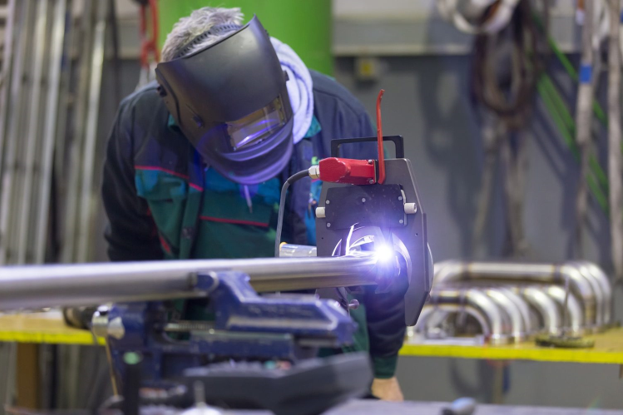
A welding electrode rotates around a fixed object, that is, a fixed workpiece, thus creating amazing quality welds with next to no human intervention. As you may have guessed it already, the precision it provides makes this technique perfect for those industries that require both durable and clean welds, and that have quite high quality standards. It is precisely the precision that sets them apart from some other techniques, as well as the fact that there is less room for error given that the process is automated. Read more about the machines that are made for this type of work.
How Do Orbital Welding Machines Work?
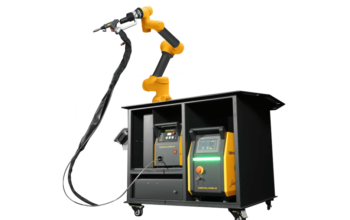
An orbital welding system typically uses a motorized weld head that travels around the outside of a pipe or tube. Once the components are properly aligned and secured, the machine controls the welding cycle according to a programmed set of parameters.
Depending on the equipment and application, the system can control factors such as:
- Welding current and voltage
- Travel speed
- Arc timing
- Shielding gas flow
- Heat input
- Rotation speed
The controlled movement of the welding head helps create uniform welds around the entire circumference of the tube or pipe. This level of automation is one reason orbital welding is widely used when manufacturers need repeatable results and precise process control.
3 Important Uses of These Machines
Moving on to our next question, you want to know what orbital welding machines are mostly used for. In other words, you are curious about the specific manufacturing industries that these have found their application in. When you think about it for a moment, though, you will realize that these can be used in pretty much any manufacturing process, given that they improve the process and enhance overall efficiency. Nevertheless, let me tell you about 3 important uses that you should undeniably be aware of.
1. Pharmaceutical and Biotechnology Manufacturing
Orbital welding is widely used in pharmaceutical and biotechnology facilities where piping systems must meet strict hygiene and quality requirements. These facilities often use stainless-steel tubing for transporting purified water, clean steam, gases, and process fluids.
Because orbital welding provides consistent, repeatable welds, it can help reduce variations that may occur with manual welding. Properly executed welds can also create smooth internal surfaces with fewer imperfections where contaminants could accumulate.
Common applications include:
- Purified water and water-for-injection (WFI) systems
- Clean steam and process piping
- Gas and fluid distribution systems
- Sanitary stainless-steel tubing
- Clean-in-place (CIP) systems
For these applications, weld quality is not simply a matter of appearance. Consistent welding and proper process control can be important for maintaining sanitary conditions and meeting applicable manufacturing and quality requirements.
Why Orbital Welding Is Useful Here
The biggest advantage is repeatability. Once the appropriate welding parameters are established, the machine can reproduce the welding cycle across multiple joints. This makes orbital welding particularly useful when a facility contains a large number of similar tube connections that need consistent results.
Food and Beverage Processing
Orbital welding machines are commonly used in food and beverage manufacturing to create consistent, hygienic welds in stainless-steel piping and tubing. Processing facilities often have extensive networks of pipes that transport ingredients, water, cleaning solutions, and finished products.
In these environments, weld quality is important because rough or inconsistent internal surfaces can create areas where product residue or contaminants may accumulate.
Common applications include:
- Stainless-steel process piping
- Beverage processing and filling systems
- Dairy processing equipment
- Food-grade fluid and water lines
- Clean-in-place (CIP) systems
- Sanitary tubing assemblies
Why Orbital Welding Is Useful Here
Automated orbital welding can produce highly consistent joints across a large number of connections. This repeatability is particularly useful for sanitary piping, where manufacturers need reliable weld quality and smooth, cleanable surfaces.
Orbital welding can also reduce dependence on individual operator technique, making it easier to maintain consistent welding parameters throughout a production project.
For food and beverage manufacturers, the combination of repeatability, precision, and process control makes orbital welding a useful option for hygienic piping applications.
Automotive and Heavy Equipment Manufacturing
Orbital welding machines are also useful in automotive and heavy equipment manufacturing, where consistent weld quality is important for components produced in large volumes. Automated welding can help manufacturers maintain repeatable results across similar parts while reducing variations caused by manual welding.
Depending on the application, orbital welding may be used for:
- Tubing and pipe assemblies
- Hydraulic and fluid lines
- Exhaust components
- Stainless-steel and other alloy tubing
- Components requiring repeatable circumferential welds
Why Orbital Welding Is Useful Here
Manufacturing environments often require the same type of weld to be performed repeatedly. Orbital welding allows manufacturers to establish and reuse welding parameters, helping maintain consistency from one component to the next.
Automation can also improve productivity by reducing the amount of manual intervention required for repetitive welding tasks. For applications where dimensional accuracy and consistent weld quality are important, this makes orbital welding a practical alternative to relying entirely on manual welding.
Manufacturing industries rely heavily on orbital welding machines for structural components, hydraulic lines, exhaust systems, and many other critical parts. For these applications, using reliable components alongside precise welding processes can further improve the durability and performance of critical systems. Vapflex offers quality solutions for fluid-handling applications, making it a useful option for manufacturers seeking dependable components for demanding industrial environments.
Other Industries That Use Orbital Welding
Although pharmaceutical, food and beverage, and automotive manufacturing are important applications, orbital welding machines are used across several other industries where precise and repeatable tube or pipe welds are required.
Semiconductor Manufacturing
Semiconductor facilities use highly controlled piping systems for process gases, chemicals, and other critical materials. Orbital welding can provide the consistency and cleanliness required for specialized tubing installations.
Aerospace Manufacturing
Aerospace applications often involve tubing and components where precision, repeatability, and strict quality control are important. Orbital welding can be used for selected aircraft and aerospace system components.
Chemical Processing
Chemical plants use extensive piping and tubing systems to transport chemicals and process fluids. Automated welding can help produce consistent joints while reducing variation between welds.
Power and Energy
Orbital welding is also used in selected power-generation and energy applications, particularly where tubing systems require controlled and repeatable welds.
The specific welding equipment and process requirements vary by industry, material, tube diameter, wall thickness, and application. However, the underlying advantage remains the same: automation helps manufacturers achieve consistent weld quality across repetitive welding operations.
Why Manufacturers Use Orbital Welding
The main advantage of orbital welding is consistent and repeatable weld quality. Because the welding head follows a controlled path around the tube or pipe, manufacturers can reduce variations that may occur during repetitive manual welding.
Other benefits include:
- Repeatability: The same welding parameters can be used across multiple joints.
- Precision: Controlled welding speed, current, and heat input can produce more consistent results.
- Productivity: Automation can reduce the time and manual effort required for repetitive welds.
- Process control: Programmable welding systems make it easier to standardize and reproduce welding procedures.
- Reduced operator variation: The automated process reduces dependence on individual welding technique.
These advantages make orbital welding particularly useful when manufacturers need reliable, repeatable welds across a large number of similar components.
How Can You Get the Right Machine for You?
Now, the above should have given you a better idea about the applications of these specific machines. Of course, there are various other industries in which they can find their place. So, if you’ve thought about it, and if you’ve realized that this could undeniably be the perfect piece of equipment for you, then the next thing you want to know is how you can actually get the right one. And, well, this shouldn’t be difficult, but it does require some research.
First things first, you have to decide between buying and renting. The fact that you can nowadays rent an orbital welding machine is amazing, because it allows you to get a high quality one without having to pay a huge amount of money all at once. Naturally, though, the decision is yours to make.
Whatever you decide, though, the most important thing you will have to do is actually choose the right provider of these machines. So, start by searching for them online, and remember to also get recommendations from some of the people you know have used these products in the past, or are using them right now. These two steps should help you make a list of potential suppliers.
Once the list is complete, start your more detailed research to narrow it down. Read reviews to assess the quality of the machines, as well as the general reputation of the suppliers you’re considering. Furthermore, remember to also compare the prices, and then make an informed final decision. A decision that will provide you with the best orbital welding machine at a fair cost.
Frequently Asked Questions About Orbital Welding Machines
What is an orbital welding machine used for?
An orbital welding machine is used to automatically weld around pipes and tubes. It is particularly useful when manufacturers need precise, repeatable, and consistent welds across multiple components.
What industries use orbital welding?
Orbital welding is commonly used in pharmaceutical and biotechnology, food and beverage, automotive, aerospace, semiconductor, chemical processing, and power-generation applications.
What are the main advantages of orbital welding?
The main advantages include consistent weld quality, repeatability, precise process control, reduced operator variation, and improved efficiency for repetitive welding applications.
Is orbital welding better than manual welding?
Neither process is universally better. Orbital welding is generally more suitable for repetitive applications requiring consistent and controlled welds, while manual welding can provide greater flexibility for complex or difficult-to-access joints.
What materials can be welded using orbital welding?
Orbital welding is commonly used with stainless steel and other metals used in industrial tubing and piping. The appropriate process depends on the material, thickness, joint design, and equipment being used.
Conclusion
Orbital welding machines provide manufacturers with a practical way to improve the consistency and repeatability of pipe and tube welding. Their automated operation makes them particularly useful in industries such as pharmaceutical manufacturing, food and beverage processing, automotive production, and other applications where precise welds are important.
When selecting an orbital welding machine, manufacturers should consider the materials and tube sizes they work with, required weld quality, level of automation, portability, and available support. Choosing equipment that matches the specific application can help maximize both productivity and welding performance.
Enjoy Worthview?
Add Worthview as a Preferred Source on Google to see more of our stories in Search.

Worthview Editorial Team is the shared byline for content created collaboratively by Worthview’s editors and contributors. Since 2008, we’ve published thousands of articles across technology, AI, finance, health, home, travel, and lifestyle. Our editorial process emphasizes original research, reputable sources, regular content updates, and clear attribution. Articles covering higher-trust topics, including health and finance, may also undergo review by qualified subject-matter experts.