When governments feel threatened by forces they cannot easily see or control, they draw borders. Historically those borders were geographic — walls, checkpoints, customs posts. Increasingly, the border is legal, and the foreign entity being regulated is not an army or a corporation, but a civil society organisation receiving a donation from abroad.
India’s proposed Foreign Contribution (Regulation) Amendment Bill, 2026, tabled in the Lok Sabha in March 2026, is the latest chapter in a pattern that stretches across at least five decades of Indian lawmaking — and across dozens of countries worldwide. The bill is not an outlier. It is part of a documented global shift in how states define sovereignty: less about territorial lines, more about controlling the ideological and financial ecosystem within them.
“From Russia to Ethiopia to India to Hungary, dozens of governments, authoritarian and democratic alike, have been cracking down on foreign support of local NGOs.” — University of Minnesota researchers Ron Krebs and James Ron
A Law With a Long Memory
India’s FCRA did not begin as a law about NGOs. When it was first enacted in 1976 — during the Emergency under Indira Gandhi — its primary concern was political parties and electoral interference. Foreign money in Indian politics was the threat; civil society was peripheral.
The shift came in 1984, when NGOs were brought under the Act and required to register with the Ministry of Home Affairs — the same ministry responsible for internal security. That institutional placement was not accidental. It positioned civil society, from the outset, within a securitisation framework rather than a development or governance one.
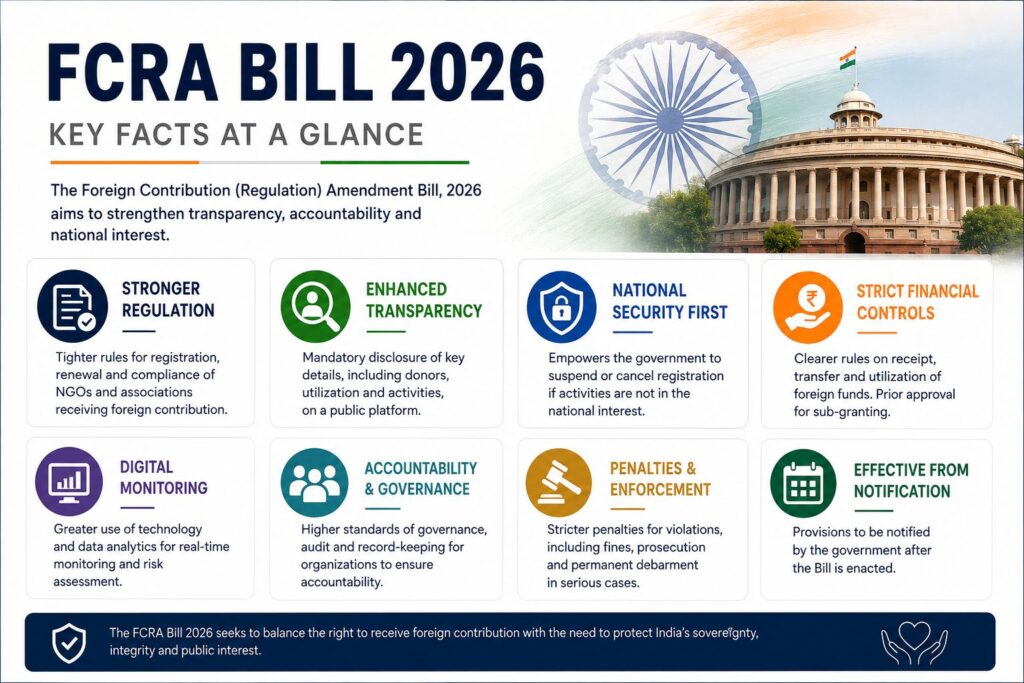
The 2010 overhaul expanded the scope further: mandatory registration, five-year validity periods, and a cap on administrative spending initially set at 50 percent. The 2020 amendments went further still — banning sub-granting between FCRA-registered organisations, reducing the spending cap to 20 percent, and requiring all foreign contributions to flow through a single designated State Bank of India account in New Delhi. The 2026 bill adds a new layer: a government-appointed Designated Authority empowered to take over, manage, and dispose of an organisation’s assets if its registration is cancelled, surrendered, or simply not renewed in time.
As of April 2026, the FCRA dashboard of the Ministry of Home Affairs shows 22,273 registrations cancelled and 15,182 expired registrations not renewed. The 2026 bill would bring those lapsed organisations’ remaining assets under formal state control.
A Global Playbook
India is not writing this playbook from scratch. The architecture of foreign-funding restriction laws across the world follows a remarkably consistent pattern: invoke national security or transparency as justification, establish a registration or labelling requirement, attach penalties for non-compliance that make continued operation untenable, and position the state as the arbiter of what counts as legitimate civil activity.
Consider the trajectory in four countries:
| Country | Law / Year | Core Mechanism | Outcome |
| Russia | Foreign Agents Law, 2012 | NGOs with foreign funding + ‘political activity’ must register as foreign agents | Memorial & dozens of NGOs dissolved; label weaponised as Soviet-era spy stigma |
| Hungary | Foreign-Funded Org. Act, 2017 | NGOs receiving >€24K/year abroad must label all materials ‘foreign-supported’ | ECJ ruled it violated EU law; several major NGOs suspended operations |
| Ethiopia | Charities & Societies Proclamation, 2009 | NGOs with >10% foreign funding barred from political/rights work | Sector decimated; human rights and democracy orgs forced to shut |
| India | FCRA (Amendment) Bill, 2026 | Designated Authority can seize assets on lapsed or cancelled registration | 22,000+ registrations already cancelled since 2010; 2026 bill tightens further |
Russia‘s 2012 Foreign Agents Law is the clearest template. The term ‘foreign agent’ was deliberately chosen to evoke Soviet-era imagery — surveys found that 14 percent of Russians associated the label with the word ‘spy’, and 7 percent with ‘traitor’. The law’s definitional elasticity was built-in: ‘political activity’ was broad enough to include virtually any commentary on public policy. Memorial, one of Russia’s oldest and most respected human rights organisations, was dissolved under it.
Hungary‘s 2017 law, while less punitive in language, required the ‘foreign-supported organisation’ label to appear on all publications, press releases, and websites — a reputational mechanism designed to delegitimise rather than prohibit. The European Court of Justice ruled in 2020 that it violated EU law, but the reputational damage to targeted organisations had already been done.
Ethiopia‘s 2009 Charities and Societies Proclamation is perhaps the most structural precedent. It barred NGOs receiving more than 10 percent of their funding from abroad from working on politically sensitive issues — effectively removing foreign-funded organisations from the fields of human rights, democracy, and conflict resolution at a single stroke.
What Makes India’s Case Distinct
India is a democracy with an independent judiciary, a free press, and a constitutional framework that explicitly protects freedom of association. That makes the FCRA’s evolution — and the 2026 amendment — analytically more complex than the Russian or Ethiopian cases.
The government’s stated justifications are also substantively different from those of authoritarian states. The MHA has cited forced religious conversions, anti-developmental activities, and inciting protests as reasons for FCRA scrutiny. These are not hypothetical concerns — there is genuine debate in India about the sources and purpose of some forms of foreign funding, particularly from religiously motivated donors abroad.
The international standard for managing that concern, however, points in a different direction. FATF — the Financial Action Task Force — which the Indian government itself frequently invokes to justify tighter FCRA regulation, issued a 2024 evaluation recommending a targeted, risk-based approach focused on organisations demonstrably at risk of terrorism financing. The 2026 bill, which expands restrictions across the entire sector rather than targeting high-risk entities, moves in the opposite direction from FATF’s own guidance.
The bill’s most consequential clause is not about cancellation — it is about what happens when registration simply lapses due to delay. An overloaded bureaucracy becomes, inadvertently or otherwise, an enforcement mechanism.
The Mechanism Behind the Mechanism
Critics of the 2026 bill have focused heavily on the Designated Authority and asset-vesting provisions. But the more structurally consequential clause may be simpler: the bill deems an FCRA certificate to have ‘ceased’ if no application for renewal was made, if renewal is denied, or if renewal is not obtained before expiry.
This converts an administrative process — renewal — into a legal trigger. Given that the MHA already has a backlog of over 15,000 organisations with expired registrations, the administrative capacity to process renewals efficiently is a material question, not an abstract one. A delayed renewal, in the new framework, is not a procedural inconvenience. It is the legal basis for asset seizure.
No comparable mechanism exists for the reverse scenario — there is no timeline within which the Designated Authority must return assets to an organisation that successfully renews or re-registers. The asymmetry is notable.
The Question Worth Asking
The comparative record across Russia, Hungary, Ethiopia, and others suggests that foreign-funding restriction laws, regardless of their stated intent, tend to produce a specific set of downstream effects: self-censorship by organisations uncertain of where regulatory lines fall; sector contraction as smaller NGOs find compliance costs prohibitive; and a narrowing of the range of voices operating in public debate.
Whether that outcome is the purpose or the by-product of these laws is a question each country’s political context must answer separately. India’s context — a functioning democracy, an active judicial review process, a vocal opposition, and a civil society sector that has challenged FCRA provisions in the Supreme Court — is meaningfully different from Russia’s or Ethiopia’s.
What the comparative lens does offer is a framework for evaluating what comes next. In Russia, the 2012 law was followed by successive expansions — each justified on its own terms, each adding a new category of prohibited activity or labelled entity. In Hungary, the 2017 law proved to be one of several instruments in a broader project of civil society de-legitimisation.
The 2026 FCRA Amendment Bill is currently deferred, having been pulled from the Budget Session agenda after significant opposition and reintroduced for the Monsoon Session. Its legislative fate is uncertain. What is certain is that the debate it has triggered reflects a tension that is genuinely global: between a state’s legitimate interest in knowing where money that shapes its public sphere comes from, and civil society’s capacity to function without the permanent threat of administrative dissolution.
That tension does not resolve neatly — and its resolution in India will matter well beyond its borders.
Enjoy Worthview?
Add Worthview as a Preferred Source on Google to see more of our stories in Search.

Worthview Editorial Team is the shared byline for content created collaboratively by Worthview’s editors and contributors. Since 2008, we’ve published thousands of articles across technology, AI, finance, health, home, travel, and lifestyle. Our editorial process emphasizes original research, reputable sources, regular content updates, and clear attribution. Articles covering higher-trust topics, including health and finance, may also undergo review by qualified subject-matter experts.