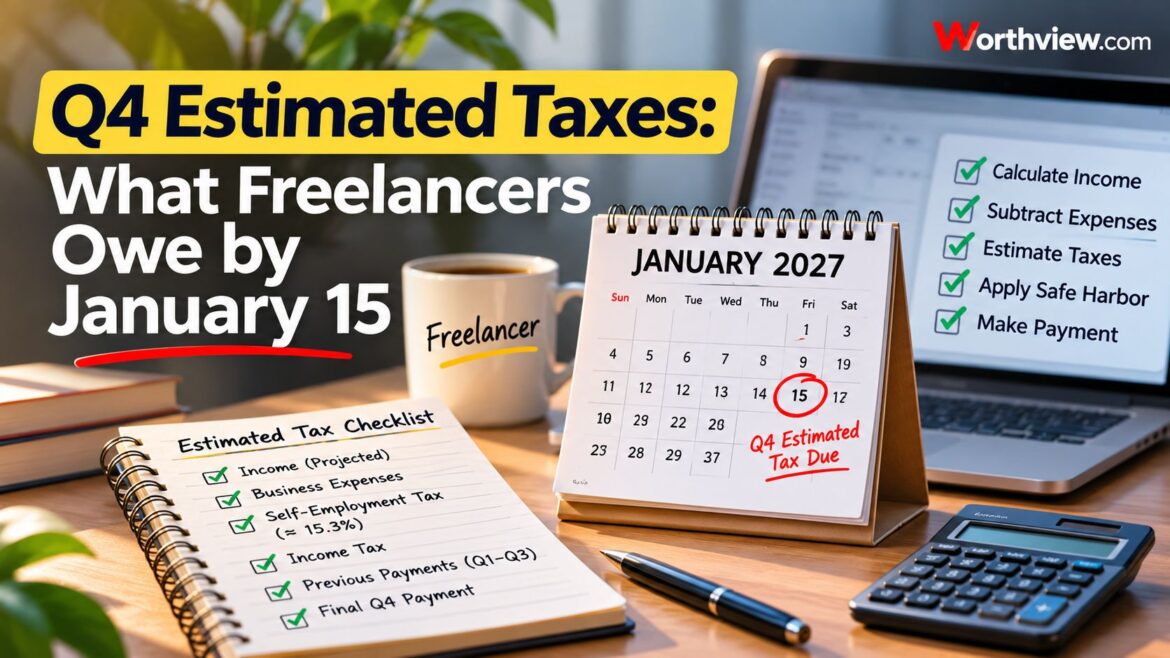
For freelancers and independent contractors, the end of the year brings one more important deadline. The fourth-quarter estimated tax payment for the 2026 tax year is due January 15, 2027. Because no employer is withholding taxes from your income, these quarterly payments are how you stay current with the IRS throughout the year.
Unlike traditional employees, independent contractors are responsible for managing their own tax obligations. Understanding the differences between W-2 and 1099 tax forms can help freelancers understand how their income is reported.
Getting this final payment right can help you avoid penalties and reduce stress when you file your return in the spring.
Key Takeaways:
- Payment deadline: The fourth-quarter estimated tax payment for the 2026 tax year is due January 15, 2027.
- Calculate your estimated tax: Start with your projected annual income, subtract eligible business expenses, and estimate your self-employment and income taxes.
- Account for previous payments: Subtract the estimated tax payments you’ve already made during the first three quarters to determine what remains due.
- Understand safe harbor rules: You can generally avoid underpayment penalties by paying at least 90% of your current-year tax or 100% of your previous year’s tax.
- Higher-income taxpayers: If your adjusted gross income exceeded $150,000 ($75,000 for married taxpayers filing separately), the prior-year safe harbor threshold increases to 110%.
- Keep accurate financial records: Updated bookkeeping and careful income projections can help freelancers calculate their final quarterly payment and avoid surprises when filing their annual tax return.
Who Needs to Pay Q4 Estimated Taxes?
Freelancers, independent contractors, sole proprietors, and self-employed individuals may need to make quarterly estimated tax payments because their income generally does not have taxes withheld automatically.
According to the IRS, you generally need to make estimated tax payments for 2026 if both conditions apply:
- You expect to owe at least $1,000 in federal tax after subtracting withholding and refundable tax credits.
- Your withholding and refundable credits are expected to cover less than 90% of your 2026 tax liability or 100% of your 2025 tax liability, whichever is smaller.
For taxpayers with adjusted gross income above $150,000 ($75,000 for married individuals filing separately), the prior-year threshold increases to 110%.
If you started earning freelance income later in the year, your first estimated payment may be due in January rather than an earlier quarter. Your payment schedule depends on when you received income subject to estimated tax.
Check the IRS estimated tax payment guidelines to determine whether you need to make a payment.
Next section: How to Pay Your Q4 Estimated Taxes to the IRS.
Calculating Your Final Quarterly Payment
Start by estimating your total income for the year. Look at your earnings through November and project December’s income based on client work you have already completed or invoiced. Then subtract business expenses to arrive at your estimated net profit.
From there, you will need to account for two main taxes. Self-employment tax covers Social Security and Medicare and is roughly 15.3 percent of most of your net earnings. Income tax depends on your total taxable income, filing status, and deductions. Once you estimate your total tax for the year, subtract the payments you have already made in the first three quarters. What remains is generally what you should pay by January 15.
If your income was uneven, with a large share coming in late in the year, you may be able to use the annualized income method to lower earlier required payments and adjust your final one. This can be especially helpful for seasonal freelancers. A detailed 1099 taxes guide can help you understand how each part of the calculation works.
Keeping your books up to date makes this process far easier, since accurate numbers mean fewer guesses.
Q4 Estimated Tax Calculator
Estimate your remaining federal tax payment for 2026.
Enter your figures to calculate your estimate.
Safe Harbor Rules That Protect You From Penalties
The IRS offers safe harbor rules that can protect you from underpayment penalties even if you end up owing more when you file. In general, you will avoid penalties if your total estimated payments and withholding cover at least 90 percent of your tax for the current year, or 100 percent of your tax from the prior year.
If your adjusted gross income was more than $150,000 last year, or $75,000 if married filing separately, the prior-year requirement rises to 110 percent. Many freelancers rely on the prior-year safe harbor because it is based on a known number, which removes the guesswork from fast-changing income.
Meeting a safe harbor does not mean you will not owe anything in April. It simply means you will not face a penalty for underpaying during the year. If your income grew significantly, set money aside now so you are not caught off guard. Working with professionals who offer business tax preparation can help you confirm you are on track before the deadline.
What Happens If You Miss the January 15 Deadline?
Missing the January 15, 2027, estimated tax payment deadline can result in an IRS underpayment penalty. The penalty may apply if you haven’t paid enough federal income tax throughout the year through estimated payments, withholding, or applicable credits.
Here are a few things freelancers should know:
- Underpayment penalties: The IRS may charge a penalty on the amount of tax you underpaid and the period it remained unpaid.
- Pay as soon as possible: Making a late payment promptly can reduce the amount of additional penalty you may owe.
- Check your safe harbor eligibility: You may avoid an underpayment penalty if your payments meet the IRS safe harbor requirements, even if you still owe tax when filing your return.
- Review Form 2210: IRS Form 2210 can help determine whether you owe an underpayment penalty and whether an exception or waiver applies.
The penalty is calculated based on the amount underpaid, the applicable IRS interest rate, and the length of the underpayment period. It is not a single fixed percentage for every taxpayer.
Important exception
You may not need to make a separate January 15 payment if you file your 2026 federal income tax return by January 31, 2027, and pay the full remaining tax balance at that time. However, this does not automatically eliminate penalties for earlier missed installments. Internal Revenue Service+1
For more information, refer to the IRS guide on underpayment penalties.
Final Thoughts
The January 15 estimated tax payment is your last chance to square up for the year. By calculating your payment carefully and understanding the safe harbor rules, you can avoid penalties and start the new year on solid footing. If the process feels overwhelming, getting help with freelance taxes can take the guesswork out of every quarterly payment going forward.
Frequently Asked Questions
1. When is the Q4 estimated tax payment due for 2026?
The fourth-quarter estimated tax payment for the 2026 tax year is due January 15, 2027. Freelancers and independent contractors must make this payment to stay current with their federal tax obligations.
2. Who needs to pay quarterly estimated taxes?
Freelancers, independent contractors, and self-employed individuals generally need to make estimated tax payments if they expect to owe at least $1,000 in federal taxes when filing their annual return, after accounting for withholding and refundable credits.
3. How do freelancers calculate their final quarterly tax payment?
Start by estimating your total annual income and subtracting eligible business expenses to determine your projected net profit. Estimate your self-employment and income taxes, then subtract the estimated payments you’ve already made during the first three quarters.
4. What is the IRS safe harbor rule for estimated taxes?
The IRS safe harbor rule generally helps taxpayers avoid underpayment penalties if their total tax payments cover at least 90% of their current-year tax liability or 100% of their previous year’s tax liability.
5. When does the estimated tax safe harbor requirement increase to 110%?
The prior-year safe harbor requirement increases to 110% if your adjusted gross income exceeded $150,000 in the previous tax year, or $75,000 if you are married filing separately.
6. Can freelancers avoid estimated tax penalties if their income changes throughout the year?
Yes. Freelancers with uneven or seasonal income may be able to use the annualized income installment method to calculate their estimated payments based on when they actually earned their income. This can help reduce underpayment penalties.
7. Does making the January 15 estimated tax payment mean I won’t owe taxes in April?
No. Meeting the estimated tax payment requirements can help you avoid underpayment penalties, but you may still owe additional taxes when you file your annual return if your total payments were less than your final tax liability.
Disclaimer: This article is for informational purposes only and should not be considered tax or legal advice. Consult a qualified tax professional or refer to IRS guidance for advice specific to your situation.
Enjoy Worthview?
Add Worthview as a Preferred Source on Google to see more of our stories in Search.

Worthview Editorial Team is the shared byline for content created collaboratively by Worthview’s editors and contributors. Since 2008, we’ve published thousands of articles across technology, AI, finance, health, home, travel, and lifestyle. Our editorial process emphasizes original research, reputable sources, regular content updates, and clear attribution. Articles covering higher-trust topics, including health and finance, may also undergo review by qualified subject-matter experts.