Artificial intelligence is moving beyond chatbots that answer questions. The latest generation of AI agents can work in the background, interact with connected applications, remember user preferences, execute multi-step tasks and return with completed work or requests for approval.
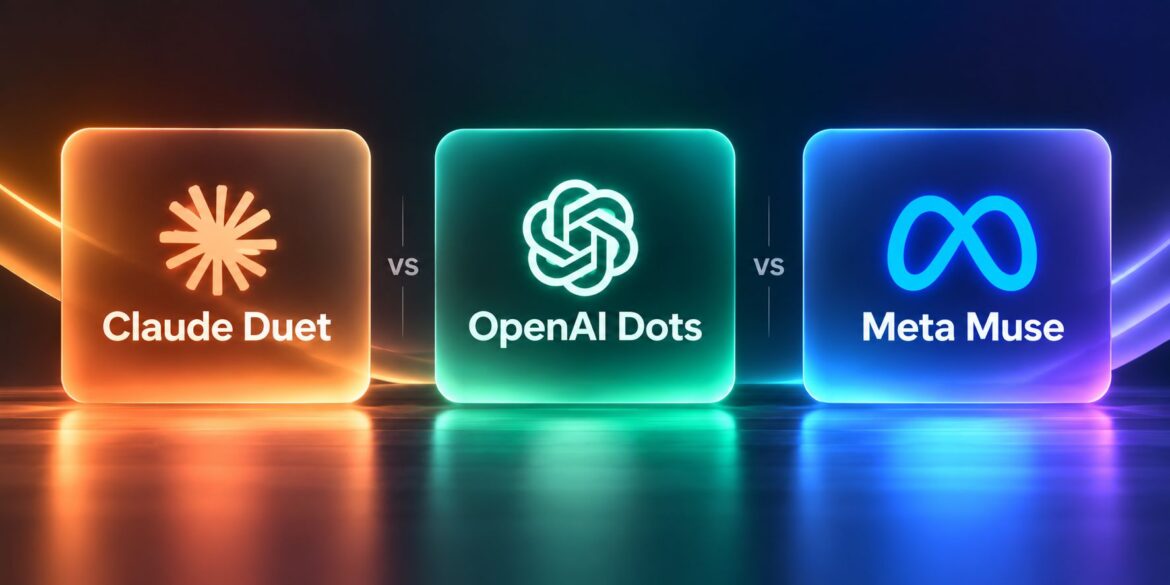
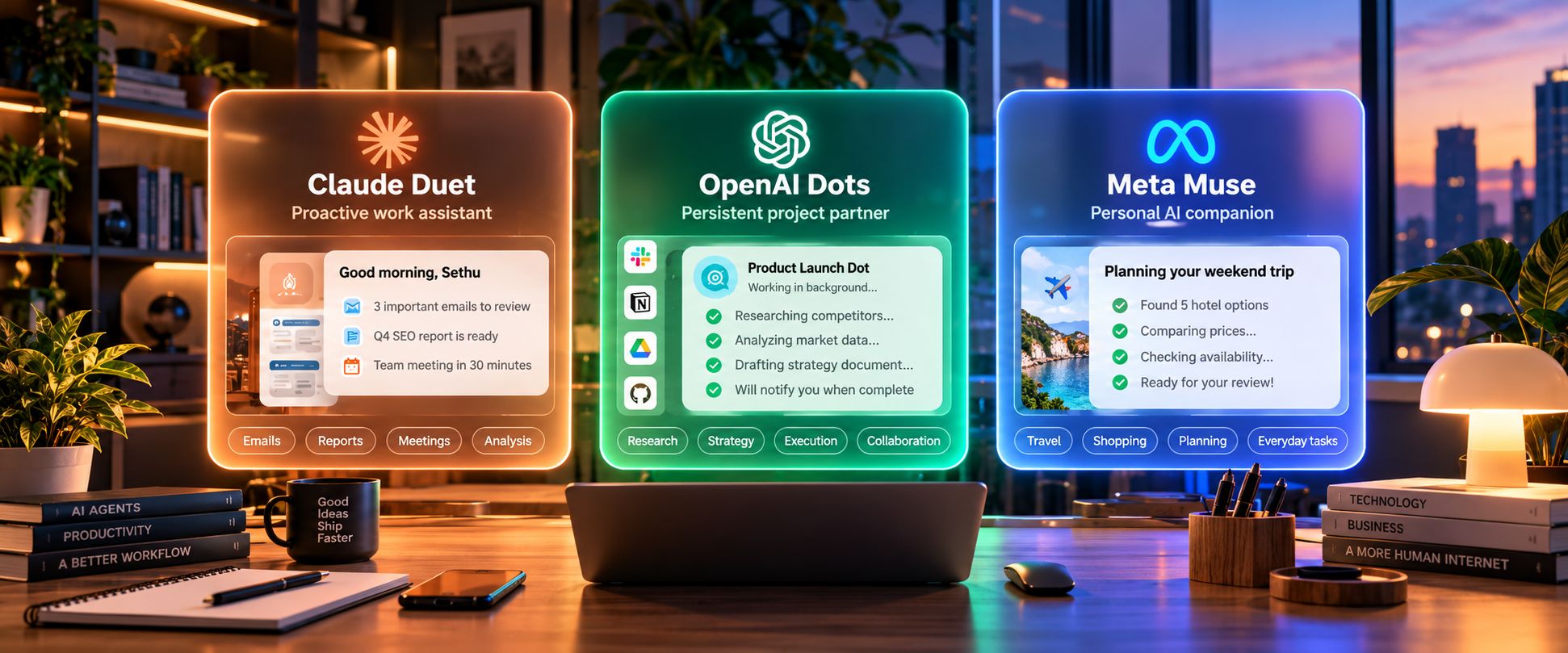
Three products illustrate this shift: Claude Duet from Anthropic, OpenAI Dots and Meta Muse. All three aim to reduce the amount of work users must manage themselves, but they take different approaches to productivity, personal assistance, integrations and security.
So, which AI agent is best? The answer depends on whether you need a professional work assistant, a persistent digital coworker or a personal agent for everyday tasks.
What Are Claude Duet, OpenAI Dots and Meta Muse?
1. Claude Duet: A proactive AI assistant for professional work
Anthropic introduced Claude Duet on October 21, 2026, as a research preview for professionals and small-business owners.
Unlike the standard Claude chat experience, Duet proactively identifies tasks that need attention. It can prepare morning briefings from connected applications, draft responses, organize work and handle longer assignments while the user is away.
Powered by Claude Opus 5.5, Duet operates through its own cloud computer and browser. Users can delegate tasks through an ongoing conversation and receive notifications when work is complete or a decision is required.
Examples include preparing a business dashboard, reviewing invoices, creating presentations and drafting follow-up messages. Duet requires approval before sensitive actions such as sending messages, making payments, signing documents or deleting information.
Anthropic says Duet inherits the user’s existing Claude memory, skills and connected applications.
Best suited to: Professionals and small-business owners who want proactive assistance with administrative and knowledge work.
Official source: Introducing Claude Duet — Anthropic
2. OpenAI Dots: Persistent AI agents for ongoing projects
OpenAI announced Dots at DevDay on September 29, 2026. The product introduces persistent agents designed to keep working toward users’ goals rather than waiting for every individual instruction.
Powered by GPT-6 Astra, Dots have their own cloud computers and can connect to more than 4,000 applications through OpenAI’s plugin ecosystem.
A Dot can monitor an ongoing project, investigate a reported software bug, prepare an invoice or coordinate tasks across connected tools. Users can interact with their agents through ChatGPT, Slack and Microsoft Teams.
Dots can learn from feedback and adapt to a user’s preferences. OpenAI has also described plans for specialist Dots with defined responsibilities and deeper integrations into enterprise systems.
The central idea is continuity: an agent takes responsibility for ongoing work, makes progress in the background and brings important decisions back to the user.
Best suited to: Individuals and teams managing projects that span multiple applications, communications and business processes.
Official source: Introducing dots — OpenAI
3. Meta Muse: A personal AI agent for everyday life
Meta introduced Muse on September 8, 2026, positioning it as a personal agent that helps people achieve goals, organize daily activities and complete tasks across connected services.
Muse initially used Meta’s Muse Spark model, while Meta announced the more capable Muse Wonder model family on October 12. Muse Wonder is available to developers through the Meta Model API and Muse Code, with integration into the consumer Muse experience planned to roll out first to subscribers.
Muse runs in a dedicated cloud environment called Muse Secure VM, which includes a browser and persistent storage. Users can interact with it through the Muse app, the web and WhatsApp.
It can develop plans around longer-term goals, browse websites, fill out forms, manage connected applications and help with shopping and travel planning. It can also remember details from previous conversations to make more relevant suggestions.
One distinctive feature is Sentinel, a separate security component that authorizes external actions. Meta says Sentinel controls network access and connector permissions, while users receive approval requests for sensitive operations and can review an audit trail.
Best suited to: People who want a personal assistant for everyday planning, web-based tasks, shopping and ongoing goals.
Official sources: Introducing Muse — Meta and Introducing Muse Wonder — Meta
Claude Duet vs OpenAI Dots vs Meta Muse: Feature Comparison
| Feature | Claude Duet | OpenAI Dots | Meta Muse |
|---|---|---|---|
| Primary focus | Professional productivity | Ongoing work and projects | Personal assistance |
| Underlying model | Claude Opus 5.5 | GPT-6 Astra | Muse Spark; Muse Wonder rollout planned |
| Background execution | Yes | Yes | Yes |
| Dedicated cloud computer | Yes | Yes | Yes, through Muse Secure VM |
| Application integrations | Claude connectors and plugins | OpenAI plugin ecosystem, with 4,000+ apps advertised | Connected services and supported app integrations |
| Persistent context | Claude memory, skills and connected apps | Learns preferences from feedback | Remembers relevant personal context |
| Proactive updates | Morning briefs and important notifications | Progress updates and requests for decisions | Suggestions and updates as goals progress |
| Human approval | Required for specified sensitive actions | Configurable rules and review controls | Permission policies and Sentinel authorization |
| Main differentiator | Attention management and professional deliverables | Persistent, cross-application work | Personal context and dedicated agent security |
Sources: Official product announcements from Anthropic, OpenAI and Meta. Features and access may change during rollout.
How Are These AI Agents Different Technically?
Although all three use cloud-based execution, connected tools and persistent context, their product designs emphasize different aspects of agentic AI.
Claude Duet: Attention management and task delegation
Duet is designed to decide which information deserves the user’s attention and when to request a decision.
Its workflow can be understood as:
- Review information from connected applications.
- Identify an important task, conflict or opportunity.
- Prepare a recommendation or deliverable.
- Notify the user when attention or approval is required.
This makes Duet particularly relevant to professionals who manage busy calendars, communications, documents and business operations.
OpenAI Dots: Continuity across ongoing work
Dots emphasize persistent responsibilities and coordination across applications.
An agent can monitor a project, respond to changes, investigate an issue and continue working toward a defined outcome. OpenAI also envisions specialist agents with narrower responsibilities inside organizations.
This approach is relevant to workflows that require several tools, repeated checks and multiple steps before a task is complete.
Meta Muse: Personal context and controlled execution
Muse emphasizes a combination of personal memory, proactive assistance and a dedicated execution environment.
Its Sentinel architecture is particularly noteworthy. Instead of relying exclusively on the main agent to follow security instructions, a separate component controls whether external actions are permitted.
This illustrates an important principle in agent engineering: the system enforcing permissions should not simply depend on the same agent that is requesting an action.
These architectural differences do not establish that one product is inherently more accurate or reliable. A fair performance comparison would require independent tests using the same tasks, permissions, tools and success criteria.
Security and Privacy: Which Approach Is Better?
Persistent agents may access email, calendars, documents, browser sessions and other sensitive information. They can also make mistakes when interpreting instructions or processing untrusted web content.
All three companies describe safeguards, but the details differ.
Claude Duet uses approval checks, credential protections, browser-security defenses and additional safeguards against exposing sensitive information. Anthropic says Duet does not directly see users’ passwords or sign-in tokens.
OpenAI Dots provide configurable rules and approval controls for delegated work. Organizations should evaluate their actual permission settings, application access and audit capabilities before using agents for sensitive workflows.
Meta Muse uses a dedicated virtual machine, isolated execution components and Sentinel as the authority for external actions. Meta also describes an audit trail and granular user-controlled permissions.
No architecture eliminates every risk. Prompt injection, incorrect decisions, excessive permissions and accidental disclosure remain important concerns.
Before connecting any agent to business systems, users should review its access permissions, understand what data it processes, require approval for consequential operations and verify how activity is logged.
Pricing and Availability
Availability is an important consideration because these products are being rolled out in stages.
Claude Duet
Anthropic’s October 21 announcement describes Duet as a research preview available through a waitlist to Claude Pro and Max subscribers in the United States. It is included in those plans and shares their existing usage limits. Team and Enterprise access was not included in the initial preview.
OpenAI Dots
OpenAI is gradually rolling out Dots to eligible users on Pro, Business Premium and Enterprise plans in supported markets. Access and features may vary by account and region.
Meta Muse
Meta describes Muse as free for many everyday uses, with usage limits and paid subscription options for users who need more. Its initial rollout is in the United States, with availability through supported apps and the web.
For users in India: Do not assume that a product is accessible simply because its announcement is public. Check the official product page and your account for regional eligibility, plan requirements and waitlist access. None of these launch announcements alone establishes that all three products are currently available to every Indian user.
Official availability pages: Claude Duet, OpenAI Dots and Meta Muse.
Which AI Agent Should You Choose?
The best option depends on the type of work you want to delegate.
- Choose Claude Duet if you want proactive professional assistance, morning briefings, business documents and help identifying what needs your attention.
- Choose OpenAI Dots if you want an ongoing digital coworker that coordinates tasks and makes progress across multiple applications.
- Choose Meta Muse if you want personal assistance, persistent context, everyday planning and web-based actions within a dedicated execution environment.
For businesses, the decision should also consider application compatibility, data policies, permission controls, usage limits and the ability to review completed actions.
For developers, a more useful comparison is how well each system handles long-running tasks, interruptions, failures, untrusted input and human approval. These characteristics matter more in production than an impressive one-off demonstration.
What Do These AI Agents Mean for SEO and Digital Marketing?
The emergence of persistent agents creates opportunities for digital marketers and website owners.
Instead of merely answering a user’s question about a product, an agent may research options, compare websites, retrieve information, complete forms or help execute a purchase.
This could change how people discover and interact with online content. However, it does not mean traditional search engines or SEO have become irrelevant.
For publishers such as Worthview, several priorities remain important:
- Create useful, original content. Articles should answer real questions, provide reliable evidence and offer value beyond generic summaries.
- Maintain technical accessibility. Search engines and supported retrieval systems need to discover and interpret your pages.
- Strengthen entity and author information. Consistent brand details, credible authorship and clear source attribution help establish context.
- Measure AI visibility separately. Track source citations, brand mentions, referral visits and conventional organic performance as distinct metrics.
- Experiment with agent-assisted workflows. AI agents can help with competitor research, technical audits, internal-link recommendations and content quality checks, provided their findings are verified.
For SEO professionals moving into AI engineering, these products also demonstrate the value of combining domain expertise with workflow orchestration, tool integrations, permissions and evaluation.
Frequently Asked Questions
Are Claude Duet, OpenAI Dots and Meta Muse chatbots?
They include conversational interfaces, but their defining capability is acting on tasks across connected tools and continuing work in the background. They are better described as persistent AI agents than conventional chatbots.
Which is best for business automation?
OpenAI Dots emphasizes ongoing cross-application work, while Claude Duet focuses on professional productivity and Meta Muse offers personal assistance with a security-focused execution environment. The best choice depends on the required integrations, permissions and workflow.
Can these agents work without supervision?
They can continue certain tasks without continuous user interaction. However, they still require suitable permissions, monitoring and approval for consequential actions. Their autonomy should not be confused with guaranteed correctness.
Are they available in India?
Availability depends on each product’s rollout, subscription requirements and regional eligibility. Check the official product pages before purchasing a plan or expecting access.
Can developers build similar agents?
Yes. Developers can combine an LLM API, Python, LangGraph, persistent storage, MCP integrations and an evaluation framework to build systems that plan tasks, use tools, retain state and request approval. Building a reliable agent requires security controls and testing in addition to model integration.
Final Verdict
Claude Duet, OpenAI Dots and Meta Muse represent three approaches to the same broader shift: AI systems are beginning to take responsibility for ongoing work instead of waiting for users to issue every instruction.
Claude Duet emphasizes professional attention management, Dots emphasizes persistent work across applications, and Muse emphasizes personal context and controlled execution.
There is no universally best agent. The right choice depends on the work being delegated, the applications involved, the level of autonomy required and the safeguards available.
For businesses and developers, the most important lesson is that useful AI agents require more than capable models. They need reliable tools, persistent state, clear permissions, human oversight and measurable outcomes.
As these products mature, their success will depend not simply on what they can demonstrate, but on how consistently and safely they can complete real work.
Enjoy Worthview?
Add Worthview as a Preferred Source on Google to see more of our stories in Search.

Worthview Editorial Team is the shared byline for content created collaboratively by Worthview’s editors and contributors. Since 2008, we’ve published thousands of articles across technology, AI, finance, health, home, travel, and lifestyle. Our editorial process emphasizes original research, reputable sources, regular content updates, and clear attribution. Articles covering higher-trust topics, including health and finance, may also undergo review by qualified subject-matter experts.