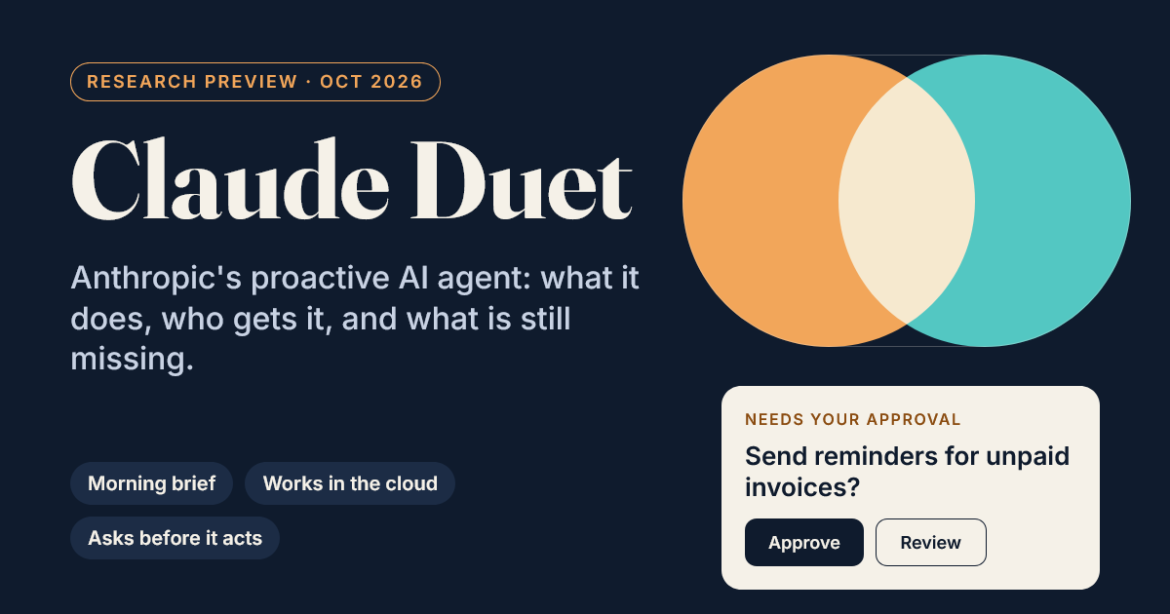
Claude Duet is Anthropic’s proactive AI agent app, opened on October 21, 2026 as a research preview. It reads the apps you connect, sends a morning brief, works in the background on its own cloud computer, and asks before it sends, pays, signs or deletes anything. Access is a waitlist for Claude Pro and Max subscribers in the US only.
What is Claude Duet
Duet is a standalone app, separate from the main Claude chat. Claude normally waits for a prompt; Duet reviews the apps you connect, decides what deserves your attention, and messages you first. Anthropic built it around Claude Opus 5.5, released in September 2026, and says the product depends on that model’s judgment: what needs you, what can wait, and when to check in before acting.
It is Anthropic’s answer to Meta’s Muse and OpenAI’s Dots, both launched in September. Anthropic aims it at professionals and small business owners with “more on their plates than they can track”.
The project is led by Karan Ahuja, who ran product management at Meta Superintelligence Labs until July and joined Anthropic in August. Crypto Briefing reports Anthropic called it Claude Loop internally.
We’re opening a research preview of Claude Duet, a new app where Claude works as a proactive agent. It comes to you with what needs your attention, completes tasks you ask of it, keeps working when you step away, and checks with you before it acts on your behalf. https://t.co/kt8gAbWuX8
— Claude (@claudeai) October 21, 2026
At a glance
| Item | Detail |
|---|---|
| Announced | October 21, 2026 |
| Stage | Research preview, by waitlist |
| Model | Claude Opus 5.5 |
| Where you use it | Standalone iOS and Android apps, and claude.ai |
| Who can join | Claude Pro and Max subscribers in the US |
| Not included yet | Team and Enterprise plans; any other country |
| Cost | No separate fee in the preview; shares your plan’s usage limits |
| How you talk to it | Text or voice, in one ongoing thread |
| Where it works | Its own cloud virtual machine with a browser; your devices can be off |
| Checks your accounts | Every few hours |
| Asks your approval for | Sending messages, payments, signing documents, deleting anything |
| Blocked even with approval | Trading securities, moving money between accounts |
| Integrations | 6,000+ connectors and plugins from the Claude Marketplace |
Source: Anthropic’s announcement.
What it does
Duet works in four modes, all from the same conversation thread.
- Briefs you. Each morning it sends a short brief on the most important items across your connected apps.
- Watches. It checks your connected accounts every few hours and messages you only when something needs attention. You can tell it what to flag and how often.
- Does the work. You hand it tasks in a short message, from scheduling meetings to building dashboards across dozens of tools, financial or sales forecasts, prototypes and web apps. It picks the apps and steps itself, and notifies you when the job is done or needs review.
- Asks first. Before it sends a message, makes a payment, signs a document or deletes anything, it shows exactly what it is about to do and waits for your approval.
What testers say
Anthropic’s own examples are small catches rather than full autonomy.
Jess Provencher, a broker at Pro Homes, said Duet flagged a property showing on her calendar for the wrong day without being asked.
Mya Dalton, a brand strategist, said it prepared a brief for a client call, noticed the call fell right before her flight, and offered to move it.
Amin Ebrahimi, who owns Shahs of Kabob (about 110 employees), used it for accounting, support and marketing, and worked through invoices store by store.
Inside Anthropic, Boris Cherny talks through his to-do list with Duet on walks, and Chelsea Larsson hands it her list before leaving for family time and reads an evening report. All of these examples were chosen by Anthropic, Implicator.
Features
- One ongoing thread. Type or speak to it; a quick reply and a week-long project start in the same place.
- Your Claude context carries over. Memory, skills and connected apps come from your Claude account, so setup is minimal.
- Its own computer. A cloud virtual machine with a browser, so it keeps working with your laptop closed and phone off.
- App connections. It can use the 6,000+ connectors and plugins in the Claude Marketplace, and you can disconnect any app at any time.
- Notification control. You can tell it what you want to hear about and how often. Anthropic says it is still tuning when Duet decides to message you.
Workflows Anthropic names
| App | What Duet can do |
|---|---|
| Gmail, Slack | Find missed messages and help you reply |
| QuickBooks, Stripe | Check for unpaid invoices and draft reminders |
| Gusto | Prepare and run payroll with hours, bonuses and reimbursements filled in |
| Draft a job posting and post it once you edit and approve | |
| Docusign | Prepare agreements and send them for review and signature |
| HubSpot | Draft follow-ups from contact and deal history |
| Canva | Turn a product launch into a social campaign |
| Shopify | Set up, design and manage a store |
Purchases
Duet can buy things for your business through Stripe’s Link wallet. It confirms the item with you, Link asks you to approve the spend, and payment runs on a virtual card so your real card number is not shared. It can also check out at online stores with Shop Pay from Shopify.
Coming soon
- A richer Shopify visual editor, with a storefront preview before anything goes live.
- With your permission, sign-in to sites using logins saved in 1Password.
Who it is for
Anthropic built Duet for professionals and small business owners who juggle many apps and decisions a day. The examples lean toward work: invoices, payroll, contracts, hiring, a storefront, a launch campaign.
Likely a good fit
- People who already keep their working context in Claude (memory, skills, connectors).
- Owners and operators with recurring admin across several tools, such as invoice chasing, inbox triage and meeting prep.
- Work that tolerates a check every few hours rather than instant alerts.
Likely a weaker fit
- Personal errands. Anthropic says Duet is built around work and is less strong at things like booking tickets.
- Anyone who needs real-time monitoring, or who wants to watch the browser as it works. Duet cannot yet show its browser.
- Teams. Team and Enterprise plans are not part of the preview, and the preview offers no shared agent for colleagues.
- Heavy Claude users close to their limits, since Duet draws on the same allowance.
One early outside review
Claire Vo, who runs ChatPRD and hosts How I AI, reviewed Duet early. She praised the onboarding and the visible task lists. Her complaints: a ticket search she started on the way to dinner got lost, some parallel task threads took more than ten minutes to finish or ask for permission, and she wanted a desktop presence and a way to share the agent with about five colleagues (Implicator). Treat it as one person’s early experience, not a measured success rate.
Who can access it, and how
Eligibility. Claude Pro or Max subscribers in the United States, through a waitlist. Team and Enterprise plans are not included yet, and Anthropic has published no date for either.
How to join
- Check that you have an eligible US Pro or Max plan.
- Open claude.com/product/claude-duet and join the waitlist. SaaSCity reports the form asks for name, email, company name, phone type (iPhone or Android) and what you would hand off to Duet first; I have not seen the form myself.
- Wait for Anthropic’s email saying Duet is ready for your account. Ahuja said the company is letting people in as quickly as possible, but no timeline has been given.
- Once in, use it in the Duet iOS or Android app, or at claude.ai.
- Before your invite arrives, review the apps connected to your Claude account and your saved memory, because Duet starts from them.
Outside the US, including India. Anthropic’s announcement names the US only and gives no date for other countries. Claude itself is supported in India, but that does not extend to the Duet preview.
What it costs
Duet has no separate price during the preview. It is included in Claude Pro and Max and shares their usage limits (Anthropic).
| Plan | US price | Duet access |
|---|---|---|
| Pro | $20 a month, or $200 billed annually (about $17 a month) | Included in the preview, via waitlist |
| Max | From $100 a month | Included in the preview, via waitlist |
The usage part matters most. Background checks of your connected accounts count toward your limits, and larger tasks such as a financial model or a deck need more model turns and background work than a normal chat reply. Anthropic checks accounts every few hours rather than continuously partly because constant checking would use up limits much faster. If you already hit your limits most weeks, expect to hit them sooner.
Safety and privacy
This is what Anthropic says about its own design:
- Credentials. Duet never directly sees your passwords or sign-in tokens. Handling follows the design of Claude Managed Agents.
- Action checks. Actions are screened by the auto mode classifier that also protects Claude and Claude Code from steps you did not ask for.
- Hidden instructions. Defenses against prompt injection come from Anthropic’s browser-use research plus model-level safeguards.
- Sensitive information. A new classifier and safety system prompt checks each message. It is designed to refuse requests to share the strictest tier of data, including credit card numbers and government ID. Health and personal finance details go out only when you explicitly tell Duet to send them.
- Testing. Red teams and an external firm penetration tested Duet, and it is covered by Anthropic’s public bug bounty.
What is not verified
All of the above is Anthropic’s description. The launch material includes no independent security audit and no measured failure rates for Duet. Anthropic’s own agent research says layered prompt-injection defenses do not guarantee protection, and it flags that people can tune out approval prompts during long tasks. Anthropic also says it will publish more safety details “in the coming days”, which had not appeared at the time of writing.
How it compares
Several always-on agents, including Muse, Dots and now Duet, arrived within weeks of each other. They look alike in a demo and differ in access, control and focus.
| Claude Duet | OpenAI Dots | Meta Muse | |
|---|---|---|---|
| Launched | Oct 21, 2026 (preview) | Sept 29, 2026 | September 2026 |
| Focus | Professional and small-business work | Ongoing work, inside the ChatGPT ecosystem | Personal agent for email, calendar, payments and more |
| Where you use it | Own iOS and Android apps, claude.ai | ChatGPT, Slack, Teams | Meta’s Muse app |
| Access | US Pro and Max, waitlist | Eligible ChatGPT Pro, Business and some Enterprise plans; EEA, Switzerland and UK excluded for personal Pro at launch | Meta’s consumer rollout, US first |
| Cost shape | Included in Pro and Max, shares limits | Tied to the ChatGPT plan | Consumer plans |
| Watch it work | Cannot yet show its browser | Inspectable cloud computer | Inspectable browser described |
Detailed, comparison article is coming soon.
Two differences matter in practice. Duet is the only one of the three framed mainly around business admin, and Anthropic itself says personal errands are weaker. And Duet’s access is narrow: US-only, paid-plan-only and waitlisted. Muse also has a head start in users: Apptopia estimated more than 14 million installs on launch day, and Meta Superintelligence Labs chief Alexandr Wang responded to Duet with a meme about how closely it resembles Muse.
What is missing or unclear
These are the questions I found no answer to in Anthropic’s announcement or in the coverage I opened as of October 22, 2026.
Access and pricing
- No date for countries outside the US, or for Team and Enterprise plans.
- No post-preview pricing. Anthropic has announced no separate price, so what happens after the preview is unknown.
- No waitlist size or invite pace, and no confirmation of whether non-US sign-ups are accepted.
- No published usage cost per task or per background check, so you cannot yet estimate how many Duet jobs fit inside Pro or Max.
Performance
- No Duet-specific benchmark, completion rate, or human-intervention rate. Only Anthropic-picked testimonials and one outside early review exist.
- Model scores describe Opus 5.5, not Duet. A Zapier business-workflow test, for example, had max-effort Opus 5.5 pass 40.0% of 657 tasks under strict scoring without fallbacks, a reminder that full workflows are hard (Kingy AI).
- “Every few hours” is not an exact schedule. Anything that arrives between checks waits for the next one.
- No published VM specs, maximum task length, or number of tasks that can run at once (Kingy AI).
Control and visibility
- You cannot yet watch Duet’s browser, so reviewing its activity is not the same as seeing the work.
- No desktop app, and no shared agent for a team. Duet lives apart from the main Claude app, and Anthropic says early-user feedback will shape how the two fit together.
Data and portability
- I found nothing in the launch material on data retention, use for model training, deleting what Duet learns, or exporting it. Duet shares your Claude account memory, so those answers likely follow the account’s settings, but that is an inference, not a stated policy.
- Anthropic has promised fuller safety documentation “in the coming days”; it was not out yet.
- No API or developer access is mentioned.
Enjoy Worthview?
Add Worthview as a Preferred Source on Google to see more of our stories in Search.

Worthview Editorial Team is the shared byline for content created collaboratively by Worthview’s editors and contributors. Since 2008, we’ve published thousands of articles across technology, AI, finance, health, home, travel, and lifestyle. Our editorial process emphasizes original research, reputable sources, regular content updates, and clear attribution. Articles covering higher-trust topics, including health and finance, may also undergo review by qualified subject-matter experts.