I’ve spent years working in SEO, and one thing I’ve learned is that a lot of SEO work isn’t actually about SEO strategy.
It is about checking, monitoring, comparing, collecting, analyzing and repeating.
I might need to check Search Console, look at traffic changes, review technical issues, analyze pages, prepare reports, identify content opportunities and then turn all of that information into something actionable.
I’ve already automated parts of this work using tools such as Python, Google Search Console, GA4, Looker Studio and SEO crawlers.
So when OpenAI announced Dots, my first thought wasn’t, “What can this AI do?”
It was:
“What SEO responsibilities could I actually delegate to a Dot?”
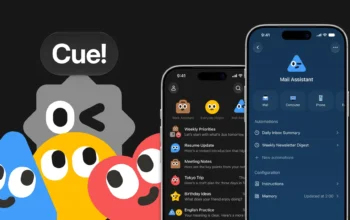
OpenAI describes Dots as persistent AI agents that can work in the background, use connected applications and a cloud computer, maintain context and continue working on projects.
That makes Dots particularly interesting to me as an SEO professional.
Here are some of the ways I could potentially use them.
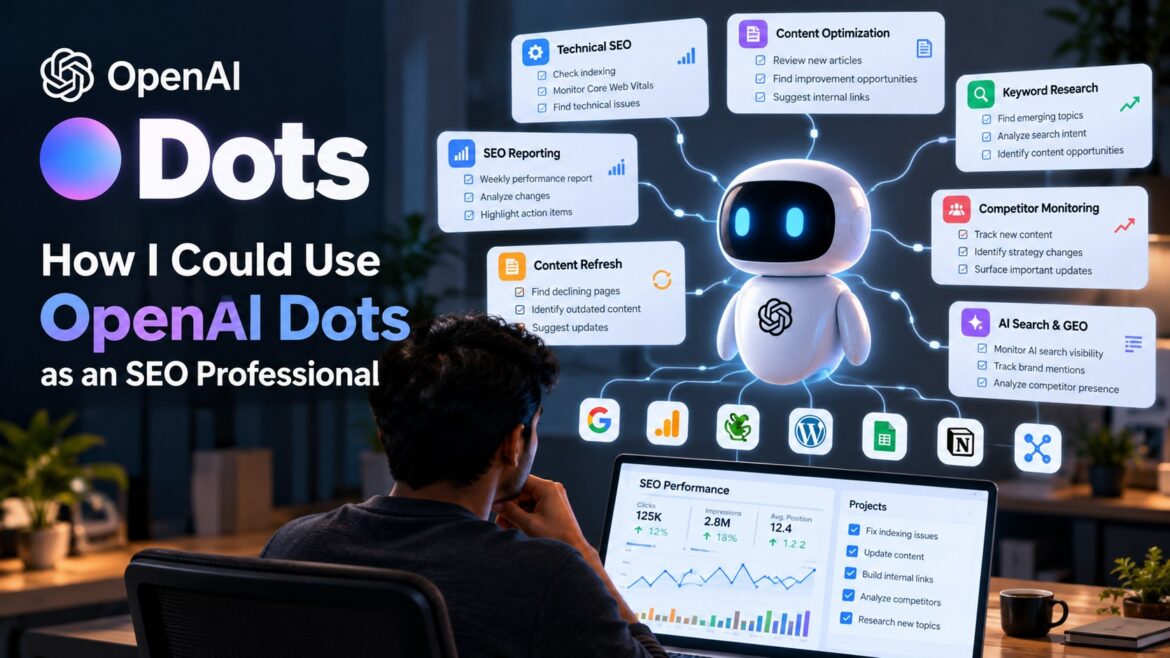
- I could use a Dot as an always-on SEO monitoring assistant rather than asking AI to analyze my website every time.
- It could potentially help with technical SEO, content optimization, reporting, research and competitor monitoring.
- I could delegate repetitive SEO investigation while keeping important decisions and publishing under human control.
- Dots could complement the Python and automation workflows I already use rather than simply replacing them.
- The bigger opportunity is to move from using AI for individual SEO tasks to giving AI responsibility for an SEO workflow.
1. I Could Have a Dot Monitor My Technical SEO
This is probably the first Dot I would experiment with.
Technical SEO involves a lot of recurring checks.
I could give a Dot a responsibility such as:
“Monitor the technical SEO health of my website and tell me when something requires investigation.”
Depending on the available integrations and permissions, the workflow could involve:
- Google Search Console
- GA4
- Crawl data
- Page performance data
- XML sitemaps
- Robots.txt
- CMS data
- Core Web Vitals
- Indexing information
Instead of simply giving me a dashboard, the Dot could potentially investigate anomalies and bring the important ones to my attention.
For example:
“Organic clicks dropped 18% this week. The decline is concentrated in 12 pages. Seven of those pages also show a change in indexing status.”
That’s much more useful to me than simply receiving another weekly spreadsheet.
Why this interests me
I’ve worked with technical SEO audits and crawlers before, and I’ve also experimented with Python automation.
The interesting possibility with Dots is that I could move from:
Run script → get output → analyze output myself
to:
Agent monitors → investigates → explains → recommends next action
The Python script may still have a role.
The Dot could become the orchestration and investigation layer around my existing automation.
2. I Could Build an SEO Reporting Dot
SEO reporting is another area where I see an obvious opportunity.
I’ve worked with GA4, Search Console and Looker Studio, and reporting can become repetitive very quickly.
I could imagine giving a Dot a responsibility like:
“Prepare my weekly SEO performance report and highlight anything that requires attention.”
Instead of simply copying numbers into a report, I would want the Dot to understand the context.
For example:
Performance
- Organic traffic
- Clicks
- Impressions
- CTR
- Average position
- Conversions
Changes
- Biggest winners
- Biggest losers
- New pages gaining visibility
- Pages losing traffic
Investigation
- What changed?
- Which pages were affected?
- Which queries changed?
- Is there an obvious technical or content-related reason?
Action
- What should I investigate?
- What should I fix?
- What should I monitor?
That turns reporting into SEO intelligence rather than simply data presentation.
3. I Could Use a Dot for Content Optimization
This is probably one of the most useful applications for me.
When I optimize an article, I typically look at several things:
- Search intent
- Title
- Introduction
- Headings
- Direct answers
- Internal links
- FAQs
- Content depth
- Readability
- Entities
- Semantic coverage
- AI search visibility
I could give a Dot my content optimization framework and ask it to continuously apply those standards.
For example:
“Review new articles against my SEO content checklist and identify anything that needs improvement.”
The Dot could potentially review an article and return:
Issue: Direct answer is too far down the page.
Issue: No relevant internal link to an existing article.
Issue: FAQ section doesn’t address common user questions.
Issue: Introduction doesn’t clearly satisfy the search intent.
Recommendation: Rewrite the opening paragraph.
I would still make the final editorial decision.
But the repetitive quality-control work could potentially be delegated.
4. I Could Have a Dot Find Content Refresh Opportunities
This is another workflow I would like to automate.
Websites accumulate content.
Some articles perform well.
Some decline.
Some become outdated.
Some need only a few changes to recover their usefulness.
I could give a Dot responsibility for finding those pages.
It could potentially look for:
- Declining organic traffic
- Falling impressions
- CTR changes
- Ranking declines
- Outdated information
- Missing sections
- Missing FAQs
- Internal-link opportunities
- Competing pages
- Old statistics
Then instead of telling me:
“Traffic declined.”
I would want it to tell me:
“This article has lost visibility over the last three months. The decline is concentrated around these queries. The content is missing information that now appears consistently in the current search landscape. Here are the sections I would review.”
That’s a much more valuable SEO workflow.
5. I Could Use a Dot for Keyword and Topic Research
Keyword research is another area where I don’t necessarily need AI to give me 10,000 keywords.
I need useful opportunities.
I could give a Dot a broader objective:
“Find emerging topics around AI SEO, GEO, AEO and agentic AI that could become useful content opportunities.”
The Dot could potentially research:
- Search trends
- Competitor content
- New products
- Industry developments
- Related questions
- New terminology
- Emerging entities
Then organize them into something like:
| Topic | Search intent | Content type | Priority |
|---|---|---|---|
| AI agents for SEO | Informational | Guide | Review |
| GEO tools | Commercial | Comparison | Review |
| Agentic SEO workflows | Informational | Tutorial | Review |
The important part is that I wouldn’t want a Dot to simply produce keywords.
I’d want it to help me answer:
“What should I write about next, and why?”
6. I Could Build a Competitor SEO Intelligence Dot
Competitor monitoring is another task that can become repetitive.
I could potentially give a Dot a list of competitors and ask it to watch for meaningful changes.
For example:
“Track these competitors and surface significant changes in their content and SEO strategy.”
It could potentially look for:
- New content
- Content updates
- New topic clusters
- New landing pages
- Changes in positioning
- New products
- Major content campaigns
Instead of manually checking competitors, I would get a summary of what actually changed.
That distinction matters.
I don’t need another list of URLs.
I need:
“What changed, and should I care?”
7. I Could Use a Dot for Internal Linking
Internal linking is one of those SEO tasks that is important but easy to postpone.
A Dot could potentially take responsibility for finding opportunities.
For every new article, it could identify:
- Relevant older articles
- Appropriate anchor-text opportunities
- Pages that should link to the new article
- Orphaned pages
- Topic clusters with weak connections
For example:
New article
- → Find related existing content
- → Identify contextual opportunities
- → Recommend anchor text
- → Suggest link placement
- → Ask me for approval
This is exactly the kind of structured, repetitive workflow where an agent could be useful.
8. I Could Combine Dots With My Python Automation
This is where things get particularly interesting for me.
I don’t see Dots as a replacement for Python.
I see them as potentially sitting above the automation I’ve already built.
For example:
Google Search Console
        ↓
Python
        ↓
Data processing
        ↓
SEO analysis
        ↓
Dot
        ↓
Investigation
        ↓
Explanation
        ↓
Recommendation
        ↓
Human approval
Python is good at deterministic operations.
For example:
- Extracting data
- Processing thousands of URLs
- Calculating metrics
- Running regex
- Calling APIs
- Comparing datasets
An AI agent is better suited to tasks that involve interpretation, research and deciding what deserves attention.
The combination could therefore be more powerful than either one alone.
9. I Could Have a Dot Monitor AI Search and GEO
This is an area I’m particularly interested in.
Search is changing.
Traditional rankings aren’t the only thing SEO professionals need to think about anymore.
I’m increasingly interested in:
- Generative Engine Optimization
- Answer Engine Optimization
- Entity SEO
- AI search visibility
- Share of Model
- How AI systems understand brands and entities
A Dot could potentially monitor how a brand or website appears across AI search experiences and identify changes.
For example:
“Track how my brand is represented in AI-generated answers for these topics.”
It could potentially look for:
- Brand mentions
- Competitor mentions
- Frequently associated entities
- Sources being cited
- Changes in visibility
- New questions where the brand appears
This could become an interesting AI-search monitoring workflow.
10. I Could Turn a Dot Into My SEO Research Assistant
Sometimes I don’t need an agent to perform an action.
I need it to keep me informed.
For example:
“Research major developments in SEO, AI search and agentic AI that could affect my work.”
Instead of asking that question every day, I could potentially have a persistent Dot responsible for the research.
It could separate:
Important
from
Interesting
from
Not relevant to me.
That filtering layer is important.
The internet produces enormous amounts of information.
My problem isn’t necessarily finding information.
It’s finding the information worth acting on.
11. I Could Create a Dot for SEO Automation Ideas
This is perhaps the most interesting use case from a career perspective.
I’m currently interested in moving deeper into AI automation and agentic workflows.
So I could give a Dot a different responsibility:
“Look at my SEO workflows and identify tasks that could be automated with AI.”
It could analyze a process such as:
SEO audit
and break it down into:
Data collection
       ↓
Data processing
       ↓
Issue detection
       ↓
Classification
       ↓
Investigation
       ↓
Recommendation
       ↓
Human approval
       ↓
Implementation
Then it could tell me which parts are:
Deterministic → Python/API
AI-assisted → LLM
Agentic → AI agent
Human-only → Approval/decision
This is exactly the kind of thinking I want to develop as I move toward AI workflow engineering.
The Use Case I Find Most Interesting
If I had to choose one experiment to start with, I wouldn’t start with an autonomous content-writing Dot.
I’d start with an SEO Intelligence Dot.
Its responsibility would be simple:
“Watch my website, investigate meaningful changes and tell me what deserves my attention.”
The workflow could eventually look like:
         SEO DATA
            ↓
    ┌────────────────┐
    │      DOT       │
    │                │
    │ Monitor        │
    │ Investigate    │
    │ Research       │
    │ Analyze        │
    │ Recommend      │
    └────────────────┘
            ↓
      HUMAN REVIEW
            ↓
       TAKE ACTION
That’s much closer to how I think about agentic SEO.
The agent isn’t replacing the SEO professional.
It is taking responsibility for a workflow and bringing the human into the process when judgment is required.
From SEO Automation to Agentic SEO
For me, this is the biggest takeaway from Dots.
I’ve already seen how automation can remove repetitive SEO work.
Python can collect data.
APIs can connect systems.
Scripts can process thousands of URLs.
Dashboards can visualize performance.
But an agent introduces another layer:
It can potentially understand the objective, work through multiple steps, investigate what changed and decide what deserves my attention.
That changes the question I ask about automation.
Instead of:
“Can I automate this task?”
I’m starting to think:
“Can I give an AI agent responsibility for this workflow?”
That is a much bigger question.
And as SEO continues moving toward AI search, GEO, AEO and agentic workflows, I think understanding how to design these systems could become just as important as understanding traditional SEO automation.
For me, Dots are interesting not because they can do one more SEO task.
They’re interesting because they could potentially allow me to build an AI layer around the way I already work as an SEO professional.
Enjoy Worthview?
Add Worthview as a Preferred Source on Google to see more of our stories in Search.

Sethuram Kishore is the founder and editor of Worthview, an online publication established in 2008. With over 18 years of experience in SEO, digital marketing, and online publishing, he writes about AI, technology, business, and digital trends. He is also the founder of MoneyHulk, a personal finance and business publication.