AI agents are moving beyond chat. Manus Cue, OpenAI Dots and Meta Muse are three of the newest attempts to create AI agents that can keep working after you close the app, use connected tools, interact with websites and services, and complete tasks with varying levels of autonomy.
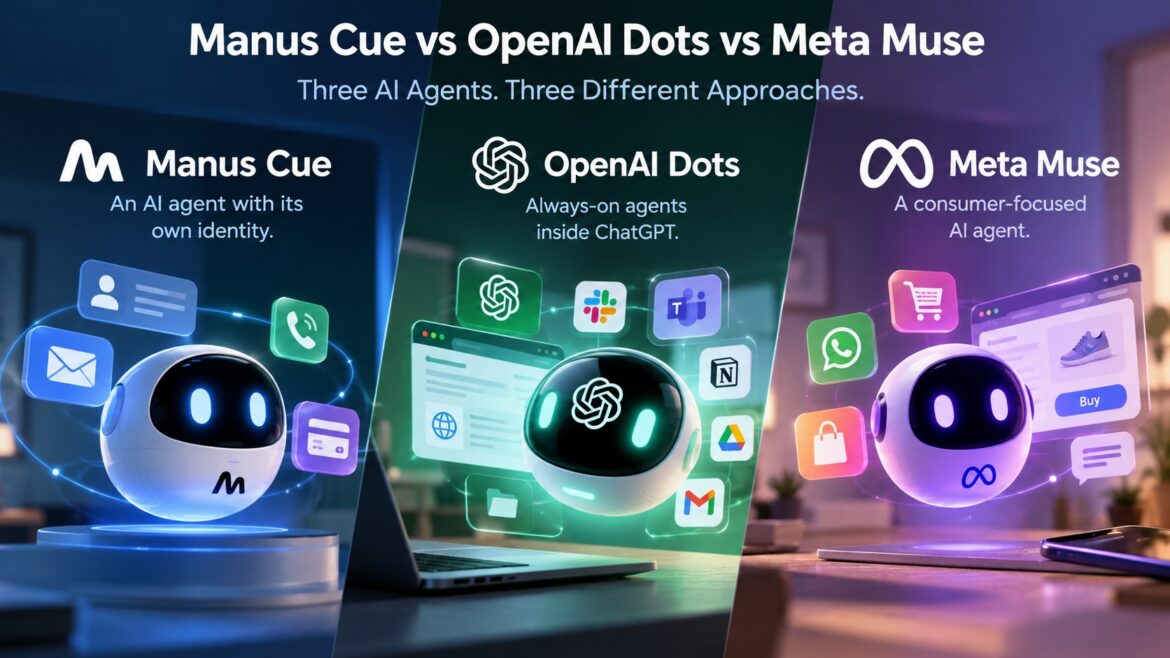
The three products take different approaches. Manus Cue gives an agent its own identity, including an email address, phone number, wallet and computer. OpenAI Dots puts an always-on agent inside ChatGPT with a cloud computer, browser and connections to thousands of apps. Meta Muse focuses on making autonomous AI accessible to consumers through a dedicated secure virtual machine, web access, shopping integrations and WhatsApp.
In this comparison, we look at Manus Cue vs OpenAI Dots vs Meta Muse across features, pricing, availability, payments, security, multi-agent capabilities, integrations and practical use cases. Because all three products are new and their features are still changing, some capabilities, prices and availability remain unconfirmed.
Key takeaways
- Manus Cue focuses on agent identity, giving each agent its own email, phone number, wallet and computer.
- OpenAI Dots focuses on an always-on agent inside ChatGPT, with a cloud computer, browser and connections to more than 4,000 apps.
- Meta Muse focuses on consumer accessibility, with a secure virtual machine, shopping capabilities, WhatsApp access and a free tier in the US.
- The biggest differences are identity, autonomy, integrations, payments, security controls, pricing and availability.
- All three are early products, so independent testing, security audits and long-term reliability are still limited.
Why These AI Agents Matter
AI agents are moving from tools that answer questions to systems that can take action on a user’s behalf. Manus Cue, OpenAI Dots and Meta Muse represent three different approaches to that shift.
Instead of waiting for a prompt every time, these agents can continue working in the background, use computers and browsers, interact with connected services, and return when they need information or approval. The important difference is not simply what each agent can do, but how much authority it receives, what identity it uses, and how it is controlled.
The timing is significant. All three products appeared within a few weeks of each other in September 2026:
| Date | Product or development | Why it matters |
|---|---|---|
| Sept. 8, 2026 | Meta launches Muse in the US | Brings autonomous AI to a broad consumer audience |
| Sept. 18, 2026 | Muse reaches No. 1 on Apple’s US free iPhone chart | Shows early consumer interest, although downloads do not measure sustained usage |
| Sept. 20, 2026 | Amazon blocks Muse from its store | Highlights the tension between autonomous shopping agents and websites’ access policies |
| Sept. 24, 2026 | Salt Labs discloses a prompt-injection flaw affecting Manus | Shows the security challenges that come with giving agents access to external content and connected accounts |
| Sept. 28, 2026 | Manus launches Manus 2.0 and Cue | Introduces agents with their own email, phone number, wallet and computer |
| Sept. 29, 2026 | OpenAI launches Dots at DevDay | Brings an always-on agent into the ChatGPT ecosystem |
The result is a new category of AI products where the key question is no longer just “Which AI model gives the best answer?” It is increasingly “Which agent can safely do the work for me?”
That makes identity, permissions, security, payments, integrations and human approval just as important as the underlying AI model.
The comparison below looks at how Cue, Dots and Muse approach those problems differently.
Manus Cue: An AI Agent With Its Own Identity
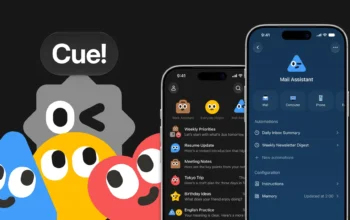
Manus Cue is an AI agent designed to act with its own identity rather than operating entirely through your accounts. According to Manus, a Cue agent can have its own email address, phone number, wallet and computer. It can send messages, handle calls, make payments within a user-defined budget and interact with everyday services.
Cue also supports multi-agent workflows, allowing several agents to work together on a shared goal. For example, one agent could research options, another create a shortlist, and another prepare a presentation.
What makes Manus Cue different?
Cue’s defining feature is agent identity. Instead of giving an AI agent broad access to your personal accounts, Manus is building an agent that can operate through its own communication and payment identity.
However, important details about the wallet, payment network, approval requirements, refunds and disputes remain unannounced.
Cue runs on the infrastructure introduced with Manus 2.0, including Cascade, Cloud Computer and event-triggered Automations. Manus says Cascade can reduce token usage and execution costs, although those figures are company-reported and have not been independently validated.
Cue is currently early access and invite-only, with pricing still unannounced. Phone-number availability also varies by country.
OpenAI Dots: The Always-On Agent Inside ChatGPT
OpenAI Dots are always-on AI agents designed to work in the background toward goals you give them. Each dot has its own cloud computer and browser and can connect to more than 4,000 apps through OpenAI’s plugins.
An “always-on agent” is an AI system that can continue working after you stop actively chatting with it or close the app, rather than waiting for a new prompt every time. Depending on its permissions, it can monitor information, perform tasks, and return when it needs your input or approval.
Dots can be used for tasks such as monitoring customer feedback, investigating software bugs, updating research as new data arrives, or preparing content and sales materials as requirements change. They can also work across ChatGPT, Slack and Teams, with voice access available.
What makes OpenAI Dots different?
Dots focus on continuous work and controlled access. OpenAI provides rules, approvals, activity monitoring and an auto-review system designed to check potentially sensitive actions. Background research is read-only, while actions that affect connected accounts go through the user’s configured controls.
OpenAI also plans to introduce specialist dots for organizations, giving individual agents their own identities and access to specific business systems.
How to access OpenAI Dots
Dots are rolling out to eligible ChatGPT Pro and Business Premium users, with Enterprise, Edu and Healthcare access available through a beta. The first dot is included with the eligible plan.
Unlike Cue, Dots do not have a wallet or payment capability documented in the launch material. Their focus is currently on knowledge work, research, software development and connected business workflows.
Meta Muse: The Consumer-Focused AI Agent
Meta Muse is a personal AI agent designed to plan and carry out tasks on a user’s behalf. Launched in the US in September 2026, Muse is available through iOS, Android, the web and WhatsApp. It can use a browser, fill out forms, interact with websites and continue working after you close the app.
What makes Meta Muse different?
Muse focuses on consumer accessibility and controlled computer use. Each agent runs inside a dedicated secure virtual machine, while a separate Sentinel system reviews its internet activity. Meta also says Muse cannot directly see users’ passwords or payment details.
Muse can handle shopping through integrations including Link by Stripe, PayPal and Shopify, with approval required for sensitive actions. Meta has also announced integrations with retailers and plans for features such as its own email address and expanded computer control.
How to access Meta Muse
Muse is free for most use at launch and US-only. Meta says the free tier provides roughly 100 million tokens per week, with paid plans also available.
Unlike Cue, which emphasizes an agent’s own identity, and Dots, which focuses on continuous work inside the ChatGPT ecosystem, Muse puts more emphasis on making an autonomous agent accessible to everyday consumers.
Manus Cue vs OpenAI Dots vs Meta Muse
The three agents share the same broad goal—doing more work on a user’s behalf—but their approaches are different. Cue emphasizes agent identity, Dots emphasize continuous work and integrations, while Muse emphasizes consumer access and shopping.
| Feature | Manus Cue | OpenAI Dots | Meta Muse |
|---|---|---|---|
| Launch | Sept. 28, 2026 | Sept. 29, 2026 | Sept. 8, 2026 |
| Core idea | Agent with its own identity | Always-on agent inside ChatGPT | Consumer-focused autonomous agent |
| AI/model | Cascade + third-party models | GPT-6 Astra | Muse Spark |
| Computer access | Cloud Computer | Dedicated cloud computer and browser | Dedicated secure VM and browser |
| Integrations | Email, calls, selected services | 4,000+ apps, ChatGPT, Slack, Teams | Retailers, GitHub, Notion, WhatsApp and more |
| Payments | Agent wallet with budget | No payment feature announced | Link by Stripe, PayPal and Shopify |
| Multi-agent | Group chats with agent hand-offs | Planned | Not announced |
| Security controls | Budget cap; other controls not fully documented | Rules, approvals, monitoring and Activity View | Sentinel, approvals and audit trail |
| Access | Early access, invite required | Eligible paid ChatGPT plans | Free for most use; US-only at launch |
| Pricing | Not announced | Pro from $100/month; Business Premium from $125/seat/month | Free tier; paid plans also available |
| Availability | Phone features limited to select countries | Eligible markets | US only at launch |
The biggest difference is where each product places the boundary between the user and the agent: Cue gives the agent more of its own identity, Dots gives it controlled access to your connected ecosystem, and Muse puts the agent inside Meta’s managed computing environment.
Which AI Agent Is Designed for What?
The three agents are aimed at different types of AI-assisted work:
- Manus Cue: Designed for users who want an agent with its own identity. Its email address, phone number and wallet are intended to let it communicate, make calls and handle payments within a defined budget. Its multi-agent group chats also make it relevant to people experimenting with collaborative agent workflows.
- OpenAI Dots: Designed for people who want an agent that can keep working across their existing digital tools. Its cloud computer, browser and connections to more than 4,000 apps make it particularly focused on research, software development, content, analysis and other knowledge-work tasks.
- Meta Muse: Designed for consumers who want an accessible autonomous agent for everyday tasks. Its browser capabilities, shopping integrations, WhatsApp access and secure virtual machine make it more focused on consumer-facing tasks such as shopping, forms, messaging and online services.
The choice therefore depends largely on what you want the agent to do. Cue emphasizes identity and multi-agent collaboration, Dots emphasizes continuous knowledge work and integrations, while Muse emphasizes consumer accessibility and online tasks.
Pricing and Availability
Pricing and access are still changing because all three products are relatively new.
- Manus Cue: Currently available through early access with an invite. Manus has not announced final Cue pricing or Cloud Computer pricing. Phone-number availability is limited to select countries.
- OpenAI Dots: Available to eligible ChatGPT Pro and Business Premium users, with Enterprise, Edu and Healthcare access through a beta. The first dot is included with the eligible plan. Pro starts at $100 per month, while Business Premium starts at $125 per seat per month.
- Meta Muse: Available in the US, with free access for most use and paid plans also available. Meta has described a free allowance of roughly 100 million tokens per week.
For users outside the US, availability is an important consideration. Muse launched as US-only, while Cue’s phone features and Dots access depend on supported markets. Users should check the latest availability information before signing up or paying for a plan.
Security and Privacy: What to Know
Giving an AI agent the ability to browse, communicate, make purchases or access connected services creates a different level of risk from using a chatbot for simple questions.
The three products take different approaches:
- Manus Cue: Its own email, phone number and wallet can separate the agent from some of the user’s personal credentials, but Manus has not fully documented Cue’s approval, audit and payment controls.
- OpenAI Dots: OpenAI provides configurable rules, approval controls, activity monitoring and an auto-review system. OpenAI also warns that dots can make mistakes and that consequential work should be reviewed.
- Meta Muse: Muse runs inside a dedicated secure virtual machine. Meta says its Sentinel system reviews internet traffic and that sensitive actions require approval. Muse also uses secure payment infrastructure for purchases.
Security remains an evolving area for all three products. We already highlighted recent security concerns involving Manus and a dispute between Meta and Amazon over Muse’s access to Amazon’s services. These incidents highlight why permissions, audit trails, approval controls and limits on autonomous actions matter as much as an agent’s capabilities.
For now, users should avoid giving an autonomous agent more access or spending authority than it needs for a particular task.
Conclusion
Manus Cue, OpenAI Dots and Meta Muse show three different approaches to the emerging always-on AI agent category.
Cue focuses on agent identity, giving an agent its own email, phone number and wallet. Dots focus on continuous knowledge work, connecting an always-on agent to ChatGPT and thousands of apps. Muse focuses on consumer access, combining autonomous computer use with shopping, messaging and Meta’s secure virtual machine.
None of these products is a finished vision of the AI agent. Features, pricing, availability and security controls are still evolving, and independent testing remains limited.
The bigger shift is clear: AI assistants are moving from simply answering prompts toward taking action, working in the background and operating on behalf of users. How safely and reliably they can do that will likely matter as much as how capable their underlying models become.
Frequently Asked Questions
What is the difference between Manus Cue, OpenAI Dots and Meta Muse?
Manus Cue focuses on giving an AI agent its own identity, including an email address, phone number and wallet. OpenAI Dots focus on always-on knowledge work through ChatGPT, connected apps and a cloud computer. Meta Muse focuses on consumer-oriented autonomous tasks such as browsing, shopping and online services.
What is an always-on AI agent?
An always-on AI agent is an AI system that can continue working toward a goal after you stop actively interacting with it. Depending on its permissions, it can monitor information, perform tasks and return when it needs your input or approval.
Does Manus Cue have its own phone number and wallet?
Yes. Manus says each Cue agent can have its own phone number and wallet, although phone-number availability is limited to select countries and details about the wallet and payment system remain unannounced.
How much does OpenAI Dots cost?
Dots are available to eligible paid ChatGPT users. The draft reports ChatGPT Pro at $100 per month and Business Premium at $125 per seat per month, with the first dot included.
Is Meta Muse free?
Meta Muse is free for most use at launch, with paid plans also available. Meta’s initial rollout was limited to the United States.
Can these AI agents make purchases?
Yes, but their payment approaches differ. Manus describes a wallet with a user-defined budget, while Meta Muse supports purchases through services including Link by Stripe and PayPal. OpenAI’s Dots launch material does not document a wallet or direct payment feature.
Which AI agent works with multiple agents?
Manus Cue currently supports group chats where multiple agents can work together and hand tasks to one another. OpenAI has described multiple or specialist dots as a future direction, while Meta’s launch material describes one agent per user.
Are Manus Cue, OpenAI Dots and Meta Muse available in India?
Availability varies. Muse launched in the US, while Cue’s phone features are limited to select countries and Dots are rolling out in eligible markets. The draft does not establish India as a confirmed supported market for all three, so availability should be checked directly before signing up.
Enjoy Worthview?
Add Worthview as a Preferred Source on Google to see more of our stories in Search.

Sethuram Kishore is the founder and editor of Worthview, an online publication established in 2008. With over 18 years of experience in SEO, digital marketing, and online publishing, he writes about AI, technology, business, and digital trends. He is also the founder of MoneyHulk, a personal finance and business publication.