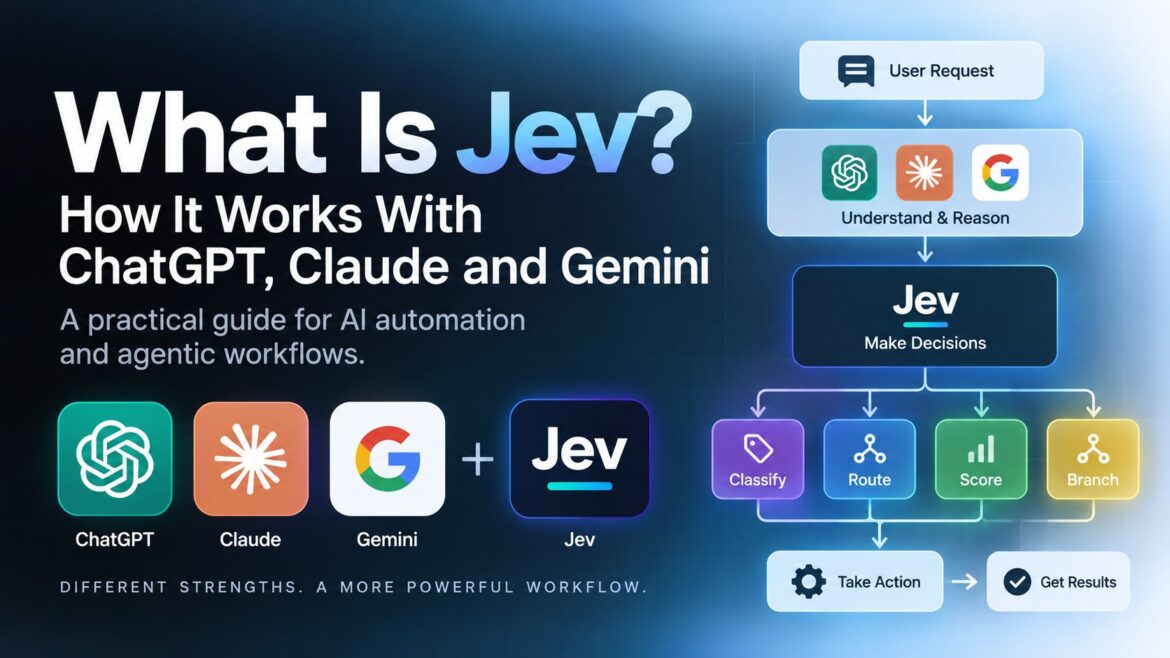
AI agents are becoming more capable, but building a useful agent is not simply about connecting an application to a powerful large language model (LLM).
Models such as ChatGPT, Claude, and Gemini can understand instructions, reason about problems, generate content, write code, and interact with tools. But an AI workflow often needs to make many smaller decisions along the way:
What type of request is this?
Where should it go?
How important is it?
Should the workflow continue, branch into another path, or ask a human for help?
This is where Jev, a decision-focused AI model from TypeSafe, takes a different approach.
Instead of trying to be another general-purpose chatbot, Jev is designed to make structured decisions that software and AI workflows can use directly. It can be used for tasks such as classification, routing, scoring, and deciding which path an agent should take next.
This doesn’t necessarily mean replacing an LLM with Jev. A more interesting possibility is using them together.
An LLM can handle the complex task of understanding a user’s request and generating a response, while a specialized decision model can handle the repeated decisions that control what happens next in the workflow.
In this article, we’ll look at what Jev is, where it fits in an AI agent architecture, how it can work alongside models such as ChatGPT, Claude, and Gemini, and where this approach could be useful in real-world AI automation.
Key Takeaways
- Jev is not designed to replace general-purpose LLMs such as ChatGPT, Claude, or Gemini.
- It focuses on structured decision-making inside software and AI workflows.
- Jev can help with classification, routing, scoring, and workflow branching.
- An AI agent can use an LLM for understanding and generation, while Jev handles specific workflow decisions.
- This approach allows developers to use different AI models for different jobs within the same agentic workflow.
What Is Jev?
Jev is an AI model developed by TypeSafe that is designed to make structured decisions inside software and AI workflows. TypeSafe describes Jev as its first System One Model, a new class of models built specifically for machine-driven decision-making rather than primarily for human conversation.
The name System One is inspired by Daniel Kahneman’s distinction between fast, intuitive “System 1” thinking and slower, deliberate “System 2” reasoning. TypeSafe uses the term to describe models optimized for fast decisions that software can use directly.
TypeSafe was founded by Diogo Almeida, Sasha Sheng, and Erik Gafni, whose backgrounds include work at organizations such as OpenAI, Google Brain, Meta/FAIR, and other technology companies. Almeida previously worked on RLHF and InstructGPT, while Sheng and Gafni have backgrounds in AI research and production AI systems.
Unlike a typical conversational AI model, Jev isn’t primarily designed to write an essay, answer a question, or have a conversation with a user. Its purpose is to evaluate information and return decisions that an application can use.
For example, an AI workflow could give Jev a customer message and ask:
- Is this a billing issue?
- How urgent is it?
- Should it be escalated?
- Which team should handle it?
Instead of generating a long explanation, Jev can return structured results that the application can act on.
This makes Jev particularly relevant to AI agents and automation workflows, where the system constantly needs to decide what should happen next.
Think of the difference this way:
An LLM generates and understands language. Jev helps software make decisions.
That doesn’t make Jev a replacement for models such as ChatGPT, Claude, or Gemini. In fact, one of the more interesting ways to use Jev is alongside these models.
An LLM could understand a user’s complicated request, while Jev handles specific decisions that control the workflow—such as classification, routing, scoring, or selecting the next branch.
This separation of responsibilities is the key idea behind using specialized AI models within agentic workflows.
How Is Jev Different From ChatGPT, Claude, and Gemini?
At first glance, Jev may sound like another AI model competing with ChatGPT, Claude, or Gemini. But they are designed around different use cases.
Models such as ChatGPT, Claude, and Gemini are general-purpose large language models. They are built to handle a wide range of tasks, including conversation, writing, coding, reasoning, summarization, analysis, and tool use.
Jev takes a more specialized approach. Its focus is on making structured decisions that can be consumed directly by software.
For example, imagine an AI customer-support workflow receiving this message:
“I was charged twice for my subscription and need this fixed today.”
A general-purpose LLM might analyze the message and produce a detailed response. Jev could instead be used to answer specific workflow questions:
Issue type → Billing
Urgency → High
Escalation required → 0.94
The application can then use those results to determine what happens next.
This creates an important distinction:
| General-purpose LLM | Jev |
|---|---|
| Understands and generates language | Makes structured decisions |
| Designed for broad tasks | Designed for specific decision tasks |
| Can produce detailed responses | Returns decision-oriented outputs |
| Useful for reasoning and generation | Useful for routing, classification, scoring and branching |
| Often interacts directly with users | Primarily interacts with software |
This doesn’t mean an AI workflow has to choose between the two.
In many agentic systems, the two approaches can complement each other. A general-purpose LLM can handle the complex reasoning and language, while Jev can handle specific decision points that determine how the workflow proceeds.
The important question, therefore, isn’t simply “Is Jev better than ChatGPT, Claude, or Gemini?” It is:
“Which part of the workflow should each model handle?”
That question becomes much more important as AI systems move from simple chatbots toward multi-step agents that need to make decisions, use tools, and take actions.
Where Does Jev Fit in an AI Agent Workflow?
To understand where Jev fits, it helps to think of an AI agent as a workflow rather than a single AI model.
A typical agent may need to understand a request, decide what needs to happen, select the right tool, determine whether human approval is required, perform an action, and then communicate the result.
A general-purpose LLM can handle many of these tasks, but developers don’t necessarily need to use the same model for every decision.
A workflow could look like this:
User Request
     ↓
General-purpose LLM
Understand the request
     ↓
Jev
Make workflow decisions
     ↓
┌────────────┼────────────┐
↓            ↓            ↓
Route       Score       Classify
     ↓
Choose next action
     ↓
Tools / APIs / Other Agents
     ↓
Final Response
For example, imagine an AI assistant handling incoming customer requests.
The LLM could first understand the customer’s message and identify the overall intent. Jev could then determine whether the request is urgent, which category it belongs to, and whether it should be handled automatically or sent to a human.
The workflow engine can use those decisions to select the next action.
This separation can be useful because not every step in an agent requires open-ended language generation. Some steps are essentially decisions:
Is this a billing request?
Should this be escalated?
Which workflow should run?
Does this request meet the criteria for automatic processing?
These are the kinds of decision points where a specialized model such as Jev can fit into the architecture.
The result is not necessarily an “LLM versus Jev” architecture. Instead, it can be a multi-model workflow, where each model is used for the task it is designed to perform.
For developers building AI automation, this is an important shift in thinking: the goal isn’t always to find one model that does everything. The goal can be to build a workflow where different models handle different parts of the job.
Four Ways Jev Can Help AI Workflows
Jev becomes easier to understand when we look at the types of decisions an AI workflow may need to make. Four useful concepts are classification, routing, scoring, and branching.
1. Classification — What is this?
Classification means identifying which category something belongs to.
For example, an AI support workflow might receive hundreds of messages and classify them as:
Billing
Technical Support
Refund
Account
General Question
The classification result can then be passed to the next stage of the workflow.
2. Routing — Where should it go?
Once a request has been classified, the system may need to decide where it should be handled.
For example:
Billing issue
     ↓
Billing Agent

Technical issue
     ↓
Technical Support Agent

Refund request
     ↓
Refund Workflow
Routing determines which agent, system, team, or tool should handle the request.
3. Scoring — How important or likely is it?
Some decisions aren’t simply yes or no. A workflow may need to assign a score or probability.
For example:
Purchase intent → 0.87
Urgency → 0.92
Escalation likelihood → 0.81
A workflow can use these values to determine whether an action should happen automatically or whether additional review is needed.
4. Branching — What happens next?
Branching means sending a workflow down different paths based on a decision.
For example:
              Is the request urgent?
                    ↓
             ┌──────┴──────┐
            YES            NO
             ↓              ↓
       Human review    AI handles it
This is one of the fundamental ideas behind automation. Instead of simply generating an answer, the AI system uses a decision to determine what should happen next.
Putting the four together
In a real AI workflow, these decisions can work together:
Customer request
       ↓
Classification
"What is it?"
       ↓
Routing
"Who should handle it?"
       ↓
Scoring
"How urgent is it?"
       ↓
Branching
"What happens next?"
       ↓
Action
This is where a decision-focused model can become useful. Rather than asking a large language model to generate text for every step, developers can use specialized decision capabilities at specific points in the workflow.
How Can Jev Work Alongside an LLM?
Jev doesn’t have to operate on its own. One of the more interesting ways to think about it is as a decision layer that works alongside a general-purpose LLM.
A typical workflow might use an LLM for understanding and generation, while Jev handles specific decisions that control the workflow.
Consider an AI customer-support agent:
Customer
   ↓
"Someone charged me twice for my subscription."
   ↓
GPT / Claude / Gemini
Understand the request
   ↓
Jev
┌─────────────────────────────┐
│ Category → Billing          │
│ Urgency → 0.94              │
│ Escalation → 0.91           │
└─────────────────────────────┘
   ↓
Workflow Engine
   ↓
Urgency > threshold?
   ↓
      YES
       ↓
Send to human support
The LLM doesn’t need to disappear from the architecture. It can still perform the tasks it is good at—understanding natural language, reasoning about complex requests, generating responses, and interacting with users.
Jev can then be called when the workflow reaches a decision point.
This creates a division of responsibilities:
LLM
- Understand the user’s request
- Reason about complex information
- Generate natural-language responses
- Interact with tools when appropriate
Jev
- Classify information
- Route requests
- Produce scores or probabilities
- Determine workflow branches
The workflow engine sits between these components and uses their outputs to decide what happens next.
This approach can also be applied to workflows beyond customer support. An AI research agent might use an LLM to understand a research question, while a decision model determines which sources should be prioritized or whether the gathered information meets predefined criteria.
Similarly, an AI automation system could use an LLM to interpret an incoming request and then use decision models at several points to determine which automation should run.
The broader idea is simple:
Use a general-purpose LLM where you need broad reasoning and language generation, and use specialized decision models where the workflow needs fast, structured decisions.
For developers building agentic systems, this can turn a single-model architecture into a multi-model AI workflow, with different models responsible for different jobs.
A Practical AI Automation Workflow Using Jev
Let’s take a simple example: an AI agent that handles incoming business requests.
A user might send:
“I need a refund for my subscription. I was charged twice, and I need this resolved today.”
Instead of sending this request through one LLM for every step, an agentic workflow could divide the work between different components.
User Request
      ↓
LLM
Understand the request
      ↓
Jev
Classify → Refund / Billing
Score → High urgency
Route → Refund workflow
      ↓
Workflow Engine
Check refund rules
      ↓
Is human approval required?
      ↓
   ┌──YES───────NO──┐
   ↓                ↓
Human review    Process automatically
   ↓                ↓
   └───────┬────────┘
           ↓
          LLM
Generate response
           ↓
         User
Here, each component has a specific responsibility.
The LLM understands the natural-language request and extracts the relevant context.
Jev can then be used at the decision points. It can help determine the request category, assign a score or probability, and identify which workflow should handle it.
The workflow engine takes those decisions and executes the appropriate actions. This could mean calling a payment API, opening a support ticket, sending the request to another AI agent, or asking for human approval.
Finally, an LLM can generate a natural-language response for the customer.
Why Not Use an LLM for Everything?
A reasonable question is: If ChatGPT, Claude, and Gemini can already classify, route, score, and make decisions, why would an AI workflow need another model?
For many applications, a general-purpose LLM may be enough. Developers don’t need to add Jev simply because it exists.
The argument for using a specialized decision model is about matching the model to the job.
An AI workflow may make dozens or hundreds of small decisions during its operation. Some of those decisions don’t require generating a detailed explanation or a natural-language response.
For example:
Is this a billing request?       → Yes
Is it urgent?                    → Yes
Should it be escalated?          → No
Which workflow should run?       → Refund
These are relatively narrow decisions. A workflow can potentially handle them with a model designed specifically for decision-making rather than asking a general-purpose LLM to generate text for every step.
This can matter in production environments where latency, cost, predictable outputs, and integration with software are important considerations.
However, that doesn’t mean specialized decision models should replace LLMs everywhere.
If an agent needs to understand a complicated document, reason through an unfamiliar problem, write code, summarize information, or communicate naturally with a user, a general-purpose LLM remains valuable.
The practical approach is therefore not:
LLM vs. Jev
but:
LLM + specialized models + workflow logic
The right architecture depends on the task, the required reliability, latency, cost, and complexity of the application.
Where Could Jev Be Useful—and Where Might It Not?
Jev is most relevant when an AI application has repeated, well-defined decision points.
For example, it could be useful when a workflow needs to repeatedly classify incoming requests, assign scores, select a route, or decide which branch of an automation should run.
Potential use cases include:
- Customer support: classify requests, determine urgency, and route tickets.
- Sales automation: score leads and determine which sales workflow should handle them.
- AI agents: decide which tool, agent, or workflow should run next.
- Content workflows: classify content and determine the appropriate production or review process.
- Operations: make repeated decisions based on structured business rules and incoming information.
However, Jev isn’t necessarily the right tool for every AI task.
If the primary requirement is writing a long-form article, generating code, having an open-ended conversation, summarizing a complex document, or reasoning through an unfamiliar problem, a general-purpose LLM may be more appropriate.
There is also an important consideration for developers: a specialized model introduces another component into the architecture. That means another API, integration, model to evaluate, and system dependency to manage.
Conclusion
Jev is interesting not simply because it is another AI model, but because it represents a different way of thinking about how AI can be used inside software.
Instead of asking one large language model to understand, reason, decide, route, and generate every part of a workflow, developers can divide those responsibilities across different components.
An LLM such as ChatGPT, Claude, or Gemini can handle language and complex reasoning, while a specialized decision model such as Jev can be used for tasks such as classification, routing, scoring, and branching.
For AI automation and agentic workflow builders, that distinction is worth understanding.
The question isn’t always “Which AI model is the smartest?”
It can be:
“Which model or component is best suited for each step of the workflow?”
That shift—from thinking about individual models to designing AI-powered systems—is an important concept for anyone building the next generation of AI automation.
Enjoy Worthview?
Add Worthview as a Preferred Source on Google to see more of our stories in Search.

Sethuram Kishore is the founder and editor of Worthview, an online publication established in 2008. With over 18 years of experience in SEO, digital marketing, and online publishing, he writes about AI, technology, business, and digital trends. He is also the founder of MoneyHulk, a personal finance and business publication.