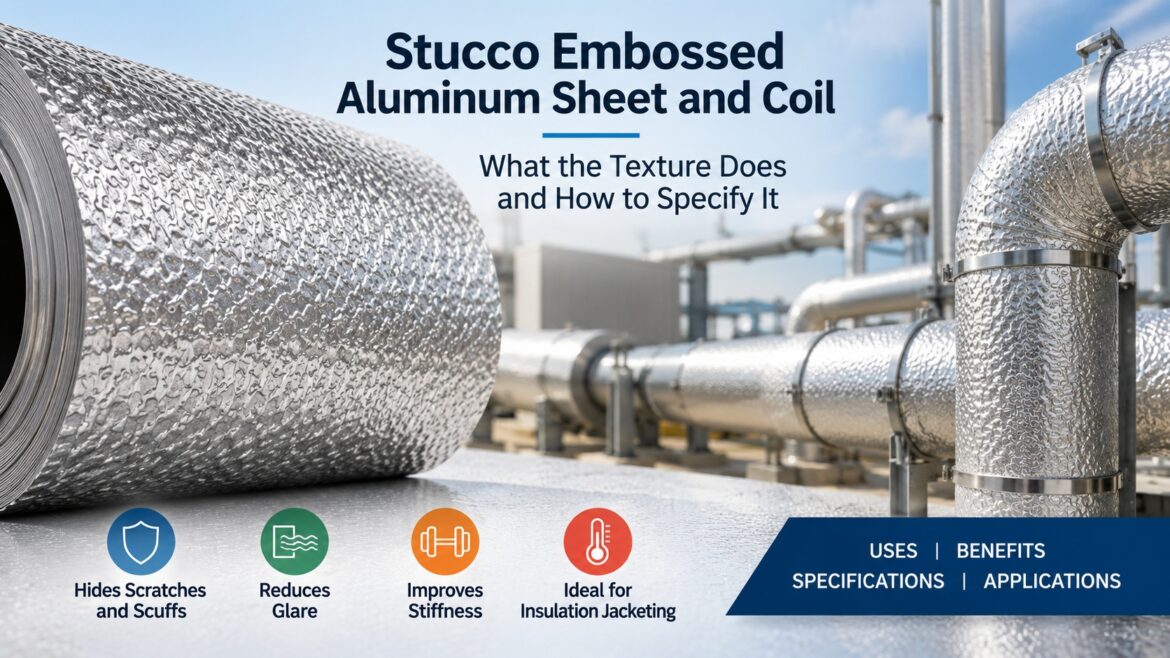
Stucco embossing tends to get chosen the way a paint color does, as a matter of looks. In practice the texture changes how a sheet handles, how flat it appears once installed, how it interacts with coating and lamination processes, and in insulation work, which standard the finished product is written against.
This guide covers what stucco embossed aluminum actually does, where it earns its place, and what to put on the order so the coil that arrives is the coil you meant.
Key Takeaways
- Stucco embossed aluminum has a textured surface created by passing aluminum through patterned embossing rolls.
- The texture helps hide scratches, scuffs, fingerprints, and minor waviness.
- It can provide additional effective out-of-plane stiffness, although it does not change aluminum’s elastic modulus.
- It is widely used for insulation jacketing, roofing, cladding, appliance panels, and fabrication.
- For insulation jacketing, ASTM C1729 is an important specification reference.
- Buyers should specify the alloy, temper, thickness basis, pattern, finish, moisture retarder, width, and quantity.
- A physical sample is recommended when matching an existing embossed pattern.
What Stucco Embossing is
Stucco embossed aluminum is sheet or coil with a repeating, irregular texture rolled into the surface. The strip passes between patterned embossing rolls, which press the texture across the full width in a controlled, repeatable pattern. The result is a low-glare, textured surface that looks broadly similar to troweled stucco, which is where the name comes from.
Embossed coil is supplied either mill finish or coated. Stucco embossing can be carried out before or after coil coating, depending on the production route, and the two routes put different demands on the coating. Where the texture is rolled in first, the pattern and depth need to be settled before the coil reaches the coating line, because they affect how evenly the paint lays down. Where prepainted coil is embossed afterward, the coating has to tolerate the embossing without cracking or losing adhesion. Ask which route your supplier uses.
What the texture actually does
- Hides handling marks. The broken surface disguises light scratches, scuffs, and fingerprints that would be obvious on a smooth sheet, through fabrication, shipping, installation, and service.
- Hides waviness. A smooth sheet produces more directional reflections, which can make minor waviness easier to see. The embossed texture scatters reflected light and masks some of that distortion.
- Adds some effective stiffness. The pattern gives the sheet additional section depth, increasing its effective out-of-plane stiffness. Temper can raise yield strength, but it does not materially increase aluminum’s elastic modulus, so the texture is doing something a harder temper cannot. How much it helps depends on the depth and form of the pattern.
- Cuts glare. The diffuse surface reduces hard reflection on roofs, walls, and equipment in direct sun.
Those effects make it tempting to drop a gauge on the strength of the texture alone. Sometimes that works. Whether it works for a given part depends on the load, the handling, and the span, so test the thinner embossed gauge against the application before committing to it.
Stucco embossed aluminum jacketing
Insulation jacketing is one of the main uses for stucco embossed aluminum. Pipe, duct, tank, and vessel insulation needs an outer skin that protects it from weather, UV, and mechanical damage, and the embossed surface hides the dents and scuffs that jacketing collects in a working plant.
In North America, aluminum jacketing for thermal and acoustical insulation is covered by ASTM C1729. It applies to insulation operating above or below ambient temperature, indoors and outdoors, and it covers smooth, corrugated, and embossed sheet. C1729 classifies jacketing on three separate factors:
- Type, the outer surface treatment and its emittance. Bare aluminum and a painted surface fall in different types.
- Grade, the alloy and temper, per ASTM B209.
- Class, the moisture retarder on the inner face.
The standard also sets minimum thicknesses for pipe jacketing, permissible thickness tolerances, and test methods for properties including emittance, surface burning characteristics, pinholes in the moisture retarder, and pencil hardness. A full jacketing specification names the type, grade, and class rather than just “stucco aluminum, .016.”
Manufacturer guidance shows how those classifications map to real products. ITW Insulation Systems, for example, recommends the following C1729 classifications by application:
| Use | Surface, alloy, temper | Moisture retarder | C1729 classification | Thickness |
| Standard roll or sheet jacketing | Bare, 3105 or 3003, H14 | 3 mil polyfilm | Type I, Grade 1, Class A | .016 to .024 in |
| More corrosive environments | Painted, 3105 or 3003, H14 | 3 mil polyfilm | Type II, Grade 1, Class A | .016 to .024 in |
| Heavy duty, high abuse areas | Bare, 3105 or 3003, H12 | 3 mil polyfilm | Type I, Grade 2, Class A | .032 in and up |
Common gauges for smooth, stucco embossed, and corrugated roll jacketing run from .016 to .040 inch, about 0.41 to 1.02 mm, with 3003 and 3105 in H14 widely used.
Two details are easy to underestimate. The first is the moisture retarder. A polyfilm or similar moisture retarder separates the inner aluminum surface from retained moisture and helps interrupt corrosion pathways. ASTM C1729 describes its function in terms of inhibiting galvanic interaction between the dissimilar metals of the pipe and the jacket and helping prevent crevice corrosion. On outdoor and below ambient lines, where moisture in the insulation is likely, it is doing real work. The second is emittance. Bare aluminum has low emittance and a painted surface much higher, and that affects the jacket’s surface temperature, which feeds into personnel protection and condensation calculations on hot and cold service.
Beyond jacketing
The same properties carry into other uses. Stucco embossed coil is used in appliance panels, where fingerprints and handling marks are a constant problem; in roofing and cladding, where glare and visible waviness matter; and in decorative and general fabrication work where a smooth sheet would show every mark. In each case the question is the same: is the texture solving a handling, appearance, or manufacturing problem, or is it only there by habit?
Specifying embossed coil
Embossed coil adds a few variables that flat coil does not have.
- Thickness basis. Confirm whether the thickness on the order means the base metal gauge or a measurement taken over the pattern. The two are not the same on a textured sheet, and a mismatch causes disputes at receiving inspection.
- Stucco patterns vary by supplier in depth and scale. If the finished product has to match existing work, send a physical sample rather than a description.
- Alloy and temper. The texture does not change the alloy decision. For jacketing, follow the C1729 grade the project calls for. For panels, choose alloy and temper around forming and strength as you would for flat sheet.
- Coated or bare. If coated, the coating system, color, emboss pattern and depth, and whether the supplier embosses before or after coating.
- Moisture retarder. For jacketing, which class, and who is laminating it. Some mills supply only the embossed coil, with a jacketing fabricator laminating the retarder and cutting rolls or sheets, so be clear which step each supplier owns.
The mill behind the coil
Primealux Alloys supplies aluminum coil produced by Orbit Aluminum Industries, an integrated producer in Aqaba, Jordan, with casting, rolling, and coil coating on one site. Orbit’s stucco embossed coil is produced in 1xxx, 3xxx, and 5xxx alloys from 0.20 to 2.00 mm thick and up to 1650 mm wide in mill finish. Coated material is available within the coating line’s range of up to 1.60 mm thick and 1350 mm wide, in PE, HDPE, PVDF, PUPA and other systems, with the coating applied over the embossed texture. Pattern and gauge are confirmed per order, temper is available on request, coils run up to 10 tonnes, and the minimum order is 6.5 MT, plus or minus 10 percent.
That range covers the common .016 to .040 inch jacketing gauges. Orbit publishes embossed coil, not a laminated moisture retarder or C1729 classified jacketing, so for insulation work treat the coil as the substrate and confirm retarder lamination and classification with the jacketing fabricator. Production is certified to ISO 9001, ISO 14001, and ISO 45001, and material certificates ship with every batch.
For North American jacketing fabricators, panel makers, and converters, Primealux Alloys supplies stucco embossed aluminum coil on a produced-to-order basis. The mill makes coil against the submitted spec rather than pulling it from standing stock, which suits a fabricator running a steady alloy, gauge, and pattern, and does not suit a contractor who needs a few rolls of jacketing for next week.
What to put on the order
- Insulation jacketing, appliance panel, roofing, cladding, or general fabrication.
- For jacketing, the ASTM C1729 type, grade, and class required.
- Alloy and temper. For example 3003 or 3105 in H14 for standard jacketing.
- Thickness and basis, in inches and millimeters, and whether it is base gauge or measured over the pattern.
- Width and form. Coil width, slit width, or cut sheet.
- Pattern, with a physical sample if matching existing work.
- Mill finish, or coating system and color.
- Moisture retarder, its class, and which supplier laminates it.
- Quantity and packaging, including coil inner diameter and weight limits for your equipment.
One last check
Ask for a sample of the actual pattern at the actual gauge, and put it through the step that matters most for your product: a lamination trial for jacketing, a coating adhesion check for painted work, or a forming trial for panels. Stucco patterns differ enough between suppliers that a sample settles questions a datasheet cannot.
Enjoy Worthview?
Add Worthview as a Preferred Source on Google to see more of our stories in Search.

Worthview Editorial Team is the shared byline for content created collaboratively by Worthview’s editors and contributors. Since 2008, we’ve published thousands of articles across technology, AI, finance, health, home, travel, and lifestyle. Our editorial process emphasizes original research, reputable sources, regular content updates, and clear attribution. Articles covering higher-trust topics, including health and finance, may also undergo review by qualified subject-matter experts.