AI-generated images have gone from a novelty to an everyday creative tool. Whether you’re creating a realistic photograph, an illustration, a social media graphic, or simply experimenting with prompts, generating an image may feel almost instantaneous.
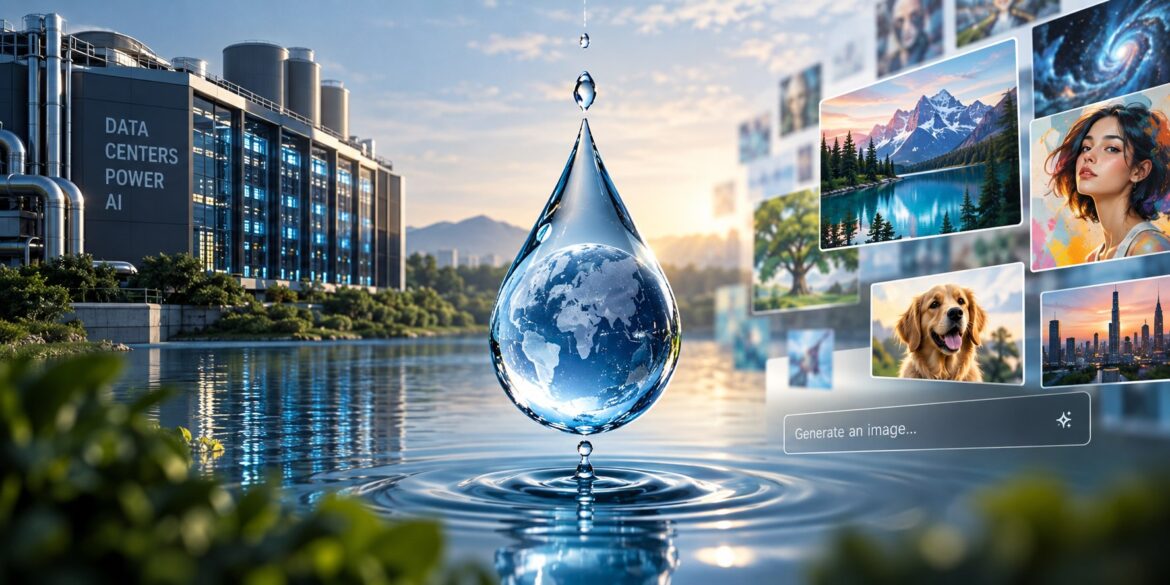
But behind that instant result is a physical infrastructure of GPUs, servers, data centers, electricity and cooling systems. And that infrastructure has an environmental footprint — including a water footprint.
So, how much water does it actually take to generate one AI image?
The Short Answer: There isn’t one universal number.
A recent 2026 assessment estimates that generating a standard-resolution AI image requires approximately 2.9 watt-hours (Wh) of electricity and 28.6 milliliters (mL) of water when the broader water footprint associated with electricity and infrastructure is considered.
Another recent analysis also estimates roughly 2.9 Wh per AI-generated image, but shows that the associated water consumption can vary dramatically depending on data-center cooling and electricity sources. Its modeled scenarios range from very low water use for water-efficient infrastructure to substantially higher figures for water-intensive cooling systems.
That means a useful ballpark is around 5–30 mL of water per AI-generated image, but this should not be treated as a fixed amount for every AI tool or every image.
Why is the number so difficult to pin down?
Because “water used by AI” isn’t simply water poured into a machine.
Water can be associated with:
- Cooling data centers where AI models run
- Generating the electricity that powers those data centers
- Manufacturing semiconductors and other hardware
- The location, climate and cooling technology used by the data center
Even the same AI model can therefore have a different water footprint depending on where and how it is operated.
And this is where the story gets more interesting.
The environmental question isn’t necessarily whether one AI image uses a significant amount of water. The bigger question is what happens when AI image generation scales to millions or billions of images.
Recent research projects that AI’s overall global water footprint could reach 4.2–6.6 billion cubic meters annually by 2027, although this figure covers AI infrastructure broadly rather than image generation alone.
In other words, the debate shouldn’t simply be “Does one AI image use a bottle of water?”
It should be:
How much water does AI use at scale, where is that water coming from, and are we using it efficiently?
How Does Generating an AI Image Use Water?
An AI image doesn’t use water directly. There is no water flowing through the GPU that creates your image.
The water footprint comes from the physical infrastructure required to run AI models—primarily data-center cooling and, indirectly, the generation of electricity used by those data centers.
1. AI servers generate a lot of heat
Generating an image requires powerful GPUs to perform billions of calculations. Those calculations consume electricity, and much of that electrical energy ultimately becomes heat.
Data centers therefore need systems to continuously remove that heat and keep the hardware within safe operating temperatures. Depending on the facility, this can involve air cooling, chilled-water systems, cooling towers, liquid cooling or combinations of these technologies.
2. Some cooling systems consume water
In evaporative cooling systems, water helps remove heat and some of it evaporates into the atmosphere.
This is an important distinction: water used for cooling isn’t necessarily “destroyed.” It is generally returned to the wider water cycle, but evaporation can mean that the water is no longer immediately available to the local river, reservoir or aquifer.
That’s why researchers distinguish between water withdrawal and water consumption.
- Water withdrawal: water taken from a source for use.
- Water consumption: the portion that isn’t returned to the same local water system, often because it evaporates.
3. Electricity can have its own water footprint
There’s another layer that is easy to overlook.
The electricity powering an AI data center may come from power plants that themselves use water for cooling. As a result, generating the electricity needed for an AI image can create an indirect water footprint outside the data center.
For data centers overall, research indicates that indirect water consumption associated with electricity generation can be substantially larger than direct onsite cooling consumption.
4. Location makes a big difference
There is therefore no single “water cost” for an AI image.
The footprint can change depending on:
- The AI model and hardware
- Image resolution and generation workload
- Data-center cooling technology
- Local temperature and climate
- Electricity source
- Whether recycled or freshwater is used
- Whether the calculation includes electricity-related water use
- Local water availability
A data center operating in a cool region with water-efficient cooling can have a very different water footprint from one operating in a hot, water-stressed region.
And this last point is particularly important: a liter of water doesn’t have the same environmental significance everywhere. The same amount can have a very different impact depending on the condition of the local watershed and when the water is being used.
The Water Footprint Adds Up at Scale
For an individual user, generating one AI image may have a relatively small water footprint. But AI isn’t generating one image at a time.
Millions of people are generating images every day, while businesses are increasingly using AI for advertising, product photography, design, entertainment and other creative work. At that scale, even a small per-image footprint can become significant.
Using the 5–30 mL per-image range as a rough illustration, the numbers quickly add up:
| AI images generated | Approximate water footprint* |
|---|---|
| 1 image | 5–30 mL |
| 10 images | 50–300 mL |
| 100 images | 0.5–3 liters |
| 1,000 images | 5–30 liters |
| 10,000 images | 50–300 liters |
| 100,000 images | 500–3,000 liters |
| 1 million images | 5,000–30,000 liters |
These are simple calculations based on the illustrative 5–30 mL range, not measurements of a specific AI service.
The latest UNU-INWEH assessment provides a more specific benchmark: it estimates that a standard-resolution AI-generated image has an associated water footprint of 28.6 mL, alongside approximately 2.9 Wh of electricity. At that benchmark, one million images would correspond to about 28,600 liters of water.
The global picture is much bigger
Image generation is only one part of AI’s overall workload. AI systems also perform text generation, video generation, search, recommendation, model training and many other computational tasks.
A 2026 review published in Water Research estimates that AI’s global water footprint could reach 4.2–6.6 billion cubic meters annually by 2027. That’s 4.2–6.6 trillion liters. The estimate covers AI infrastructure broadly, rather than image generation alone.
That distinction matters.
It would be misleading to take the global AI figure and attribute it entirely to AI images. Likewise, it would be misleading to assume that every AI image consumes exactly 28.6 mL.
The actual footprint depends on the model, hardware, data-center location, cooling system, electricity source and the methodology used to calculate water use.
Why scale matters more than a single image
This is the central point of the water debate.
One AI image isn’t the environmental crisis.
The concern is the combination of:
small footprint per generation × enormous volume of generations × growing AI infrastructure.
And there is another factor that makes the issue more complicated: where that water is being used.
A few thousand liters used in an area with abundant water resources can have a very different significance from the same amount consumed in a drought-prone or water-stressed region.
A 2026 review notes that many newer data centers are located in water-stressed regions, making the geographic distribution of AI infrastructure an important part of the sustainability discussion.
So the most useful question isn’t simply:
“How much water does my AI image use?”
It’s also:
“How much water does the AI industry use, where is it being consumed, and how efficiently is that water being used?”
Why AI Water-Usage Estimates Vary So Much
You may come across very different figures for the water footprint of AI. That doesn’t necessarily mean one study is wrong.
The biggest reason is that researchers use different assumptions and measurement methods.
Key factors include:
- AI model: Different models require different amounts of computing.
- Image size: Higher-resolution images generally require more computation.
- Hardware: Newer GPUs can perform the same workload more efficiently.
- Data-center cooling: Air cooling, evaporative cooling and liquid cooling have different water requirements.
- Electricity source: Power generated from different sources can have very different water footprints.
- Location: Climate and local infrastructure affect cooling requirements.
- What is counted: Some studies include only direct cooling water, while others also include water associated with electricity generation and infrastructure.
That’s why it’s better to describe AI image water consumption as a range or estimate, rather than claim that every image uses a fixed amount.
For this article, we’ll use ~5–30 mL per image as an illustrative range, while clearly identifying specific research estimates when discussing them.
Myth Busting: Does One AI Image Use a Bottle of Water?
Myth: “Every AI-generated image uses a bottle of water.”
Reality: Not necessarily.
The widely cited 500 mL figure comes from earlier research examining AI’s water footprint under specific assumptions. That research did not establish that every individual AI image consumes 500 mL of water.
More recent research specifically examining AI image generation produces much smaller estimates. A 2026 UNU-INWEH assessment estimates roughly 29 mL of water per typical AI image when its methodology’s associated water footprint is included.
So where did the “bottle of water” claim come from?
It largely comes from taking an estimate for AI workloads or conversations and applying it directly to individual images.
That’s problematic because water usage depends on:
- The AI model
- The type of task
- Data-center cooling
- Electricity source
- Location
- How water consumption is calculated
The better takeaway: AI images do have a water footprint, but “one image = one bottle of water” is an oversimplification.
The bigger environmental concern is billions of AI generations and the rapidly expanding infrastructure required to support them.
The Actual Concern: It’s About Scale and Location
The biggest concern isn’t that one AI image consumes a large amount of water. It’s what happens when AI usage reaches enormous scale.
Three things matter most:
1. Scale
Billions of AI requests can turn relatively small per-request footprints into substantial resource demand.
2. Location
Water use matters more when data centers operate in water-stressed regions, where competing demand for freshwater is already high.
3. Efficiency
Newer chips, better cooling systems, renewable electricity and reclaimed water can reduce the environmental footprint of AI infrastructure.
So the question isn’t simply “Does AI use water?”
It does.
AI Images vs. Text and Video: Does Image Generation Use More Water?
AI workloads don’t all have the same resource requirements.
In general, image generation requires substantially more computation than a simple text-generation request, while AI video generation can require considerably more because it involves generating many frames.
A simplified comparison is:
| AI task | Relative computing demand |
|---|---|
| Text generation | 🟢 Lower |
| Image generation | 🟡 Higher |
| Video generation | 🔴 Much higher |
However, there isn’t a reliable universal water-per-request number for each category. Model architecture, output size, hardware and data-center infrastructure can dramatically change the result.
The important point is that AI image generation sits somewhere between lightweight text inference and much more computationally intensive video generation.
Conclusion
AI-generated images do have a real water footprint, but the popular claim that “one AI image wastes a bottle of water” oversimplifies the science.
Current estimates suggest that a typical AI image may be associated with a few milliliters to a few tens of milliliters of water, depending on the model, hardware, data center, cooling system, electricity source and calculation method.
The bigger issue is scale. As billions of AI requests are processed, the combined demand for electricity, cooling and water can become significant—particularly in regions already facing water stress.
The takeaway isn’t that we should stop using AI images. Instead, the focus should be on more efficient models, water-conscious data-center design, cleaner energy and responsible AI infrastructure.
AI may be digital, but the infrastructure powering it is very physical. Understanding that footprint is the first step toward making AI more sustainable.
Enjoy Worthview?
Add Worthview as a Preferred Source on Google to see more of our stories in Search.

Sethuram Kishore is the founder and editor of Worthview, an online publication established in 2008. With over 18 years of experience in SEO, digital marketing, and online publishing, he writes about AI, technology, business, and digital trends. He is also the founder of MoneyHulk, a personal finance and business publication.